How to Sell Music Memorabilia Online: Complete Guide
Master how to sell music memorabilia online. Expert tips on sourcing, photography, pricing, platforms, and fulfillment for maximum profit in 2026.

September 25, 2026
Music Marketplace Advisor
Buying & SellingThe global music memorabilia market reached $1.2 billion in 2025 and is projected to reach $2.1 billion by 2034, growing at a 7.2% compound annual rate. Selling music memorabilia online is now a mainstream resale strategy, but the profitable route depends on matching each item with the right buyer, platform, and level of proof.
The popular advice is simple: list everything on eBay, add a few photographs, and wait for a fan to find it. That approach works for some common posters, shirts, and records, but it fails when the item is rare, expensive, fragile, difficult to authenticate, or aimed at a specialist audience.
The better approach is a decision tree. First identify what creates value, then assess authenticity and condition, estimate the buyer's intent, and only then choose between a broad marketplace, specialist auction, direct sale, or commission-free music platform. The market already has meaningful scale, with autographed items representing 28.5% of music memorabilia revenue in 2025, or approximately $342 million, while North America accounted for 42.0% of global revenue according to MarketIntelo's music memorabilia market analysis.
Sourcing and Authenticating Music Memorabilia
A profitable listing starts long before the camera comes out. Inventory quality determines how confidently you can describe an item, defend its price, and handle questions from a serious collector. Estate sales, private collections, record fairs, specialist dealers, auction houses, and online lots can all produce worthwhile pieces, but each channel carries a different authentication burden.
Estate and family collections can contain untouched material, especially tour programs, backstage passes, correspondence, photographs, and signed records. The story attached to the item matters, but a story alone isn't provenance. Ask who owned it, when it was acquired, where it was stored, and whether receipts, letters, ticket stubs, photographs, or other supporting records exist.
Record fairs and specialist dealers offer a practical advantage because you can inspect the object directly. Look for consistency in ink, paper, printing, stitching, hardware, wear patterns, and production details. A tour-used item should show a plausible relationship between its construction and the period or event claimed. A guitar with stage wear, replacement parts, or handwritten modifications needs a different review from a commercially signed poster.
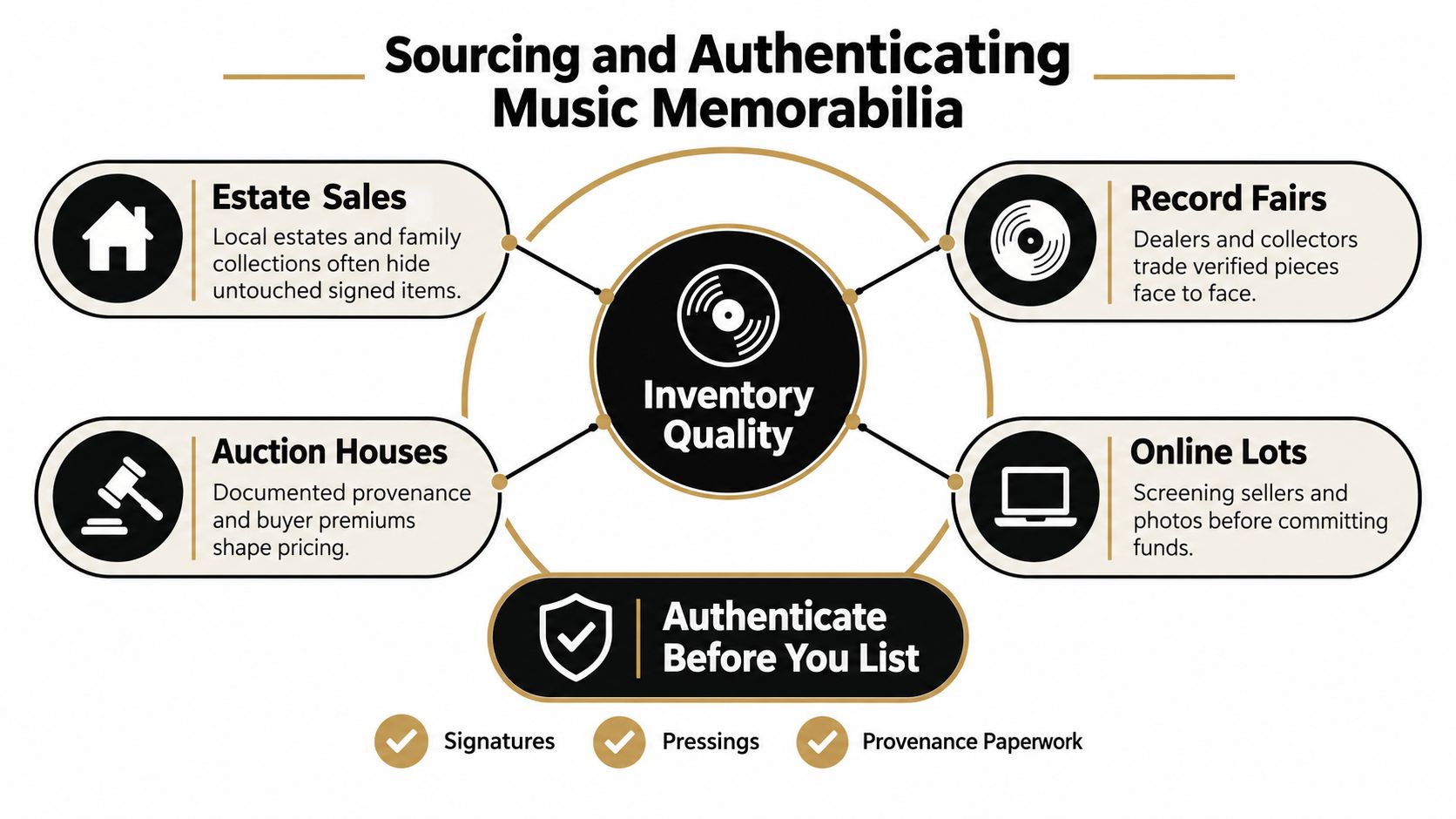
Build an evidence file before listing
Create one folder for every valuable item. Include acquisition records, photographs taken before and after purchase, measurements, serial numbers, edition information, correspondence, and any expert opinion. Keep the original wording of seller claims, but label unsupported statements as claims rather than facts.
For signatures, compare the autograph with reliable reference examples from the same era where possible. Examine letter formation, spacing, pressure, ink flow, placement, and whether the signature appears naturally integrated with the object. Authentication services can help with higher-risk items, but their documentation should complement your own chain of custody, not replace it.
Pressings and printed ephemera deserve equal care. Catalog numbers, label variations, matrix information, paper stock, copyright lines, and period-correct design details can separate an original from a later reproduction. If your collection extends beyond objects, a resource such as Galleryy's guide to search art by instrument theme can help you understand how musical subject matter is categorized across related art and collecting markets.
Practical rule: If you can't explain what the item is, why it's authentic, and how you obtained it, don't describe it as rare or genuine in the listing.
Don't alter, clean, repair, or reframe an item merely to make it look newer. Modifications can erase evidence and reduce collector confidence. Disclose restoration, replacement components, trimmed edges, fading, personalization, and any uncertainty. Transparent sourcing protects against returns and disputes, while ethical handling preserves the item's history for the next owner.
Choosing the Right Sales Platform
Platform selection should follow the item, not habit. A common marketplace provides discovery and familiar checkout, but its broad audience includes many buyers who don't understand specialist condition or provenance. A focused community may produce fewer enquiries but better ones. A direct, commission-free channel can improve the economics when you already have access to fans or collectors.
Online distribution is now a major route through the wider collectibles economy. One MarketIntelo collectibles report estimates that online platforms captured 38.1% of global collectibles revenue in 2025, compared with roughly 22% in 2019. The same report estimates 3.59 million eBay collectible units and $220.23 million in sold value over a recent 30-day period, alongside 17.19 million active listings and a 20.9% sell-through rate. Those figures describe collectibles broadly, not music memorabilia alone, but they show why online channels deserve a deliberate role in your sales plan.
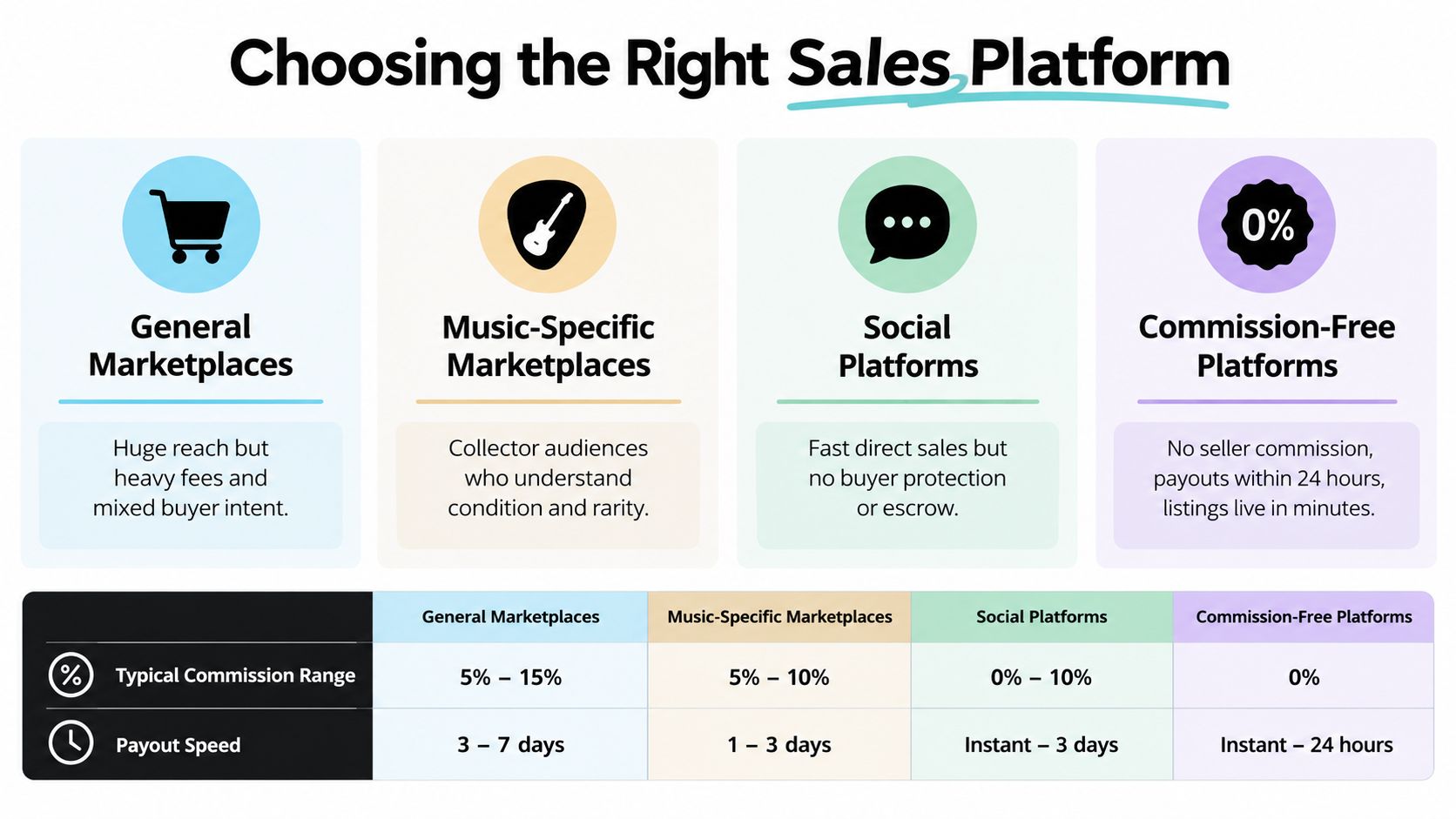
Use the item's value driver as the filter
| Item profile | Best initial venue | What works | What often fails |
|---|---|---|---|
| Common records, posters, shirts | General marketplace | Search visibility, familiar checkout, simple shipping | Paying specialist fees for an ordinary item |
| Signed or limited-edition pieces | Specialist marketplace or collector community | Detailed proof, targeted discovery, direct questions | Treating an autograph as self-authenticating |
| Rare instruments, stage-used objects, major artist material | Specialist auction house or curated sale | Provenance review, expert cataloging, controlled presentation | Setting a casual fixed price without comparable research |
| Fan merchandise and direct artist inventory | Commission-free music marketplace | Direct audience access and retained sale proceeds | Assuming the platform supplies all discovery |
For a practical comparison beyond music, collectors can consult this guide to the best place to sell cards, particularly for its treatment of audience fit, fees, and item value. The same logic applies to backstage passes and signed ephemera: a buyer who understands the category is often more valuable than a larger but less relevant audience.
General marketplaces suit items that are easy to identify, photograph, pack, and price. Specialist auction houses make more sense when provenance, scarcity, and presentation can justify a slower process and additional buyer or seller costs. Social selling can generate fast conversations, but it leaves more responsibility with you for payment security, records, returns, and dispute handling.
A commission-free option such as the OohYeah marketplace can fit direct fan merchandise and music-related items when retaining the full sale price matters and you can bring some audience attention yourself. Don't choose it because the fee is attractive alone. Choose it when the platform's audience, product format, payment process, and operational requirements match the item.
Photography and Listing Best Practices
Buyers can't handle your item through a screen, so your photographs must answer the questions a physical inspection would normally resolve. Use even, diffused light and a neutral background. Avoid colored bulbs, aggressive filters, reflective glare, and cropping that hides edges or defects.
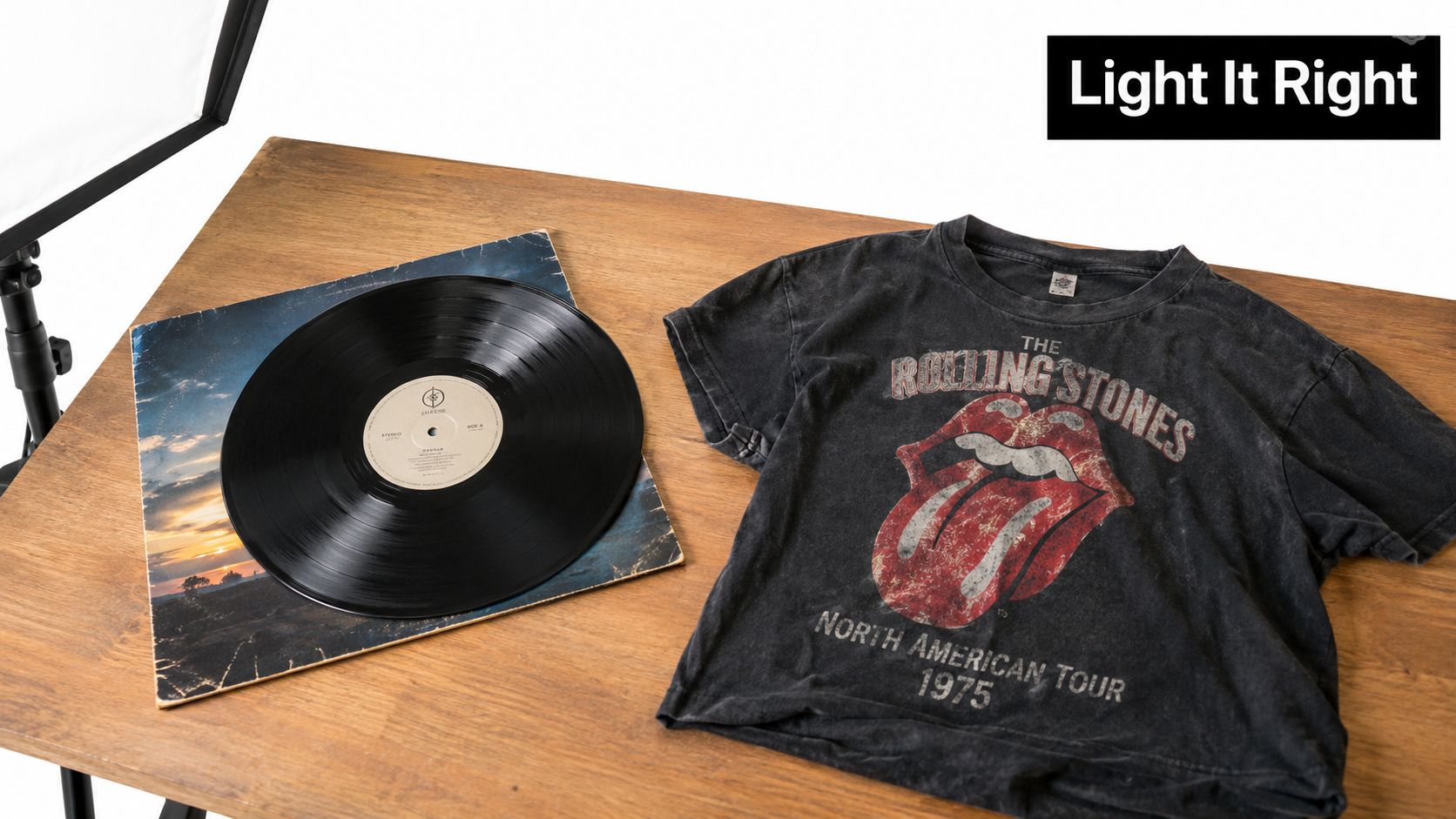
Start with a complete front view, then photograph the reverse, labels, seams, corners, signatures, serial numbers, stamps, inserts, and packaging. Add close-ups of flaws rather than relying on a sentence such as “shows signs of age.” A collector needs to see surface marks, creases, fading, edge wear, repairs, stains, and personalization before deciding whether your price is reasonable.
Build the listing around verification
The title should identify the artist, item type, relevant date or tour, edition or pressing detail, and the feature that creates demand. Avoid unsupported words such as “original,” “game-used,” “stage-worn,” or “authenticated” unless your evidence supports them.
Use a predictable description structure:
- Object identity: State exactly what the buyer receives.
- Condition: Separate general condition from specific defects.
- Dimensions and weight: Measure the actual item, not an assumed standard.
- Provenance: Explain the acquisition history and identify supporting documents.
- Included materials: List certificates, sleeves, cases, inserts, or display hardware.
- Shipping details: State how the item will be protected and dispatched.
The platform guide from Alibaba's data-backed collectibles selling guide recommends at least three macro condition photographs, exact dimensions and weight, grading documentation where relevant, and a provenance statement. It reports that matching the item type, value tier, and audience intent to the right marketplace can improve net profit by 32% compared with using one default marketplace, while skipping those listing requirements can reduce net profit by 7% to 15% on average. Treat those figures as the guide's reported findings, and apply the underlying discipline regardless of platform.
A video can help you evaluate presentation, lighting, and handling before publishing a listing:
Write for both search and a knowledgeable human. Include artist names and recognized item terminology, but don't stuff repeated keywords into awkward sentences. A clear listing attracts better questions, and better questions reveal whether a buyer understands what they're purchasing.
Pricing Strategies and Auction Dynamics
Pricing rare music memorabilia requires more than searching for the highest asking price. Unsold listings can remain visible for months, while completed sales reveal what buyers accepted. Compare objects with similar artist relevance, format, condition, documentation, and audience rather than copying a superficially similar listing.
Fixed-price listings work well when the item has a defensible range and you can wait for the right collector. They also give you control over negotiation, shipping terms, and the amount of explanation attached to the sale. Auctions create urgency and can expose an item to competing buyers, but a weak starting price, poor timing, or thin presentation can produce an outcome you can't easily correct.
Choose the format according to your priority
Online-only auctions generally produce slightly lower average prices than equivalent live-room auctions, but they achieve higher sell-through. The Collectibles Auction Market report places typical online-only sell-through at 75% to 90%, compared with 55% to 70% for traditional live sessions. Use that distinction carefully: an online auction may be preferable when completing the sale matters more than extracting the maximum possible hammer price.
For a rare instrument or well-documented stage-used item, a reserve or curated hybrid format may protect against an uninformed market. For a desirable but less exceptional signed item, a fixed price with offers can preserve control while still testing demand. Don't set a reserve so high that the listing attracts attention but never converts.
Calculate net proceeds before setting the public price
Your real result is the sale price minus every cost required to complete the transaction. Include platform commission, payment processing, packaging, insurance, shipping subsidies, authentication, storage, taxes where applicable, and the time spent answering questions and managing the order.
A simple internal worksheet should record:
- Expected sale price
- Platform and payment deductions
- Authentication or grading cost
- Packing and insurance cost
- Expected shipping contribution
- Minimum acceptable net proceeds
Price endings matter less than credibility in this category. A collector will usually care more about a defensible description and credible evidence than a small psychological adjustment to the final digits. If your item is difficult to compare, explain how you arrived at the price and invite specific questions rather than making an inflated claim about rarity.
Fulfillment and Legal Considerations
A successful sale can still become expensive if the object arrives damaged or the transaction record is incomplete. Match the packaging to the object. Use rigid mailers for paper goods, corner protection for posters and sleeves, moisture protection for textiles, and a properly supported case or crate for instruments. Photograph the item and package before sealing the shipment.
For valuable pieces, use tracked delivery, signature confirmation, and insurance that reflects the carrier's actual terms. Check exclusions before promising coverage. International shipments may involve customs declarations, import taxes, restrictions on materials, and rules affecting wood, animal products, or vintage electronics.
Keep the transaction defensible
Save the original listing, photographs, buyer messages, payment record, shipping receipt, tracking history, and delivery confirmation. Describe the item accurately rather than promising that a buyer will receive a particular emotional experience or celebrity connection. Don't claim endorsement, authorization, or official status unless you have evidence and the right to make that claim.
Copyright and publicity rights also require care. Selling a physical photograph, poster, shirt, or record isn't the same as acquiring permission to reproduce the artist's image, logo, album artwork, or signature in marketing materials. Use your own photographs of the item, write factual descriptions, and avoid creating new merchandise from protected artwork or branding.
Returns and disputes should follow the selected platform's published rules. Before listing, read the OohYeah return policy if you're using that marketplace, and make sure your condition description aligns with the process. A clear policy can't prevent every disagreement, but it gives both sides a defined reference point.
Shipping rule: Pack for the careless handoff you hope won't happen, not the gentle handling you expect.
Never under-declare a shipment to reduce customs friction. Keep copies of receipts and disclose defects before payment. Professional fulfillment isn't administrative decoration. It protects the object's value, your cash flow, and the trust that brings repeat buyers.
Leveraging Commission-Free Platforms
Commission-free marketplaces change the calculation for direct sales. Instead of treating the platform as the primary source of demand, you use it as the transaction layer for an audience you can reach through artist pages, newsletters, social posts, live events, or collector communities.
OohYeah is a music-first ecosystem where artists can offer tracks, merchandise, subscriptions, and related fan products through a unified platform. Its marketplace supports direct sales of music merchandise and memorabilia, while its broader tools support fan interaction, promotion, and analytics. That makes the model relevant for signed shirts, vinyl, limited fan items, and other inventory connected to an artist or active music community.
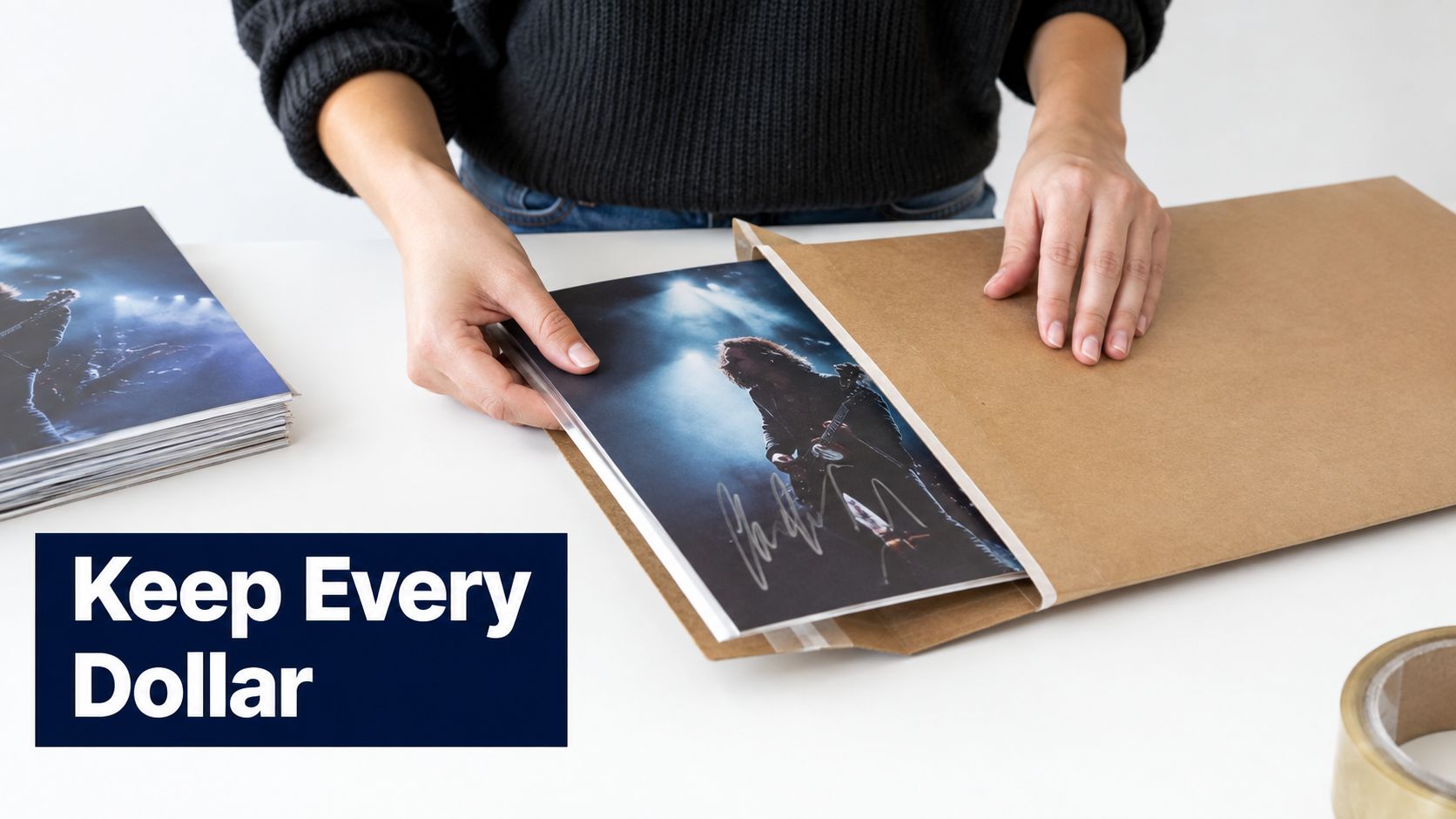
Understand the trade-off
Removing seller commission can leave more of the transaction value with the seller, but it doesn't remove the work of discovery. You still need strong photographs, accurate descriptions, responsive communication, reliable fulfillment, and an audience that cares about the item. A general marketplace may provide more passive search demand, while a music-first platform can provide greater relevance for direct fan commerce.
Use a commission-free channel when:
- You control the audience: You can direct fans or collectors to the listing.
- The item has a clear music connection: The product fits a music-centered buying environment.
- You want direct relationships: You can answer questions and build future demand.
- The margin matters: The item is priced where intermediary deductions materially affect your result.
Use a broader or specialist venue when the item needs independent discovery, formal appraisal, extensive provenance review, or auction-house presentation. A mixed strategy can work, but don't create duplicate listings with conflicting prices or unclear availability.
Creating Your Sales Action Plan
Start with an inventory audit. Group items by type, value driver, condition, documentation, fragility, and likely buyer. Separate objects that need authentication from those that can be listed after ordinary inspection.
Then follow this sequence:
- Document the item: Photograph every surface, record dimensions, and gather provenance.
- Choose the venue: Match audience intent and risk to a general, specialist, direct, or commission-free platform.
- Calculate net proceeds: Include all transaction, authentication, packing, shipping, and time costs.
- Publish accurately: Use a searchable title, condition details, evidence, and clear terms.
- Manage the sale: Answer questions in writing, preserve records, and confirm payment before dispatch.
- Review the result: Record enquiries, offers, sale price, costs, delivery outcome, and buyer feedback.
For broader operational guidance, AmaJova's resource on how to sell online successfully provides a useful checklist mindset that can complement a memorabilia-specific workflow. Before publishing through OohYeah, review its terms of service so your listing, transaction, and fulfillment practices fit the platform's requirements.
The first sale should teach you something. Track which titles attracted views, which evidence answered objections, which platform produced qualified buyers, and where fulfillment consumed unexpected time. Repeat the process only after improving the weak point.
OohYeah gives musicians and sellers a music-first marketplace for offering merchandise, memorabilia, and other fan products through direct transactions. Create a focused listing with clear proof and professional photographs, then invite interested collectors to visit OohYeah and discover the item.