Assuming Direct Control for Independent Artists
Assuming direct control means keeping rights, prices, distribution and fan ties. Use the rights map, trade-offs and break points before you switch.
November 2, 2026
Music Marketplace Advisor
Buying & SellingAssuming direct control means you keep authority over your composition, master recording, price, sales channels, and fan terms instead of assigning those decisions to a label, distributor, or marketplace. You do not get that control just by uploading a file yourself.
The popular advice says cut out the middleman and you are free. That's backwards. Removing a label does not remove co-writers, producers, sample owners, or the person whose voice is on the record, and it puts your name on every sale, license, refund, and dispute. If your paperwork is thin, more control means more exposure, not less. Treat assuming direct control as a job you are taking over, with a ledger to prove you can do it.
What Assuming Direct Control Means for Artists
Leaving a middleman is not the same as owning the rights. Say a singer-songwriter uploads a finished single to a direct store, sets a price, and announces independence. If a co-writer never approved the release, that store page does not fix the problem. She has changed the shopfront, not the ownership.
Assuming direct control means the artist keeps authority over the musical work, the sound recording, the price, where a release is offered, and the terms of the fan relationship, rather than signing those decisions over to a label, distributor, or store. You decide who may use the track, where, for how long, and for what fee. You also decide what happens when a buyer asks for a refund or a filmmaker wants a wider use than you sold.
Four levers, not one slogan
- Rights: Who owns the composition and the master, and who must approve each use
- Distribution: Whether you choose a download, membership, license, streaming, or a mix
- Pricing: Who sets the number, the bundle, and any exclusivity
- Fan relations: Who can message buyers, see who bought, and set access terms
Think of a landlord who hires a letting agent. The agent can list the property and collect rent, but renting it out does not transfer the building. The owner still sets the rent, writes the house rules, and decides who may enter. Music works the same way. A distributor can deliver files without owning the master, and a playlist placement can drive listening without giving you pricing power.
Streaming scale still matters for discovery. According to the IFPI Global Music Report 2025, the number of global paid music-subscription accounts rose 10.6% to 752 million in 2024. Subscriber growth does not decide who owns your master or what your download costs. It decides where many listeners first hear you.
Calling a release independent does not cure a missing co-writer approval.
The sensible sequence is a rights map first, then how distribution, pricing, and fans change, then money, worked examples, risks, and a go, wait, or hybrid decision. Start with what you hold. Everything else depends on that answer.
The Rights an Artist Must Actually Hold
| Asset | Who may still control it | What you must have on file | Blocked if missing |
|---|---|---|---|
| Musical work | Co-writers, publishers | Split sheet, registrations, territory limits | Sale or sync of the composition |
| Sound recording (master) | Label, producer, featured artists under contract | Master ownership and term | Download, stream file or derivative |
| Samples and interpolations | Original composition and master owners | Written clearances and scope | Any release containing the sample |
| Featured performers | Performer or their representative | Approval and credit terms | Release and promo using the performance |
| Producer contribution | Producer under points or work-for-hire | Agreement on ownership and royalty | Master exploitation |
| Name, image, likeness, voice | The person depicted or heard | Separate consent beyond the recording | Synthetic voice, ads, avatar uses |
| Merchandise artwork | Designer, photographer, band members | Assignment or license of the design | Physical or digital merch |
| AI training or model use | Rights holders plus performers | Explicit training and voice permission | Supplying tracks to train models |
A release carries at least two distinct copyrights that can have different owners and must be licensed separately: the musical work, meaning melody, lyrics, and composition, and the sound recording, or master, as the Congressional Research Service guide to music copyright explains. Owning one does not hand you the other. That's the split that trips up most direct sellers.
Walk the rows in order
If you sampled or interpolated another work, you need clearances from the owners of both the original composition and the original recording, with scope in writing. A featured singer's informal yes in a message thread is not approval and credit terms. A producer on points or a work-for-hire deal needs an agreement that says who owns what and what royalty is owed. Each gap blocks a specific use, such as offering a download while a co-writer still controls part of the composition.
Name, image, likeness, and voice sit apart from the recording itself, so synthetic voice, ads, and avatar uses need separate consent. Merchandise artwork belongs to its designer or photographer until you hold an assignment or license. AI training needs explicit permission from rights holders and performers, not a general release for the track.
Keep an auditable ledger
Before listing anything, assemble one file per track with:
- Shares and approvals: Writer and performer shares, collaborator approvals, producer agreements
- Ownership proof: Master ownership, registration identifiers, dated project files
- Limits: Territories, contract restrictions, sample clearances
Sound-recording owners generally control reproduction, distribution, and derivative uses, but U.S. law does not grant a broad exclusive public-performance right for sound recordings. That right is principally limited to digital audio transmissions, so your direct store does not replace performance-rights administration.
When you're negotiating those approvals, a practical guide to supplier negotiations helps you raise scope, term, and payment early instead of after a dispute. You can also read how hosting fits this picture in the OohYeah artist agreement. Users keep ownership of the content they submit to OohYeah, and grant OohYeah a non-exclusive, worldwide, royalty-free license to host, display, distribute, and promote it as needed to operate and market the service.
Practical rule: If a row in your ledger is blank, do not list that use.
How Distribution Pricing and Fans Change
| Lever | Through an intermediary | Assuming direct control | What you take on |
|---|---|---|---|
| Distribution | Store or label chooses channels and windows | Artist chooses download, membership, license or hybrid | Channel setup and metadata |
| Pricing | Rate card or royalty formula set upstream | Artist sets price, bundle and exclusivity | Discount and tax decisions |
| License scope | Blanket or opaque downstream use | Written use, territory, term and media | Drafting and dispute handling |
| Fan relationship | Platform holds the audience | Artist messages buyers on stated terms | Support and community upkeep |
| Payment reporting | Delayed statements | Receipt tied to each approved use | Reconciliation and refunds |
| Statutory royalties | Often administered for you | Still owed where the law requires | Separate from your shop price |
The comparison below shows those same levers in visual form.
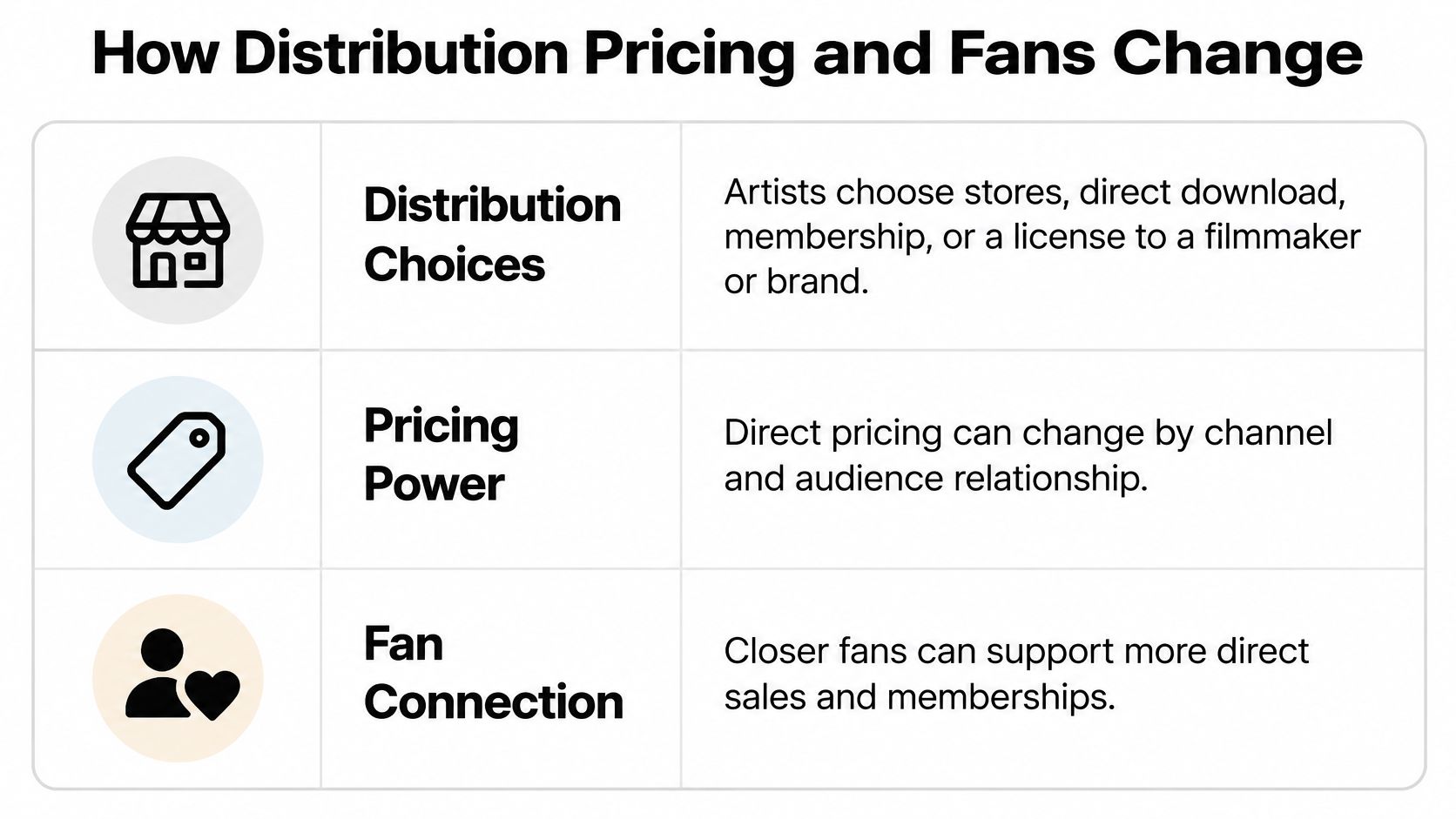
Distribution is where choice becomes visible. You can offer a direct download, a membership, streaming, or a license to a filmmaker, brand, or podcaster, and each deal needs a structured license naming the exact recording and composition, counterparty, territory, start and end dates, permitted media, usage limits, fee or revenue share, exclusivity, attribution, and takedown or audit rights. The Cambridge guide to music licensing describes this shift as a move from opaque downstream accounting to explicit first-party authorization and settlement. You're no longer waiting to learn what was sold downstream.
Pricing and the work attached to it
You set the price, bundle, and exclusivity. You also take on contract drafting, rights verification, invoicing, payment collection, and dispute handling. That's the trade. The economic benefit depends on operational controls, not on eliminating an intermediary, because a wrong territory or an open-ended term costs more than a commission would have.
Fan relations and payment reporting
Email addresses, messages, community posts, and exclusive files become assets only if you can see who bought and on what terms. That's different from a playlist placement you cannot price. With direct reporting, each receipt ties to an approved use, so you can match gross receipts sale by sale instead of decoding a delayed statement.
Clearer ownership data cuts unauthorized-use and royalty-allocation errors. Precise license scope cuts downstream disputes. Direct payment reporting lets you reconcile money against each approved use, and those three gains matter more than a higher headline margin.
Negotiated licenses do not erase collective-management or statutory royalties where those regimes still apply. Keep them in a separate workflow from your shop price. Keep streaming for reach, and use direct sales for the uses you can authorize.
How Platforms Like OohYeas Enable Direct Control
A platform supports direct control only if it makes ownership and permissions visible. A clean storefront without rights fields just moves the argument to a nicer page.
What to look for in the tooling
- Separate record fields: Composition and master metadata stored apart on each release
- Approval workflows: Co-owned works cannot publish until collaborators approve
- Structured license objects: Territory, term, media, fee, exclusivity, and takedown terms attached to each offer
- Per-product reporting: Sales and engagement shown release by release, not as one lump sum
Those features pay off in concrete ways. You keep the pricing decision, see the buyer list, and reconcile receipts against a specific track and offer. You can also keep streaming running for discovery while testing one direct product, which is why way the OohYeah artist joining page frames a direct channel alongside existing listening, not instead of it.
If you're comparing membership tooling, subscription tools for creators gives a useful baseline for what recurring access, perks, and billing should cover. Judge any option by whether it preserves your price and permission settings, not by how fast you can publish.
Set up one release properly
- Create the release record: Split composition from master and enter owners and shares.
- Attach the proof: Add collaborator approvals, split sheets, and sample clearances.
- Set one offer: Choose a single product with its price, bundle, and exclusivity.
- Publish and reconcile: Release it to your fan list and check the first sales against the release record.
OohYeah is one artist-first option in this pattern, where fans buy directly and the artist keeps the pricing decision. The limit is plain. A platform makes paperwork visible, but it does not cure weak ownership. If the record is wrong, the tool will faithfully sell the wrong thing.
When Direct Sales Beat Intermediary Scale
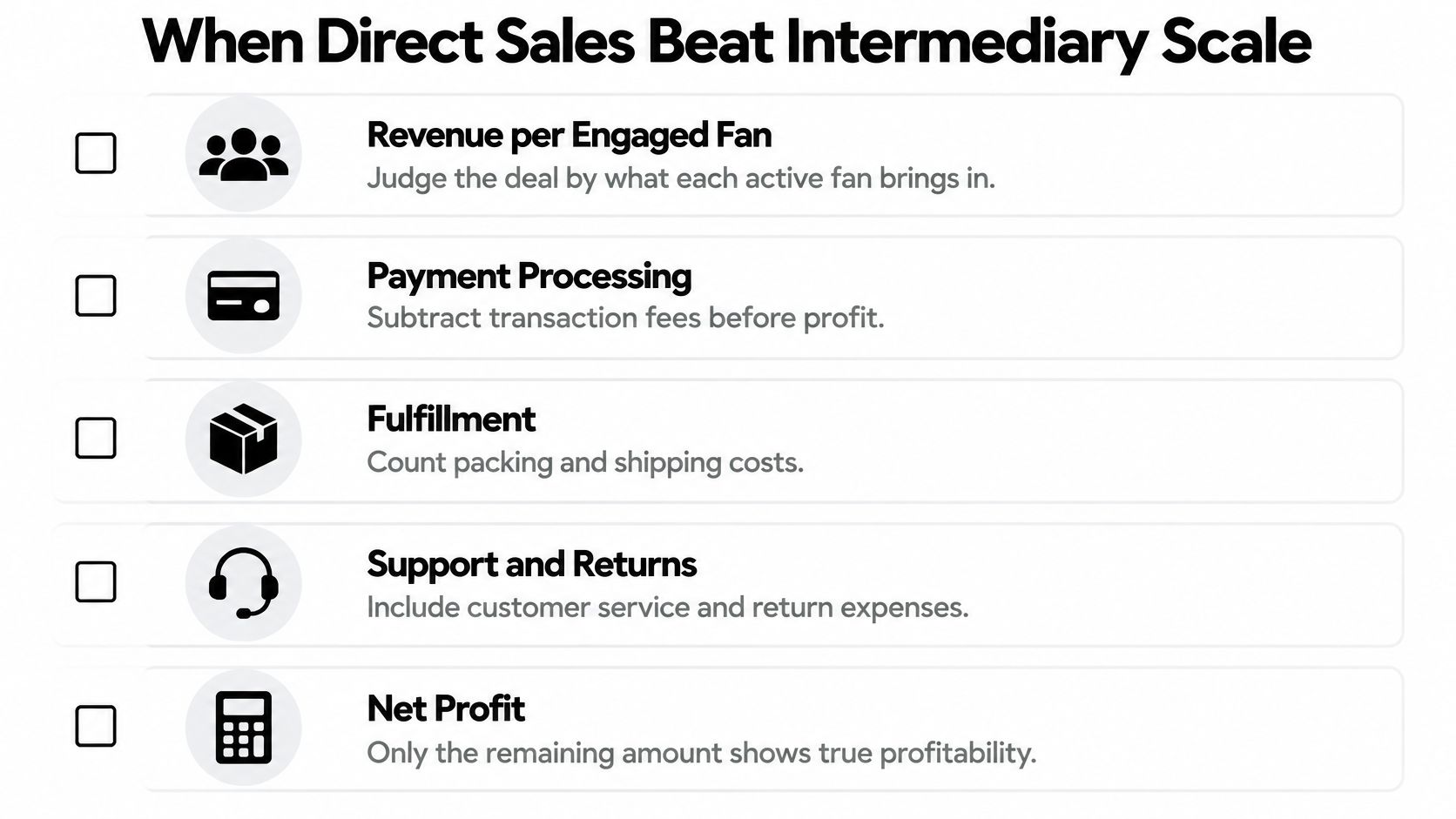
Judge direct commerce by revenue per engaged fan, not by a headline commission rate. A low fee means little if you spend unpaid hours packing boxes, answering support mail, and chasing refunds.
The Marketintelo music artist services report notes that non-streaming income, including merchandise, patronage, live activity, and exclusive content, has become a major component of independent artists' earnings, but figures vary widely by genre, audience size, and marketing investment. That variability is your warning. No single margin proves direct control wins for your audience.
| Offer | You control | Extra work | Try it when |
|---|---|---|---|
| Digital download or bundle | Price and file | Support, tax, delivery | A known list will pay for the recording |
| Membership or patronage tier | Tier price and perks | Steady content cadence | Repeat listeners already return |
| Preorder | Window and bonus | Deadline and fulfillment promise | Demand exists before you manufacture |
| Merchandise catalog | Design and margin | Stock, shipping, refunds | A smaller test already sold through |
| Premium interaction | Access rules | Time and boundaries | Fans ask for contact you can limit |
| Sync or brand license | Fee, scope, exclusivity | Contract and clearance | Chain of title is already complete |
Subtract the real costs first
Before calling a shop profitable, deduct payment processing, fulfillment, customer support, refunds, taxes, content production, and the opportunity cost of winning the fan. Promotion counts too, whether you write the posts yourself or test creative with a tool such as ShortGenius AI UGC ad platform for short video ads. Browsing the OohYeah marketplace can show how sellers frame offers, but their workload is not yours.
For a small but loyal audience, a limited membership, preorder, or digital bundle often beats a wide merchandise catalog. Physical goods pay only once demand is proven, because someone still packs and ships each order. A sync or brand license pays well only with a clean chain of title, since licensees audit before they pay.
Keeping ownership does not require doing every job yourself.
You can retain control and still hire specialists for manufacturing, logistics, rights administration, or promotion. Run a simple experiment instead. Pick one offer, set a fan-conversion target and an hours-per-week cap, and run it for a defined window. If net receipts do not cover the extra job, stop or narrow the offer. Sustainable net income is the test, not gross sales.
Worked Examples of Direct Control in Practice
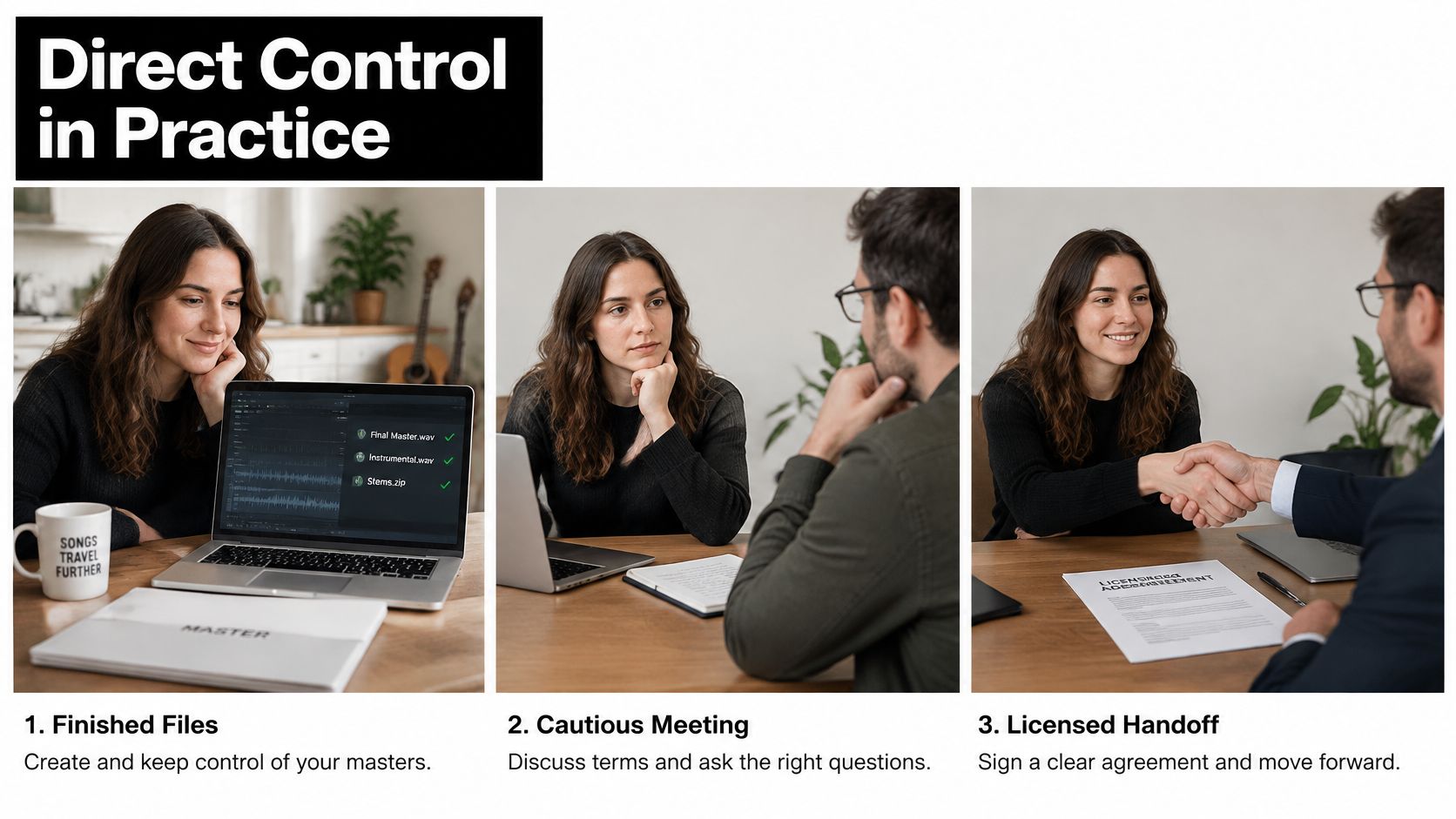
The three scenes below increase in legal care. Each turns on paperwork, not on which shop logo appeared on the page.
Scene one, a clean solo release
A solo songwriter owns the composition outright, paid for the master, and has a signed split sheet showing no other writers. She sells a pay-what-you-want bundle to her mailing list, keeps streaming live for discovery, and records each sale against that master only. Direct control works here because every permission she needs is already hers.
Scene two, a band that must wait
A band wants to sell its single direct next week, but the producer still owns points and no agreement states who owns the master or how credit reads. They do not sell the track yet. They can announce the release date, collect email signups, and post studio clips while the producer agreement is finished. Waiting protects the sale they want to make.
The walkthrough below shows how those preparation steps fit together before a signature.
Scene three, a license with an AI clause
A filmmaker asks to license a track for a short film. The artist negotiates fee, territory, term, media, and exclusivity directly and keeps the license tied to that exact recording and composition. Then she refuses a voice-clone clause bundled into the draft, because owning the recording does not authorize use of her identity, likeness, or voice in synthetic content.
That distinction matches the Reed Smith guide to AI and music copyright, which notes that prompts alone generally do not establish authorship, while sufficiently original human selection, arrangement, or modification may qualify for protection. She keeps dated project files showing her human choices, and treats any voice or likeness permission as a separate negotiation, or declines it.
Each scene succeeded or paused on documentation. Copy the ledger from the rights section and apply it track by track.
Risks, Myths and the Go, Wait or Hybrid Decision
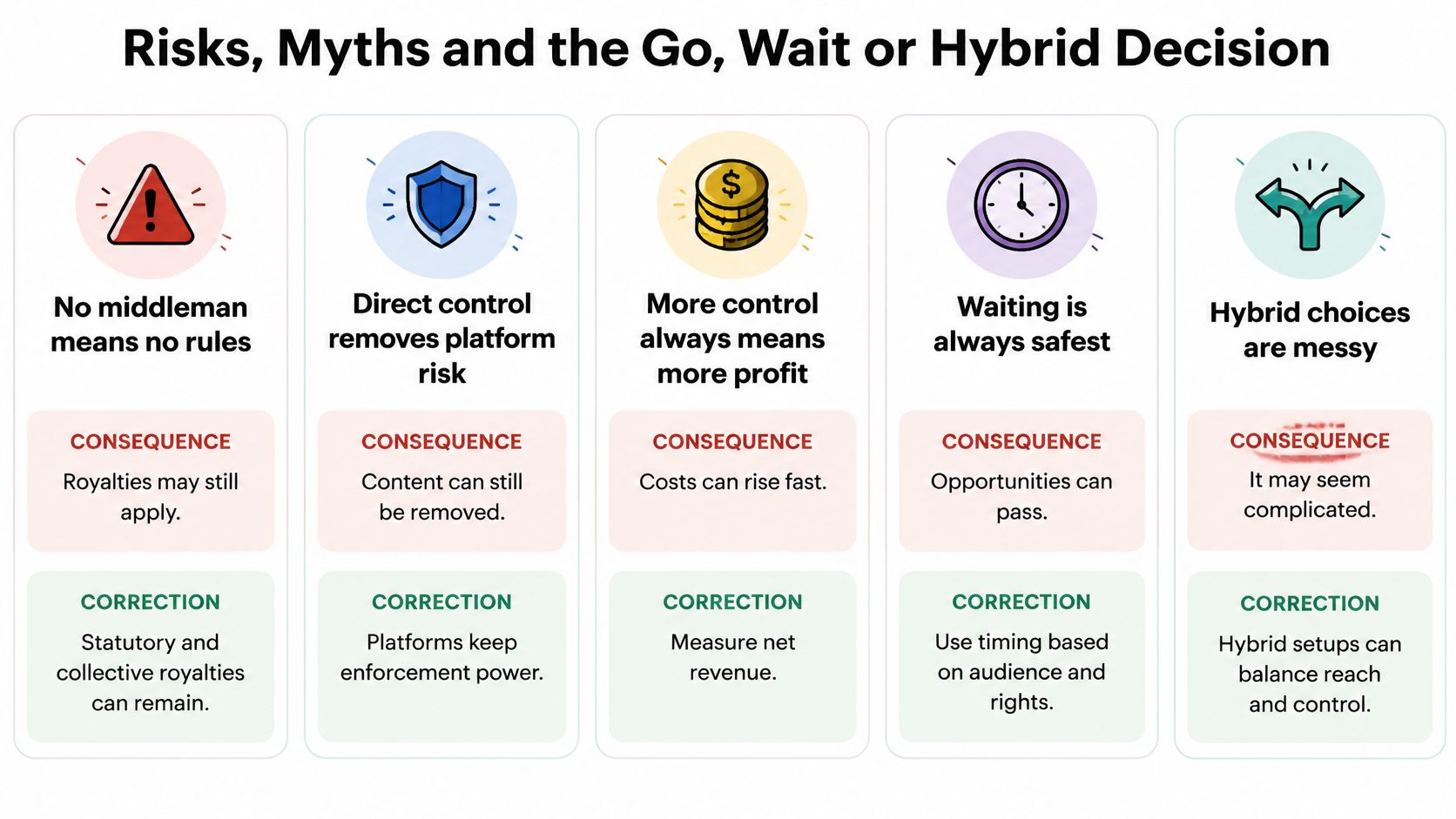
Five common beliefs create most of the trouble. Each sounds freeing and each transfers a cost to you.
Five beliefs that do not hold
1. No middleman means no rules. Statutory and collective royalties still apply where they apply. On OohYeah, we may investigate reports and remove content or limit user access when permitted by our Terms or the law, so platform enforcement does not disappear either.
2. Uploading proves ownership. It proves you pressed publish. A weak chain of title increases exposure because you are now the person offering the file, setting the price, and answering the claim.
3. The store fulfills the order. A seller or provider remains responsible for accepting and fulfilling an order. For physical goods, that includes clear pickup instructions and inspection at handoff when practical, so buyers follow your stated location, timing, and identification steps.
4. Fan access is free marketing. Direct messages, voice notes, and exclusive content need scope, time limits, and boundaries. Without them, you have not built community. You have sold unlimited labor at a fixed price.
5. One shop replaces every income line. Direct sales fund only the uses you can deliver. OohYeah adds a direct purchase path for fans and does not replace streaming, and the same logic applies to live work, specialist promotion, and hired logistics.
Verdict in one line: Go when the ledger is complete for one release, wait when any row is blank, and go hybrid when ownership is clear but your audience is still thin.
Apply the decision to your next release
Go now if the ledger is complete for the specific release, one offer has a realistic fan list behind it, and you have support hours set aside. Start narrow and prove reconciliation works before adding products.
Wait if any composition, master, sample, producer, or likeness row is blank. Those gaps are stops, not optimization tips. Collect signups and finish the documents instead of selling around them.
Go hybrid if ownership is clear but the audience is small. Keep streaming for reach, add one direct product such as a bundle or limited membership, and hire help for tasks you cannot cover well.
Your next step is small on purpose. Finish the ledger for one track, choose one offer row, write the sale or license terms, and review the first ten transactions against that track before adding merchandise or a membership. If those ten do not reconcile, fix the paperwork before widening control. That discipline is what makes assuming direct control real, rather than a label on a store page.
Finish the ledger for one track, set one offer at a price you choose, and sell it directly to the fans who already know the song. OohYeah gives you a direct purchase path alongside streaming, so you keep pricing and fan relationships in your hands while testing what direct control earns.