More of the Same: How Artists Break Creative Ruts
Tired of making more of the same? Practical steps to diversify your sound, songwriting, production and releases without losing your fans.
November 1, 2026
Music Marketplace Advisor
Buying & SellingYou've finished three demos this month, and they all trouble you for the same reason. Same tempo, same drum kit, same lift into the chorus, and a friend sums up the whole project with one adjective. That's more of the same showing up as a pattern, not a single bad track. You don't need a total reinvention. You need to find what's repeating, change one piece at a time, and give fans a way to follow the shift.
Find the Parts of Your Music That Keep Repeating
Repetition hides in five places, and each one needs a different check. I would run all five in one afternoon, with your last five tracks open in a playlist and a notebook beside the session. You're looking for shared settings, not shared quality. A track can be good and still prove you're circling the same ground.
| Area | Check | Warning sign | Quick test |
|---|---|---|---|
| Sound palette | Tempo, key and instrument set of the last five tracks | Three or more tracks share tempo and core instruments | Swap one instrument per track for a week |
| Songwriting structure | Intro length, first chorus timing and song length | Every chorus lands within the same 30 seconds | Write one track with no chorus until the final third |
| Production chain | Starting loop, preset or template for each session | Every session opens from the same project file | Start three sessions from a sample you have never used |
| Release rhythm | Gap between releases over the past 12 months | Releases follow an identical gap and format every time | Change the format of one release, such as a live take or stripped version |
| Fan response | Last ten comments and replies on releases | Phrases like "same vibe" or "sounds like the last one" recur | Ask one question per release and track the answers |
Reading the Results Without Panicking
Sound palette and structure are where listeners notice sameness first, because tempo and chorus timing shape the first minute. If three tracks share both, fans decide they've heard the song before you've sung the hook. A healthier result is overlap in tone but variety in pace and shape.
Production chain and release rhythm explain why the pattern keeps forming. Opening the same template loads the same kick, the same reverb send, and the same first decision. Releasing on an identical gap, in an identical format, trains fans to expect the same experience before they press play.
Fan comments are the bluntest signal. One "same vibe" is taste. Three people using the same phrase on different releases is a diagnosis.
A signature is a choice you could defend in one sentence. A habit is a default you never chose.
Keep the signature. A vocal treatment, a way of phrasing, or a rhythmic feel that listeners recognise as yours is brand, and stripping it out confuses people more than sameness does. Study an artist whose shifts still read as one clear identity and you'll see the fixed points held while other elements moved. Finish the audit by naming the two areas with the strongest pattern. Those are the only candidates for change right now, however much the others bother you.
How to Change One Variable at a Time
One variable, held steady against everything else, is how you learn what moved the response. Change four things and every comment becomes unreadable, because you can't tell whether fans reacted to the tempo, the mix, or the artwork. Treat the next three tracks as a small experiment, and write the hypothesis down the way the Otter A/B hypothesis guide frames a testable statement.
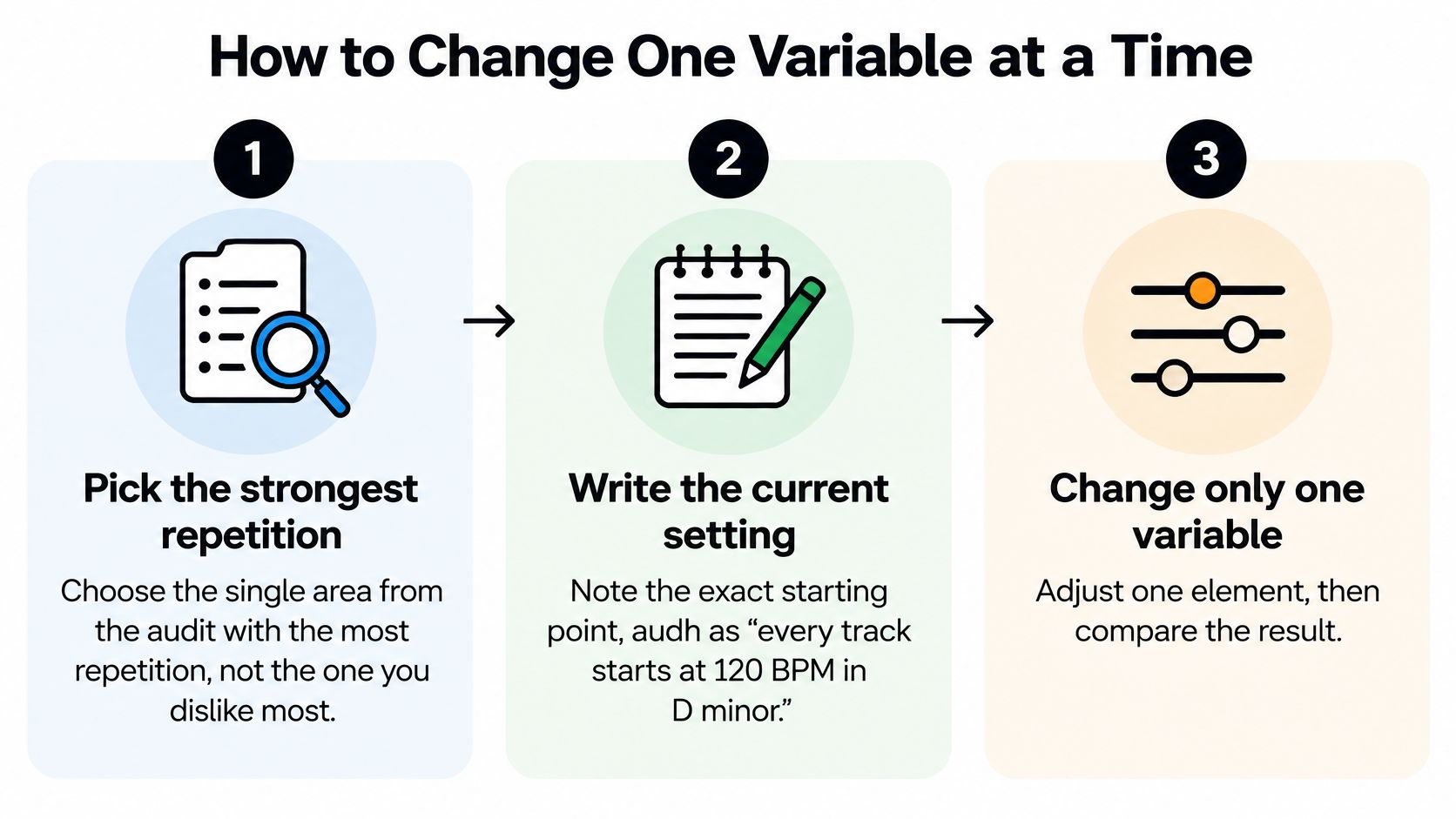
- Pick the strongest repetition. Take the top area from your audit, not the one you dislike most. Dislike is mood, repetition is evidence, and the slip here is fixing what's annoying instead of what's constant.
- Write the current setting. Note it exactly, for example "every track starts at 120 BPM in D minor". Without that line you've got no baseline, and memory will rewrite it in your favour.
- Change only that setting. Drop to 92 BPM, or write in a modal key you never touch. Hold it for two to three tracks, since one track tells you about that day, not about the change.
- Keep everything else fixed. Same mixing chain, same release format, same posting rhythm. It's boring on purpose, because a fixed background is what makes the one moving part legible.
- Record the result the same day. Write how the session felt, how three trusted listeners described the track unprompted, and whether the next idea came easier or harder. Notes written a week later are fiction.
- Decide after three tracks. Keep, adjust, or revert, and give the reason in writing. Judging after one attempt usually sends you straight back to the old habit.
- Only then pick the next variable. Running two experiments at once is the same mistake as step one, just better organised.
Telling Fans What Moved
Close each cycle with one line to fans about what changed and why, posted with the release. "Wrote this one slower and left the chorus until late, tell me where you feel it land" reads as intent. Silence reads as drift.
Keep that wording fixed across the next two tracks so people connect the releases. A successful cycle ends with a new element that regular listeners still recognise as yours. If strangers love it and your core fans can't place you, you've changed identity, not a variable.
Songwriting and Production Moves That Shift Your Sound
Start where you work, at the desk with the notebook, and change texture before you touch identity.

Songwriting Moves
- Change the narrator: Write the verse from a secondary character or an object in the scene, such as the car outside the argument. Cost is one writing session. Risk is losing emotional directness, so keep your own voice in the chorus.
- Melody before chords: Sing a topline over silence, record it on your phone, then build harmony underneath. A rough draft takes about two hours. Risk is a melody that wanders, so check the hook still lands.
- Break your metre: Deliberately write a line that won't fit your usual bar pattern, then phrase around it. Cost is one verse rewrite. Risk is tripping the listener, so keep one anchor line per section.
Production Moves
- Replace one default sound: Swap the kick you always load for a field recording, a stomped floor, or a different instrument family. Cost is half a session of auditioning. Risk is a mix that loses punch, so A/B it carefully.
- Cap the palette: Limit yourself to three sounds for a full track and force the arrangement to do the work. Cost is one session. Risk is thinness, which movement and automation usually fix better than extra layers.
- Re-amp a finished part: Send a synth or vocal through a guitar pedal or a different room and rerecord it. Cost is under an hour once it's rigged. Risk is mud, so print a dry copy first.
Watch a producer work a single constraint through a session before you try your own version.
Log what each tactic altered beyond its target, because swapping a kick changes how the bass feels too. That log is also useful when a shift deserves a physical moment for fans, and guides to branded giveaways for music events show how a small, relevant item can mark a new phase without a full merch drop. Look at an artist catalogue where production moves carry the reinvention and note how the voice stays put. Texture changes first, which is why the song still sounds like you.
Test New Directions Through Release Formats
A listener can't react to a direction you've only tested in your studio. In a mixed-method study of five independent artists, the strongest follower-to-Spotify-listener conversion during the four-month periods surrounding single releases came when artists explained their music and made fan interaction participatory. Build each test the same way. Set a pre-release narrative, publish one piece of context about the writing or production choice, invite a low-friction response, send people to one measurable destination, then follow up with responders on release day and after.
| Release format | Best for | Fan action to invite | Measure to track |
|---|---|---|---|
| Single with context post | Testing a new sound with existing fans | Question or reaction | New monthly listeners per attributable follower |
| Stripped or live version | Showing the songwriting behind a new direction | Poll on which version to keep | Repeat listens within 30 days |
| Teaser series before a single | Building anticipation for a shift in sound | Duet or remix request | Visits to the listening destination per teaser |
| Alternating-content test | Comparing two directions with the same audience | Choosing between two clips | Conversion gap between the two clips over identical windows |
| Full project after singles | Confirming a new direction once singles have landed | Preorder or download | Downloads and merchandise purchases per 1,000 listeners |
Measuring Without Fooling Yourself
Calculate conversion as new monthly listeners divided by attributable followers or engaged viewers, against a baseline over an identical window. Likes and views are leading indicators, not proof anyone listened. Leave the window open rather than calling it on launch week, because delayed discovery is exactly what a launch snapshot misses.
Sequence matters at album scale too, and the album release advice from Isolate Audio is a useful check on track order before you commit a full project. Study a project that tests formats as part of its identity for how far format play can go. Five artists is a small sample, so treat this workflow as a hypothesis for your own catalogue, not a guaranteed rate.
Match Each New Offer to Where a Fan Actually Is
Offer overload is the commercial version of more of the same. Launch downloads, merchandise, subscriptions and exclusives in the same week and you haven't given fans choice, you've given them homework. Worse, a passive listener hit with a superfan offer feels charged for loyalty they haven't built yet, and that's how artists lose people they already had.
Match the offer to commitment instead, using signals fans give voluntarily. No intrusive tracking, no guessing from passive data.
| Fan stage | Voluntary signal | Offer that fits | Contact rhythm |
|---|---|---|---|
| New listener | Saves or follows after a track | Free download or playlist | Once per release |
| Repeat buyer | Second purchase within 90 days | Merchandise or paid downloads | Monthly, with purchase-linked updates |
| Subscriber | Renews after the first billing period | Exclusive tracks or early access | Every two weeks |
| Community participant | Replies to posts or sends voice notes | Invitation to shape the next release | Opt-in only |
| Advocate | Shares a release or refers a friend | Early listening or public credit | Occasional, and asked rather than pushed |
Why the Stages Stay Separate
According to Weverse Magazine reporting on superfan research, 73% of superfans buy merchandise compared with 26% of general listeners, and 81% of superfans discuss favorite artists with friends or family. Buying and advocating travel together, but they aren't the same behaviour, so don't pay an advocate only in discounts or ask a new listener to recruit friends.
The same reporting notes that social video platforms are the largest source of new fans for 67% of independent artists. Many listeners first encounter you inside someone else's feed, not your own. Your first direct offer therefore has to be small, clearly explained, and easy to decline.
Consent rule: If a fan didn't take an action you can name, you don't get to move them up a stage.
Maximum personalisation isn't automatically best. Predictable timing and stated boundaries build more trust than aggressive targeting, and they're cheaper to run. Judge the stages by repeat purchase rate, subscription retention, response rate and fan-perceived value, not follower counts or how many messages you sent.
Confirm One Experiment Before Your Next Release
Don't rebuild the whole project at once. Pick one repeated area, run it through the one-variable routine, ship it in one release format, and score that single experiment properly. Three tracks or one full release cycle is the minimum before you decide anything.
Follower count won't score it for you. In a quantitative study of 255 artists signed to a large UK independent music publisher, follower growth was strongly associated with streaming royalties but not with total publishing royalties, and a 10% increase in Twitter followers corresponded to only a 0.5% increase in royalties when other variables were held constant. Reach can climb while the money that matters barely moves.
Your Scoreboard
- Funnel stages: Track profile visits, streams, downloads, messages, purchases and subscriptions as separate steps, not one blended engagement number.
- New versus returning fans: Compare the two groups over 30, 60 and 90 day windows, since a change that only attracts strangers hasn't strengthened your base.
- Revenue per active fan: Use this as the summary figure, and note sample size alongside it.
Alternate teasers or calls to action where you can, so you've got something resembling a control. Report your numbers with their limits, and don't claim a cause from one release, because association isn't proof. The trap to watch is reach growing while monetisation stays flat, which feels like momentum and pays like standing still.
Here's my decision rule. Keep the change if repeat purchase rate and response rate rise together. Revert it if only reach moves. That single rule stops you chasing an audience that applauds and never buys, and it turns breaking a rut into something you can repeat on purpose.
Run your next experiment where the response is measurable, with your tracks, downloads, merchandise and subscriptions in one place and your pricing under your control. OohYeah gives you that setup without commission eating the result, plus direct messaging and analytics to score each change. Set up your page, post the one line about what's changing, and let three tracks answer the question.