Music Subscription Services Explained for Artists and Fans
Learn how music subscription services work in 2026: service types, artist payouts, pros and cons, and where OohYeah fits.
November 3, 2026
Music Marketplace Advisor
Buying & SellingThe United States reached 100 million average paid music subscriptions in 2024 for the first time, and paid subscription services generated US$11.7 billion, according to the RIAA 2024 year-end revenue report. That number reframes music subscription services. They're no longer a listening convenience added to album sales. They're the main way recorded music earns money, which means the important question isn't how large a catalog looks. It's how each recurring payment is divided, whether that payment reaches the artists a fan plays, and whether local and independent artists can build a living inside the system.
Service Types Compared at a Glance
| Type | Typical example | What the fan pays for | Where the money goes |
|---|---|---|---|
| Platform streaming | Spotify Premium, Apple Music | On-demand access to the full catalog for a monthly fee | Rights holders and artists, paid by share of streams or user-centric splits |
| Artist-led membership | Patreon-style fan clubs | Recurring support for one creator in exchange for posts, messages and early access | Mostly the artist, after platform and payment fees |
| Marketplace subscription tiers | Artist tiers on a music marketplace such as OohYeah | Tiered recurring access to downloads, exclusives, community and merchandise benefits | The artist, after payment processing fees |
| Direct purchase with optional plan | Bandcamp-style album and merch sales | One-time purchases of music and merch, optionally with a recurring plan | The artist directly, per sale |
Platform streaming sells breadth. A fan pays one fee for the whole catalog, and the service pools that money across millions of tracks. That design favors convenience and discovery, but it separates an individual payment from an individual artist.
Artist-led membership reverses the trade. The catalog is small, sometimes only one creator's work, but the relationship is direct. Fans pay for posts, messages, early access and the feeling of backing someone specific, and most of the fee goes to that creator.
Two Middle Paths
Marketplace tiers combine recurring support with commerce. A tier can provide downloads, exclusive releases, community access, and merchandise benefits, so the fan isn't only renting access. Direct purchase with an optional plan keeps ownership at the centre, with albums and merch bought outright and a subscription added only when the fan wants continuing benefits.
The mechanics are similar across all four rows. A plan bills on a set period, renews automatically until the fan cancels, and shows its price and terms before the first charge. Artist-led and marketplace offers usually ask the fan to pick one level, while platform streaming covers the full catalog for a single fee.
If you're comparing the wider logic behind these offers, it helps to explore recurring revenue business models and note what each one rewards. Find the row that matches your goal first. The money flow, risks and fit that follow only make sense against that starting point.
Why Recurring Access Now Drives Music Revenue
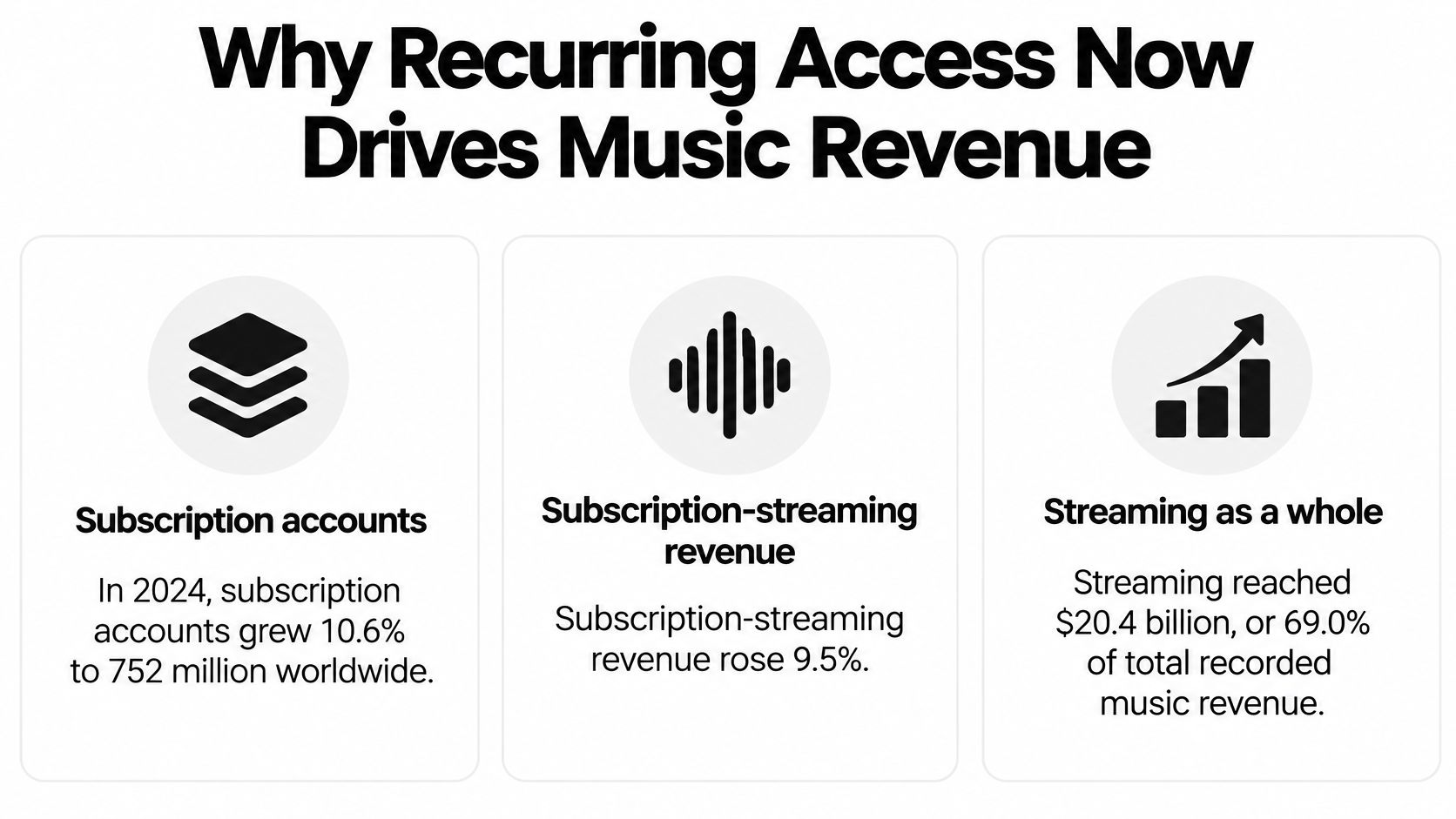
The IFPI Global Music Report 2025 summary records subscription-account users increasing 10.6% year over year to 752 million worldwide in 2024, while subscription-streaming revenue grew 9.5%. Total streaming revenue reached US$20.4 billion, representing 69.0% of global recorded-music revenue, and ad-supported streaming grew only 1.2%.
Those four figures tell a sharper story than any one of them alone.
- Subscription accounts: up 10.6% to 752 million
- Subscription-streaming revenue: up 9.5%
- Total streaming revenue: US$20.4 billion, or 69.0% of recorded-music revenue
- Ad-supported streaming: up 1.2%
Why Subscriber Count Is Not Enough
Accounts grew faster than revenue. That gap means average revenue per account isn't rising at the same rate. Think of a gym that signs up more members each month but collects a little less from each one. Membership looks healthier on a chart, while the income supporting staff and equipment grows more slowly than the headline suggests.
Subscriber growth shows reach. Revenue per paying account shows whether that reach can pay for music.
Artists and managers should therefore read growth claims carefully. A service can add accounts through discounts, bundles or lower-priced markets and still generate modest gains for creators. The stronger test is whether paying fans renew at prices that sustain recording, touring and promotion.
That's also why direct fan income sits alongside streaming rather than beneath it. Services and creator platforms for tips and merch point to the same underlying shift, recurring support plus commerce tied to a specific artist. Recurring access is now the central commercial model. The useful questions are who gets paid, how much reaches them, and whether fans keep paying once novelty fades.
How Subscription Royalties Reach Artists
Royalty allocation is a payment-design choice, not a reporting detail. Two services can collect the same monthly fee from the same fan, play the same songs, and still pay different artists different amounts because their allocation rules differ.
The comparison in Reuters reporting on streaming revenue and royalty models distinguishes the dominant pro-rata model, where an artist's payout depends on their share of all streams on the service, from the user-centric model, where each subscriber's fee is divided among the artists that subscriber listened to. Hybrid approaches blend the two.
| Model | How payouts are calculated | Main effect on artists |
|---|---|---|
| Pro-rata | Artist share of all streams on the service | A heavy listener's fee can indirectly pay artists they never played |
| User-centric | Each subscriber's fee split among the artists that subscriber played | Payment follows individual listening, but needs per-user tracking |
| Hybrid models | A blend of pooled and per-user allocation | Aims to balance incentives among artists, fans and platforms |
What Changes for a Niche Artist
Say a fan spends a month playing one independent folk singer and nobody else. Under pro-rata, that fan's fee enters a global pool, so most of it can flow to high-volume catalogs the fan never opened. Under user-centric accounting, the same fee is attributed to the folk singer, subject to the service's share and eligibility rules.
Neither model solves every problem. Pro-rata is simpler to administer at scale and rewards total listening share. User-centric accounting matches fan intent more closely, but it requires reliable per-user tracking and careful fraud controls. Hybrid systems try to soften the weaknesses of both, which makes their exact formula even more important to read.
Questions to Ask Before You Trust a Payout
- Eligible streams: What's the minimum play duration that counts?
- Repeat plays: How are duplicate or looped plays handled?
- Discounted plans: How are refunds, trials, bundles and promotional subscriptions treated?
- Territory and tax: Which territories and taxes apply before settlement?
- Reporting: Can you see both global stream share and subscriber-attributed earnings?
On our side, the applicable terms are set out in the artist agreement, and artists should read payout rules before judging likely income. That discipline matters because the same listening can pay very differently under each model.
Direct purchases work differently. When fans buy music, merchandise or other products directly, that money funds recordings, musicians, touring and merchandise in a visible, per-sale way. It doesn't replace the need to understand streaming royalties, but it gives artists a second income line that isn't diluted by a global stream pool.
Benefits and Drawbacks for Artists
Subscription income suits an artist who already has engaged fans and can deliver benefits on a steady schedule. It suits an artist far less when the audience is casual or the content pipeline depends on spare weekends.
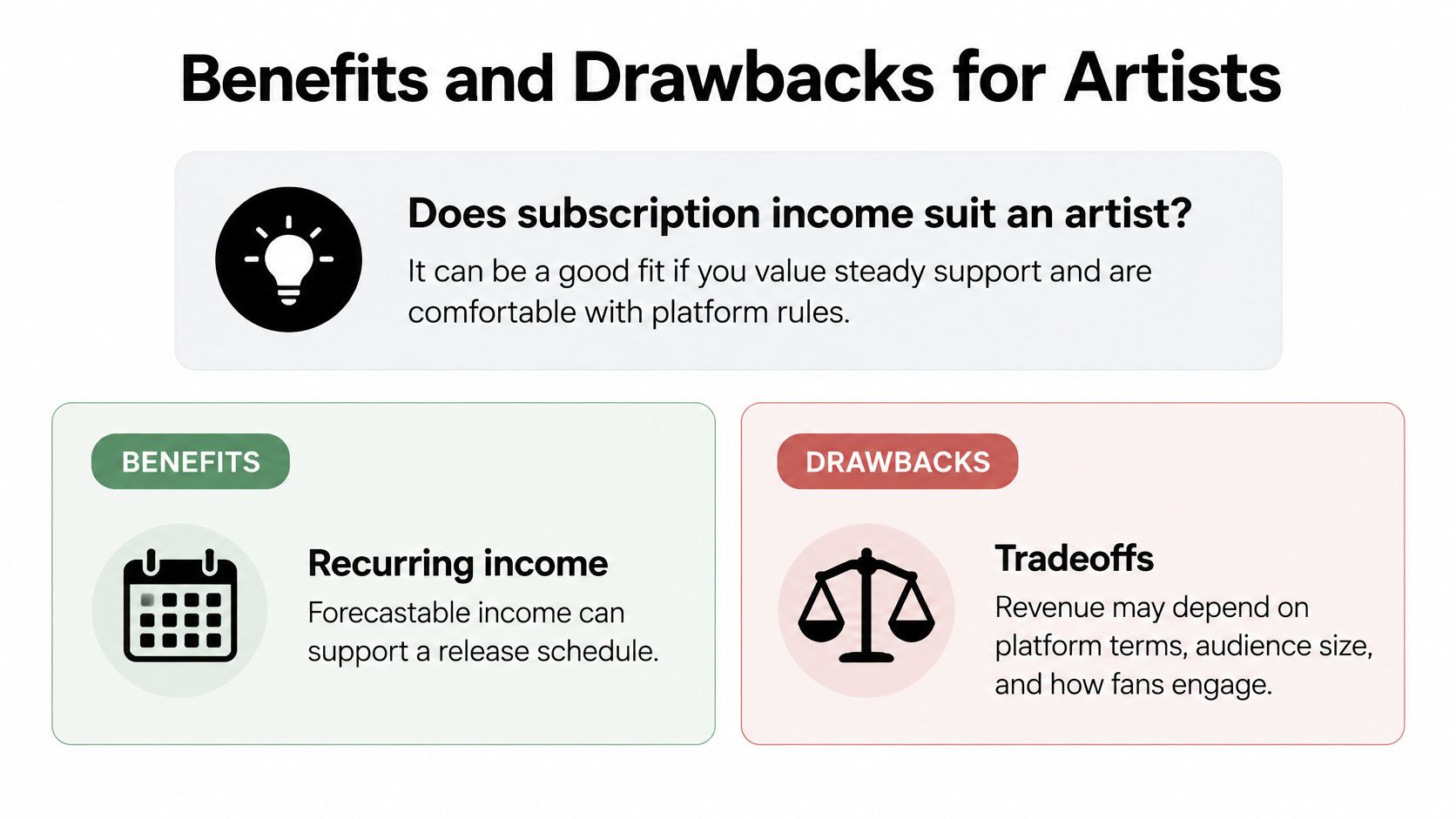
Benefits
- Forecastable income: Recurring payments are easier to plan around than one-off sales, so they can support a release schedule, studio time or a small touring budget.
- Direct relationships: Paying fans can be messaged, rewarded and asked what they value, which gives the artist information a stream count doesn't provide.
- Bundled offers: Exclusives, downloads, community access and merchandise benefits can sit in one tier instead of being sold as disconnected extras.
- Price control: On artist-led and marketplace tiers, the artist sets the level and decides what each level includes.
Drawbacks
- Small pooled payouts: Under pro-rata streaming, per-stream income stays small unless listening volume is large, so a loyal but small audience may generate less than expected.
- Renewal risk: Income depends on subscribers staying. A tier that loses people after a few months leaves gaps that a launch spike can't fill.
- Production workload: Exclusive tracks, videos, posts and live sessions take time. Artists often price the benefit and underestimate the labour behind it.
- Fees: Platform and payment fees reduce what reaches the artist, and those deductions matter most at low tier prices.
For example, an artist with 300 paying supporters at 5 per month would collect about 1,500 before fees. That's meaningful, steady money for many independent acts. It's also 300 people expecting the next benefit on time, every month.
Decision rule: Start a subscription only when you can name the recurring benefit, the production time it needs, and the audience segment most likely to renew.
Subscriptions work best when engagement and output reinforce each other. Without both, a recurring fee becomes a promise the artist has to keep under pressure, and cancellation usually follows disappointment rather than price alone.
What Fans Gain and Where Local Artists Stand
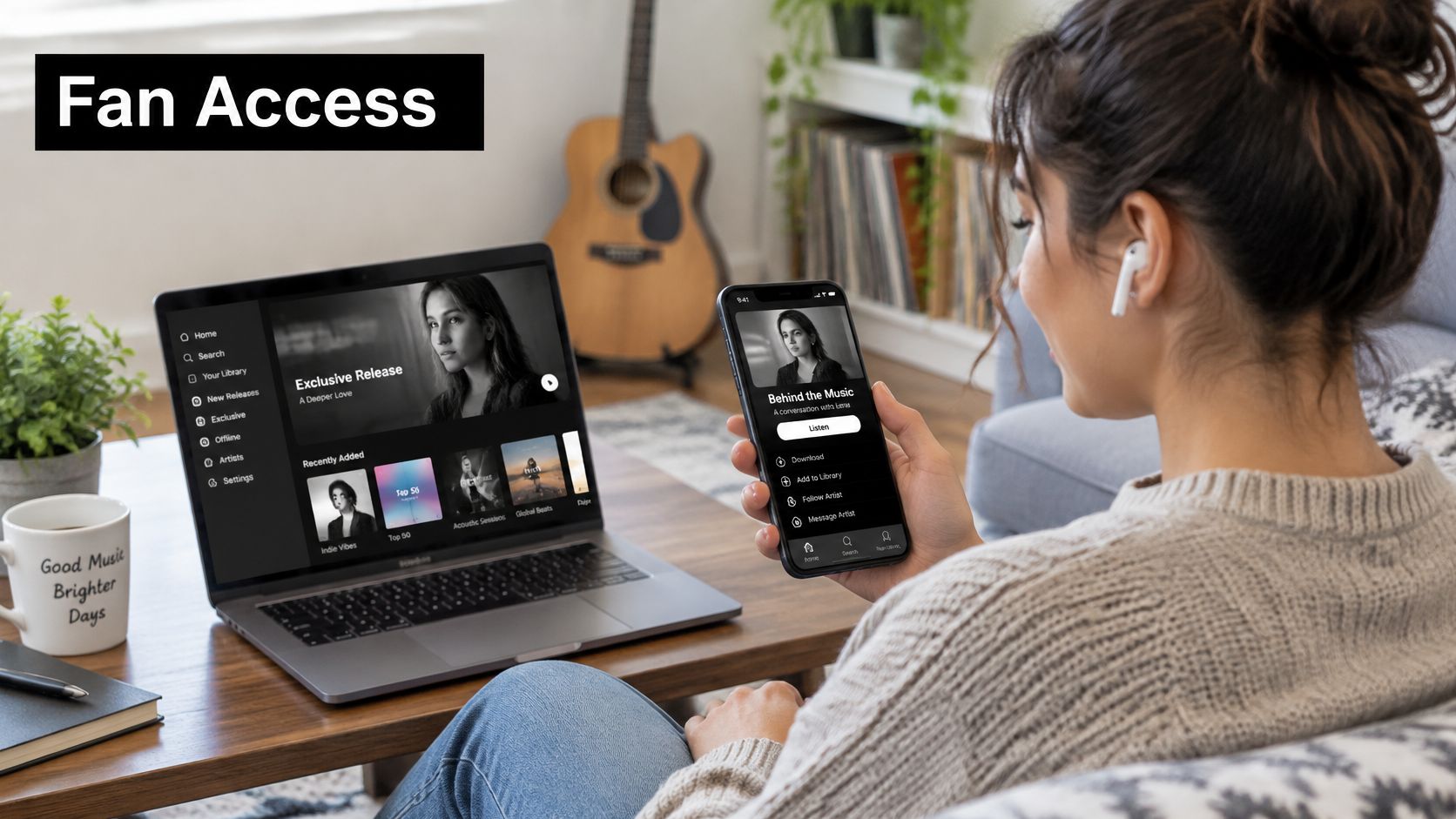
Fans gain a broad catalog, offline listening, exclusive releases and, on artist-led services, direct contact with the people they support. You can see how that fan experience is framed on our page for fans, including following artists and messaging them directly after joining for free.
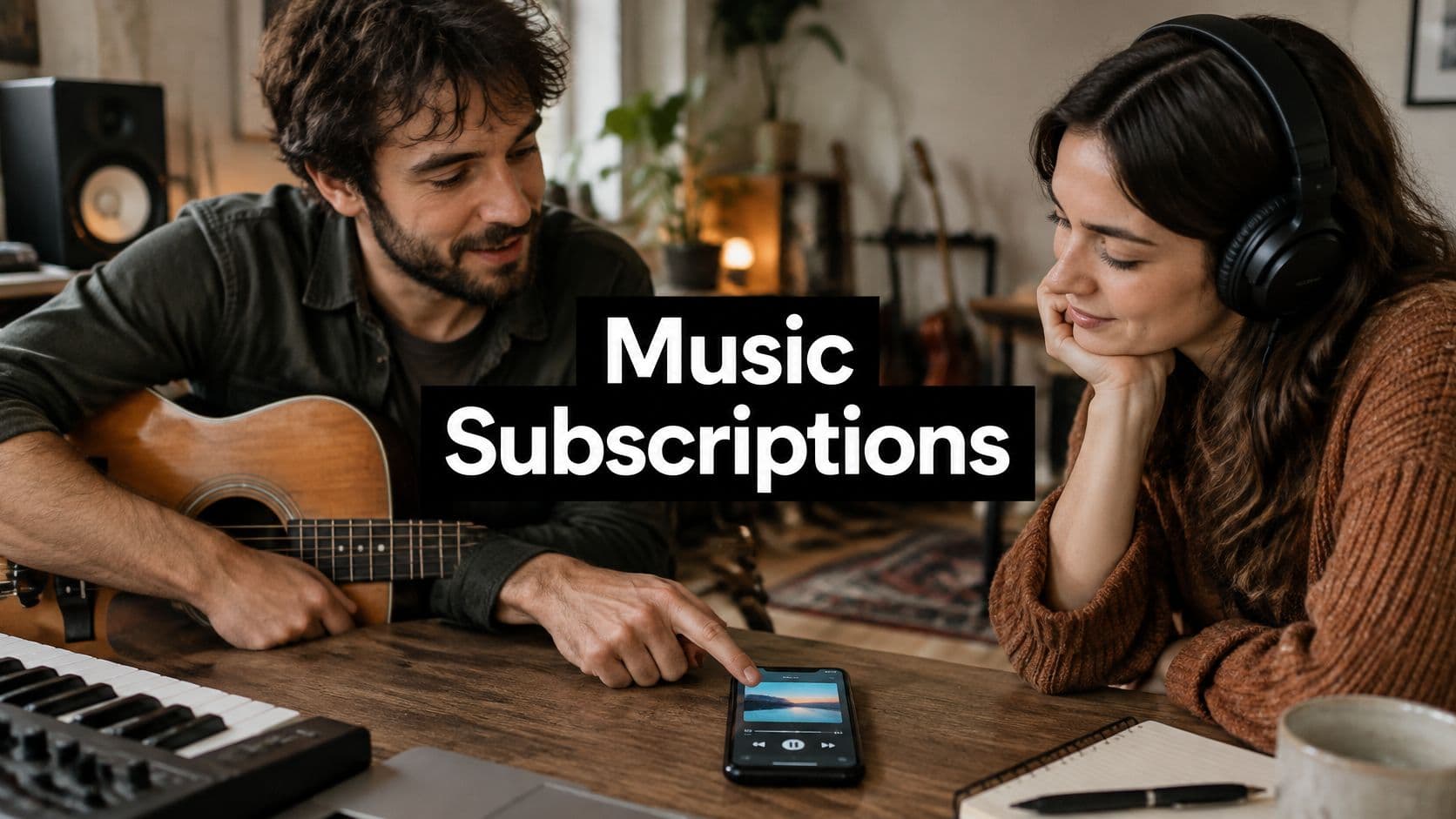
The photo below shows the everyday version of that access, listening across phone and laptop at home.
Convenience, however, doesn't prove that a global service serves local music well. The MIDiA Research subscriber market shares analysis states that paid subscriptions reached 865 million worldwide in 2025, and Latin America, Asia-Pacific and the rest of the world generated more than 70% of global subscriber additions for the fifth consecutive year. Consumption remains strongly local, with 79.2% of India's on-demand streams coming from Indian artists, compared with 75.2% in Brazil, 69.9% in Turkey and 62.2% in Nigeria.
A Local Market Checklist
- Language coverage: Does the service cover local-language catalog and interface needs?
- Editorial discovery: Are there local playlists made by people who know the scene?
- Payment access: Can fans pay with local cards and wallets?
- Regional pricing: Does the price make sense against local incomes?
- Offline access: Does it work reliably on common devices and connections?
- Artist economics: Do payout rules make sense for artists in lower-revenue markets?
A catalog can be global while discovery remains narrow. If recommendations push the same international releases to every market, local artists become searchable in theory and invisible in practice. Direct tiers, regional communities and merchandise bundles give those artists another route to supporters who already want local music.
The short video below adds listening context before you apply the checklist to a specific service.
Use the checklist as a test for any service you subscribe to or recommend. It shifts the decision from catalog size alone to whether fans can find, pay for and sustain the artists around them.
Where OohYeah Fits in the Subscription Ecosystem
We sit in the marketplace tier row, with a direct purchase path for fans. We don't replace streaming. A fan can keep a platform subscription for everyday catalog listening and still buy directly from an artist when they want ownership, exclusives or a closer relationship.
The screenshot below shows the marketplace setting where those direct offers sit.
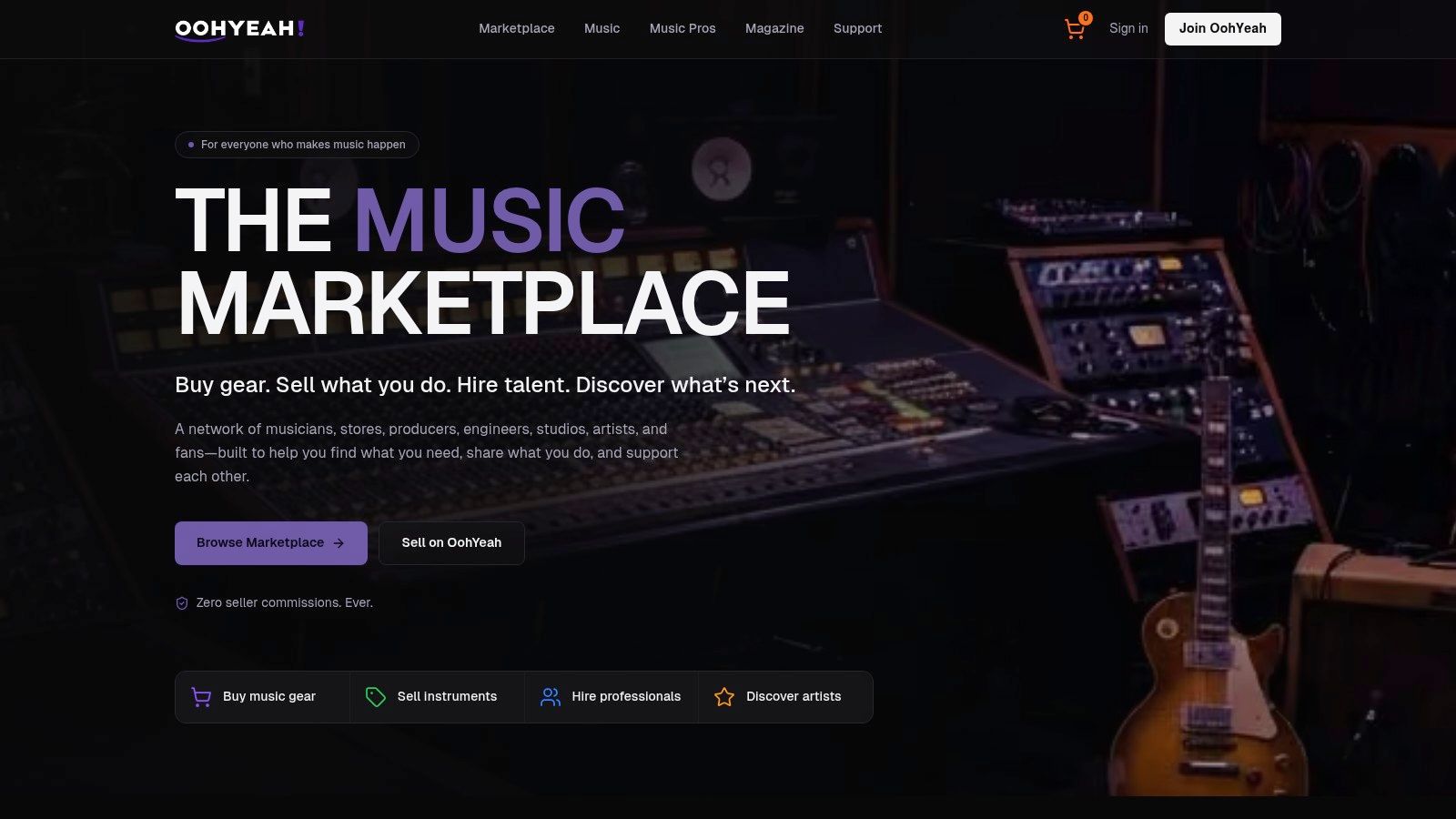
Sellers can offer music downloads, merchandise, digital products, subscriptions, exclusives, instruments, pro audio gear, and other music-related products. That range matters because a subscription tier doesn't have to carry the whole business. An artist can pair a modest monthly tier with downloads and merch, so committed fans get recurring benefits and occasional buyers still have a simple purchase option.
How the Economics Differ
We take no commission from marketplace sales and charge sellers a subscription instead. More of each sale therefore reaches the creator, minus payment processing. Fans join for free, can follow artists and can message them directly, which keeps the relationship visible rather than hiding it behind stream counts alone.
That structure changes the artist's break-even question. Instead of asking what percentage disappears from every sale, the artist asks whether expected direct sales and tier income justify the seller subscription. For an act with regular releases or merch drops, that can be a clearer calculation. For an act with rare sales, it may not be.
You can review the marketplace itself at the music marketplace homepage before deciding where it belongs in your income mix.
Setting Up a Tier
- Decide the benefit: Choose something repeatable, such as early releases, downloads or community access.
- Set price and billing period: Price the production time, not only the file or post being delivered.
- Check the terms: Review the terms before publishing, then confirm what subscribers receive in the first cycle.
A tier should promise less than you can deliver on a bad month, not everything you can deliver on your best one.
The honest limit is fit. We work best alongside streaming, as the direct layer for sales, subscriptions and fan contact. Artists should compare the seller subscription against their current income mix, including what streaming and direct sales already pay, before moving any sales across. If the audience isn't yet buying directly, build that habit with one clear product before adding recurring tiers.
Choose the Subscription Model That Fits Your Goal
The right model is the one whose renewal economics survive a slow month. Catalog breadth matters for daily listening; a local or independent act needs evidence that money reaches a named artist and keeps arriving after the first cycle.
| Your situation | Best-fit model | What to check first |
|---|---|---|
| Fan who wants the full catalog for daily listening | Platform streaming | Price per billing period, offline access and catalog breadth |
| Fan who wants to back one artist | Artist-led membership or tier | Tier benefits, cancellation terms and refund limits |
| Independent artist selling music and merchandise | Marketplace subscription tiers | Price of each tier, renewal rate and churn |
| Manager, label or promoter comparing services | Analytics across models | Conversion, renewal, churn, ARPU and engagement by benefit |
Start with your row, then test the economics across more than one billing period. Track conversion, renewal, churn, average revenue per paying user and engagement by benefit separately; together they show whether value is being created, while a single paid-account snapshot cannot because paid accounts and revenue move on different timelines.
Metrics That Show Health
- Conversion: How many free or trial users become paying subscribers?
- Renewal and churn: How many stay after the first cycle, and when do leavers leave?
- Average revenue per paying user: Is each paying account worth more or less over time?
- Engagement by benefit: Which exclusive, download or community perk do subscribers use?
Read those metrics by cohort, meaning groups who joined in the same period, instead of relying on one snapshot. A launch cohort recruited by longtime fans will behave differently from a discount cohort, and blending them hides the reason people renew. A benefit with no use does not justify its place in the price, however attractive it looked in the sales copy.
Pricing structure deserves the same discipline. If you are setting tiers, use guidance to find the right membership pricing structure and test bundles or localized prices carefully. Subscriber count is a weaker health signal than paid revenue per account, because acquisition can rise while each paying account yields less and uses fewer benefits.
Checks for Fans and Independent Artists
For a fan, the first checks are price by billing period, what each tier includes, and how cancellation works. On OohYeah, Subscription Terms apply before a recurring plan starts, subscription plan prices vary by profile type and billing period and are shown before you subscribe, and cancellation or return requests start through the order. Digital access, services and subscriptions can carry different cancellation or refund limits.
For an independent artist, add one production check. Write down the benefit you will deliver in month three, not only the launch offer. If month three depends on unfinished songs or unpaid collaborators, lower the promise or delay the launch. A direct tier is strongest when nearby listeners already buy, attend or message; it is weakest when it asks for commitment before that relationship has a paid path.
A Three-Step Routine
- Check the terms: Read cancellation and refund rules for the option that matches your situation.
- Compare two options: Score monthly cost, benefits you will use or deliver, and how easily you can leave.
- Start cancellable: Choose the cheaper option you can cancel, then review renewal before the next billing date.
That routine keeps the decision reversible while you gather real behaviour. After one or two cycles, you will know whether the catalog, tier benefits or direct relationship are worth the recurring charge. Judge music subscription services by retention and revenue per paying account, not by launch applause.
If you want a direct layer beside streaming, visit OohYeah to sell downloads, merchandise and subscription tiers with no marketplace commission; fans join free and can message artists directly. Set one clear tier, check the terms before publishing, and use the first renewal cycle to prove the offer before expanding it.