Direct Message for Inquiries: How Artists Reply Well
Learn how artists handle direct message for inquiries with response-time targets, reply templates for fans and bookings, and safe verification steps.

November 7, 2026
Music Marketplace Advisor
Buying & SellingYou've just announced a release. A fan wants help downloading it, a promoter wants your availability, and someone claiming to represent a label wants unreleased tracks. They're all in the same inbox, but they shouldn't get the same response.
Putting direct message for inquiries on your profile creates a service promise. Make that promise specific: who answers, when they answer, and what happens when a request needs verification or support. That's how you keep an artist inbox useful without spending the whole day inside it.
Response Times to Promise for Each Inquiry Type
| Inquiry type | Acknowledge | Substantive reply | Who answers |
|---|---|---|---|
| Fan question about a release or download | Automated within 5 minutes | Within 1 hour during stated hours | Artist or team member |
| Merch or purchase question | Automated within 5 minutes | Within 1 hour during stated hours, pointing to the order thread first | Seller, then OohYeah Support if unresolved |
| Booking or event request | Automated within 5 minutes | Within 1 hour during stated hours, then a written next step | Artist or manager |
| Collaboration or licensing proposal | Automated within 5 minutes | Within 24 hours, with a stated follow-up date | Artist or manager |
| Safety or privacy concern | Immediate | Same day, with escalation to Support | Artist and OohYeah Support |
These are proposed working targets, not platform guarantees or research benchmarks. An acknowledgement and a substantive reply are different promises. The first confirms receipt; the second gives a human answer or a useful, specific next step.
Your acknowledgement should name the owner, explain what they'll check, and state when the sender should hear back. It mustn't suggest that a download problem is fixed because an automated message was delivered.
Set hours you can actually cover
A single artist might receive a vinyl pre-order question, a festival invitation, and a licensing proposal while preparing for soundcheck. The fan may need a straightforward answer. The licensing proposal may require rights checks before you can say anything meaningful.
Consumer expectations justify clear windows, not permanent availability. Emplifi's consumer engagement findings report that 32% of U.S. consumers expect a response within one hour, while its 2025 survey of 1,005 UK consumers found that roughly half expect a reply within five hours and about 40% within three hours.
Publish your time zone, working days, and inbox hours. Explain how event-day problems are routed when you're performing, rather than implying you can answer during a set. If you can't staff urgent monitoring, don't advertise it.
Practical rule: Promise the response window you can keep on a release day, not the one you can manage on a quiet afternoon.
Automation should handle repeatable administration, not make artistic or commercial commitments. If paid promotion will drive more inquiries, Exerta's guide to Facebook advertising automation is useful context for planning the advertising workload separately from inbox coverage.
Test your policy for two weeks. If average replies miss the target, narrow the hours you promise, allow a longer response window, or add a trusted helper. Don't keep an impressive promise that your inbox records disprove.
How to Triage and Answer an Inquiry Step by Step
A fast acknowledgement doesn't excuse an unanswered question. In a survey of more than 1,000 social-media users reported by MarketingCharts, 52% expected a response within one hour. Build a workflow that gets the message to someone who can act, rather than merely triggering a notification.
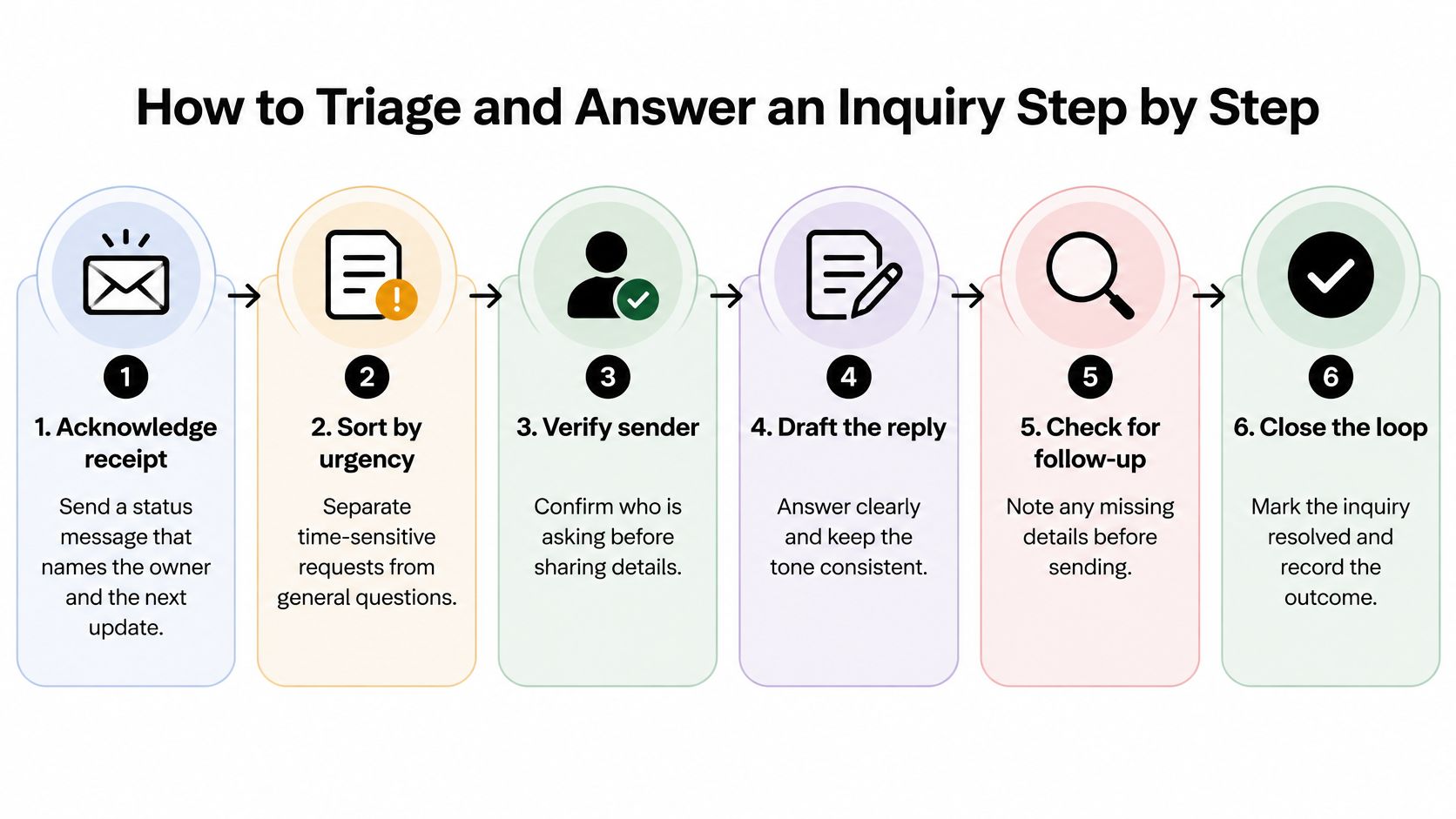
Acknowledge receipt. Name the owner and next action using your published timing policy. Confirming receipt comes first because silence leaves the sender unsure whether anyone is responsible.
Classify the inquiry. Tag it as purchase, technical support, booking, collaboration, or safety/privacy, then mark its urgency. Don't let an interesting collaboration push an unresolved purchase question out of sight.
Answer from verified information. Check the listing, release details, or approved booking terms before replying. Generic copy that ignores the actual question creates another exchange instead of resolving the first.
Ask only what's missing. A booking request might need the city and date before you can check availability. Don't send a full intake form when a short question will establish whether the request is workable.
Move sensitive details safely. Keep payment details, full addresses, and account information out of ordinary chat. Establish the appropriate order or support route before requesting anything private.
Record the outcome and deadline. Note what you answered, who owns the next action, and when it's due. A promised follow-up without an assigned owner is an easy commitment to lose.
Turn the workflow into a useful answer
Say a fan asks whether a signed CD ships to their country. Check the listing's available shipping methods, explain what it currently offers, and ask only for the destination country, not their street address. In this hypothetical case, log a 48-hour check to confirm that the shipping question reached a conclusion.
For marketplace questions, use our seller guide when preparing answers instead of inventing fulfillment terms. If you're considering automated intake on another channel, SupportGPT's guide to AI chatbots for Instagram engagement offers a starting point for evaluating that setup. Keep exceptions and commitments with a human owner.
A paste-and-edit acknowledgement can be simple:
Thanks for your message about [topic]. [Name/role] is checking [specific detail] and will update you by [time and time zone]. This confirms receipt; your request is still open.
Every message needs a named owner, including messages waiting on someone else.
Reply Patterns for Fans, Buyers, Promoters and Collaborators
Saved replies work best when they supply accurate information without pretending every sender has the same needs. Customize the greeting and first sentence, then use the relevant pattern below. The question should help you decide the next action, not collect information you might someday use.
Match the opening to the sender
Fans. Start with something specific: Thanks for listening to the new track. I can help you find the download. Ask which release they mean if it isn't clear. Avoid turning a practical question into an unsolicited sales pitch.
Merch buyers. Open with Thanks for flagging the order issue. Please contact the seller through your order so the details stay together. Ask whether they've already done that. Buyers should contact the seller first when practical; when requesting our help, include the order number. Our buyer guide is a useful reference for that process.
Promoters. Try Thanks for considering the band. Let's check whether the event fits before discussing terms. Ask for the date, city, and fee range, then confirm availability. Don't imply a date is held just because you're discussing it.
Managers and labels. Use Thanks for reaching out. Please send the project brief to our management contact. Ask what role they're proposing for the artist. Avoid sharing unreleased material just because the account name looks familiar.
Producers and potential collaborators. Begin with Thanks for the idea. Please share a sample and the proposed scope. Ask for a sample, deadline, and budget before offering studio time. Don't commit to sessions before understanding the work and rights involved.
Service bookings. Start with Thanks for the booking inquiry. Let's confirm the service and appointment details before you commit. Ask which listed service they need. Explain early that personalized work, lessons, repair services, bookings, and subscriptions are generally non-returnable after performance or an appointment begins.
Choose text, voice, or a business channel
Use a saved reply for repeated, low-stakes fan questions. Send a voice note only when tone matters and the fan has already engaged in voice. Keep instructions in text when someone needs to retrieve them later.
Move the inquiry into a documented business channel once money, contracts, or licensing terms appear. A slightly slower, specific answer to a promoter is better than an instant template that gets the event name wrong.
Verify Senders and Protect Private Information
No file, link, or personal detail leaves the inbox until the sender and request are verified. A familiar profile photo isn't enough. Verify what the person wants as well as who they claim to be.
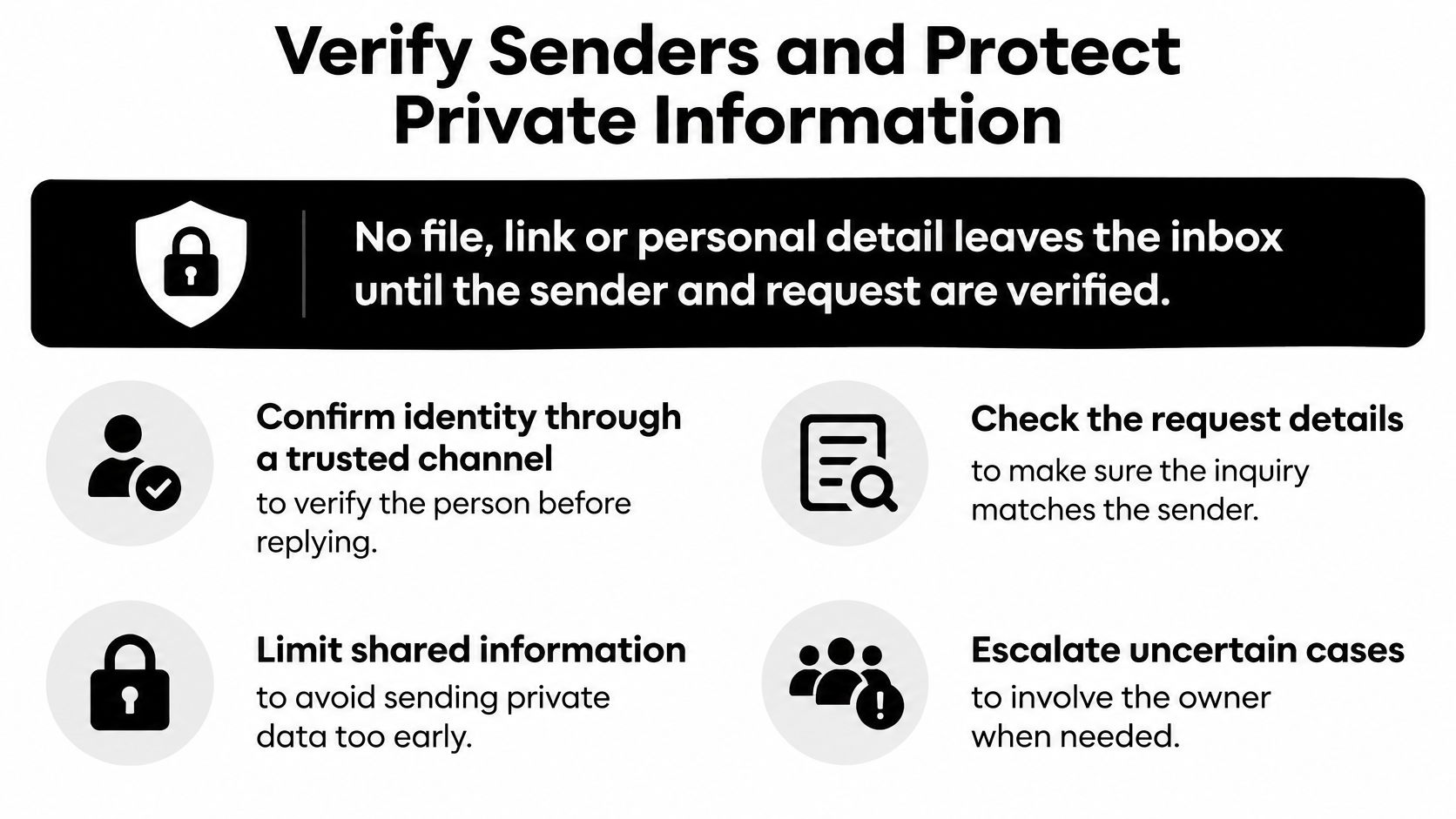
Confirm identity through a trusted channel. Use a known email address or independently located official profile. Don't verify someone through contact details supplied only in the suspicious message.
Check the request details. Compare names, email domains, project descriptions, and the information requested. Pressure to sign immediately or move straight to another app is a reason to pause, not accelerate.
Limit shared information. Don't send payment links, unreleased masters, contracts, or home addresses in chat. Once verified, use the appropriate secure transaction or documented business route.
Escalate uncertain cases. Involve the artist, manager, or Support before making an irreversible decision. A helper can flag a licensing request without having permission to release files.
Keep human judgement at the boundary
In Emplifi's 2025 social-media consumer findings, 67% of surveyed consumers preferred human responses to AI. That's a useful reason to keep automation focused on sorting and status messages, while a person handles identity checks, disputes, and unusual requests.
Private messaging also isn't permission to share everything. Ciphar's explanation of how private messages work provides useful background when setting communication boundaries with your team. Restrict inbox access to people who need it, and don't copy personal information into a shared rehearsal chat.
Escalate with evidence, not assumptions
For marketplace money issues or disputes, submit the order number and evidence through Support. We can facilitate communication, review platform records, and enforce marketplace rules, but we don't guarantee a refund. Use our Trust & Safety guidance to orient your escalation process.
Add someone to marketing only after they opt in. Depending on location, users may request access, correction, deletion, restriction, objection, or a copy of their personal information through Support. Keep inquiry records organized enough to locate them without collecting unnecessary details.
For a suspicious approach, stay professional: I can review the proposal once your identity is confirmed through your official business contact. I won't share files or account details through this chat.
Measure Inquiry Performance as a Funnel
A high reply count can hide wrong answers, unresolved purchases, and conversations that never reach a next step. Count outcomes separately from activity. Otherwise, an automated acknowledgement can make an unattended inbox look healthy.
| Funnel metric | What it reveals | Review rhythm |
|---|---|---|
| Median first response time | Typical wait a fan or buyer experiences | Weekly |
| 90th-percentile response time | Long waits that may lead senders to abandon the conversation | Weekly |
| Response coverage | Share of inquiries that received any reply | Weekly |
| Resolution rate | Share of requests closed without escalation | Monthly |
| Escalation rate | Share passed to Support or a manager | Monthly |
| Action completion rate | Share that became a download, subscription, purchase, booking or attendance | Monthly |
Treat this review rhythm as a proposed operating schedule. Track acknowledgement time separately from substantive human response time so automation doesn't conceal the wait for help.
Follow the conversation through to an outcome
Use these stages in your tracker: inquiry received → first response → qualified conversation → resolved request → completed action. A qualified conversation has enough information to act. A resolved request has an answer or agreed outcome; it doesn't automatically count as a purchase.
Start with a proposed 30-day baseline. Tag messages by intent and urgency, publish availability windows, and prepare approved answers for recurring questions. Audit a random sample weekly for correctness, tone, privacy, and next-step clarity.
A shared spreadsheet can work initially. Record an inquiry identifier, category, owner, receipt time, human reply time, outcome, and follow-up date. Keep sensitive evidence in its appropriate support channel rather than duplicating it across the tracker.
Don't optimize the greeting while buyers are still waiting for an answer about their orders.
Test changes without changing everything
Test greeting style, question count, or calls to action separately. Compare similar inquiry types, not fan compliments against licensing negotiations. Check whether the change improves resolution or action completion, rather than merely producing more replies.
An observational, vendor-run benchmark cited in the Sprout Social Index reported 35.1% conversion for conversations answered within 60 seconds versus 7.1% after one to 24 hours. Treat that as a hypothesis to test in your inbox, not proof that speed caused the difference or a result you can promise.
Publish Your Inquiry Policy Before Your Next Release
Finish the inbox setup before you invite another wave of messages. Release week isn't the moment to decide who can answer refund questions or approve a collaboration. Write those boundaries while you can still review them carefully.
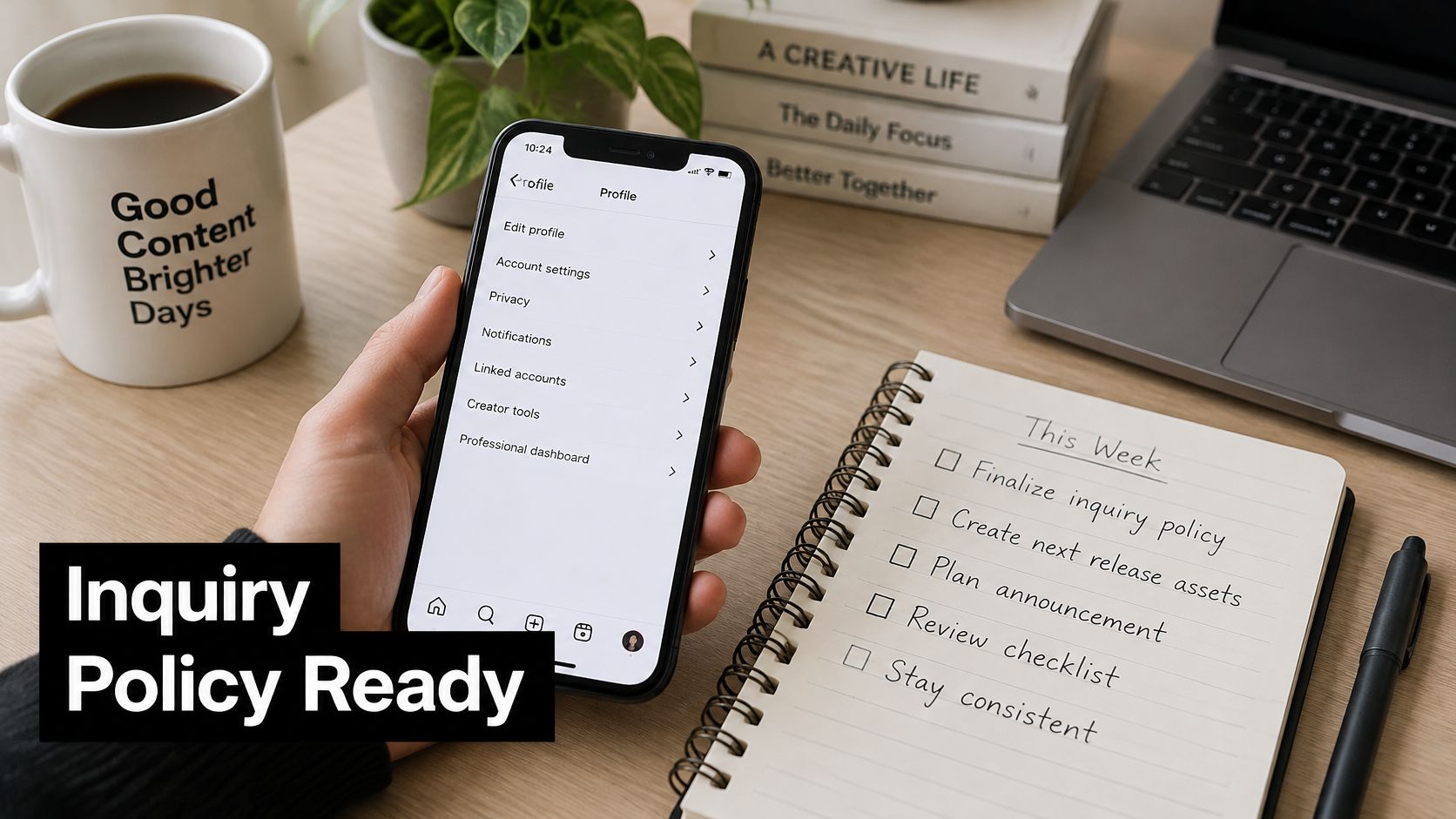
Complete a practical setup this week
Publish availability. Put inbox hours and your time zone on your profile. Include a clear note for messages received while you're touring or performing.
Write five saved replies. Prepare fan, purchase, booking, collaboration, and safety responses. Give each an editable opening, a useful answer, and a next action.
Configure the acknowledgement. Name the responsible person and expected timing. Don't assume your messaging tool supports automation; if it doesn't, use the wording manually during inbox checks.
Assign access and escalation. Decide who can read messages, answer routine questions, and approve commitments. Send marketplace disputes through Support with the order number and evidence. Customers can also contact OohYeah or PayPal directly for platform or transaction help.
Schedule measurement. Begin the baseline and book the full sample audit for day 30, alongside weekly spot checks. Compare what you promised with what senders received.
OohYeah brings direct messaging, voice notes, and community posts into the artist-fan relationship, with Support available for marketplace help. Give each channel a job: private questions in messages, appropriate personal replies in voice, and shared release updates in community posts. Intercom support messaging is used only where enabled and after the visitor consents.
A reply that arrives on time and says what happens next beats a fast reply that says nothing.
Your policy doesn't need legalistic wording or a complicated help desk. It needs an honest promise and someone responsible for keeping it. Today, write the five saved replies before opening the inbox again, then check that each one tells the sender what happens next.
OohYeah offers artists a place to share music, sell merchandise and subscriptions, and communicate directly with fans. Visit OohYeah to build that direct connection, then pair your next release with clear inquiry hours, useful replies, and a safe route for marketplace questions.