Band Merchandise Metal: Make, Sell and Buy Fan Gear
Compare ways to create, sell and buy band merchandise metal, from screen printing to direct-to-fan sales with artist-set prices.
November 24, 2026
Music Marketplace Advisor
Buying & SellingThe shirts land two days before the tour, and half the box is XXL. You sell out of mediums by the third night, then haul the rest home in the van.
That's not a design problem, it's an inventory decision made weeks earlier by whoever chose the run size. Band merchandise in metal works the same way at every scale: the route you pick decides who sets the retail price, who eats the unsold stock, and what paperwork a fan or a customs officer can expect to find. Get that structure right and the artwork finally has something solid to sit on.
Options for Making and Selling Metal Band Merch
Five routes cover most independent releases, and they differ less in print quality than in who carries the risk. The choice is a pricing and inventory decision before it is a design task. Each route changes who sets the retail price, who holds unsold stock, and what fans can expect from the listing.
Print-on-demand means the provider prints each order as it arrives. You start at a single unit, hold nothing, and pay a higher unit cost for that freedom. It suits new logos, test drops, and fans in countries you will never play. Margin is thinner, but failure is contained: no size curve sits in the van after the tour.
A bulk screen-print run with a local printer cuts unit cost and gives you control over the retail price, but the leftovers are yours. Shops usually require a minimum run before setup makes sense, and that minimum is where tour inventory risk starts. Proven sellers are the right candidates here. A speculative design can turn cheap unit economics into dead stock fast.
A small preorder batch flips the sequence: orders close first, production starts after. You size the run to real demand instead of a guess. The constraint is timing, because fans expect clear delivery terms and patient updates. Coverage of the 2025 festival season from Woodshed Stage Art reported an 8% year-over-year increase in festival merchandise sales and recommends demand forecasting and presales specifically to cut overproduction.
Direct-to-fan marketplace sales put the retail price in your hands with no intermediary markup, and the inventory risk underneath is whatever production method you chose. OohYeah is a music marketplace where fans can buy music, merchandise and other products directly from artists. Sellers can offer music downloads, merchandise, digital products, subscriptions, exclusives, instruments, pro audio gear, and other music-related products. That makes it useful when a band wants one listing structure for shirts, records, digital releases, and gear, while keeping the pricing decision close to the artist.
Licensed merch through a label trades some of that control for reach: the licensor approves designs, influences pricing, and shares distribution. That route can suit bands with label backing and larger runs, but the agreement decides the working rules. Read who controls price, who approves artwork, and who absorbs returns before committing.
Metal band merch routes compared
| Route | Who sets the price | Inventory risk | Typical minimum run | Best fit |
|---|---|---|---|---|
| Print-on-demand | Artist | None, printed per order | 1 unit | Testing designs and reaching fans abroad |
| Bulk screen-print run | Artist | High, unsold stock stays with the band | A shop-set minimum per design | Tour merch with proven sellers |
| Small preorder batch | Artist | Low, produced after orders close | Set by the artist | New designs and limited drops |
| Direct-to-fan marketplace | Artist, no intermediary markup | Set by the production method behind it | 1 unit when paired with print-on-demand | Selling direct to a band's own audience |
| Licensed label merch | Shared with the licensor | Fixed in the licensing agreement | Fixed in the licensing agreement | Bands with label backing and large runs |
Choosing between them
Read the table as a cash-flow question. A bulk run ties up money in a size curve you cannot change, while print-on-demand ties up nothing and gives away margin on every sale. Preorders protect cash but ask fans to wait. Marketplace sales give control over listing terms, while licensed merch trades that control for distribution and approval support. For a practical view of catalog and product setup before choosing a channel, see the F3 Gear results.
Practical rule: test a new design through print-on-demand or a preorder, and move to a bulk run only after that design has sold out twice.
How to Print Shirts That Survive Fan Washing
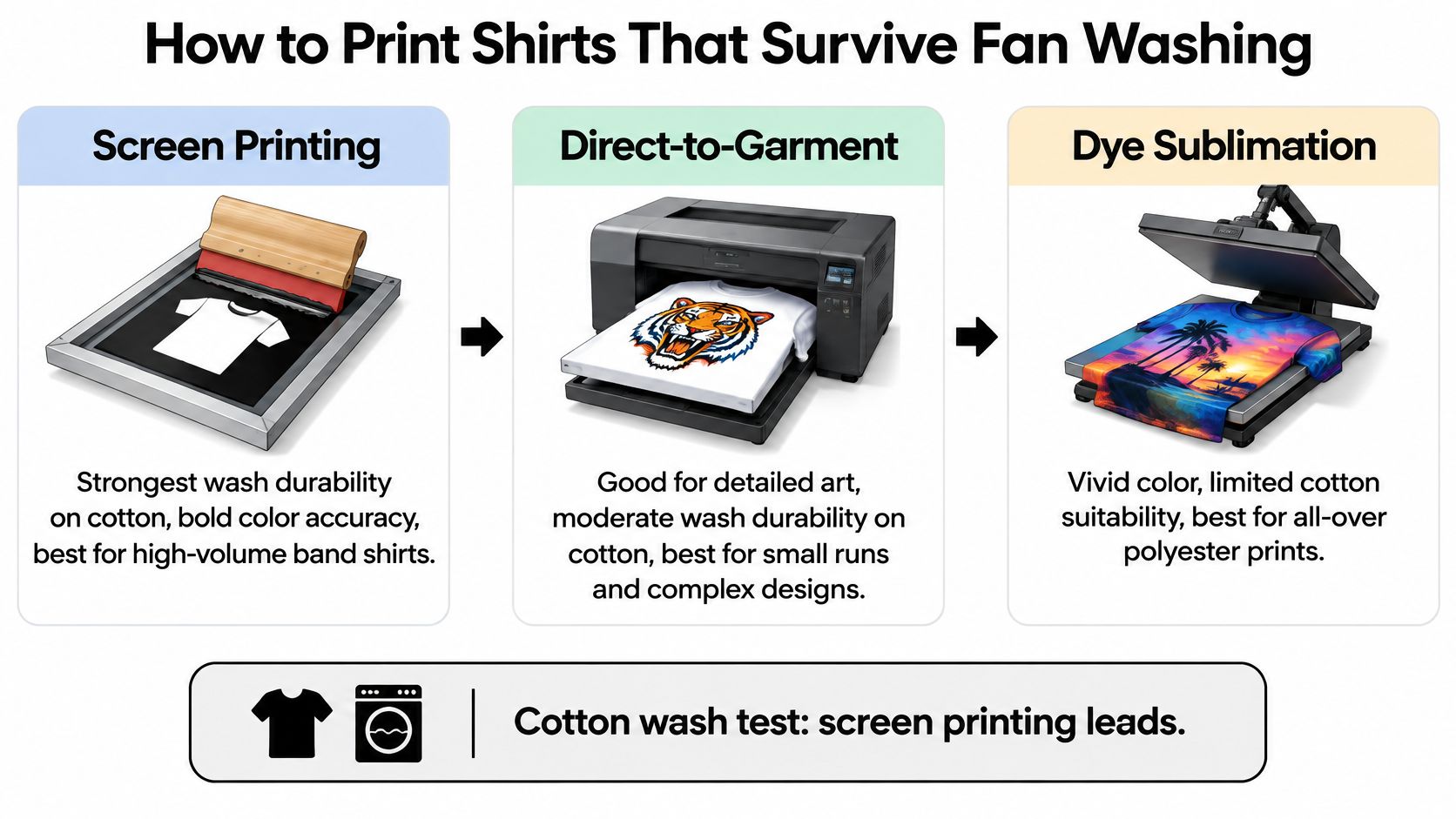
Print method decides whether your shirt is still wearable after a summer of shows. The comparison below is the short version for cotton blanks.
Print methods for metal shirts on cotton
| Print method | Wash durability on cotton | Color accuracy on cotton | Best use |
|---|---|---|---|
| Screen printing | Strongest of the three after repeated washing | Best combination with durability | Bulk runs with bold, high-contrast artwork |
| Direct-to-garment | Stable after repeated treatment | Good | Short runs with detailed artwork |
| Dye sublimation | Less stable than screen printing or direct-to-garment | Weak on cotton, vivid on polyester | Polyester garments rather than cotton shirts |
A comparative textile-printing study summarized in the Specialty Graphic Imaging Association's washfastness guide found screen printing and direct-to-garment more stable than dye sublimation after repeated treatment, with screen printing delivering the best combination of color accuracy and durability on cotton. For metal artwork, that matters more than it does for a pastel logo: dense black fills and sharp white line work show every crack.
The three methods side by side:
The production routine that prevents complaints
- Pick the blank for the artwork. Heavyweight cotton carries a large plastisol back print without the panel puckering. Lightweight blanks feel great and distort under a heavy ink film.
- Specify cotton-compatible inks in writing. Tell the shop the fiber content, not just the color count, so they choose the right ink system rather than whatever is on press.
- Require controlled curing. The SGIA guide is blunt about this: wash durability hinges on whether the ink film gets enough heat to fuse, and under-cured ink abrades rapidly. Ask for the cure temperature and how it is verified.
- Launder a production sample, not a proof. Wash a shirt from the actual production run before approving the job. The proof can look perfect while the run cures differently, prints heavier, or lands on a blank with a different surface.
- Approve the run only after the test passes. Make the wash result a gate, with a date and a name attached. A verbal "looks good" is not an approval record.
- Re-read the artwork after washing. Check that fine line work and reversed-out text still read clearly, because high-contrast metal designs lose legibility before they lose color.
Here's the process on video:
The failure patterns this gate catches are predictable: cracking across a thick fill, fading where the ink never fully fused, and peeling at the edges of a transfer. Each one shows up after the fan has worn the shirt, which means each one becomes a refund request and a public comment rather than a quiet fix at the printer.
Judge a limited tour drop by how it looks after the wash test, never by how it looks coming off the press.
Keeping Pricing Control on Direct-to-Fan Sales
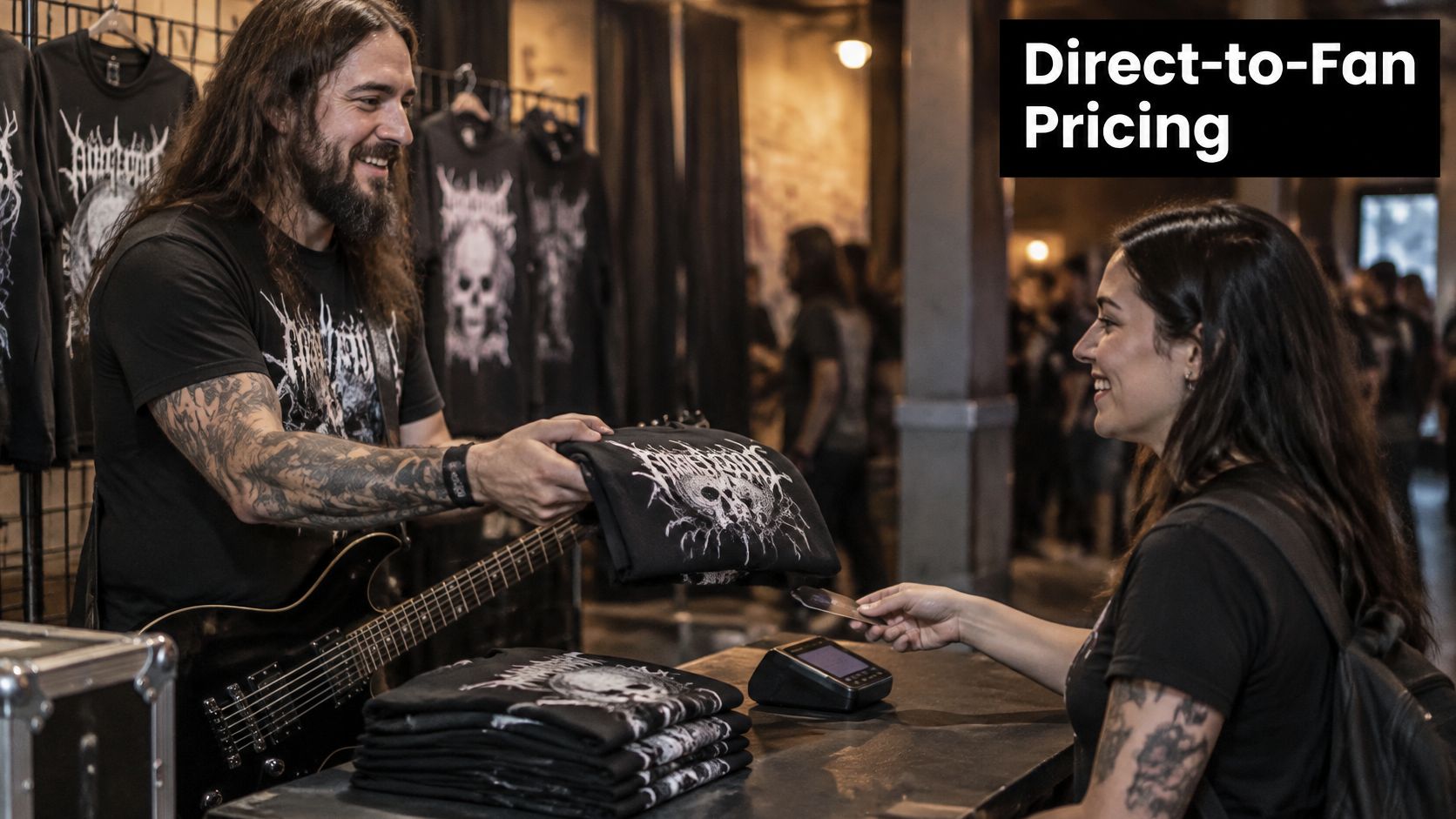
When a fan buys straight from the artist, you set the price and the money lands where you intended it. Direct purchases fund recordings, musicians, touring and merchandise, which is a different outcome from a wholesale order where someone else's margin comes out first.
Repeat buying is what makes that channel worth building. A Custom Ink study covered by Loudwire in 2024, built on Google search-volume data for artist T-shirts from January 2023 through December 2024, estimated that metal fans spend an average of $500 on band T-shirts over their lifetime and own an average of 10 band shirts each, the highest of the genres examined. Treat those as interest indicators rather than a sales census, but the implication is clear: you're pricing for a customer who buys again.
Building the price from cost up
Start with what leaves your account, not with what a comparable band charges. The figures below are an illustrative example in US dollars for one shirt, not a market rate.
| Cost line | Notes |
|---|---|
| Blank garment | $4.00, heavyweight cotton blank |
| Screen print | $3.00 per shirt at a small-run rate |
| Tag and mailer | $0.75, packaging for one order |
| Shipping share | $1.50, per-shirt share of order shipping |
| Total cost | $9.25, sum of the lines above |
| Retail price | $25.00, set by the artist |
| Remaining margin | $15.75, before the payment processing fee your provider charges |
Payment processing sits on its own line because it's a percentage plus a fixed charge set by the provider, not by you. Subtract it from the margin before you call anything profit. Then subtract the things bands forget: a replacement for a damaged mailer, the sample you washed, and the two shirts you gave to the opening band.
Tiers, floors and reprints
Run three price points rather than one. A standard tier for restocks keeps a permanent catalog item at a price fans recognize. A limited tier for numbered editions carries a higher price because the edition is closed, not because you printed fewer this week. And a hard floor: never discount below total cost to clear a size curve, because you're paying fans to take stock you over-ordered.
Recalculate the whole build-up after every reprint. Blank prices and per-shirt print rates move with volume and with the supplier's stock, so a margin that worked on the first run can disappear on the third.
A price you haven't rebuilt since the last reprint isn't a price, it's a guess you're still honoring.
Accessories and Bundles That Raise Order Value
The shirt is the anchor, not the whole store. In 2025, T-shirts made up 56% of concert-merchandise units sold at an average price of $37, and fans bought an average of 2.1 items per transaction, up from 1.7 in 2024, with accessories identified as an add-on category for metal fans, according to Atvenu's year in review.
That second number is the opportunity. A fan who can't justify a $37 apparel purchase can still buy something, and a fan who already bought the shirt will often add a small item at the same time. Judge every candidate on four things: price point, packing weight, collectability, and how much unsold stock it leaves in your van.
Accessory options compared for tour merch
| Item | Price point | Packing weight | Collectability | Tour-inventory risk |
|---|---|---|---|---|
| Patches | Low | Light | Moderate | Low |
| Stickers | Low | Light | Low | Low |
| Pins | Low | Light | Higher | Low |
| Signed inserts | Low | Light | Higher | Low |
| Lyric booklets | Low | Light | Moderate | Low |
| Posters | Low | Bulky, needs a tube | Moderate | Higher |
| Beanies | Mid | Bulky, seasonal sizing | Low | Higher |
| Digital bonuses | Low | None | Moderate | Low |
Patches and stickers are the easiest yes: they fit in the same mailer as a shirt, they survive a merch table in a rain-soaked field, and leftovers cost you almost nothing to store. Pins and signed inserts carry more collectable weight, which is why they suit numbered drops rather than permanent stock. Beanies and posters are the trap, because both add bulk and one of them is seasonal.
A bundle test worth running
Pair the shirt with one small item at a combined price, then watch the attachment rate: what share of shirt orders include the add-on. Run it for one drop cycle, change nothing else, and compare against shirt-only orders.
If the add-on barely attaches, your audience wants wearable identity and you should put the effort into a second shirt colorway. If it attaches strongly, they want objects and access, and a signed insert or an exclusive digital bonus will do more for order value than another garment.
Labels, Listings and Sustainability Claims
For merch sold to customers in the European Union, the garment label is a compliance specification, not a branding surface. Textile products sold to end consumers must identify the composition of every textile fiber, and labels must also identify non-textile parts of animal origin where applicable, as set out in the European Commission Product Bureau's textile assessment. Mixed-fiber hoodies, leather patches and heavyweight blanks are exactly where bands get this wrong.
The percentages on the physical label, the product data you send the printer, and the marketplace listing have to say the same thing. A listing that claims pure cotton over a cotton-poly blend is a compliance gap, not a copywriting slip. Treat the listing as part of the production record, because it sets the buyer's expectation before the garment ships.
The product record to complete for every design
- Fiber composition: every fiber, with percentages, matching the sewn-in label.
- Origin: country or region of manufacture where required, taken from the supplier's documentation.
- Care instructions: wash temperature, inside-out washing, tumble-dry guidance, written for the actual print method.
- Print method and ink system: so a fan or a returning customer can match a reprint to the original.
- Claim evidence: the certificate, supplier statement or deadstock record behind any environmental wording.
- Provenance: design origin, tour date, edition number, and authenticity evidence for vintage or limited pieces.
That last field does more than help collectors judge a garment's value on documented origin. Clear artwork ownership protects you before a drop goes live, especially when a design uses someone else's illustration or a licensed logo. Read the intellectual property guidance for merch artwork and logos before approving the artwork file for print.
EU textile policy is moving toward durability, repairability, recyclability, hazardous-substance controls and environmental labeling as emerging product requirements. That direction makes accurate metadata part of the product, not admin attached after the sale. It reduces customs and consumer-compliance risk, and it gives fans something concrete to compare beyond the artwork.
Name the material, the supplier and the quantity behind a green claim, or leave the claim out.
Buying Metal Merch Without Getting Burned
A bad shirt is annoying. A shirt with a fake story is worse, because you pay for artwork, provenance and band support that may not exist. Buying direct works in three steps: stream to discover the artist, buy something the artist makes available, and help fund what comes next. Direct purchases fund recordings, musicians, touring and merchandise. That chain only works when the listing tells you what you are getting.
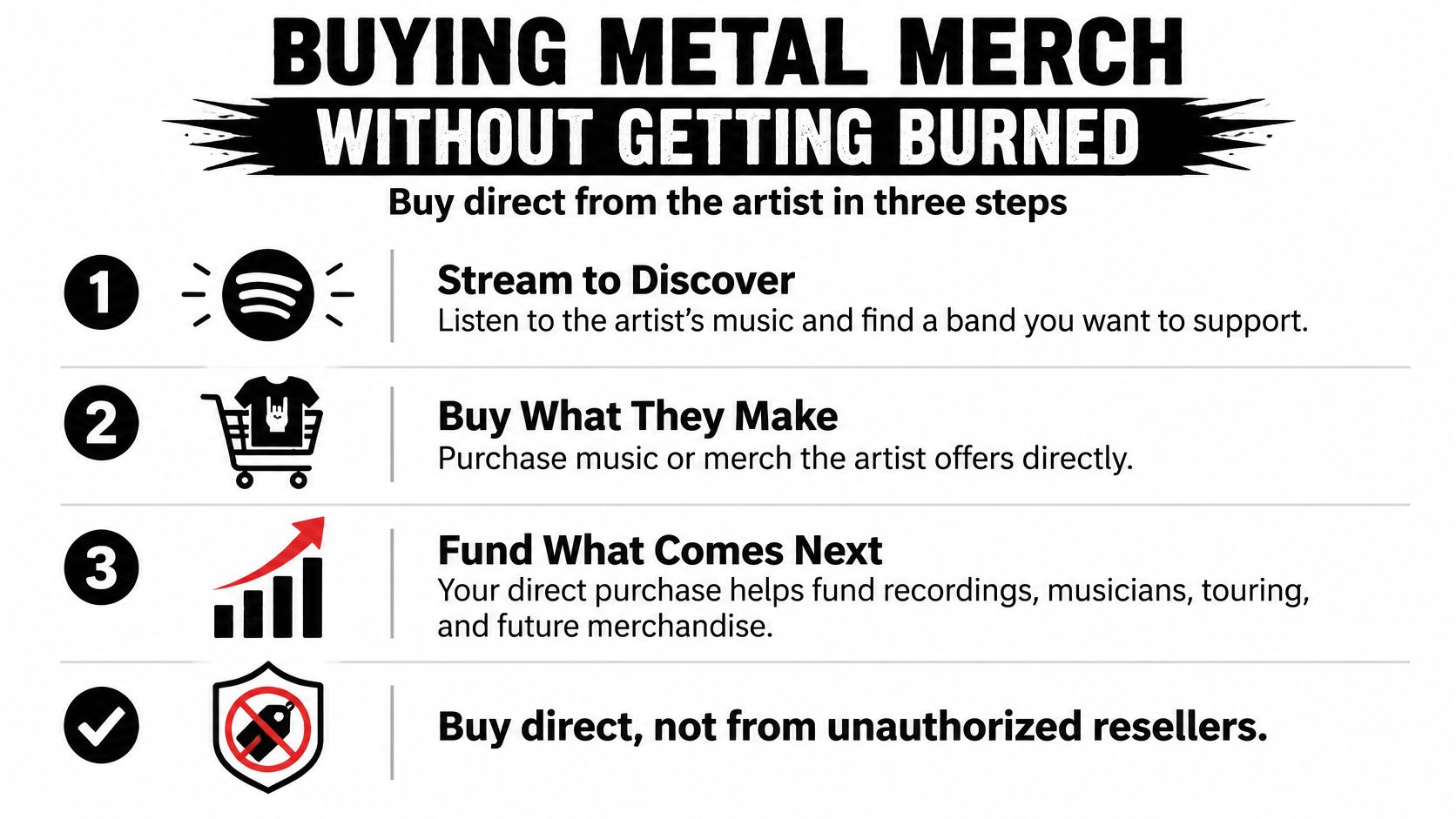
The risk sits in the middle step. Unauthorized reproductions have been circulating for decades, and rare vintage tour shirts now change hands for hundreds or even thousands of dollars in the collector market described by Vintage Metal's history of shirt design. Where there's that much value in a provenance story, there's also an incentive to invent one. The practical question is whether the seller has given you enough detail to separate a real piece from a attractive guess.
What a trustworthy listing shows
- Measurements, not just sizes: a size chart in centimeters and inches, with chest width and body length, so you can compare against a shirt you already own.
- Fiber content: stated plainly, matching the label photos.
- Print method: screen print, direct-to-garment or transfer, since that tells you how the shirt will age.
- Edition details: how many pieces, whether they're numbered, and whether a restock is planned.
- Vintage evidence: tour date, venue or leg, and photographs of the tag and print wear.
Read those fields as a set. A shirt with strong photos but no measurements can still be the wrong fit. A "limited" run with no edition size tells you nothing about scarcity. A vintage listing with no tour details leaves the premium unsupported.
Returns, preorders and cross-border costs
For physical goods, returned items must be in the condition stated in the listing, with included parts and reasonable packaging. Keep the mailer and any insert until you've tried the shirt on, and read the condition wording before you order rather than after. Our buyer protection terms set out how that process runs.
Preorders deserve a separate check, because production has already started by the time your order is placed. Read the return terms and the expected ship window first. That is where the trade-off sits: preorders can fund a specific run, while leaving you dependent on the seller's timing and wording.
Red flags are consistent: no fiber content anywhere in the listing, edition information that amounts to "limited" with no number, a vintage claim with no tour details attached, and a price far below comparable copies of the same shirt. On cross-border orders, confirm the shipping cost, who pays import duties, and how a return works from your country before checkout. Those three lines are what turn a fair price into an expensive one.
Launch Your First Direct-to-Fan Merch Drop
Keep the first drop small enough that a mistake is cheap.
- Choose one design with a clear identity. Tour artwork or an album cover beats a generic logo, because the design carries a date and a story a fan can point to.
- Pick the low-risk route. Print-on-demand if you want the listing live immediately and fans abroad served, a preorder batch if you want a numbered edition and a known run size.
- Build the price from your cost lines. Blank, print, packaging, shipping share, then payment processing on top. Set the retail figure after the arithmetic, not before it.
- Complete the product record. Fiber composition, care instructions, print method, edition and origin, plus evidence for any claim you make. Do it once and reuse the template.
- Add one low-cost accessory and measure it. A patch or a sticker pack in the same mailer, with the attachment rate tracked against shirt-only orders.
OohYeah is a music marketplace where fans can buy music, merchandise and other products directly from artists, and sellers can list merchandise, digital products and exclusives alongside their music. Artists join as sellers and set their own prices, which is the part that matters when you're protecting a margin you calculated yourself. The seller guide walks through setting up a storefront and listing your first product.
Treat run one as a test with a written result. Record what sold, which sizes went first, what the wash test showed, and what the margin looked like after processing fees. Scale to a bulk run only when the design has sold out twice and the margin still holds after a reprint quote at the higher volume. Anything earlier than that is you financing a warehouse of XXL shirts.
OohYeah gives artists a commission-free place to sell shirts, patches, limited editions and digital exclusives straight to the fans who stream them, with pricing and product details under your control. Set up your artist page, publish one well-documented design with a tested print and a complete product record, and let the first drop tell you what your audience buys. Visit OohYeah to join as a seller and launch your first direct-to-fan merch drop.