Music Distribution and Promotion: A 2026 Guide for Artists
Music distribution and promotion for independent artists: choose a distributor, time your release and sell direct to fans in 2026.
November 26, 2026
Music Marketplace Advisor
Buying & Selling88% of tracks on streaming services received fewer than 1,000 plays across the year, according to the State of Independent Musicians 2026 report, which also counts roughly 106,000 new songs uploaded every day. Read that again as a planning constraint rather than a complaint. Getting a track onto Spotify, Apple Music and the rest is now the cheap, solved part of the job. Getting anyone to hear it, return to it and pay for something is the scarce part, and no distributor sells that.
So treat promotion as a fixed budget, not an open-ended obligation. You have a set number of hours each week and a set amount of cash per release, and every channel you run spends both. The artists who stall aren't the ones who chose the wrong distributor. They're the ones who spread twelve hours across six channels, measured plays instead of purchases, and then released again before the last campaign finished.
Choose the Distribution Model That Fits Your Catalog
Four models cover almost every independent case, and the difference between them isn't quality of delivery. It's who gets paid, when, and what you give up for it.
Start from where the money comes from. The RIAA 2024 year-end revenue report puts streaming at 84% of total U.S. recorded-music revenue, with paid subscription revenue at approximately $10.7 billion. Your distributor is the pipe that carries almost all of your recorded-music income, which makes its fee structure a long-term decision rather than a checkout choice.
Distribution models compared
| Model | How it earns | What you keep | Best for |
|---|---|---|---|
| Annual-fee aggregator | Flat fee per release or per year | Most streaming royalties, minus fees | Artists releasing often with a set budget |
| Royalty-split distributor | Percentage of royalties | The share set in your agreement, with the provider keeping a percentage for the term | Artists who want no upfront fee |
| Label or licensing deal | Advance plus negotiated royalty share | Reduced share, with master ownership often licensed for a fixed term | Artists seeking funding and label services |
| Direct marketplace sales | Fan purchases of downloads, merchandise and subscriptions | Most eligible sales, minus payment processing | Artists building owned fan revenue |
The aggregator trade-off is simple arithmetic. Cost is predictable and paid upfront, so a flat annual fee gets cheaper per release the more you put out, and it stings when you release one single a year and forget to cancel. A royalty-split distributor removes the upfront barrier and then keeps a slice for as long as the agreement runs, which is fine on a track that earns little and expensive on the one that doesn't.
Practical rule: Read the exit terms before the fee schedule. Whether your releases stay live after you stop paying, and how cleanly you can move a catalog with its ISRCs intact, matters more than a small difference in commission.
A label or licensing deal buys you something the other two don't: cash before release and a team working the record. You pay for it in share and sometimes in rights, so take it when the funding changes what's possible, not because it feels like a promotion.
Direct sales sit alongside any of the three. If you're building short-form video as a discovery channel, it's worth studying video distribution tactics that work from ClipCreator.ai, because the same clip that sends a stranger to a streaming page can send an existing fan to a purchase page, and only one of those pays reliably.
Three questions settle the choice: how many releases will you put out this year, do you need an advance or only delivery, and do you want to keep your masters? Answer those and you'll land on one model, or a mix such as an aggregator plus direct sales. If you're taking the second route, you can join OohYeah as an artist and keep streaming where it is.
How to Plan Your Release Timeline Step by Step
Timing beats effort here. An editorial pitch submitted after release day is worthless, and a pre-save link that goes up on launch morning has nothing to pre-save. Work backwards from the date and the whole campaign gets easier to budget.
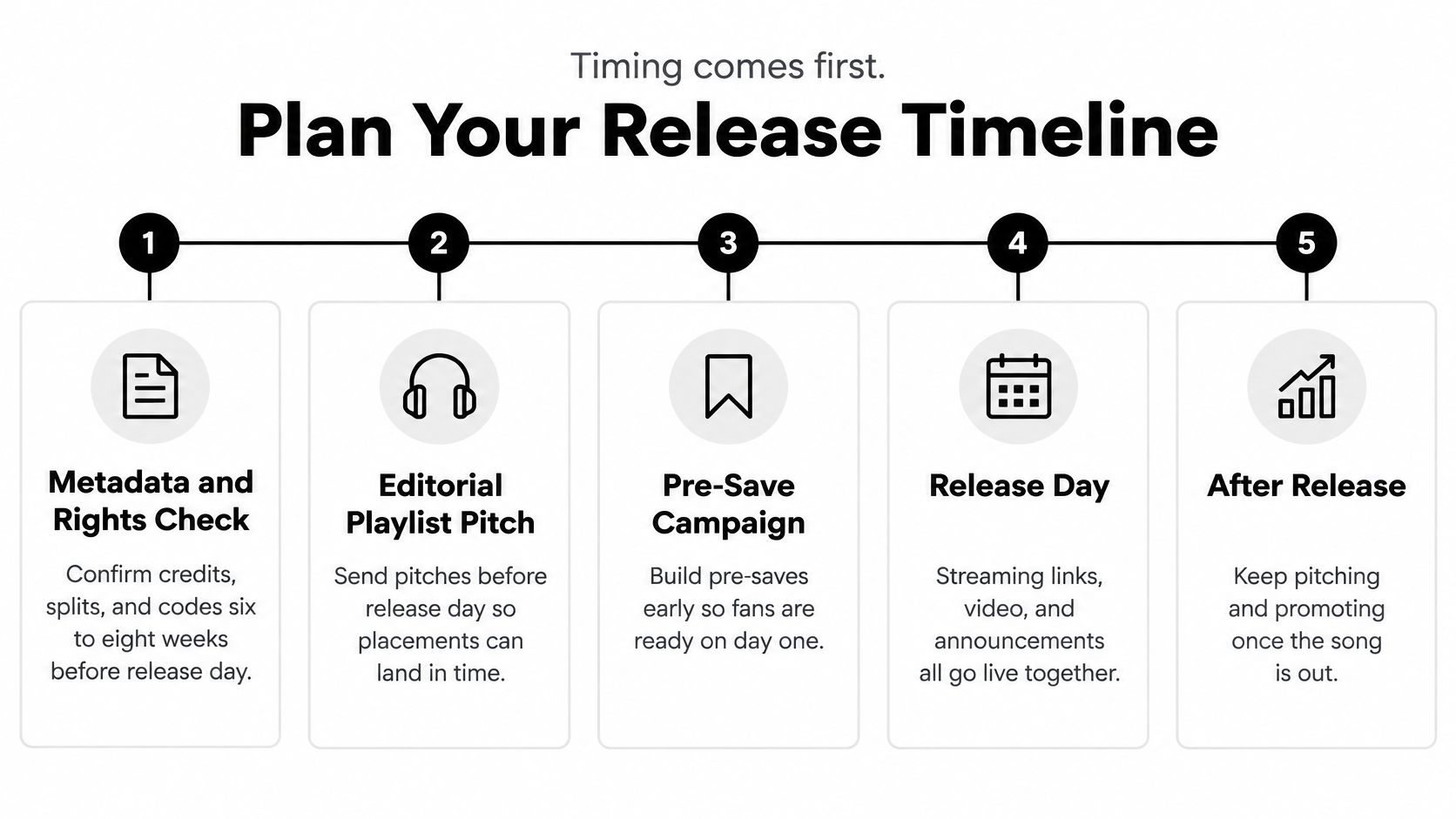
- Check metadata and rights six to eight weeks out. Confirm the ISRC for each track and the UPC for the release, then list songwriter, producer and featured-artist credits with their splits. Those splits must match signed paperwork, because a mismatch doesn't just delay a payout, it can hold the whole release in review.
- Deliver to your distributor at least four weeks before release. Upload the final WAV master, artwork at the required resolution and complete metadata, then schedule the date rather than pushing it live. Processing and store ingestion take time you don't control.
- Open the pre-save and email your list first. Your own list converts better than a cold feed, and pre-saves give you an early demand reading you can act on while there's still time to change the plan.
- Submit the editorial pitch at least seven days before release. Write two or three plain sentences: what the track sounds like, who it's for, and the story behind it. Editors read genre and mood fields, so keep them accurate rather than aspirational.
- On release day, send fans to your owned channels and your direct purchase page, not only to a streaming link. Streaming is where the track lives; your page is where a fan can buy something.
- Review the first week and retarget. Look at which audience segments finished the track and saved it, then put the next slice of budget behind them instead of spreading it evenly.
Release timeline by phase
| Phase | Timing | Key action | Done when |
|---|---|---|---|
| Metadata and rights check | 6-8 weeks before release | Confirm ISRC, UPC, credits and splits | Records match signed contracts |
| Delivery to distributor | At least 4 weeks before release | Upload masters, artwork and metadata | Distributor confirms delivery |
| Pre-save and playlist pitch | At least 7 days before release | Share pre-save link and submit editorial pitch | Pitch submitted and pre-save page live |
| Release day | Release date | Send fans to owned channels and direct purchase page | Links live across channels |
| Review and retarget | 1-2 weeks after release | Review first-week metrics and retarget | Next promotion decision made |
Two practical notes on running this. Keep a folder per release with the master, artwork, metadata sheet, codes, split sheets and live links, so a distributor change later doesn't turn into archaeology. And confirm every date in that table in writing with your provider, because ingestion windows differ between distributors and a support ticket is not a plan.
Book the delivery date in your calendar before you book the studio time for the next single. The release that slips is almost always the one that was delivered late.
What Being Available on Every Platform Does Not Get You
Your catalog belongs on streaming services. That's where listening happens, and the RIAA's 2025 annual revenue announcement records U.S. wholesale recorded-music revenue at a record US$11.5 billion, with streaming accounting for 82% of the total. Opting out of that isn't a strategy, it's a hobby.
But availability and discovery are separate problems, and only one of them is solved by your distributor. The catalog is oversupplied to the point where a new upload competes with an enormous existing shelf and a daily flood of additions. Adding a fifth single to that shelf doesn't buy attention for the other four. It splits the hours you had.
Two gaps, not one
- Discovery: does anyone find you at all? This is a metadata, pitching and content problem, and it's mostly rented from platforms.
- Monetization: do the people who find you pay? This is an offer problem, and it's the one you control.
Streaming answers the first partially and the second weakly. Direct sales and subscriptions answer the second directly, to a smaller group.
Say an artist has 500 monthly listeners. A handful of those people buy a download and a shirt in a month, and that handful can out-earn the entire streaming total, because a purchase is worth many multiples of a play and doesn't reset to zero when the playlist drops you. The 500 aren't the asset. The handful is.
So the question worth budgeting against isn't "which distributor gets me everywhere." It's which specific actions turn a listener into a paying fan, and which numbers prove that happened.
Promotion Channels Compared by Effort and Return
A release campaign runs on a fixed budget of hours and money, and every channel you add spends both. With the 2026 supply glut pushing most new uploads toward fewer than a thousand plays, distributing more music no longer buys visibility on its own. What buys visibility is fan action: saves, follows, clicks, purchases. Rank your channels by those actions and by the effort you can sustain, and the plan writes itself.

The commercial logic favors depth over volume. In its Global Music Report 2025, IFPI reports subscription streaming grew 9.5% in 2024 while combined advertising-supported formats grew only 1.2%. Engaged, paying audiences are where the growth is, and that's the audience your owned channels reach.
Promotion channels by effort and return
| Channel | Effort | What it builds | Judge it by |
|---|---|---|---|
| Short-form video | High and recurring | Discovery reach | Saves and profile follows from viewers |
| Email list | Low once built | Owned fans | Click-through and pre-order rate |
| Playlist pitching | Medium and lead-time bound | Algorithmic reach | Save rate and listener retention |
| Live shows | High per event | Local fans and sales | Tickets and merchandise sold per show |
| Merchandise and downloads | Low to medium | Revenue per fan | Purchases per 100 followers |
| Catalog reactivation | Low | Streams from older releases | Streams and new followers from the back catalog |
Short-form video is the only channel on that list that stops working the moment you stop feeding it. It earns its hours if you can hold a steady pace for a full release window, and it wastes them if you post twice and disappear, because the algorithm rewards consistency rather than occasional bursts. Email is the opposite: slow to build, cheap to maintain, and the only list nobody can take away from you. Playlist pitching sits between the two, since the work is front-loaded into the weeks before release and the payoff depends on save rate once the track lands.
Live shows create the densest relationships you'll get, and they sell merchandise on the night because the buying moment and the emotional moment are the same moment. If you're playing a run of dates, direct messaging does the heavy lifting on turnout, and Express Text's breakdown of text campaigns that fill venues shows how those sends are structured and timed. Catalog reactivation is the cheapest row in the table: an older track with a new angle costs almost nothing and tells you whether the back catalog still has pull.
Pick three, not six
Choose one discovery channel, one owned channel and one revenue channel per release. With a small audience and limited hours, that usually means short-form video or playlist pitching for discovery, email for owned contact, and downloads or merchandise for revenue. With a touring calendar, swap discovery for live shows and let the merch table carry revenue.
Three channels run properly beat six channels run thin. Each one you drop frees hours for the ones that remain, and each one you keep should have a number from the table you check after every release.
If you'd rather buy reach than film it, paid placement is a legitimate fourth option, and it deserves the same treatment as everything else in the budget: a fixed ceiling, weighed against the hours you'd otherwise spend editing. OohYeah's guide to advertising your music walks through how to think about paid promotion, and the test afterward is the same as for any channel. Count fan actions per dollar, not impressions, and cut what doesn't convert.
How to Promote Without Becoming a Full-Time Creator
Promotion itself has become the strain. A 2026 Ditto Music survey of 5,039 independent artists across 112 countries, reported by Business Wire via Morningstar, found 86% create social content to promote their music, 75% consider social-media success essential to a viable career, and 23.5% name marketing and self-promotion as a major stress source.
The useful question isn't what to post. It's what to stop doing.
Write the budget down before the campaign starts. Four hours a week is a defensible starting point: one hour filming, one hour on email and fan replies, one hour on playlist and press follow-up, one hour reading numbers and deciding what changes. Cash gets the same treatment, with a fixed ceiling per release.
Then apply three rules:
- Batch. Film four to six short videos in one session, in one outfit change if you can stand it, and schedule them across the window. Setup and teardown are what eat the hours, not filming.
- Concentrate. Run one release campaign at a time. Two singles promoted at half strength each usually lose to one single promoted properly.
- Reuse. Reactivate a catalog track with a new angle, a live take or a lyric clip instead of producing fresh content for every slot.
Owned channels hold a fixed line in that budget even in weeks with nothing new to announce, because they cost little to maintain and they're the only ones that still work when a platform changes its reach rules.
Sustainability test: cut any channel that couldn't survive your busiest month. If a tactic only works when life is calm, it isn't part of your system, it's a hobby that occasionally pays.
Metrics That Separate Reach From Real Demand
Most bad promotion decisions come from one mistake: reading plays as demand. A play can be an autoplay continuation, a playlist skip in progress, or a fan on their fifth listen of the day, and the counter treats all three identically.
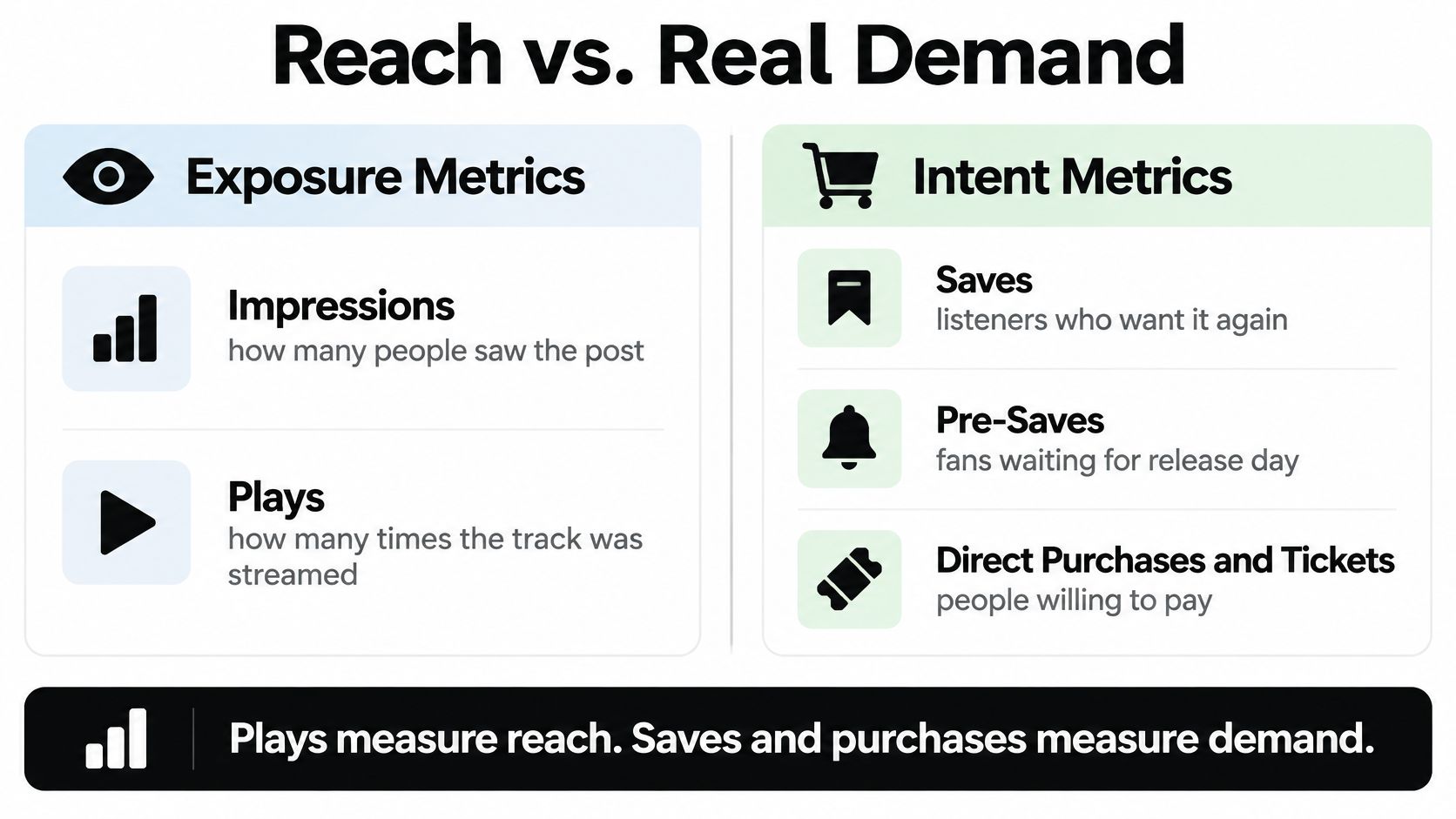
The distinction matters mechanically, not just philosophically. Research on streaming platform recommendation systems describes algorithmic curation combining collaborative filtering, natural-language processing and raw-audio analysis, which means your metadata and early listener behavior feed the next round of recommendations. Low-intent traffic doesn't just fail to earn money, it teaches the system the wrong thing about who your track is for.
Exposure and intent metrics
| Metric | Category | What it shows | How to use it |
|---|---|---|---|
| Impressions | Exposure | How often the release was shown | Judge the reach of a campaign |
| Plays | Exposure | Starts, including low-intent traffic | Compare exposure, not demand |
| Completion rate | Intent | Whether listeners stayed to the end | Choose tracks and audiences to back |
| Repeat listens | Intent | Whether the track earned a return | Spot tracks worth more budget |
| Saves and follows | Intent | Whether the listener kept the artist | Measure retention |
| Merchandise and download purchases | Intent | Paid demand | Judge direct revenue per campaign |
| Subscriptions and direct messages | Intent | Deepest fan relationship | Measure owned audience growth |
Build one spreadsheet with those two groups in separate columns and never total them together. Review at fixed windows, the first week and the first month, so releases are compared on the same clock rather than whenever you happen to look.
Then segment. Identify which audience source produces completions and purchases rather than starts, and move the next campaign's budget there. Consistent metadata across releases (genre, mood, language, collaborators, territory, release timing) is what makes that comparison fair; change three fields at once and you're comparing nothing.
Promote more of what earns intent, not what earns the largest play count.
Selling Direct to Fans Alongside Streaming
Paying audiences are a proven market, not a niche. Paid subscriptions generated US$3.2 billion across 105 million accounts in the RIAA 2025 mid-year revenue report, while the report puts U.S. recorded-music revenue at US$5.6 billion for the first half of 2025. Globally, streaming surpassed US$22 billion in 2025 and represented 69.6% of recorded-music income, per IFPI's Global Music Report 2026. People already pay for music every month. The practical lesson is narrow: a listener gives you reach, while a paying fan gives you a revenue path you can plan around.
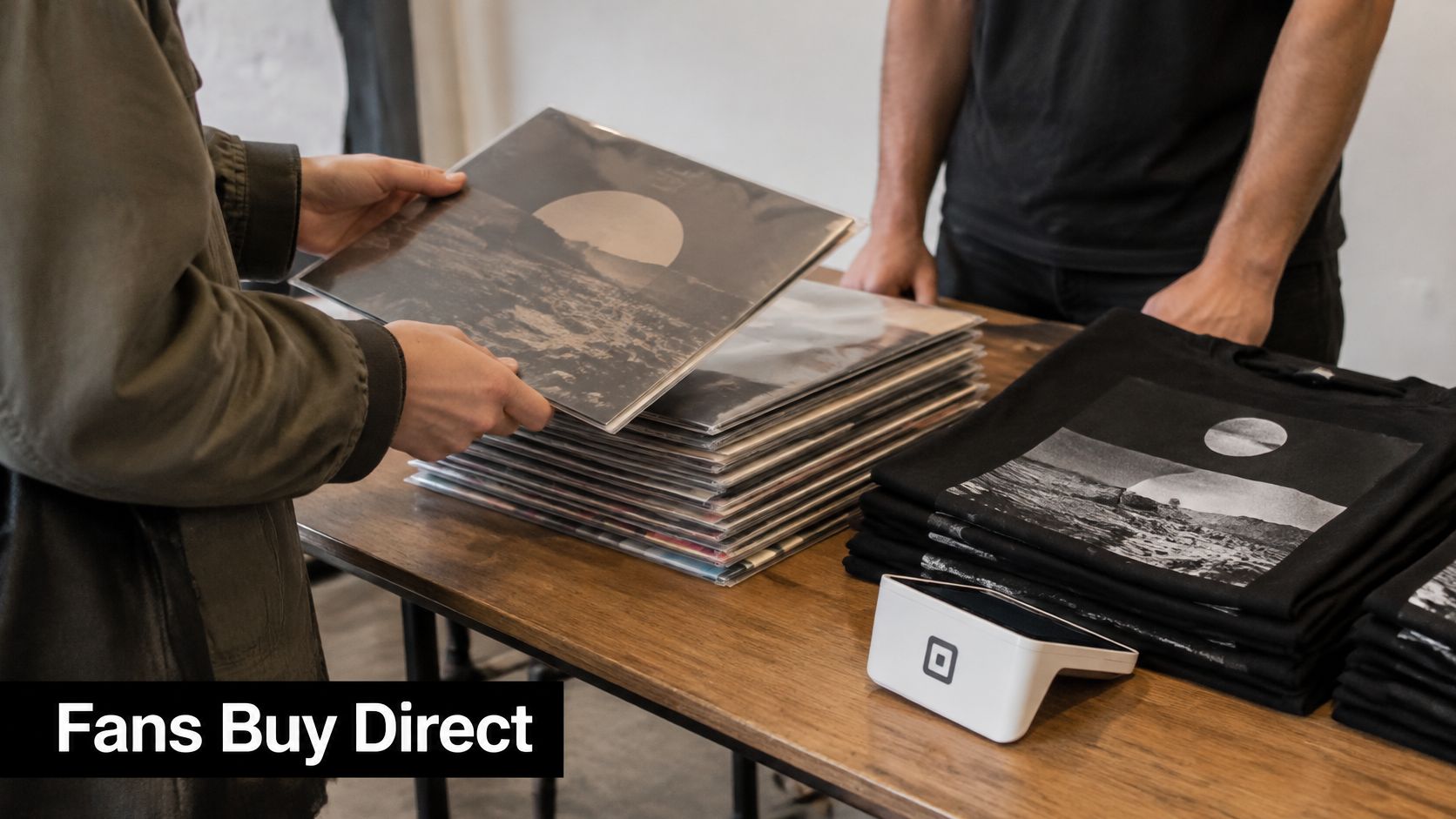
What you can sell, in order of difficulty
A download is the easiest first offer: the fan keeps the file, you keep most of the sale, and stock never runs out. Merchandise tied to the release artwork comes next, especially when the design makes sense as part of the release rather than generic artist branding. Exclusives such as demos, alternate mixes or a live recording work after that, because they give buyers a reason to act beyond access to the song. A fan subscription works once you can commit to regular material. Direct messages are the next step, since they give you a route to the buyer when the next release arrives.
OohYeah is one place artists can sell downloads, merchandise, subscriptions and other music-related products directly to fans. Artists keep 100% of eligible sales, minus payment processing. Treat that as one input in the decision, alongside how easily a fan can buy and whether the platform leaves you with a way to contact your audience. The OohYeah seller guide is the relevant reference for sellers setting up that direct path.
The sequence matters more than the storefront. Stream first for reach, then offer one direct item per release to the fans who listened most. OohYeah adds a direct purchase path for fans and does not replace streaming. The buying path stays simple: stream to discover the artist, buy something the artist makes available, and help fund what comes next. That means recordings, musicians, touring and merchandise can be supported by the same fan action. Keep the ask specific, place it next to the stream link, and measure purchases by source. A purchase is a stronger planning signal than a passive play, because it shows the fan chose to spend money on your work.
Fix What Stalls a Release Before Launch Day
The most expensive mistake isn't a weak song. It's a missed metadata window, because everything downstream of it (pitching, pre-saves, press, the video edit) was scheduled against a date that no longer exists.
Five failures cause most of the damage:
- Late delivery. Files reach the distributor inside four weeks and the date slips. Fix it by booking the delivery date as a hard milestone, not a task you'll get to.
- Mismatched splits. Credits or royalty shares don't match the paperwork, so payments stall while collaborators argue. Sign a split sheet before delivery, including producer points and any featured-artist terms.
- Chasing plays. Budget goes to reach while completions and purchases stay flat. Read intent metrics weekly and reallocate mid-campaign rather than post-mortem.
- Streaming-only links. Every fan lands on a streaming page with no way to buy. Add one purchase link per release and put it in the same bio, caption and email as the stream link.
- No owned contact. Fans stay rented from platforms. Capture an email address or a direct channel from your first release onward, even if the list starts tiny.
If your campaign keeps stalling at the handoff between tasks, the problem is usually workflow rather than motivation. The Content Map's look at how teams run campaigns in 2026 is a sensible model for assigning one owner and one deadline per asset, which is exactly what a two-person band needs.
Three decisions to write down before money moves
- The release date.
- The distributor delivery date, confirmed in writing.
- The direct sales link that will be live on release day.
Then put three questions to any provider you're considering: what does the model cost, what do I keep, and can I contact my fans directly? On the second and third, our answers are that artists keep 100% of eligible sales minus payment processing, and that fan contact stays with the artist through messaging and community posts. Users also keep ownership of the content they submit.
Test each fix across one full release cycle before judging it. A single campaign is too noisy to tell you whether the system changed or the song did.
Set your next release date, then build the direct offer that goes with it: a download, a shirt, or a subscription tier for the fans who already replay you. OohYeah lets you sell music, merchandise and subscriptions straight to those fans while your streaming distribution stays exactly where it is, with 100% of eligible sales minus payment processing going to you. Create your artist page at OohYeah and put one purchase link live before your next release week starts.