How to remake your Suno demo with Nashville studio musicians
Hire musicians for Suno song projects with a clear brief. Match Nashville players to your sound, agree on rights, and get files your engineer can use.
November 6, 2026
FRANKLY with Frank Lee
To remake your Suno demo with Nashville studio musicians, turn the recording into a clear song brief, hire players whose recorded work fits the arrangement, and agree on performances, files, revisions, and usage rights before recording. Treat the demo as a reference, not an instruction to copy every sound. Replacing generated audio with human performances does not, by itself, settle ownership or permission questions.
- To hire musicians for Suno song projects, prepare lyrics, song structure, reference audio, and a clear performance brief.
- OohYeah connects songwriters with music professionals; choose collaborators by relevant recordings and agreed deliverables.
- Hire Nashville studio musicians for demonstrated musical fit, not location alone.
- Separate performance work, songwriting contributions, production decisions, and recording permissions before the session.
How do you remake your Suno demo with Nashville studio musicians?
Decide what survives the demo before you book the band. Keep the hook, lyric, groove, or arrangement ideas you actually want. Then identify the parts that need human interpretation rather than literal replacement.
Use this sequence for your 2026 session plan:
- Define the song. Finalize the lyric, melody decisions, section order, and intended use.
- Prepare references. Supply the demo, a lyric sheet, and notes explaining what to keep or change.
- Choose collaborators. Match the producer, singer, and instrumentalists to the actual work.
- Confirm the agreement. Specify deliverables, revisions, credits, permissions, and responsibilities.
- Record and review. Approve the musical direction before completing every overdub.
- Collect the handoff. Receive organized recordings and confirm what is ready for mixing.
The session-musician booking workflow covers the move from a shortlist to a written agreement. Don't skip that transition just because the demo already sounds finished.
Why this matters
Wrote some songs, now what? A convincing demo gives collaborators something to hear. It does not tell a drummer which fills matter, a singer which melody changes are welcome, or a producer whether the chorus needs rebuilding.
Your job is to separate the song from the generated performance. A human remake gives you new interpretive decisions to make: phrasing, dynamics, instrumentation, and how the band supports the vocal.
Book people for decisions you can describe. If you cannot explain whether you need faithful replacement or a new arrangement, get song feedback from an industry professional before hiring the whole lineup.
Choose the right remake approach
Not every Suno demo needs a full-band session. Choose the smallest recording setup that serves the song, then expand only when the arrangement calls for it.
| Approach | Best for | Main advantage | Main limitation |
|---|---|---|---|
| Remote overdubs | Songwriters with a settled structure who need individual parts | You can approve one instrument before adding another | Someone must coordinate timing, files, and arrangement decisions |
| Shared studio session | Songs that depend on musicians responding to each other | Players can shape feel together during recording | You must coordinate the room, players, engineering, and session plan |
| Producer-led remake | Writers who need arrangement and recording direction | A producer can coordinate musical decisions and the recording workflow | You still need to define what the producer handles and what requires separate collaborators |
These are recording approaches, not guaranteed service packages. Ask each professional what their proposed scope includes.
Remote overdubs: best for a settled arrangement
Choose remote overdubs when you know the structure and can describe each part. For example, replace a reference bass performance, approve it against the vocal, and then commission guitar parts that leave room for that bass line.
The trade-off is coordination. If every player interprets a different version of the demo, the final session becomes an editing problem instead of a musical conversation.
Shared studio session: best for band interaction
Choose a shared session when the groove depends on players hearing and reacting to one another. Ask who leads the session, who supplies charts, and who makes the final call on takes.
A Nashville address is not a substitute for hearing relevant work. Confirm where the recording will happen, which musicians are involved, and whether everyone you need will actually record together.
Producer-led remake: best for unfinished production decisions
Choose a producer-led remake when you like the song but cannot yet specify its instrumentation, vocal direction, or recording sequence. Ask the producer to explain the proposed approach before booking additional players.
The limitation is scope ambiguity. Producing, arranging, editing, mixing, and mastering are different tasks; don't assume one agreement includes all of them.
Prepare a brief musicians can play from
Your 2026 brief should tell musicians what the song needs, not narrate every step that created the demo. Disclose that Suno generated the reference and identify any elements you intend to retain.
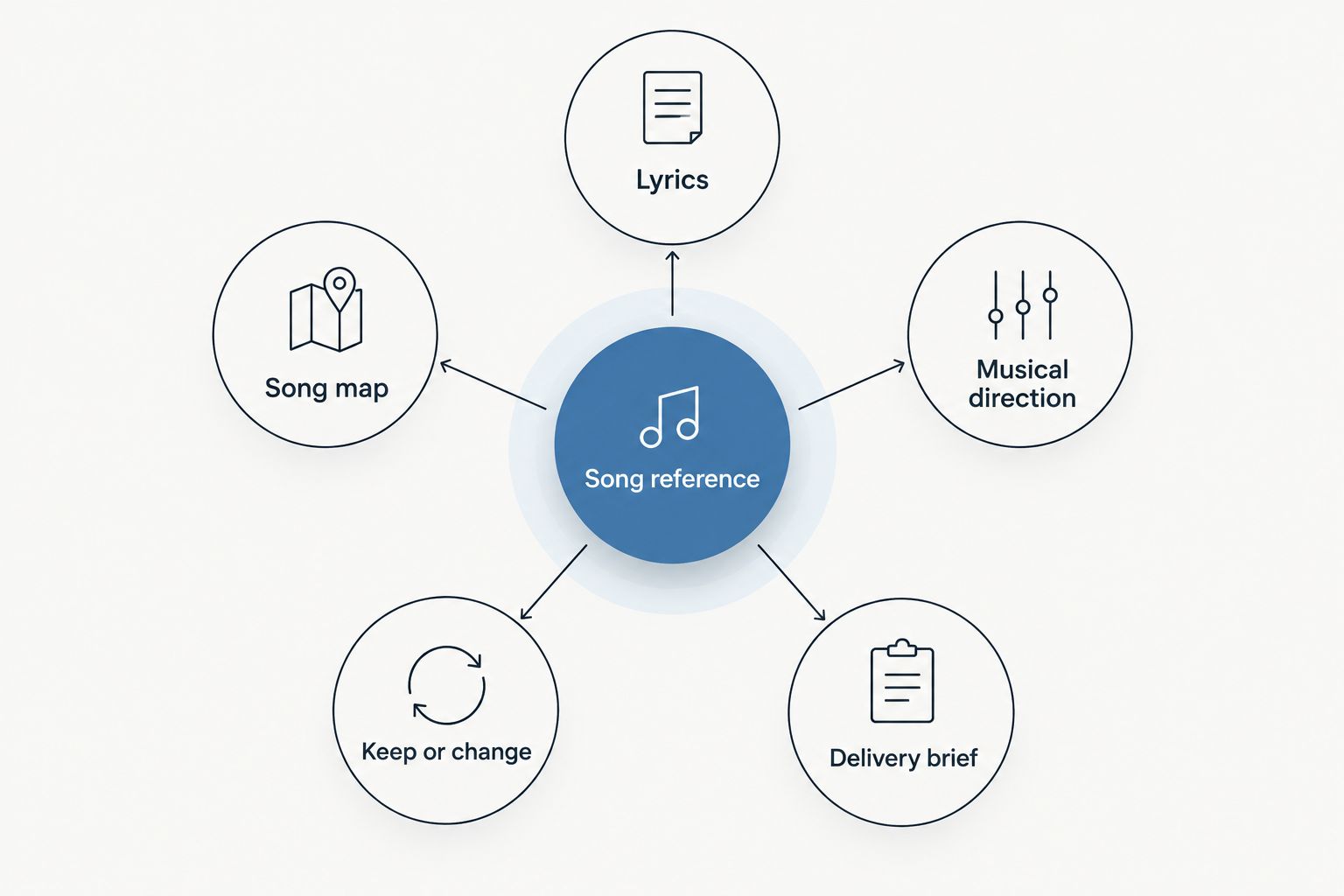
Include these essentials:
- Song reference: The exact demo version everyone should use.
- Lyrics: The current words, with sections clearly labeled.
- Song map: Intro, verses, choruses, bridge, ending, and any deliberate repeats.
- Musical direction: Key, tempo if established, feel, and the role of each instrument.
- Keep or change: The hooks you want preserved and the sounds you want replaced.
- Delivery brief: Required recordings, file organization, revision boundaries, and intended use.
Don't guess a chord chart from a confusing passage and present it as settled. Ask a qualified collaborator to confirm the harmony. If the reference drifts against a fixed tempo, decide whether to follow that movement or rebuild around a steady click.
Use timestamps for specific feedback. Tell the guitarist which chorus entrance needs a lift, or tell the singer where the melody should move away from the reference. Concrete instructions beat a paragraph asking for more emotion.
Find Nashville musicians by musical fit
OohYeah is best for songwriters seeking music professionals and musicians offering their services. Use OohYeah to explore the marketplace and its Music Pros section, then evaluate potential collaborators against your brief.
Listen for the work you need done. A polished instrumental solo does not answer whether a player can support a lyric-heavy verse. Ask for recordings that show the relevant instrument, style, and role.
For Nashville studio musicians, clarify whether you want local in-person recording or remote work from someone based there. Those are different booking requirements. Confirm location directly rather than treating a search result or profile description as a session commitment.
Ask practical questions:
- Can you record the instrument and style this arrangement needs?
- Will you create an original part, follow a chart, or interpret the reference?
- Who records and edits the performance?
- What files will you deliver?
- What changes fall within the agreed revision scope?
- How will we document credits and recording permissions?
For musicians offering services through OohYeah, answer those questions in your service description and first reply. State what you play, what you deliver, and what you need from the songwriter. Don't promise bookings or imply that every inquiry is a confirmed session.
Agree on the recording handoff before tracking
Technical choices belong in the agreement, not in a surprise message after delivery. In a 2026 remote session, the receiving engineer should specify the session format before anyone records.
A practical starting proposal is 24-bit WAV at 48 kHz, if the receiving engineer accepts that format. It is an example delivery specification, not a requirement imposed by Suno or a universal rule for Nashville sessions. Match the actual project when it uses another format.
Request files with a shared start point so the engineer can place them together without guessing. Specify whether you need raw recordings, edited performances, effects-printed versions, or separate alternatives. Those are not interchangeable deliverables.
A 2-bar count-in is one possible way to prepare a recording guide. Agree on it with the players rather than assuming every collaborator uses the same lead-in. Label the song version clearly and keep that reference unchanged once tracking begins.
Ask for individual instrument tracks when you need control at mix time. Clarify what someone means by stems: a grouped stereo drum export is not the same handoff as separate kick, snare, and overhead recordings.
Rebuild the groove before decorating the track
Start with the parts that establish the song's feel. That might be voice and acoustic guitar, a rhythm section, or a producer's guide arrangement. The right starting point depends on what carries the song.
For a rhythm-driven remake, booking a custom beat session belongs in the same arrangement conversation as hiring live drums: decide who creates the groove, whether programmed elements remain, and what the musicians should play around. Otherwise, you risk commissioning parts that compete for the same space.
Approve a representative passage before completing every layer. Listen to the verse-to-chorus transition with the vocal present. A guitar part that sounds exciting alone can still obscure the hook.
Keep feedback actionable:
- Replace “make it bigger” with a request for stronger chorus accents.
- Replace “less busy” with a request to leave gaps between vocal phrases.
- Replace “copy the demo” with a list of the specific rhythmic or melodic details to retain.
Approve the direction before approving the polish. Editing cannot resolve an arrangement everyone interpreted differently.
Why the scope of a Suno remake varies
The work changes with the brief. Use these factors to define your 2026 project before asking professionals to commit:
- Arrangement readiness: A settled song requires different work from a demo that still needs structural changes.
- Performer lineup: A singer and acoustic guitarist create a different session from a full rhythm section with overdubs.
- Recording location: Remote delivery and a shared studio session require different coordination.
- Production responsibility: Someone must own charts, direction, editing, and the handoff to mixing.
- Revision boundaries: Replaying an agreed part differs from changing the key or structure after recording.
- Intended use: A private writing reference and a planned commercial release need clearly stated permissions and expectations.
Don't ask only whether someone can recreate the track. Ask what they need to deliver the recording you actually intend to use.
Do you need a producer or just session players?
Hire session players when the arrangement is settled; hire a producer when you need recording and arrangement direction. A mixing engineer balances and processes recorded material, which is different from deciding what the musicians should play.
Get song feedback first if your biggest uncertainty is the chorus, lyric, or structure. Ask for a defined feedback session rather than expecting instrumentalists to resolve songwriting questions during tracking.
Can you keep the melody from your Suno demo?
Keeping a melody requires separating your creative decisions from questions about permission and legal protection. Do not assume that paying musicians to replay it establishes rights in every underlying element.
For a 2026 release, review the terms applicable to your Suno use and get qualified legal advice when ownership or permitted use is unclear. Give collaborators an accurate account of how the reference was made.
What should you agree with a session singer?
Agree on melody, key, lyric pronunciation, harmonies, doubles, editing, credits, and permitted uses of the recording. Tell the singer which phrasing choices are fixed and where interpretation is welcome.
Do not assume a vocal session includes permission to clone the singer's voice or train a model on the recordings. Address any proposed synthetic-voice use explicitly and separately.
FAQ
How do I hire musicians for a Suno song?
Prepare your reference demo, lyrics, song structure, and a clear performance brief, then contact musicians with relevant recordings. Agree on deliverables, revisions, credits, and permissions before recording.
Do Nashville studio musicians have to record my song in person?
No, your project can use remote performances or a shared studio session, depending on what the musicians offer and you agree. Confirm location, recording responsibilities, and file requirements directly.
Can OohYeah help me find musicians for my demo?
OohYeah has a Music Pros section for finding music professionals. Evaluate collaborators by relevant work and confirm the project scope directly; a marketplace listing is not a booking guarantee.
Do I need separate tracks from Suno before hiring musicians?
Separate reference tracks are not required for every remake. A full demo and a clear brief can explain the song, but ask your producer or musicians what materials they need.
Should I book a producer before a session singer?
Book a producer first when the key, arrangement, or vocal direction still needs decisions. If those choices are settled, you can approach a singer with a defined recording brief.
Does replacing generated audio with musicians make the song legally mine?
Replacing generated audio does not by itself settle ownership, permissions, or copyright protection. Review the applicable terms and get qualified legal advice about your specific material and release plans.
What should musicians offering Suno remake services put in their listings?
State the instrument or vocal service, relevant styles, required reference materials, and recording deliverables. Define revision boundaries and avoid promising guaranteed work or rights clearance.
One last thing
Before hiring the full lineup, record yourself singing the song without the generated lead vocal. You do not need a release-ready performance. You need to hear which words, melody choices, and breaths you actually want another singer to deliver.
If you cannot explain a phrase without replaying the demo, mark it for a decision. Hire people to perform your musical choices, not to guess which parts of the reference you meant to keep.