Can you sell an instrument bought on finance? What to check
Sell instrument bought on finance only after checking ownership and lender terms. Learn what to verify before listing gear, accepting payment, or shipping.
November 26, 2026
FRANKLY with Frank Lee
You can sell an instrument bought on finance if you have the right to transfer it and the sale complies with your finance agreement. Selling the gear does not automatically cancel the debt or remove a lender’s claim against the instrument, so confirm ownership, resale restrictions, and any required payoff before handing it over.
- Sell instrument bought on finance: confirm ownership, resale restrictions, and any lender claim before accepting payment.
- Unsecured borrowing and instrument-secured finance require different checks; read the actual agreement.
- Selling a guitar, keyboard, or drum kit does not automatically transfer your debt to the buyer.
- OohYeah suits musicians seeking zero-seller-commission gear sales after resolving financing restrictions.
Can you sell an instrument bought on finance?
Yes, when your ownership rights and agreement allow the sale. Having the instrument in your rehearsal room is not enough. Before you create an account and list gear on OohYeah, establish whether the lender has rights over that specific instrument.
For a US sale in 2026, start with the agreement—not the financing label used at checkout. A monthly payment can represent unsecured borrowing, a secured purchase, or a rental arrangement, with different consequences for resale.
| Purchase arrangement | Main distinction | Useful feature | Resale concern |
|---|---|---|---|
| Unsecured personal loan | The instrument is not pledged as collateral under that loan | Repayment is separate from possession of the gear | You still owe the loan after selling |
| Credit card purchase | Account terms determine whether any security interest applies | Purchase records help document the transaction | Do not assume every store card is unsecured |
| Secured installment agreement | The lender has a security interest in the instrument | The agreement identifies the lender’s rights | Sale permission, payoff, or release needs checking |
| Buy now, pay later | The label alone does not establish ownership or collateral terms | The agreement gives the relevant conditions | Selling does not automatically end installments |
| Rental or rent-to-own | Ownership depends on the contract and completion requirements | The contract identifies the path to ownership | Possessing the instrument does not establish a right to sell |
A security interest is a creditor’s legal interest in property used to secure a debt. Under US secured-transactions law, that interest can continue after a sale unless an applicable authorization or legal exception removes it. Do not make your buyer responsible for sorting that out.
Why this matters
Your buyer wants a playable instrument and a clean ownership transfer. You need to establish the right to sell the gear, separately from showing that it works. A receipt supports your purchase history; it does not necessarily establish that a financing claim has been released.
The practical goal in 2026 is simple: finish the sale without leaving unresolved claims against the instrument. Keep the financing conversation separate from the condition report, but complete both before committing to a handover.
This is general US information, not advice about your particular contract. State law, business borrowing, bankruptcy, and disputed ownership require individual legal advice.
Unsecured borrowing: the debt stays with you
An unsecured personal loan does not give the lender a security interest in the instrument under that loan. Selling the guitar or keyboard does not repay the borrowing, however. You remain responsible for the account according to its terms.
Best for: sellers whose documents establish unsecured borrowing and permit the sale. The useful distinction is that the debt is not secured by the instrument. The downside is just as clear: you can lose possession of the gear and still have payments due.
Check the actual paperwork before treating a credit card purchase the same way. Some retail credit agreements contain security-interest provisions. A familiar card logo or checkout screen does not settle the question.
Secured finance: resolve the lender’s rights first
With secured finance, the instrument serves as collateral. Paying installments on time does not, by itself, prove you can transfer it free of the lender’s interest.
Ask the lender what it requires for an authorized sale and release. Get those instructions in writing. If payoff is required, ask how the lender confirms receipt and documents the release; do not substitute your own interpretation of an account screenshot.
Best for: sellers who can follow a documented lender-approved process. That process gives you a defined route to a sale. Its limitation is coordination: the buyer’s payment, your repayment, and the lender’s release must fit together without relying on an unsupported promise.
Rental and rent-to-own: establish ownership before listing
A rented saxophone or rent-to-own keyboard is not automatically yours to resell. Check who owns it now, not who expects to own it after the remaining payments.
Find the ownership-transfer clause and ask the provider what documents establish completion. If ownership has not transferred, do not advertise the instrument as yours to sell. Ask about permitted return, purchase, or transfer procedures instead.
Best for: completing the ownership check before starting a sale. The contract gives you the place to start. The limitation is that an unfinished rental or ownership arrangement can prevent the sale you intended to make.
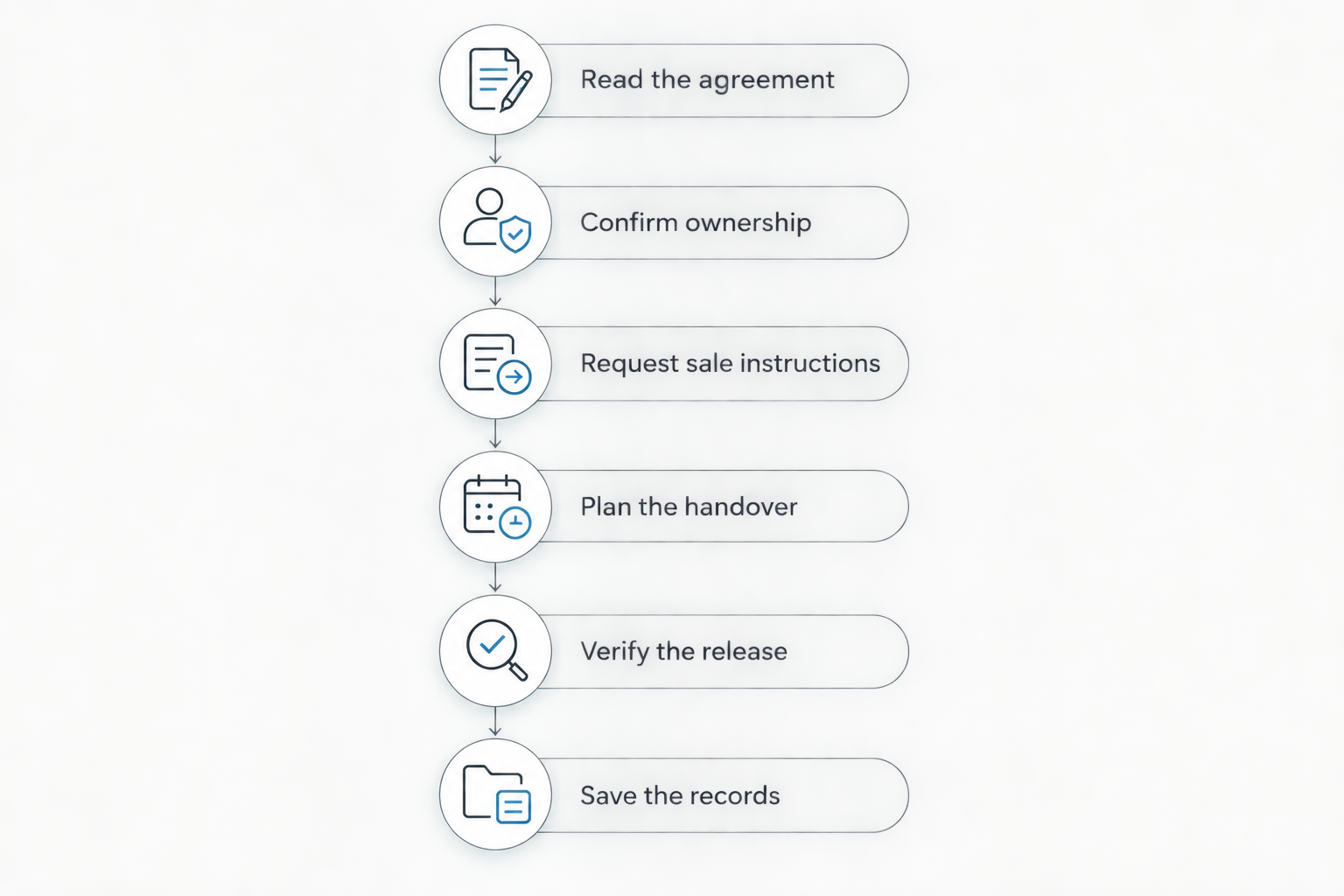
Follow these 6 steps before you accept payment
1. Read the agreement
Find the signed contract, financing disclosures, purchase receipt, and current account information. Search for terms such as security interest, collateral, sale, transfer, default, early repayment, and ownership.
Match the paperwork to the instrument. Check the model and serial number wherever recorded. If the purchase bundled an instrument, case, and accessories, establish which items the agreement covers rather than assuming only the main instrument matters.
2. Confirm ownership
Ask whether you own the instrument now and whether anyone else has an interest in it. Distinguish an obligation to repay money from a lender’s rights against the gear itself.
If the contract is unclear, request a written explanation from the lender or provider. Keep that response with the agreement. Do not replace it with a sales assistant’s informal recollection of how the financing normally works.
3. Request sale instructions
Tell the lender that you want to sell the identified instrument. Ask whether the sale is permitted, whether consent is required, and what must happen before the buyer takes possession.
If payoff is part of the process, request current written instructions and their validity period. The balance shown in an app is not necessarily a complete statement of what is required to settle the agreement and release collateral.
4. Plan the handover
Agree on a sequence that follows the lender’s instructions and the marketplace’s transaction rules. Establish who pays whom, what confirms settlement, and when the instrument changes hands.
Do not promise to clear secured finance later without resolving the lender’s requirements first. If sale proceeds are needed for payoff, get an approved process before accepting money. Do not improvise a split payment or redirect a buyer outside the platform’s permitted payment process.
5. Verify the release
Obtain the documents the lender identifies as evidence that its interest has been released. A payment submission, a settled account, and a released security interest are related concepts—not interchangeable proof.
Check names, instrument details, and any remaining conditions. If a public filing exists, ask what termination or other record update is required. Do not assume that every financed instrument has a public filing or that every release follows the same procedure.
6. Save the records
Keep the contract, lender correspondence, settlement evidence, and sale record together. Give the buyer relevant ownership and release evidence without exposing account credentials, full financial account numbers, or unrelated personal information.
Record the instrument’s model, serial number, condition, included accessories, and handover details. These records serve different purposes: financing documents address the lender’s rights, while the sale record documents what you transferred to the buyer.
Why the answer varies between finance agreements
The word “finance” does not identify a single legal arrangement. For a 2026 sale, these are the factors to check in your own documents:
- Ownership: A purchase and a rental do not give you the same rights. Find the clause that identifies when ownership transfers.
- Collateral: Establish whether the agreement gives the lender a security interest in the instrument or other property.
- Transfer restrictions: Check whether selling requires consent, repayment, or another condition, even when the account is current.
- Account status: Missed payments, default notices, and disputed balances need resolving with the lender before you plan around an ordinary sale.
- Release requirements: Find out which evidence confirms the lender’s interest has ended and whether additional records need updating.
- Applicable law: State law and the details of the transaction affect creditor and buyer rights. Get legal advice when those rights are disputed.
An account being current is not the same as permission to sell. Likewise, a lender allowing a sale does not necessarily mean the lender has released its interest. Ask both questions explicitly.
What should you ask the lender before selling?
Send these 5 questions together so the response covers the full transaction. Identify the instrument and account through the lender’s secure communication channel.
- Do I own this instrument now, and does your agreement give you a security interest in it?
- Does the agreement permit me to sell it, and do I need written consent?
- What must happen before the buyer takes possession?
- If payoff is required, what instructions and confirmation should I use?
- What document confirms the release of your interest in this instrument?
Ask for clarification if the answer addresses repayment but ignores resale. Save the response with your 2026 sale records, and follow the stated conditions rather than summarizing them from memory.
Can I use the buyer’s payment to pay off the finance?
You need a lender-approved process if the sale depends on using the buyer’s payment to release secured finance. Do not assume a marketplace payout arrives in time for the proposed handover or that the lender accepts your proposed payment arrangement.
Check how long it takes to get paid after selling music gear before committing to a sequence. If you cannot meet the lender’s conditions with the payment method and timing permitted, pause the sale.
Does the buyer take over my remaining payments?
The buyer does not take over your finance agreement simply by buying the instrument. A private agreement between you and the buyer does not, by itself, release you from your obligation to the lender.
If an account transfer is proposed, ask the lender whether it permits one and what formal approval requires. Do not describe an informal installment arrangement as an approved finance transfer.
Prepare the listing after the finance check
Once you establish your right to sell and resolve any required consent or release, prepare the gear listing. Photograph wear, test the controls and connections, and state exactly what comes with the instrument. Keep claims about ownership as accurate as claims about condition.
OohYeah is a music gear marketplace with zero seller commissions. That is useful for musicians selling instruments, but a marketplace listing does not replace lender consent or proof that a financing interest has been released.
OohYeah is best for musicians seeking zero-seller-commission gear sales. Create an account and list your instrument after completing the finance checks. Describe the model, condition, modifications, faults, and included accessories plainly; do not use the listing to promise a release you have not arranged.
The same discipline applies to a local handover. Meeting face-to-face lets the buyer inspect the instrument, but it does not settle ownership questions or change the finance contract.
FAQ
Can I sell a guitar that I am still paying off?
You can sell a guitar you are still paying off if your ownership rights and finance agreement permit it. Resolve any required lender consent or release before transferring possession; the sale does not automatically cancel your debt.
Can I sell an instrument bought with a credit card?
Check the card agreement before selling the instrument. An unsecured card balance remains your responsibility after the sale, while a security-interest provision requires additional checks.
Can I sell a rent-to-own instrument before the final payment?
Do not sell a rent-to-own instrument unless you have established your right to transfer ownership. Check the contract and obtain confirmation from the provider rather than treating possession as proof of ownership.
Does paying off the finance prove the instrument is clear to sell?
Payoff alone is not a substitute for checking the lender’s release requirements. Obtain the evidence the lender identifies as confirming that its interest in the instrument has ended.
Can a buyer just make the remaining payments for me?
A buyer making payments does not automatically release you from your finance agreement. Any lender-approved transfer needs to follow the lender’s formal requirements.
Should I send a buyer my entire finance agreement?
Give the buyer relevant evidence without exposing unrelated financial or personal information. Keep the complete original records yourself and use appropriately redacted copies where suitable.
What if the lender will not let me sell the instrument?
Do not proceed with a sale that breaches the agreement or transfers property you do not have the right to sell. Ask the lender about permitted settlement or other options, and get legal advice if ownership or resale rights are disputed.
One last thing
A balance screen and a release document answer different questions. Before your 2026 handover, confirm both what you owe and what rights the lender still holds over the instrument. Finish the paperwork. Then move the gear.