Selling school-owned instruments: permission and ownership checks
Selling school owned instruments starts with ownership checks and written approval. Follow the steps to verify authority, list gear, and record the sale.
November 26, 2026
FRANKLY with Frank Lee
Selling school owned instruments starts with confirming who owns each instrument and getting written authorization through the owner’s disposal process. A teacher’s access to a band room, a booster club’s fundraising role, or an instrument’s condition does not establish permission to sell it. Before listing anything in 2026, document ownership, sale authority, the permitted sales method, and where the proceeds must go.
- Selling school owned instruments requires verified ownership and documented sale authority before listing.
- Check purchase records, donation terms, loan agreements, and asset records against each instrument.
- OohYeah offers zero seller commissions, but marketplace access does not replace school disposal approval.
- Keep the authorization, transaction record, and inventory update together after the sale.
What permission do you need for selling school owned instruments?
Get written authorization from the person or governing body empowered to dispose of the instrument. Ask the school’s business office to identify that authority under the applicable policy. Do not treat an informal conversation as the sale record.
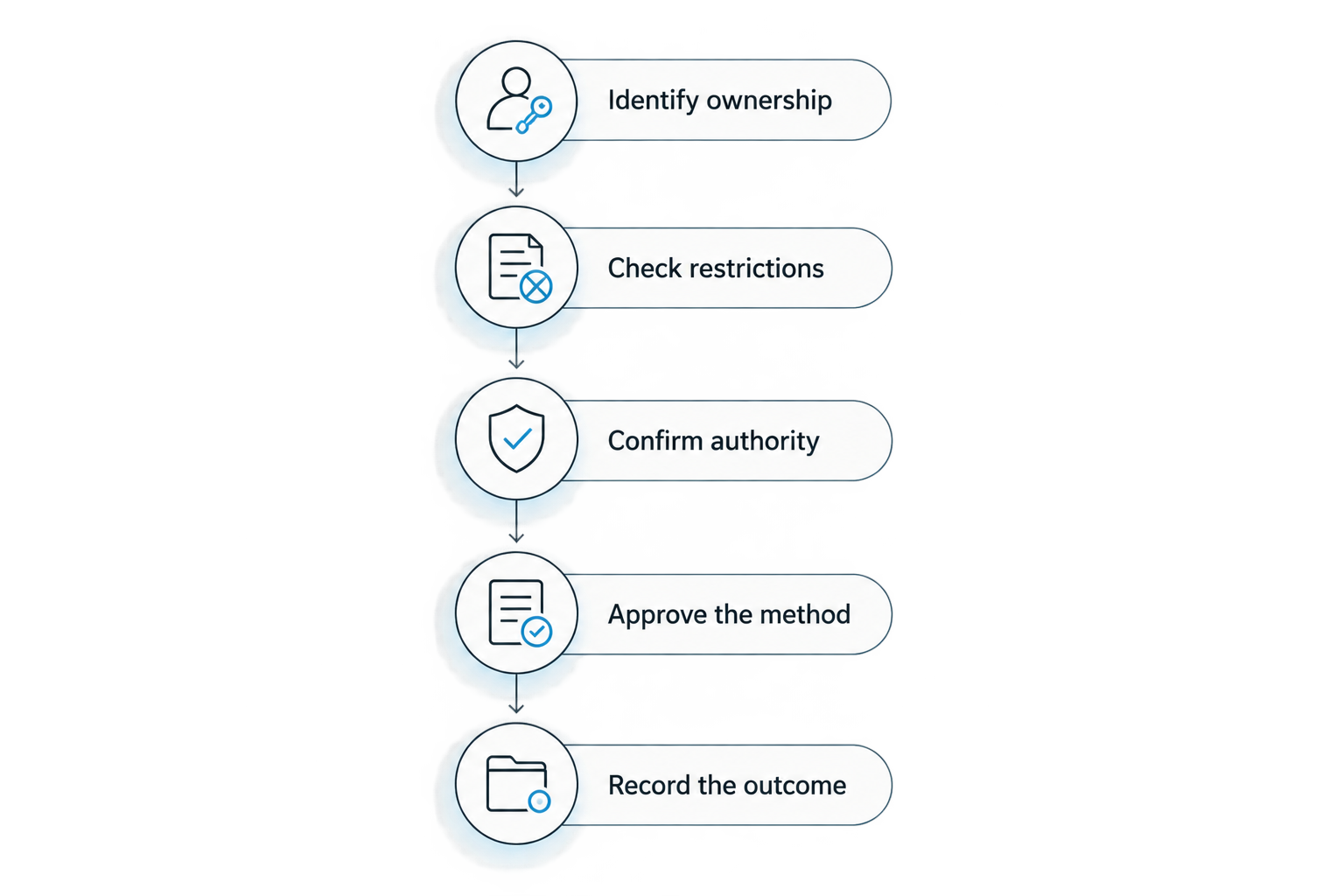
Use this sequence before you photograph gear for a public listing:
- Identify ownership. Match the instrument to purchase, donation, loan, or rental records.
- Check restrictions. Read the terms attached to the purchase, funding, donation, or loan.
- Confirm authority. Identify who can approve disposal and who can act as the seller.
- Approve the method. Confirm whether the proposed marketplace sale fits the owner’s process.
- Record the outcome. Retain the approval, sale documentation, payment record, and inventory update.
For the wider teaching workflow, see the guide to instrument buying and selling for music teachers. Keep this distinction clear: helping students find instruments is different from disposing of institutional property.
Why this matters
A dusty trumpet still needs an owner. A broken keyboard still needs authorization. Calling an instrument surplus—property the school no longer needs—does not, by itself, give the person holding it permission to sell.
For a 2026 sale, separate musical judgment from disposal authority. You can explain that a clarinet needs repairs or that a drum kit no longer fits the program without assuming you can transfer ownership.
Decide whether the instrument should leave the program before deciding how to advertise it. That order keeps listing work from getting ahead of approval.
Establish ownership before you discuss a sale
Start with the physical instrument, not a spreadsheet description alone. Record the manufacturer, model where identifiable, serial number where present, school asset tag, case, and included accessories. Photograph identifying marks for the internal file.
Use 1 instrument per inventory row as a working rule. For a matched set, identify the components separately within the same record so the approval clearly covers everything leaving campus.
| Ownership situation | Useful evidence | What the evidence helps establish | What it does not settle |
|---|---|---|---|
| School-purchased instrument | Invoice, receiving record, asset entry | Which institution acquired the instrument | Who can authorize its sale now |
| Donated instrument | Gift agreement, acceptance record, donor correspondence | Who received the gift and its stated terms | Whether an unrestricted sale is permitted |
| Booster-purchased instrument | Purchase record and any transfer documentation | Whether the booster organization retained or transferred ownership | Whether school staff can sell it |
| Loaned or rented instrument | Current agreement and identifying details | The owner and agreed use | Permission to sell someone else’s property |
| Unclear ownership | Archived records and written clarification | What still needs resolving | A basis for listing the instrument |
These are evidence categories, not automatic clearance. An invoice identifies a purchase; it does not replace a disposal decision. An asset tag identifies a record to investigate; it is not a bill of sale.
Donated instruments need their own check
Find the donation paperwork. Ask whether the gift was accepted by the school, a district, a foundation, or a booster organization, and whether any restrictions address use or disposal.
Do not assume the donor’s original intent from a staff member’s memory. If the written terms are unclear, ask the business office or legal counsel to resolve them before proceeding.
Loaned instruments stay off the sales list
Separate rentals, family loans, demonstration instruments, and personally owned staff gear from school assets. Keep those items out of the sale batch while you confirm the agreements.
If a record says the instrument belongs to someone else, contact that owner about the next step. Possession is not sale authority.
Build a written permission packet
Keep 3 checks distinct: ownership, authorization, and sale method. Passing one check does not answer the others. A school can own an instrument while requiring a specific approval or disposal route before anyone advertises it.
For a 2026 permission packet, collect the following information in a shared institutional file:
- Asset identity: instrument description, identifying marks, and included accessories.
- Ownership evidence: purchase record, accepted gift documentation, or other supporting records.
- Disposal reason: condition, program fit, or another documented reason for release.
- Written authorization: the decision, its scope, and the authorized approver.
- Sale instructions: permitted channel, seller representative, payment destination, and handoff arrangements.
Make the authorization specific enough to use. A general instruction to clear a storage room does not clearly identify which instruments, cases, stands, or spare parts are covered.
Ask the business office to resolve missing details before publication. Name the person responsible for buyer messages, payment reconciliation, and inventory closure so those tasks do not fall between departments.
Why school instrument sale requirements vary
Use the current owner’s rules, not another school’s experience. For a 2026 disposal decision, ask about these factors:
- Owner type: establish whether the owner is a public school entity, private school, foundation, booster organization, or another party.
- Acquisition terms: review purchase, donation, rental, and loan documentation for restrictions.
- Funding conditions: ask whether the funding source places conditions on disposal or proceeds.
- Delegated authority: identify which role or governing body can approve the transaction.
- Disposal policy: confirm any required declaration, notice, bidding process, or other sale procedure.
- Proceeds handling: establish the approved recipient and accounting treatment before accepting payment.
These are questions for the responsible office, not a claim that every school follows the same procedure. Get answers tied to your institution and the particular asset.
If someone proposes a direct sale to a staff member, student’s family, or other connected buyer, flag that relationship before approval. Ask whether the institution’s conflict-of-interest rules affect the proposed transaction.
Can a band director sell instruments the program no longer uses?
A band director should sell school-owned instruments only within documented authority granted through the owner’s process. Musical expertise supports the disposal recommendation; it does not establish the right to transfer the asset.
Put the recommendation in writing. Describe the instrument, its condition, why the program no longer needs it, and any known restrictions, then send it to the responsible administrator or business office.
Can a booster club sell instruments it paid for?
A booster club should first establish whether it still owns the instruments or transferred them to the school. Paying the original invoice does not resolve what happened afterward.
Check both the club’s records and the school’s acceptance records. If ownership changed, route the proposed sale through the current owner rather than relying on the original purchaser’s permission.
Can you sell an instrument with a school asset tag?
A school asset tag is a reason to verify the disposal record, not automatic proof that a sale is authorized or unauthorized. Match the tag and serial number to the institution’s records before proceeding.
Do not remove identifying marks to avoid questions. Ask the asset office how it wants tags handled after approval, and preserve the identifying information in the transaction file.
Prepare the listing only after approval
Describe what the buyer will receive. Include the instrument’s identifiable make and model, known repairs, visible damage, missing parts, and exactly which case or accessories are included.
Separate tested functions from unknowns. For an electronic keyboard, turning the power on does not establish that every key, output, pedal connection, and control works. For a wind instrument, appearance does not establish playing condition.
Use these listing checks:
- Match the approved asset. Confirm that the photographed instrument is the one authorized for disposal.
- Show condition clearly. Include wear, damage, repairs, and included accessories.
- Describe testing honestly. State what was checked and leave untested functions identified as untested.
- Protect private information. Exclude student names, checkout sheets, account details, and unrelated school documents.
- Set an approved handoff. Arrange collection or shipping through the person responsible for the sale.
For multiple instruments, build 1 listing per separately approved sale unit unless the authorization specifically covers a bundle. This working rule helps prevent an approved trumpet sale from quietly expanding to include an unapproved case of accessories.
Choose a marketplace only if the disposal process permits it
OohYeah is best for authorized sellers who want a music gear marketplace with zero seller commissions. The platform serves musicians, music stores, and producers buying and selling instruments and studio gear.
The limit matters: OohYeah does not replace the institution’s ownership checks or approval process. Zero seller commissions are not permission to bypass a required sale procedure, and they do not establish that every other transaction expense is zero.
Once the approved method allows it, create an account on OohYeah and prepare the authorized listing. Use an account arrangement and payment destination the institution has approved; do not default to a staff member’s personal setup.
List approved school gear
Confirm ownership, written permission, and the approved sales method before you publish.
Close the sale without losing the paper trail
Before handoff, match the buyer’s transaction to the approved instrument and included accessories. Follow the institution’s payment-verification procedure rather than treating a buyer’s message or screenshot as the accounting record.
Prepare a sale or transfer record that identifies the parties, instrument, serial number where present, included items, transaction date, and agreed condition description. Have the authorized representative handle any required institutional signatures.
After a 2026 sale, send the completed record to the office responsible for the asset register. Ask that office to record the disposal and reconcile the proceeds to the approved destination.
Retain 1 complete sale file per transaction as an organizational practice, following the institution’s actual retention policy. Keep authorization, listing details, buyer correspondence, payment documentation, and handoff evidence together; do not invent a retention period.
FAQ
Can I sell a school instrument that nobody has used for years?
Long-term nonuse does not establish permission to sell a school instrument. Verify ownership and obtain authorization through the owner’s disposal process before listing it.
Is a principal’s email enough permission to sell school instruments?
A principal’s email is sufficient only if the principal has the required authority and the approval satisfies the applicable process. Ask the business office to confirm the authority, covered assets, and permitted sales method.
Can we sell donated band instruments to fund replacements?
Check ownership, donation terms, and disposal approval before selling donated band instruments. Also confirm that the proposed use of the proceeds is permitted rather than assuming replacement purchases settle the issue.
Can a teacher keep the proceeds and buy supplies later?
Use the payment destination and accounting process approved by the institution. Do not route proceeds through a personal account without explicit institutional authorization.
Do school instruments need to be repaired before sale?
Ask the approving office whether repairs are part of the authorized disposal plan. Describe actual condition and testing accurately instead of implying an untested instrument is ready to play.
Can school instruments be listed on OohYeah?
OohYeah is a music gear marketplace with zero seller commissions; use it for school instruments only when the owner has authorized that sales method. Marketplace access does not establish ownership or sale authority.
What should I do if an instrument’s serial number does not match the records?
Pause the sale and resolve the mismatch before listing or handing over the instrument. Compare photographs, asset tags, purchase records, and repair records with the responsible office.
One last thing
Check the case before it leaves. A correctly approved instrument can still contain a student’s music, an unrelated mouthpiece, a school-owned pickup, or accessories that were never included in the authorization.
Approval follows the identified asset, not everything stored beside it. Compare the final contents with the sale record, then hand over only what the institution approved.