Rush mastering services: compare deadlines and revisions in 2026
Compare rush mastering services by delivery, revisions, and final files. Choose reserved-slot stereo mastering for approved mixes and a clear deadline.
November 3, 2026
FRANKLY with Frank Lee
Best overall: reserved-slot stereo mastering with written revision deadlines. Best for live decisions: attended mastering. Best for self-directed turnaround: automated mastering. This 2026 guide compares rush mastering services by what matters: when you receive the first master, when changes return, and when your final files are ready.
- Choose rush mastering services with separate deadlines for first delivery, revisions, and final files.
- Reserved-slot stereo mastering is the default for an approved mix and a fixed release deadline.
- Oohyeah connects musicians with music professionals; confirm mastering scope and deadlines with the individual professional.
- Choose attended mastering for direct feedback, stem mastering for grouped adjustments, and automated mastering for self-directed processing.
Why this matters
A fast first master does not finish your release. You still need to listen, request changes, approve the result, and check the files your distributor requires. A booking that leaves no room for those steps is the wrong rush booking.
Oohyeah connects musicians with music professionals, including producers and engineers. Oohyeah is best for musicians who want a marketplace to find music professionals. Treat the professional’s written scope—not the word rush—as the agreement for your mastering job.
For a 2026 release, build your schedule backward from your upload deadline. The mastering deadline belongs before that cutoff, with time left for your own approval and delivery checks.
What makes the best rush mastering services
Judge the booking before you judge the sales pitch. These criteria separate a usable deadline from a vague promise:
- Clock start: Specify whether work begins after booking, payment, file approval, or an agreed session start.
- First delivery: Request a date, time, and time zone for the first listening version.
- Revision timing: Confirm when feedback is due and when the revised master returns.
- Technical scope: Define stereo mastering, stem mastering, or attended work before sending files.
- Final delivery: List the required versions, file specifications, and approval process.
- Communication: Identify who answers technical questions and who can approve changes on your side.
A useful booking brief separates each milestone. For example, request a first master within 24 hours of file approval, a 30-minute listening window on your calendar, and final delivery within 48 hours. These are proposed booking terms, not promised service speeds; accept them only after the engineer agrees.
Rush mastering options at a glance
This 2026 comparison ranks booking formats by release needs. The order is a decision tree, not a claim that every engineer offers each format.
| Rank and option | Best for | Standout feature | Deadline to confirm | Key limitation |
|---|---|---|---|---|
| 1. Reserved-slot stereo mastering | Approved mixes with fixed deadlines | Work from a finished stereo mix | First master and revised master | Cannot independently rebalance instruments |
| 2. Attended mastering | Artists ready to make live decisions | Direct feedback during the session | Session start, finish, and exports | Requires everyone’s attention together |
| 3. Stem mastering | Mixes needing grouped adjustments | Separate processing of grouped audio | File validation, first pass, revisions | Adds preparation and coordination |
| 4. Automated mastering | Self-directed processing and reference checks | Processing without a booked human session | Processing completion and export checks | No human feedback unless separately arranged |
1. Reserved-slot stereo mastering: best for approved mixes
Reserved-slot stereo mastering means agreeing on a place in an engineer’s schedule for your finished mix. The engineer works from the stereo file rather than separate instrument tracks. Choose this format when the production, arrangement, and mix balance are approved.
Best for: independent artists delivering a finished mix against a fixed deadline. Your job is to send an unambiguous brief, not several competing mixes with instructions to choose a favorite.
Reserved-slot stereo mastering pros
- A stereo file keeps the source-file handoff straightforward.
- The brief can focus on tone, dynamics, transitions, and delivery.
- Separate delivery and revision milestones make approval easier to schedule.
- You retain a human contact for questions about the master.
Reserved-slot stereo mastering cons
- A mastering engineer cannot independently move a vocal or snare within a stereo mix.
- A replacement mix changes the source and needs its own agreed handling.
- A reserved slot is useful only when your files and feedback arrive on time.
Ask whether a mix replacement counts as a revision or a new mastering pass. Also separate an artistic change, such as less brightness, from a technical correction, such as an incorrect export format.
Use the guide to platforms for hiring a mastering engineer to organize your search. On Oohyeah, confirm the individual professional’s mastering scope before agreeing to the schedule.
Verdict: Buy this format when your mix is approved and both delivery deadlines are written down.
2. Attended mastering: best for live creative decisions
Attended mastering puts you and the engineer in the same decision-making session, either in person or through an agreed remote setup. You listen, give feedback, and settle changes during the appointment. The session still needs a defined export and delivery stage.
Best for: artists and producers who can approve tonal and dynamic decisions live. Bring the person with final approval. An absent decision-maker turns a finished session into another feedback round.
Attended mastering pros
- You can explain a concern while the engineer hears the same passage.
- Creative questions do not have to wait for an email exchange.
- The session provides a clear appointment around which to organize approvals.
Attended mastering cons
- Scheduling depends on everyone being present together.
- Your listening setup affects what you hear during a remote session.
- Final exports and alternate versions still need explicit delivery terms.
Before booking, ask how audio reaches you during a remote session. Distinguish the conversation channel from the audio-monitoring path, and confirm how you will check the exported master afterward.
For a 2026 release with several stakeholders, appoint an approval lead before the session. Collect the team’s priorities in advance so the engineer receives one clear direction rather than contradictory requests.
Verdict: Buy attended mastering when you can listen carefully and make final decisions during the appointment.
3. Stem mastering: best for agreed group-level adjustments
Stem mastering uses grouped audio exports, such as drums, bass, vocals, and other instruments. It gives the engineer access to those groups instead of only the complete stereo mix. Agree on the grouping and processing approach before exporting anything.
Best for: projects where the engineer has identified a specific need for group-level control. Do not choose stems simply because the deadline is tight. More files create more handoff decisions.
Stem mastering pros
- The engineer can adjust agreed groups separately.
- Group-level processing offers control unavailable from a single stereo file.
- A defined stem brief makes the intended intervention explicit.
Stem mastering cons
- Incorrect alignment or missing processing can change the mix.
- Stem preparation adds work before mastering begins.
- Unresolved arrangement or mix decisions can expand the job beyond mastering.
Confirm whether your exported stems should reconstruct the approved mix when summed. Shared effects and mix-bus processing need particular attention: splitting a mix into groups does not automatically preserve the sound of its full processing chain.
Send the approved stereo mix as a reference alongside the requested stems. Tell the engineer exactly what needs attention, such as vocal-group brightness, rather than asking for an undefined rescue.
Verdict: Hold until the engineer confirms that stems solve a specific problem and fit the deadline.
4. Automated mastering: best for self-directed processing
Automated mastering applies processing through a software-driven workflow rather than a booked human mastering session. It gives you a way to generate and compare a processed version yourself. You remain responsible for judging the result and checking the exports.
Best for: musicians who want a self-directed reference or an export they can assess without human consultation. Processing completion is not the same as release approval.
Automated mastering pros
- You can work without arranging a human session.
- The workflow supports self-directed comparison against your mix.
- You control when to upload, evaluate, and accept the result.
Automated mastering cons
- Processing alone does not include an engineer’s explanation or creative discussion.
- A finished output does not establish that your mix problems are resolved.
- You must check version control and delivery requirements yourself.
Compare the processed version and your mix at similar listening levels. A louder file can seem more impressive even when the tonal balance or transients are less suitable for the song.
Do not assume any automated service produces the same result, provides the same controls, or supports the same exports. Check the particular service before building a release schedule around it.
Verdict: Buy into this workflow only when you can make the final quality decision yourself; skip it when human feedback is essential.
Build a rush schedule that includes revisions
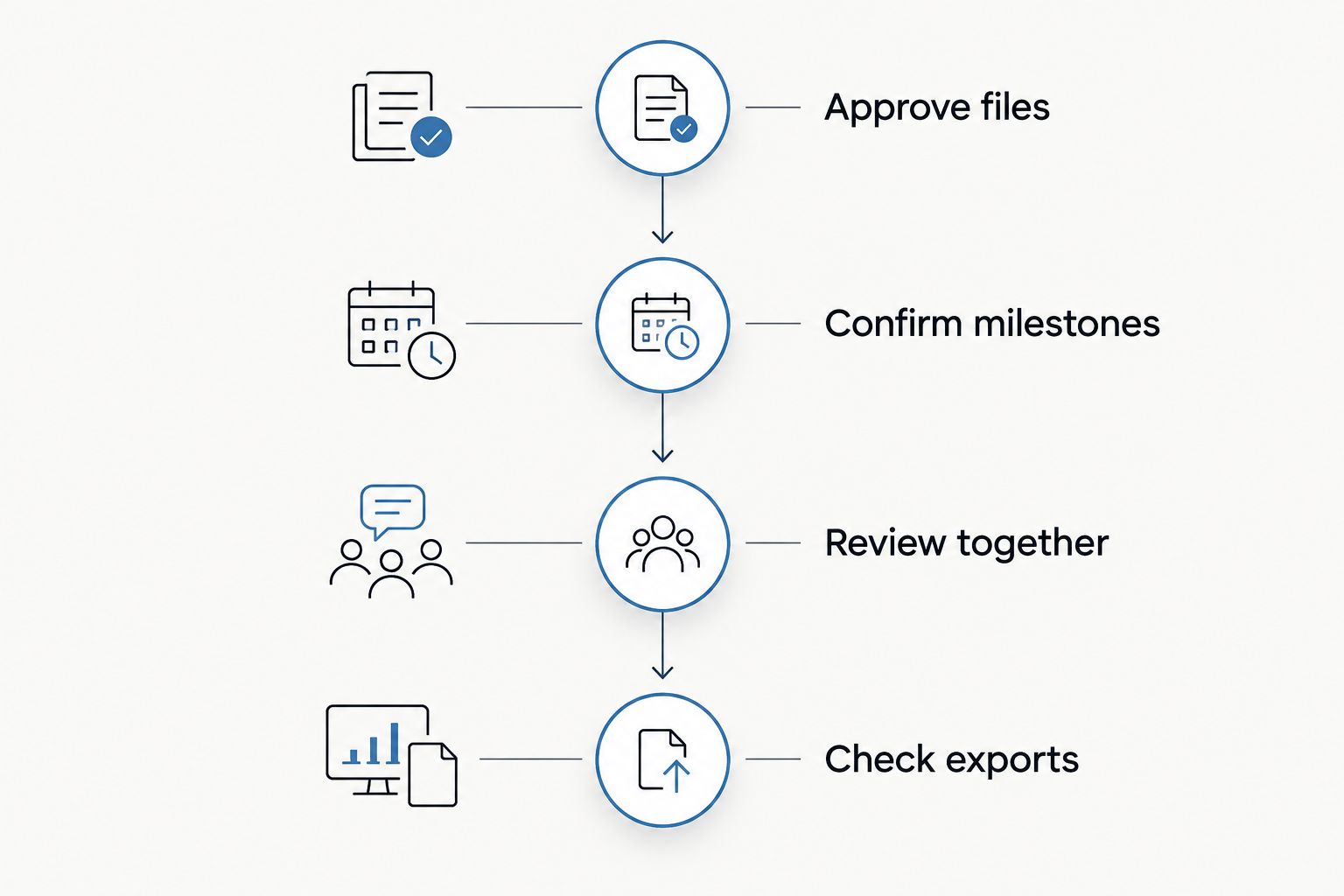
For your 2026 booking, use a sequence that ends with approved files—not merely a first delivery. Keep the engineer’s work, your listening time, and your distributor’s processing requirements separate.
Approve files
Send the final mix and identify it clearly. Include the song title, version, reference material, intended uses, and any issue the engineer should hear before accepting the job.
Confirm milestones
Write down the clock start, first delivery, feedback cutoff, revision return, and final export deadline. Include the time zone. Ask what happens if the supplied file has a technical problem.
Review together
Collect feedback in a single message from your approval lead. Use timestamps and describe the audible issue: a harsh chorus, softened kick attack, or a fade that ends too abruptly.
Check exports
Listen to the delivered files from beginning to end. Check starts, endings, filenames, channel format, and the versions requested in your brief before uploading.
Do not request a sample-rate conversion just to make the file look more professional. Tell the engineer the source format and delivery requirements, then agree on the appropriate exports. If a destination requests 44.1 kHz audio, put that exact requirement in the brief rather than relying on an assumption.
How the ranking works
The ranking prioritizes a defined source, direct communication, revision timing, and final delivery. Reserved-slot stereo mastering is the default because it matches a finished mix to a clearly scoped job. Attended work suits live approval; stems suit agreed group-level intervention; automation suits self-directed decisions.
This is a booking-format comparison, not a claim of measured listening superiority. Choose the format first, then evaluate the engineer’s relevant work and proposed scope.
Find your next music professional
Explore Oohyeah, then confirm the professional’s scope, revision process, and delivery deadline.
Which rush mastering service should you choose?
Choose reserved-slot stereo mastering for an approved mix and a fixed deadline. Move to attended mastering when immediate discussion is central to approval. Choose stems only for an agreed technical reason, and automation when you can evaluate the result independently.
For a 2026 release, reject any booking that defines the first pass but leaves the revision return unresolved. That missing milestone is the difference between receiving audio and having a release-ready master.
FAQ
What's the best rush mastering service for an independent artist?
Reserved-slot stereo mastering is the default for an independent artist with an approved mix and a fixed deadline. Confirm separate times for the first master, feedback, revisions, and final exports before booking.
Can I get a song mastered within 24 hours?
A 24-hour deadline requires the individual engineer’s explicit agreement. Confirm when the clock starts and whether the deadline covers a first pass or approved final files.
Does rush mastering include revisions?
Revision terms depend on the individual agreement. Get the included scope, feedback cutoff, and revision return deadline in writing; do not treat a mix replacement as an automatically included change.
Is attended mastering better than sending files online?
Attended mastering is better suited to artists who need live discussion and can make decisions during the session. A file-based handoff suits an approved mix and a clear written brief.
Should I send stems for rush mastering?
Send stems only when the engineer requests them and confirms the required groups. Otherwise, prepare the approved stereo mix and ask for source-file instructions before exporting additional files.
Can automated mastering replace a human engineer?
Automated mastering can produce a processed version, but processing alone does not provide a human engineer’s discussion or judgment. Choose it when you can assess the result and verify the final exports yourself.
Can I find music professionals through Oohyeah?
Yes. Oohyeah is a marketplace where musicians can hire music professionals, including producers and engineers. Confirm mastering experience, project scope, and delivery terms directly with the professional.
One last thing
Send feedback about the sound, not a prescribed plugin setting. Describe where the problem happens and what you want to hear instead. The engineer needs a clear target; an instruction to turn a particular control can point toward the wrong fix.
Keep the approved mix unchanged while mastering is underway. If you discover a mix problem, flag it immediately and agree on a replacement-file schedule rather than silently uploading another version.