
How to test a used electric guitar: neck, frets, and electronics
Test used electric guitar before buying with neck, fret, pickup, and tuning checks. Spot repair warning signs and know when to get a guitar tech involved.
November 23, 2026
FRANKLY with Frank Lee
To test a used electric guitar before buying, tune it, inspect the neck and frets, play every fret on every string, and check every pickup and control through a clean amp. Then check tuning stability and hardware; a guitar that needs a setup is a different purchase from one with structural damage or unresolved electrical faults.
- Test used electric guitar before buying: check neck relief, fret wear, electronics, and tuning stability before committing.
- Play every fret through a clean amp; distortion can hide weak notes and unwanted noise.
- OohYeah connects gear buyers and sellers; a marketplace listing never replaces a hands-on condition check.
- Get a guitar technician’s assessment when cracks, neck twist, or persistent dead notes remain unexplained.
How do I test a used electric guitar before buying it?
Check condition before chasing tone. Bring a tuner, a cable you trust, and a pick. Ask permission before adjusting anything, and read the guide to checking whether a used instrument listing is legit before arranging the test.
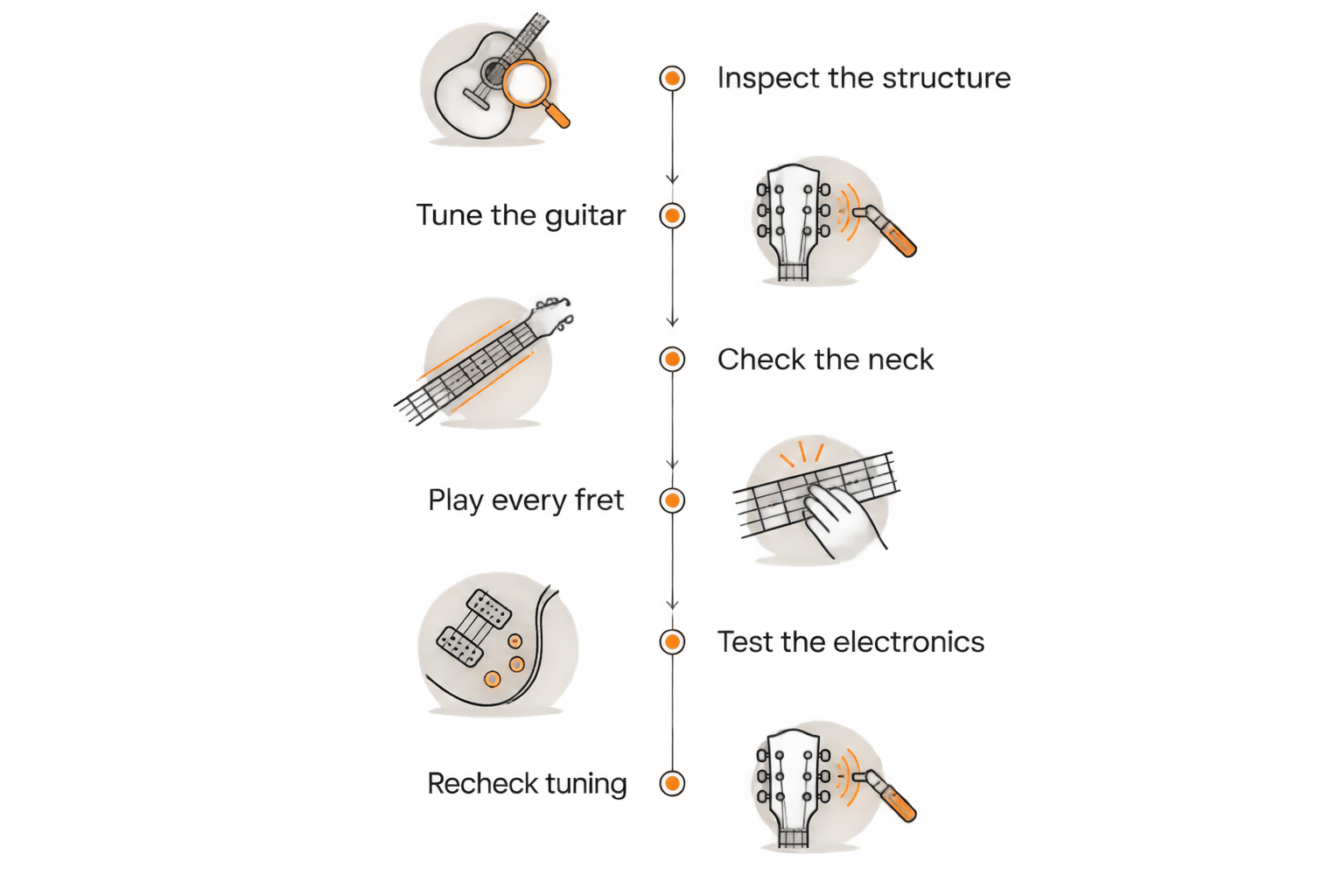
Use this inspection sequence:
- Inspect the structure. Look around the headstock, neck joint, bridge, and repaired areas.
- Tune the guitar. Use the tuning you intend to play, provided the seller agrees and the setup supports it.
- Check the neck. Look for uneven curvature, poor string alignment, and unusual relief.
- Play every fret. Listen for buzzing, dead notes, and bends that choke out.
- Test the electronics. Try every selector position and sweep every control.
- Recheck tuning. Play chords and bends, then check the tuner again.
Finish with music you actually play. A guitar can pass isolated tests and still feel wrong in your hands.
Why this matters
For a used-guitar purchase in 2026, separate what you can observe from what still needs diagnosis. Scratched paint is visible. An intermittent jack or a bend that dies high on the neck takes deliberate testing to catch.
A seller’s explanation is a starting point, not a repair assessment. “It just needs a setup” does not establish whether the cause is neck relief, uneven frets, a worn nut, or damaged hardware.
Check the neck without forcing an adjustment
Hold the guitar in playing position and look along both edges of the fingerboard. Check whether the strings track sensibly over the frets and whether either outer string sits unusually close to the edge. Sight down the neck from the headstock too, but do not treat that view as a definitive diagnosis of twist.
Next, check relief: the slight forward curve that gives vibrating strings clearance. Hold a string at the 1st fret and near the neck-to-body joint, using the string as a straightedge. Look for a small gap around the 7th–8th frets; the appropriate amount depends on the instrument and setup.
Do not demand a perfectly straight neck or a universal gap measurement. String gauge, tuning, playing attack, and the manufacturer’s specifications all matter.
Look closely at these areas:
- Headstock and nut: Check for cracks, separated wood, or signs of a previous repair.
- Neck joint: Inspect gaps and cracks without assuming every finish line is structural damage.
- Fingerboard edges: Feel for sharp fret ends and look for lifting frets.
- Truss-rod access: Ask about adjustment history; leave functional testing to someone qualified.
A repaired neck is not automatically unusable. An unexplained repair needs assessment before you buy.
Test frets, bends, and intonation
Play each string open, then fret each note from the nut to the highest accessible fret. Use your normal picking strength. Repeat a suspect note with your finger close behind the fret to rule out an avoidable technique issue.
Listen through a clean amp. Some acoustic string rattle does not come through the pickup, but persistent amplified buzzing, weak sustain, and notes that die abruptly deserve attention.
Inspect the fret tops under good light. Grooves beneath the strings and broad, flattened crowns show wear, but appearance alone does not tell you whether the frets need dressing or replacement. A guitar technician needs to assess the remaining fret material and overall condition.
Bend notes where you actually play
Bend the treble strings in your usual lead-playing positions. A bend that suddenly stops ringing is called choking out. Uneven frets and an unsuitable setup are possible causes; the symptom alone does not identify the repair.
Compare the octave
Compare the harmonic at the 12th fret with the gently fretted note at the same fret. They should closely match on a tuner when intonation is set correctly. Fretting too hard can pull the note sharp.
An octave spans 12 frets. A mismatch is a reason to investigate string condition, setup, and saddle adjustment—not proof that the neck is defective.
Test pickups, switches, pots, and the output jack
Use a clean amp setting with effects off. Keep the amp controls steady so changes come from the guitar rather than the signal chain. Start at a comfortable listening level.
Play every pickup position
Move through every selector position while playing the same phrase. Listen for dropouts, sudden crackling, and outputs that do not match the guitar’s intended wiring. Different pickups can sound very different, so a tonal change alone is not a fault.
If the guitar has coil-splitting, phase switching, or other extra controls, ask the seller to demonstrate their intended operation. Do not assume every switch has the same function across guitar models.
Sweep every control
Turn each volume and tone knob through its full travel while playing. Check for scratchiness, dead spots, and abrupt signal loss. Control tapers differ, so a volume change that feels uneven is not automatically a broken component.
Check the connection
Seat your known-good cable properly, then gently move the plug without forcing it sideways. Crackling or signal loss needs investigation. A cable fault, loose jack, or wiring problem can produce similar symptoms.
Single-coil pickups can produce hum, and nearby electrical equipment can add interference. Change your position relative to the amp and nearby devices to check whether the noise changes. Stop immediately if you feel electrical tingling; never defeat an amp’s safety ground to remove hum.
For active electronics, ask whether the battery is fresh. Get permission before opening a battery compartment.
Check the bridge, tuners, and tuning stability
Look for missing screws, damaged screw heads, leaning bridge posts, lifting hardware, and saddles that appear to have reached their adjustment limits. Surface tarnish and seized hardware are different problems. Do not force a stiff part to find out which one you have.
Tune, play chords, bend strings, and check tuning again. If the guitar has a vibrato bridge, ask the seller to demonstrate its normal use before trying it yourself. Use the correct arm and avoid aggressive movement during an unfamiliar instrument’s inspection.
Tuning instability can involve strings, nut slots, the bridge, tuners, or setup. Do not accept “bad tuners” as a complete diagnosis. Listen for pinging at the nut while tuning and note which strings return sharp or flat after bends.
Also check strap buttons and the security of the output-jack mounting. A guitar should be safe to hold and play before you worry about recording it.
Why used electric guitar condition varies
These factors explain why similar-looking guitars need different follow-up checks:
- Setup: Relief, string height, and intonation affect playability. An unsuitable setup can hide otherwise usable frets—or make problems harder to isolate.
- Fret wear: Wear patterns follow where and how the guitar has been played. Check the whole neck, not just open-chord positions.
- Strings and tuning: Worn strings and unfamiliar tunings complicate judgments about tone, intonation, and stability.
- Electronics: Pickup type, wiring modifications, and active circuitry change what the controls should do.
- Repairs and modifications: Changed hardware or repaired wood needs explanation and, when uncertain, professional inspection.
Ask what changed and why. A modification is neither an automatic upgrade nor an automatic defect.
Should you proceed, get an inspection, or walk away?
Use this decision table after completing the playing test. It separates a clear condition report from an unresolved diagnosis; it does not substitute for a technician’s assessment.
| Decision | Best for | Evidence to look for | Benefit | Limitation |
|---|---|---|---|---|
| Proceed with the purchase | Players comfortable with the demonstrated condition | Stable performance, working controls, disclosed wear, no unexplained damage | You know how the guitar behaves in your hands | A short test cannot reveal every intermittent fault |
| Arrange a technician’s inspection | Buyers considering a repair or an unexplained playing issue | Persistent buzzing, suspect repair, uncertain neck condition | You get a repair assessment before committing | You need the seller’s cooperation to arrange it |
| Walk away | Buyers unable to accept unresolved condition risk | Refused testing, inconsistent explanations, or significant unexplained damage | You avoid committing without evidence | You leave the instrument behind without resolving its condition |
Buy the condition you can verify, not the explanation you hope is true. If the purchase only makes sense when an unknown fault turns out to be minor, stop and get it diagnosed.
How do I test a used electric guitar when buying online?
For an online purchase in 2026, ask for an uninterrupted demonstration that follows the same inspection sequence. Request close-ups of the headstock, neck joint, fret wear, bridge, and any disclosed repair. A clean-amp recording is more useful for diagnosing faults than an effects-heavy performance.
Ask the seller to play every fret, demonstrate controls, and show tuning before and after bends. Video helps document symptoms; it cannot establish neck feel, sharp fret ends, or every intermittent fault.
Save the condition description and clarify the applicable inspection and return terms before committing. Do not assume a listing or marketplace provides a particular remedy.
Where does OohYeah fit into the purchase?
OohYeah is best for musicians who want a music-focused marketplace for buying and selling gear. Use OohYeah to connect with sellers, then apply the same inspection standards you would elsewhere. A marketplace connection is useful; it is not a hands-on assessment of the guitar.
Selling your current instrument to make room? Create an account and list the gear with clear condition notes. OohYeah has zero seller commissions. Show the same honest tests you would ask another seller to provide.
Is fret buzz always a reason not to buy a used guitar?
Fret buzz is not an automatic rejection. Check whether it happens on isolated notes or across the neck, whether it comes through the amp, and whether it appears under your normal playing attack.
Those observations help a technician diagnose the issue. They do not establish that a setup alone will fix it.
Can I check a guitar properly without an amp?
You can inspect the structure, neck feel, fret edges, and acoustic behavior without an amp. You cannot properly assess the pickups, controls, output jack, or amplified noise that way.
If you cannot plug in, treat the electronics as untested. Do not turn silence about their condition into an assumption that they work.
FAQ
What should I bring to test a used electric guitar before buying?
Bring a tuner, a cable you trust, and a pick, and arrange access to a working amp. Familiar test equipment makes it easier to separate a guitar problem from a signal-chain problem.
What tuning reference should I use for a used-guitar test in 2026?
A 440 Hz reference for A is the conventional tuning reference, but confirm the seller’s tuning and setup before changing anything. An alternate tuning or different string gauge can change how the guitar plays.
How do I know whether a used guitar neck is warped?
Uneven curvature, unusual string alignment, or persistent playing problems justify a guitar technician’s assessment. Sighting down the neck alone does not confirm or rule out a twist.
Should I buy a guitar with scratchy volume knobs?
Treat scratchy volume knobs as a fault to investigate, not a confirmed easy repair. Demonstrate the symptom and get the cause assessed if it affects your decision.
Does a repaired headstock mean the guitar is bad?
A repaired headstock does not automatically make a guitar unusable. Ask for the repair history and have a qualified technician assess the work before committing.
Can I trust a guitar that sounds good with distortion?
A distorted sound alone is not a sufficient condition test. Play through a clean amp to hear weak notes, dropouts, and unwanted noise more clearly.
Does finding a guitar on OohYeah replace an inspection?
No. OohYeah is a music gear marketplace, and you still need to verify the individual guitar’s condition through testing, documentation, and professional assessment where necessary.
One last thing
Before closing your 2026 guitar inspection, replay the exact passage that exposed a problem. Keep the same amp settings and picking attack. If the seller changes the setup or swaps a cable during the demonstration, repeat the relevant checks afterward.
A successful adjustment is useful evidence. An explanation without a repeatable test is not. Leave with a guitar you understand—or leave without the guitar.