Music distributor renewals: what happens to your back catalog?
Music distributor fees for back catalog depend on renewal terms. Check takedown rules, royalties, and transfer requirements before canceling your plan.
October 28, 2026
FRANKLY with Frank Lee
Your back catalog’s fate at renewal depends on your distribution agreement: check whether continued delivery requires an active subscription, release-level renewal, or another arrangement. Cancellation does not automatically settle unpaid royalties or end every service attached to your recordings. Before you stop paying, confirm the takedown rules, save your release records, and arrange any transfer.
- Music distributor fees for back catalog require a contract check: renewal, takedown, and royalty terms are separate questions.
- Keep original audio, artwork, metadata, and recording identifiers before changing distributors.
- An existing recording’s ISRC identifies the recording; it does not guarantee playlist or stream-count continuity.
- OohYeah serves independent artists seeking fan support, not as a substitute for checking their distribution agreement.
Why this matters
Your old releases still need an owner on the admin side. A billing decision affects more than the next upload: it can touch existing delivery, reporting access, royalty collection, and services attached to individual recordings.
Treat your 2026 renewal as a catalog decision, not just an account charge. Separate the job of keeping recordings delivered from the job of earning elsewhere; fan support payments and streaming royalties belong in different parts of your plan.
You need written answers before changing anything. A renewal reminder tells you when billing happens. It does not necessarily explain what happens to every release afterward.
Music distributor renewals: what happens to your back catalog?
The agreement determines whether your existing releases remain delivered after renewal stops. Read the cancellation clause alongside the terms for each release and any optional services. Do not treat an account-wide promise as confirmation that every attached service continues.
Use this table to identify the condition your agreement actually describes. These are contract scenarios to check, not promises about a particular distributor.
| Contract condition | What it means for your catalog | Best for | Main limitation |
|---|---|---|---|
| Continued delivery requires an active subscription | Ending the subscription puts continued delivery at issue | Artists willing to maintain an ongoing account | You must understand the cancellation and removal process |
| Individual releases require renewal | Each release needs its own renewal decision | Artists managing releases separately | Different release dates create separate admin tasks |
| A release has an ongoing-delivery provision | That provision governs what survives cancellation | Artists seeking fewer recurring delivery decisions | Extra services and royalty handling need separate checks |
| Distribution compensation comes from royalties | The agreement governs deductions and service duration | Artists evaluating revenue-linked compensation | Ending account access and ending distribution are not necessarily identical |
Read the actual wording. Look for the difference between disabling automatic renewal, canceling a subscription, closing an account, and requesting a takedown. Those actions describe different instructions; do not assume the distributor treats them as interchangeable.
For your 2026 review, save the relevant agreement and support response with the date. Keep a copy outside the distributor’s dashboard so you can find it after account access changes.
What should you check before renewing or canceling?
Start with the releases, not the plan name. A catalog can contain original tracks, alternate versions, collaborations, and releases covered by different permissions. Put each release on a checklist before making an account-wide change.
Subscription-dependent delivery
If your agreement ties delivery to an active subscription, establish exactly what cancellation triggers. Ask whether the distributor sends removal requests, when that process starts, and whether disabling automatic renewal leaves the current service period intact.
Best for: artists prepared to maintain the account that supports their existing delivery. The drawback is the ongoing admin obligation, especially when nobody is actively releasing new music.
Release-level renewal
If renewal applies to individual releases, map each release to its own terms. Confirm whether a single, an album, and any later version are treated separately under your agreement.
Best for: artists who want to make release-by-release decisions. The drawback is fragmentation: an account-level view alone might not tell you which releases need attention.
Ongoing-delivery provisions
If a provision says a release stays delivered after cancellation, check its scope. Read the exclusions, the termination clause, and what happens if a store removes the recording for reasons unrelated to renewal.
Best for: artists prioritizing continuity without repeated release-level decisions. The limitation is scope: continued delivery is not the same promise as continued access to every reporting, collection, or support feature.
Why music distributor fees for back catalog vary
Compare what an agreement covers before comparing its headline wording. For your 2026 decision, use these factors as questions to put to the distributor:
- Billing unit: Does the agreement apply to the account, artist profile, release, or an optional service? Establish what actually renews.
- Delivery duration: Does continued delivery depend on renewal, or does a separate provision apply to existing releases?
- Collection scope: Does the service cover recording royalties only, or are other collection arrangements attached? Read each authorization separately.
- Attached services: Identify any content-identification, licensing, reporting, or other services you enabled. Check their cancellation terms individually.
- Exit conditions: Look for takedown instructions, termination notice, outstanding balances, and access to historical statements.
Do not label a plan cheaper merely because one line looks smaller. First establish whether the agreements cover the same work. A distribution agreement, a publishing administration agreement, and a fan-commerce account are not interchangeable services.
Build your comparison around the releases you intend to keep active. Exclude features you do not use, but do not remove a service without checking whether it serves a current rights or reporting obligation.
How do you protect your catalog before changing distributors?
Prepare the transfer before requesting removal. The goal is to preserve accurate delivery information and avoid making an irreversible change before the receiving distributor has reviewed your releases.
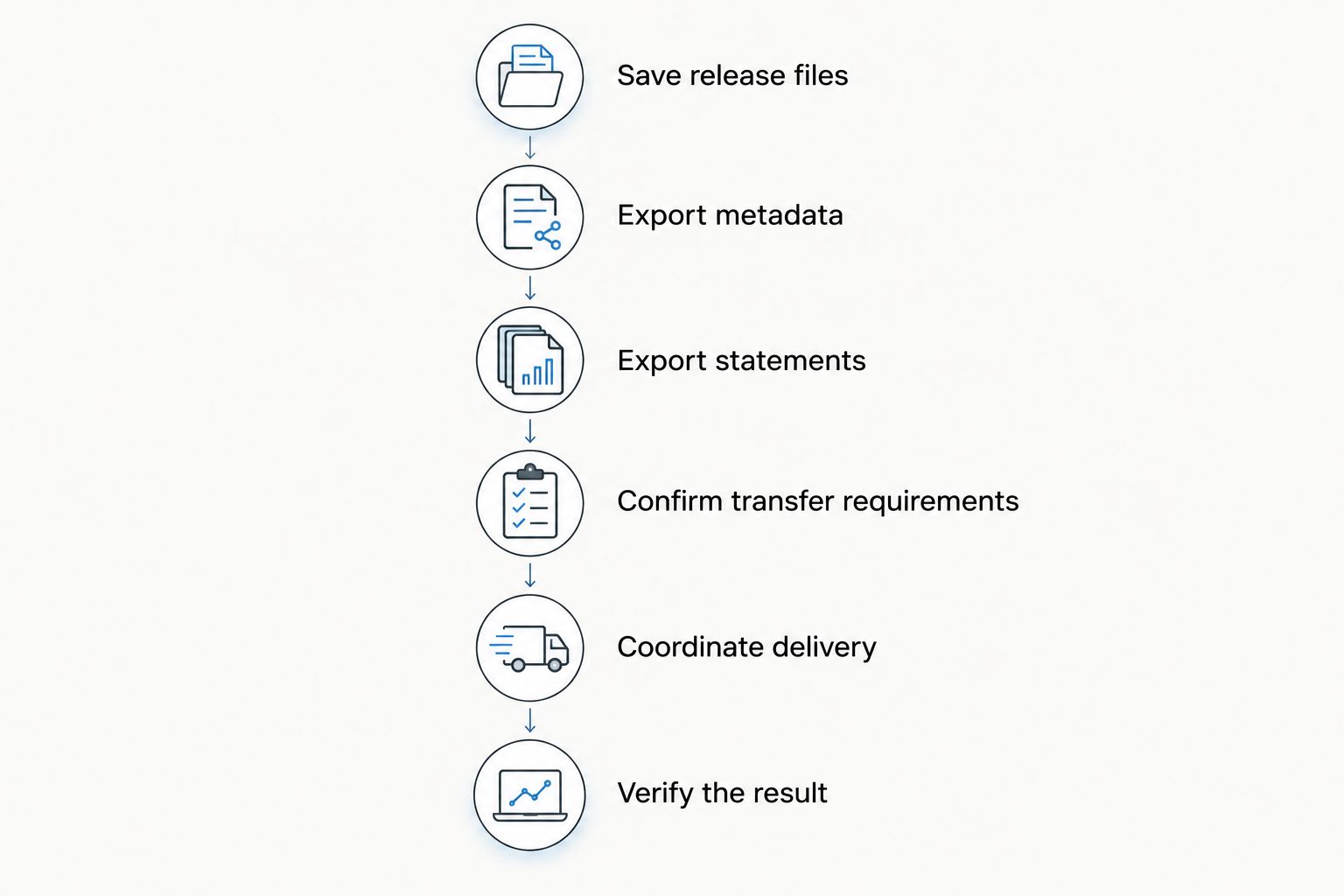
- Save release files. Keep the delivered audio masters and artwork. Distinguish the released version from demos, later edits, and alternate masters.
- Export metadata. Record titles, artist names, credits, version labels, explicit-content settings, original release dates, and identifiers. Save existing store links as reference points.
- Export statements. Download royalty reports and transaction records you need for accounting, collaborators, and unresolved payments. Do not rely on permanent dashboard access.
- Confirm transfer requirements. Ask the receiving distributor how to submit previously released recordings and retain their existing identifiers. Resolve rights or metadata questions before delivery.
- Coordinate delivery. Follow both distributors’ transfer instructions. Confirm the replacement delivery status rather than assuming an upload means the release is live everywhere.
- Verify the result. Check artist profiles, track versions, artwork, credits, and playback. Request removal of the old delivery only as directed by the coordinated transfer process.
The sequence matters more than an arbitrary deadline. Schedule your 2026 renewal review early enough to complete the receiving distributor’s actual requirements, not a guessed transfer window.
Keep one working catalog sheet and one folder of original assets. Give collaborators access to the records they need, but keep account credentials and payment information out of shared release documents.
Will your ISRCs, stream counts, and playlists transfer?
Keep the existing ISRC when transferring the same recording, following the receiving distributor’s instructions. An ISRC is a 12-character recording identifier. It identifies a recording, not a distribution subscription or your ownership of the underlying rights.
Product identifiers serve a different purpose. A UPC-A has 12 digits, while an EAN-13 has 13 digits; these identify a release product rather than an individual recording. Save the identifiers already attached to your catalog and ask which the receiving distributor accepts.
Matching identifiers are not a guarantee of matching store history. Store-side linking also depends on the release information and the platform’s handling of the delivery. Do not promise collaborators that every playlist placement, saved link, or displayed count will survive unchanged.
Check these details against the existing release:
- The audio is the same released recording, not a new edit or remaster.
- Artist names and profile destinations are correct.
- Track titles and version descriptions match the intended release.
- Original release dates and identifiers are entered correctly.
- Territory rights and permissions cover the replacement delivery.
If you are replacing the recording rather than transferring it, say so. A revised master or alternate version requires a separate identifier decision; do not reuse an ISRC simply to chase continuity.
Do you lose unpaid royalties when you cancel?
Cancellation alone does not answer what happens to unpaid royalties. Check the agreement’s payment provisions, reporting access, payout requirements, and termination language before closing the account.
Save statements showing what has been reported and what remains unresolved. Ask how later-arriving reports for earlier activity are handled, whether you retain statement access, and how to update payment details after cancellation.
Keep collaborator accounting separate from the distribution decision. Export any split records and document who is responsible for settling amounts that arrive after the move. Do not treat a catalog transfer as proof that every outstanding payment has transferred with it.
Should you renew if you are not releasing new music?
Renewal is a continuity decision when your agreement makes existing delivery dependent on the account. No new uploads does not, by itself, establish that the account has no remaining job.
List what you still need: delivery, statements, royalty processing, collaborator records, and any separately authorized services. Then decide whether to retain the current arrangement or prepare a transfer that covers those needs.
Ask the distributor directly: what continues if you stop uploading, disable renewal, cancel the plan, or close the account? Get an answer for the action you intend to take. Avoid vague requests to cancel everything.
Keep fan support separate from distribution
OohYeah is best for independent artists who want a marketplace where fans can discover and support their work. That is a different job from checking the contract that keeps an existing catalog delivered to streaming services.
OohYeah connects artist and fan commerce with a marketplace for music gear and professional services. Use that distinction when planning your income: a fan-commerce account does not establish what another company will do with your distributed recordings.
The benefit is another way to connect your work with supporters. The limitation is equally clear: it does not resolve your distributor’s renewal, takedown, or transfer obligations. Keep the catalog admin moving while you build those relationships.
FAQ
Do I have to pay music distributor fees for back catalog every year?
Your distribution agreement determines whether existing releases require recurring renewal. Check whether the obligation applies to your account, individual releases, or attached services rather than assuming every catalog follows the same model.
Will my songs disappear if I cancel my distributor?
Your cancellation terms determine whether the distributor requests removal of your songs. Confirm the consequences of disabling renewal, canceling the subscription, and closing the account before choosing an action.
Can I move old releases to another music distributor?
You can arrange a transfer when you control the necessary rights and meet the receiving distributor’s requirements. Prepare the original audio, artwork, metadata, and existing identifiers before coordinating delivery and removal.
Does keeping the same ISRC preserve all my streams?
Keeping the same ISRC does not guarantee that every displayed stream count or playlist placement will carry over. Use accurate recording identifiers and matching release information, then verify the store-side result.
What happens to royalties reported after I leave?
Your agreement governs royalties reported after departure. Confirm how later statements and payments are handled, and save your reporting records before account access changes.
Does OohYeah replace my music distributor?
OohYeah is described as a marketplace for music gear, professional services, and artist-fan commerce, not as a replacement distribution service. Review your existing distributor’s agreement separately.
One last thing
Test a link, not just a dashboard status. After any catalog change, open a release as a listener and confirm that it leads to the intended artist and recording.
For your 2026 renewal, make the final decision from a saved checklist: delivery terms understood, assets backed up, identifiers recorded, statements exported, and any transfer verified. Keep the music reachable. Keep the paperwork usable.