Fan support vs streaming royalties: when does an artist get paid?
Fan support payments vs streaming royalties timing: neither means instant cash. Trace reporting, payout approval, and bank deposits before spending.
October 24, 2026
FRANKLY with Frank Lee
Fan support starts with a direct payment; streaming royalties reach you after listening activity is reported, royalties are accounted for, and the relevant payee releases your share. Neither route means instant bank access: processing, payout eligibility, account verification, and bank settlement still determine when you can spend the money.
- Fan support payments vs streaming royalties timing comes down to transaction settlement versus royalty reporting and payout.
- A completed fan payment is not necessarily a completed bank deposit.
- Streaming royalties for recordings and songwriting can arrive through different payment channels.
- OohYeah connects independent artists with fans; confirm payout terms before planning spending around support.
Why this matters
Your mastering engineer needs a payment date, not a screenshot of your stream count. Treat money shown in an activity dashboard differently from money available to withdraw—and differently again from money deposited in your bank.
Budget from cleared funds, not attention metrics. That rule applies whether you receive direct fan support, royalties, or both in 2026.
OohYeah is an artist-and-fan commerce platform where fans can discover and support independent artists. That makes it relevant to direct support, but the platform’s purpose alone does not establish a payout deadline.
Fan support vs streaming royalties: when does an artist get paid?
You get usable cash when the payment reaches your receiving account and becomes available—not when a fan presses play or completes checkout. Compare the payment paths before choosing which income to commit to a bill.
| Payment route | What starts the process | What happens before bank access | Best for | Main limitation |
|---|---|---|---|---|
| Direct fan support | A fan submits a payment | Payment processing, any applicable account checks, payout release, and bank settlement | Fans who want to support an artist directly | A successful transaction does not establish an immediate withdrawal date |
| Recording royalties | Listening activity generates royalties under applicable agreements | Usage reporting, accounting through the relevant rights holder or distributor, and payout | Earning from use of your recordings | A stream counter is not a payable royalty statement |
| Songwriting royalties | Use of a composition generates royalties under the relevant rights and licenses | Identification of the composition and rights holders, collection, accounting, and distribution | Writers and publishers earning from compositions | Different rights and collection channels have different schedules |
Direct support skips the streaming-usage reporting stage. It does not skip the payment system.
Streaming income has a different starting point: use of music rather than a fan’s payment to you. The party receiving royalties first also matters. If a label or another rights holder receives the recording income, your agreement governs how that income reaches you.
Direct fan support: follow the transaction to the bank
A fan’s checkout confirmation tells you that a transaction occurred. It does not, by itself, tell you that you can withdraw the proceeds or that your bank has received them.
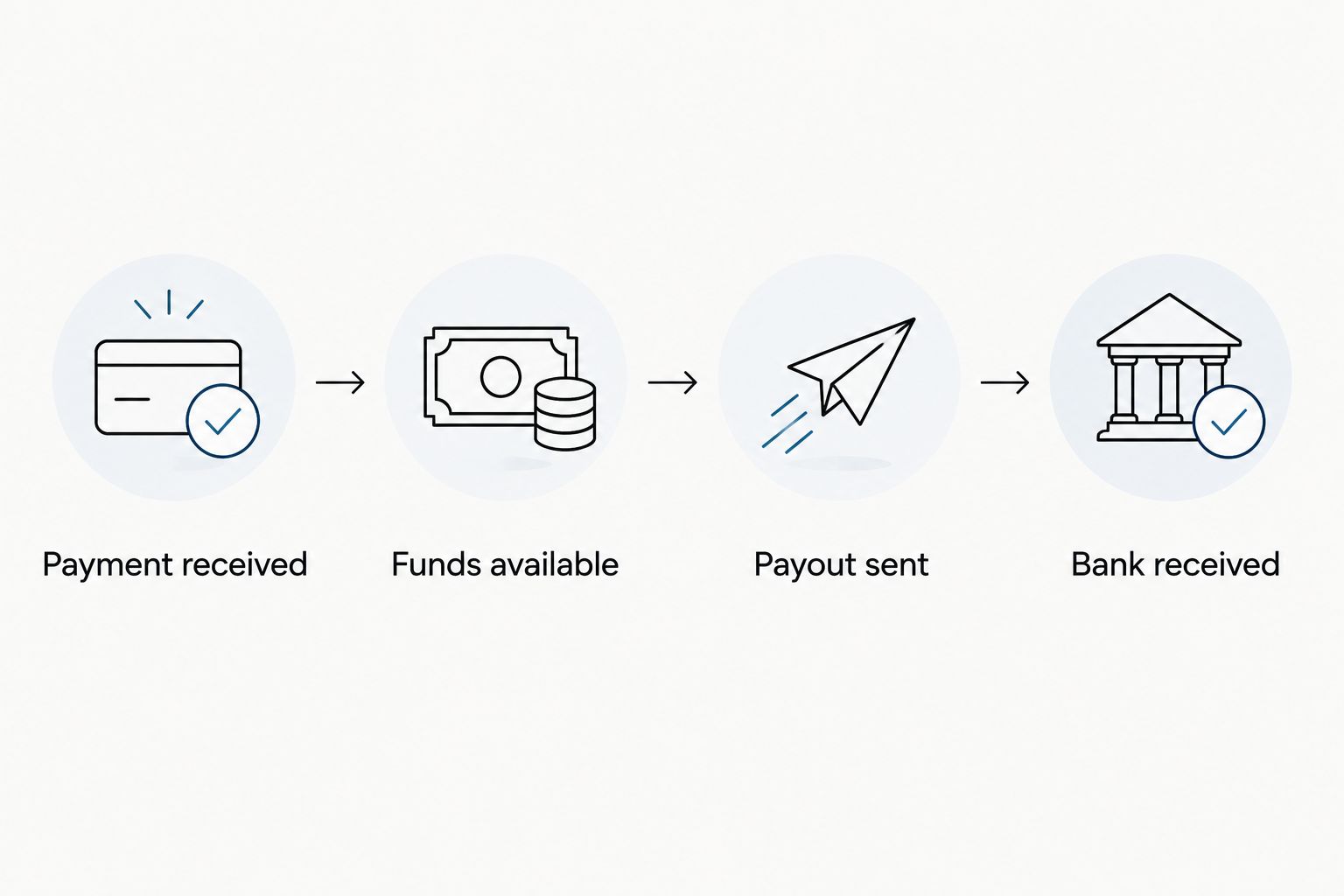
For your 2026 release plan, follow 4 payment milestones:
- Payment received. Confirm the transaction’s status. Distinguish a successful payment from a pending or unsuccessful attempt.
- Funds available. Check whether the proceeds are eligible for payout. Read any account notice explaining a restriction.
- Payout sent. Look for a payout record or transfer reference. A withdrawal request and a sent transfer are different events.
- Bank received. Match the deposit to the payout record. This is the point to confirm that the money is available for your bill.
Keep those statuses separate. A dashboard total can contain activity that has not reached the last milestone.
Before asking fans to fund a release expense, read the payment terms for the support method you intend to use. Check the payout schedule, verification requirements, withdrawal rules, and handling of refunds or disputes.
Sell the music. Explain the support. Verify the payout. If you want a practical campaign sequence, use the guide to turning fan support into real revenue.
Streaming royalties: follow the statement, not the stream counter
A listening dashboard measures activity. A royalty statement accounts for income. They answer different questions, so do not use the former as proof that a payment is due today.
Start with your distributor or rights holder’s reporting information. Identify the usage period covered by a statement, the amount attributed to you, and the conditions for releasing it. Then check whether a payout has actually been initiated.
A statement issued in 2026 can describe listening from an earlier reporting period. Keep the listening period, statement date, and payout date in separate fields. Otherwise, a payment arriving this month can look like revenue generated this month when it belongs to earlier activity.
Your contract matters as much as the dashboard. If another party administers the recording, establish who receives the royalties, who accounts to you, and which payment terms apply. Do not assume your artist account is the first destination for the money.
When a royalty payment looks late, trace the last confirmed event. Has the relevant usage been reported? Has the income appeared on a statement? Has it become payable? Has the transfer been sent? Each answer points to a different next move.
Recording and songwriting royalties: track separate paths
A recording and the composition performed in that recording are distinct rights. Owning your master does not automatically establish ownership of every songwriting share, and writing a song does not automatically establish ownership of its recording.
Track 2 royalty paths separately: recording income and songwriting income. This is an accounting distinction, not a promise that you will receive only that many payments.
For recording income, identify the distributor, label, or other party responsible for accounting to you. For songwriting income, identify the relevant publisher, administrator, or collection organization for the rights involved.
Registration and ownership information matter. Use consistent song titles, writer information, and identifiers where required, and resolve conflicting ownership information with the relevant administrator.
Do not label every music-related deposit as streaming income. A payment description without its statement can hide which rights, recordings, or reporting periods generated the money. Save the supporting record alongside the deposit.
Why artist payment timing varies
There is no shared payout clock for direct support and streaming royalties. For your 2026 cash plan, check these factors against the terms governing each payment route:
- Reporting and accounting schedules. Streaming activity must enter the relevant royalty accounting process before it becomes a payment to you.
- Who receives the money first. A distributor, label, publisher, or administrator can sit between the original payment source and your account.
- Payout eligibility. Check applicable minimum balances, payout schedules, and whether withdrawals require an action from you.
- Account verification. Incomplete identity, tax, or receiving-account information can prevent a payment from progressing.
- Payment status. Pending payments, refunds, disputes, or account restrictions require different actions from a completed transaction.
- Bank processing. A transfer marked sent still needs to reach the receiving account; bank processing and non-business days affect that final stage.
Find the blocked stage before contacting support. Send the transaction or statement reference, relevant dates, and current status—not just your artist name and a missing-payment complaint.
Keep sensitive banking and identity information out of public posts. Use the payment provider’s designated support channel for account-specific issues.
Which route should fund your next release expense?
Direct support is best for inviting willing fans to contribute directly. Its advantage is a transaction tied to that support; its limitation is that checkout success still leaves processing and payout steps to confirm.
Streaming royalties are best for earning from listening activity under your rights agreements. Their limitation for immediate budgeting is the distance between listening, reporting, accounting, and deposit. Do not assign unreported listening income to a bill with a fixed due date.
OohYeah is best for independent artists who want fans to discover and support them directly. That is a community-and-commerce fit, not a claim that OohYeah artist support settles faster than another payment route.
Keep discovery and cash planning connected but separate. A listener can become a supporter, but listening alone does not establish that the listener will make a direct payment. Give fans a clear reason to support the work without treating every play as an expected sale.
If your next expense has a firm deadline, confirm available funds before committing. A promising campaign or rising stream count is encouraging. Neither is a cleared deposit.
How do you check when the money will arrive?
Build 1 payment ledger for your 2026 release. Keep separate entries for direct support, recording royalties, and songwriting royalties so you can trace each deposit to its source.
Use a simple record with these fields:
- Income source: the platform or organization responsible for the payment.
- Underlying activity: the transaction reference or royalty usage period.
- Current status: pending, available, sent, or received, using the provider’s actual wording.
- Next action: complete verification, request withdrawal, review a statement, or investigate a transfer.
- Evidence: the transaction record, statement, payout reference, and matching bank entry.
Record an expected deposit date only when the responsible provider gives you one. Label estimates as estimates. Do not turn an informal assumption into a commitment to a collaborator.
Before paying an engineer or booking a session, check the bank entry rather than adding together every dashboard balance. This keeps your plan tied to money you can actually use.
Does direct fan support always arrive before royalties?
Direct fan support does not have a guaranteed lead over royalties. A new support payment can still be processing while previously accounted-for royalties are already eligible for withdrawal.
Compare payments at the same stage. A fresh checkout and an approved royalty payout are not equivalent starting points, so their arrival order does not prove which route is universally faster.
Can I spend royalties as soon as they appear in my dashboard?
A displayed royalty balance is not automatically spendable cash. Check whether the figure is estimated, finalized, available for payout, or already sent, then confirm the corresponding bank deposit.
Use the platform’s own status definitions. Similar-looking dashboard labels do not establish identical payment rules across providers.
What should I tell collaborators about payment dates?
Give collaborators dates supported by your available funds and written agreement. Do not promise an engineer, producer, or session player payment on the assumption that a campaign or royalty statement will clear first.
Separate the obligation from the funding source. Agree on when you owe payment, then make sure your cash plan supports that commitment.
FAQ
When do artists actually get paid from fan support?
Artists get usable money from fan support when the proceeds complete the applicable payout process and reach their receiving account. A fan’s checkout confirmation does not establish the bank deposit date.
Why are my streams showing but my royalties are not?
Stream activity and royalty accounting are different records. Check the relevant reporting period and statement before treating displayed listening activity as payable income.
Are fan support payments instant?
Fan support payments are not automatically instant bank deposits. Check payment processing, account verification, payout eligibility, and transfer status for the support method you use.
Do recording and songwriting royalties arrive together?
Recording and songwriting royalties do not share a universal payment schedule. They involve distinct rights and can reach you through different rights holders, administrators, or collection channels.
What should I check if my artist payout is missing?
Check the last confirmed payment stage: received, available, sent, or deposited. Use the transaction or statement reference to ask the responsible provider about the stage that has not completed.
Should I use fan support or streaming royalties to pay release bills?
Use cleared funds to pay release bills, regardless of whether they came from fan support or royalties. Treat future support and unreported listening income as uncertain until the payment process confirms otherwise.
Does OohYeah guarantee immediate artist payouts?
Do not treat OohYeah artist support as a guarantee of immediate payout. Confirm the applicable payment and withdrawal terms before setting a spending deadline.
One last thing
The useful date is not always the date the money was earned. For your 2026 release budget, the decisive event is when the deposit becomes available to cover the expense.
Keep the statement. Match the deposit. Then spend. That habit gives you a cleaner answer to “when do I get paid?” than any stream count or checkout notification.