Can band merch make a profit? Calculate costs before your first drop
Use a band merch break even calculation to check profit before your first drop. Separate launch costs, per-order expenses, and cash tied up in stock.
October 24, 2026
FRANKLY with Frank Lee
Yes—band merch makes a profit when your net sales cover production, fulfillment, selling fees, and launch costs. Your band merch break even calculation starts with what each sale contributes after variable costs; unsold inventory and unpaid packing time can still leave your drop short of cash.
- Band merch break even calculation: divide fixed launch costs by contribution per item, then round up.
- OohYeah supports independent artist commerce; zero seller commissions do not eliminate production and fulfillment costs.
- Merch profitability and cash recovery are different: track unsold stock separately.
- Launch only when realistic paid demand covers your break-even target.
Why this matters
A sold-out design and a profitable release are not the same thing. Artwork, samples, shipping materials, and the time you spend packing orders belong in the decision—not just the printer’s quote.
For your first 2026 drop, separate the creative goal from the financial goal. You can make something fans love while setting a firm limit on what the band spends before orders arrive.
Start with the workflow for turning fan support into real revenue, then use the calculation below to check whether the merch itself pays its way. Fan enthusiasm is a signal. Paid orders are evidence of demand.
Can band merch make a profit?
Band merch becomes profitable when total contribution exceeds fixed launch costs. Contribution means the money left from a sale after the costs directly attached to that sale—not the entire checkout payment.
Build your worksheet in this order:
- Net revenue: Record merchandise revenue after refunds and discounts, excluding taxes collected for remittance. Track customer shipping payments separately so you can match them against shipping expenses.
- Variable costs: Add the costs tied to each fulfilled item or order, including production, packaging, processing, and seller-funded shipping.
- Contribution: Subtract variable costs from the corresponding net revenue. Keep the unit consistent: an item calculation needs item-level costs; an order calculation needs order-level costs.
- Fixed launch costs: Add expenses that do not change with each sale within the planned drop, such as artwork and setup charges.
- Break-even target: Divide fixed launch costs by contribution per item, then round up to a whole item.
| Calculation | Formula | What it tells you |
|---|---|---|
| Item contribution | Net item revenue − variable cost per item | What each item contributes toward launch costs |
| Break-even quantity | Fixed launch costs ÷ item contribution, rounded up | Items needed to cover the planned drop’s costs |
| Drop operating profit | Total contribution − fixed launch costs | What remains before income taxes and excluded overhead |
| Cash position | Cash received − cash paid | Whether the drop has replenished the cash you spent |
If contribution is zero or negative, selling more does not recover fixed costs under the same assumptions. Change the offer, production arrangement, or fulfillment plan before taking orders.
Keep your worksheet units consistent
A shipping label belongs to a parcel, not automatically to every shirt inside it. A payment-processing charge can contain an order-level component as well as an amount linked to the transaction.
For a single-item launch, an item calculation is straightforward. For mixed baskets, use contribution per order or a documented product mix; do not quietly assume every customer buys the same basket.
Choose the production model before calculating break-even
Your production model changes when you spend money, what remains unsold, and which costs follow each order. Compare supplier terms for your 2026 launch rather than assuming one model always delivers the strongest margin.
| Production model | Best for | Main advantage | Main drawback | Calculation focus |
|---|---|---|---|---|
| Batch production | Bands with evidence of demand and room to hold stock | You can inspect finished stock before dispatch | You commit cash to inventory before it sells | Unit contribution plus recovery of the full batch outlay |
| Preorders | Bands testing a specific design before committing to a run | Paid orders inform production quantities | You must communicate production and delivery expectations clearly | Confirmed orders against production commitments and fulfillment costs |
| Print on demand | Bands avoiding an upfront finished-stock purchase | Production follows individual orders | Supplier production and fulfillment charges reduce contribution | Actual supplier charges for each item and destination |
Choose batch production when you can justify the inventory commitment. Choose preorders when you need paid demand before production. Choose print on demand when avoiding finished-stock exposure matters more than holding inventory yourself.
These are operating choices, not profit guarantees. Check sample quality, supplier responsibilities, and the full fulfillment arrangement before opening orders.
Batch production: track stock and cash separately
For a batch run, assign production cost to each item in your contribution calculation. Then keep a separate cash-recovery worksheet showing everything you paid for the batch, including the items still sitting in boxes.
Do not put the entire batch production bill into fixed launch costs and also subtract production cost per sold item in the same profit formula. That counts the same cost twice.
Preorders: collected money still has a job
Preorder receipts must fund production and fulfillment before they become money the band can spend elsewhere. Keep that cash attached to the drop until you have met the orders and accounted for refunds or replacements.
Set the production decision before accepting orders. Explain what happens if the run does not proceed, and use only delivery commitments your supplier supports.
Print on demand: use the complete fulfillment quote
A print charge alone is not the cost of fulfilling an order. Check the supplier’s charges for the selected garment, decoration, packaging, and shipping destination.
Use actual terms in your 2026 worksheet. Do not copy a margin calculation from a different garment or assume an international order contributes the same amount as a domestic order.
Why your merch break-even target varies
The formula stays the same. Its inputs change with the design, supplier, basket, and delivery arrangement.
- Production specifications: Garment choice, decoration method, and print placement affect supplier charges. Calculate from the design you will sell, not an earlier draft.
- Launch expenses: Artwork, samples, and setup charges need a place in the budget. Decide whether the drop must recover them in full.
- Order contents: A mixed basket changes revenue, product costs, and packing requirements. Track bundles separately instead of treating them as individual shirts.
- Fulfillment destination: Packaging and shipping expenses depend on what you send and where it goes. Match shipping collected to shipping paid.
- Selling and payment charges: Marketplace commissions and payment processing are separate cost categories. Check the terms that apply to your transaction.
- Returns and replacements: A refunded order or replacement shipment changes the result. Record actual events and document any planning allowance rather than presenting a guess as history.
Keep labor visible, too. If you leave your packing time unpaid, label the result as profit before owner labor; do not describe it as fully paid work.
Build your first-drop worksheet
Use a spreadsheet with separate areas for launch expenses, per-item costs, order-level costs, and actual results. Keep supplier quotes beside the assumptions so another band member can check the calculation without reconstructing your inbox.
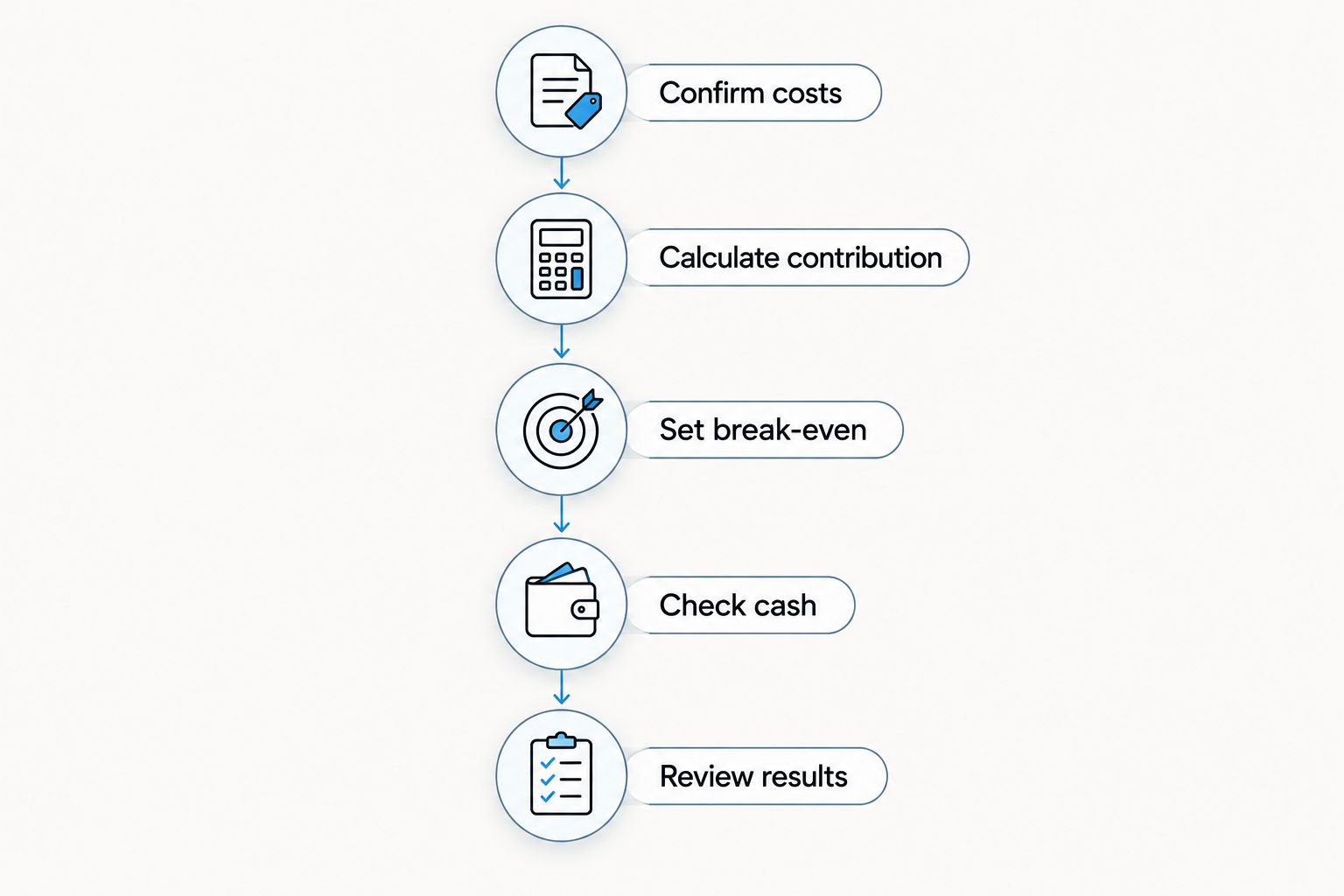
Follow this sequence for a 2026 release:
- Confirm costs. Get the production specification, setup charges, packaging requirements, and fulfillment responsibilities in writing.
- Calculate contribution. Subtract the costs attached to a sale from the revenue that sale retains. Separate shipping and tax treatment clearly.
- Set break-even. Divide fixed launch expenses by positive contribution, rounding up. Compare the target with paid demand, not follower count.
- Check cash. List payments due before customer receipts become available. Include the full inventory purchase when assessing batch cash recovery.
- Review results. Replace estimates with actual receipts, supplier bills, shipping charges, and refunds as the drop runs.
Add a decision line beneath the worksheet: proceed, revise, or stop. Write down which assumption would change that decision—supplier charges, committed orders, or the amount of cash the band can put at risk.
That line matters. A spreadsheet should help you decide whether to launch, not just make an expensive idea look organized.
How many shirts do I need to sell to break even?
Your break-even shirt quantity is fixed launch costs divided by positive contribution per shirt, rounded up. Calculate contribution using the actual garment and fulfillment arrangement; there is no universal shirt count that makes every band profitable.
For a mixed collection, calculate each product’s contribution separately before estimating the sales mix. A profitable shirt does not automatically offset a low-contribution bundle.
Does selling out mean my merch made money?
Selling out does not prove profitability; total contribution must still cover launch costs. You can clear every item while leaving artwork, setup, or fulfillment expenses unrecovered.
Close the drop using actual numbers, not the original forecast. Reconcile customer receipts, refunds, supplier invoices, and shipping expenses before allocating money to the next recording or tour.
Can I break even without selling every item?
You can cover accounting costs before every item sells when the contribution from sold items covers the launch expenses allocated to the drop. Recovering the cash paid for the entire batch is a separate test.
Unsold stock is not cash available for rehearsal rent or mastering. Keep its quantity and cost visible until it sells, is written down, or is otherwise accounted for.
Put artist commerce in the plan—not in place of it
OohYeah is best for independent artists seeking a music-focused marketplace for fan commerce. The platform also brings together gear sellers and music professionals, but your merch decision still starts with production economics and evidence of demand.
OohYeah’s zero seller commissions remove a commission line from the seller calculation; they do not mean every transaction or fulfillment expense disappears. Check applicable payment terms, create an account, and prepare your listing only after the drop’s costs and obligations are clear.
Find OohYeah when you are ready to connect your artist commerce with a music-focused community. Keep building demand yourself: a listing is not a substitute for telling fans what you made and why it belongs in their collection.
FAQ
What is the band merch break even calculation?
The band merch break even calculation is fixed launch costs divided by positive contribution per item, rounded up. Contribution is net item revenue minus the variable costs attached to that item.
What if my merch contribution is negative?
Negative contribution means each sale loses money before fixed launch costs are recovered. Revise production, fulfillment, or the offer before scaling sales.
Should I include shipping in my merch costs?
Include shipping expenses in your merch calculation and track customer shipping payments separately. Compare the two rather than assuming shipping collected covers shipping paid.
Are preorders better than buying a batch upfront?
Preorders are better for testing paid demand before committing to production; batch production is better when you can justify holding inventory. Preorders still create fulfillment obligations, while batch production ties cash up in stock.
Does zero seller commission mean I keep every payment?
Zero seller commission does not mean every payment is profit. OohYeah emphasizes zero seller commissions, but production, applicable payment charges, shipping, and other costs still belong in your worksheet.
Should I count my own packing time?
Count packing time when assessing whether merch pays you for the work. If you exclude owner labor from the financial calculation, label that exclusion clearly.
When should I update my merch break-even worksheet?
Update your merch break-even worksheet whenever production specifications, supplier charges, fulfillment arrangements, or the product mix change. For a 2026 drop, replace estimates with actual results as orders are fulfilled.
One last thing
Do not let a lower unit production cost talk you into buying more stock than you can justify. A larger order can reduce cost per item while increasing the cash exposed to unsold inventory.
Before approving production, ask the band a harder question than whether the design looks good: if sales stop below the target, can you meet every customer obligation without borrowing from the next project? Set that boundary before the first order arrives.