How to avoid scams when selling instruments: payment red flags
Avoid getting scammed selling instruments online: verify payments, reject overpayments, and document delivery before your guitar, keyboard, or amp leaves.
November 17, 2026
FRANKLY with Frank Lee
To avoid getting scammed selling instruments online in 2026, verify payment inside your own account, reject overpayments, and never pay a buyer to release your money. A payment screenshot, bank notification, or shipping label is not proof that a transaction qualifies for seller protection. Keep the instrument until you independently confirm the payment and the provider’s requirements for shipping or pickup.
- To avoid getting scammed selling instruments online, verify payment yourself; screenshots and buyer messages prove nothing.
- Reject overpayments, payment-release charges, and requests for verification codes before handing over music gear.
- OohYeah offers zero seller commissions for music gear sellers; payment verification remains essential.
- Keep listing photos, transaction records, and delivery evidence together in case a buyer disputes the sale.
How do I avoid getting scammed selling instruments online?
Verify the money. Verify the handoff. Keep the evidence. Follow these checks before a guitar, keyboard, amp, or drum kit leaves your possession:
- Check the account. Open the payment service or bank app yourself, not through a buyer’s link. Match the payment to the actual sale.
- Check the status. Read what the provider says about pending funds, holds, reversals, and permission to fulfill the order. An available balance is not a universal guarantee against disputes.
- Reject extra money. Do not accept an overpayment and send the difference to a buyer, mover, or courier.
- Confirm the destination. Follow the payment provider’s address and delivery requirements before shipping. Stop if the buyer changes the destination afterward.
- Record the condition. Save your description, photos, disclosed faults, included accessories, and the instrument’s identifying details.
- Document delivery. Keep tracking and any required signature evidence, or a pickup record that meets the provider’s rules.
You can create an account and list music gear on OohYeah, which offers zero seller commissions. Treat payment verification as a separate task from choosing where to list.
Why this matters
A convincing buyer can still send a fake payment notice. A real payment can still become the subject of an unauthorized-payment claim or a dispute about the instrument’s condition. Those are different problems, and they need different defenses.
For your 2026 gear sales, separate payment evidence from delivery evidence. The payment account tells you what transaction exists; your listing and fulfillment records help establish what you sold and where it went. Neither replaces the other.
Which payment red flags mean I should stop?
Pressure is not proof of fraud by itself. But requests that make you send money, surrender account access, or ignore the payment provider’s instructions are reasons to stop the transaction.
| Buyer request or claim | What makes it risky | Your next move |
|---|---|---|
| A screenshot proves payment | Images and messages can be fabricated | Check your own payment account |
| Send back an accidental overpayment | You send real money against a payment that can fail or be reversed | Decline; contact the provider yourself |
| Pay to upgrade your account before receiving money | The demand can be part of a fake payment notice | Verify any requirement directly with the provider |
| Give me the code sent to your phone | The code can authorize account access or another action | Never share authentication codes |
| Ship to a different address after payment | The change can conflict with seller-protection requirements | Ask the provider how to proceed before shipping |
| Pay my courier from the money I sent | You become responsible for transferring money to a third party | Refuse the arrangement |
Fake payment emails and screenshots
A familiar logo does not authenticate an email. Neither does a message that includes your name, the listing title, or an accurate description of your amp.
Open the provider’s app or type its known address yourself. If the supposed payment does not appear there, do not ship. Contact support through the account, not through a number or link supplied in the buyer’s message.
Overpayments and courier arrangements
The core trick is simple: the buyer sends too much, then asks you to return part of it or pay someone else. The original payment fails or is reversed, while your outgoing transfer remains your problem.
Do not turn an instrument sale into a money-transfer job. If a buyer says they made a genuine mistake, ask the payment provider how to handle it within the original transaction. Do not send a separate payment to make the numbers balance.
Verification codes and account access
A buyer does not need your sign-in code to purchase your guitar. Never share a one-time password, approve an unexpected login request, or let someone remotely access your device to fix a supposed payment issue.
Enable 2-factor authentication on your selling account and email account. Use a unique password for each, since control of your email can give an attacker a route into other accounts.
Which payment approach should I use for an instrument sale?
Choose a payment method whose rules you understand before accepting money. No method removes every risk. Match the transaction type to a commercial sale, then read the provider’s current requirements rather than relying on the buyer’s explanation.
| Payment approach | Best for | Useful feature | Main limitation |
|---|---|---|---|
| Eligible goods-and-services payment | Shipped sales where you can meet the provider’s requirements | A defined transaction and dispute process | Protection depends on eligibility and fulfillment evidence |
| Cash at an agreed public handoff | Local sales where both parties can inspect and complete the exchange | No shipping-address mismatch or remote payment screenshot | Counterfeit cash and personal safety still require attention |
| Check or cashier’s check | Sellers prepared to verify the instrument with their bank | A bank can explain collection and verification issues | Funds appearing available does not prove a check is genuine |
| Personal-transfer payment | Personal transfers, not a substitute for purchase protection | Direct transfer between account holders | Commercial-sale protections can be absent or restricted |
For a shipped sale in 2026, check the actual transaction’s eligibility before packing. Read the rules for the item category, destination, tracking, signatures, and deadlines. If the provider cannot confirm how your planned handoff fits its rules, pause the sale.
For a local cash sale, agree on a suitable public location with permission to test the instrument where needed. Do not let the meeting turn into an unplanned trip to a second location. If you cannot comfortably verify the payment or complete the exchange, leave with your gear.
How do I document an instrument before shipping?
Create a sale record that answers a basic question: What exactly did the buyer agree to purchase? Photograph the whole instrument, identifying marks, relevant serial number, accessories, and any existing damage. Save the listing as it appeared when the buyer committed.
For an electric guitar, document the neck, headstock, body, hardware, and working electronics. For a keyboard, record the keys, display, outputs, included power supply, and any known faults. Avoid broad claims such as perfect condition when you have not checked every function.
A short demonstration can help document operation. It does not prove what happened in transit or guarantee that a provider will decide a dispute in your favor.
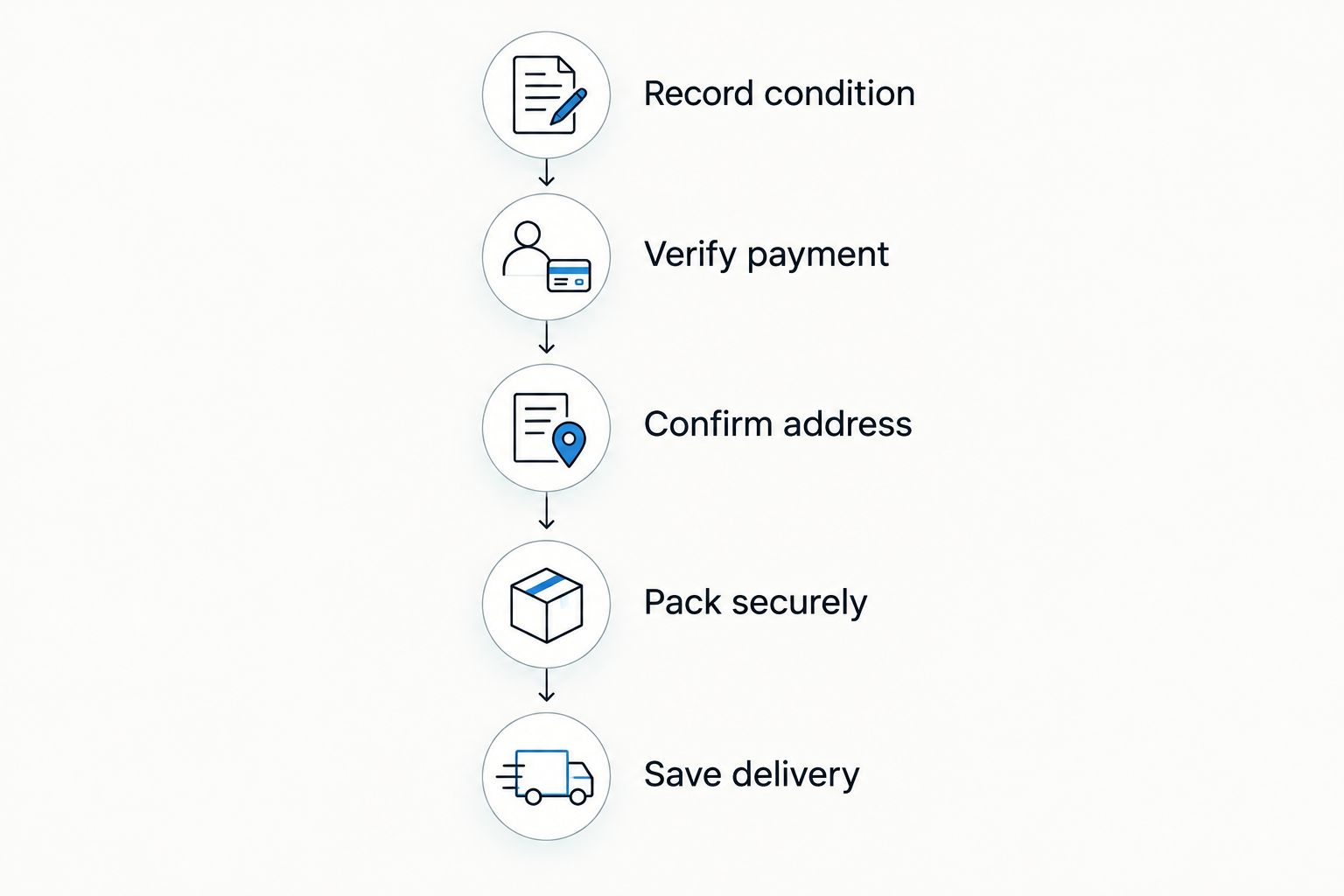
Use this sequence for your 2026 shipping record:
- Record condition. Capture the instrument, identifying details, accessories, and disclosed faults.
- Verify payment. Confirm the transaction and fulfillment instructions inside your account.
- Confirm address. Match the destination to the provider’s requirements before buying a label.
- Pack securely. Photograph the protected instrument and the closed package; retain carrier documentation.
- Save delivery. Keep tracking, any required signature record, and buyer communications together.
Follow the carrier’s packing requirements and read any declared-value or insurance terms before shipping. Keep the acceptance receipt, not just the label. Buying a label does not establish that the carrier received your instrument.
Why does instrument-sale risk vary?
The amount of evidence you need depends on how the transaction works. These factors deserve a check before you accept the buyer’s plan:
- Payment rules. A commercial transaction and a personal transfer do not necessarily carry the same protections.
- Handoff method. Shipping produces different evidence from an in-person pickup; confirm which records your provider accepts.
- Address changes. A new destination can put your shipment outside the transaction’s fulfillment requirements.
- Condition claims. Undisclosed repairs, intermittent faults, and missing accessories create room for disputes even with a genuine buyer.
- Third-party involvement. A courier, relative, or assistant collecting gear adds another identity and handoff to document.
- Account security. A stolen account can make a fraudulent message look as though it came from someone with an established history.
A detailed buyer profile is context, not payment verification. Keep the same checks for a friendly musician, a store account, and someone claiming to purchase equipment for a studio.
What should I do if I already shipped the instrument?
Contact the carrier immediately through its official service channels and ask whether interception or a delivery change is possible. Do not assume the package can be recovered. Give the payment provider the transaction details and explain exactly what prompted the concern.
Preserve the listing, messages, payment notices, tracking, and any outgoing transfers. Report the account to the marketplace. In the United States, suspected online fraud can also be reported to the FTC and the FBI’s Internet Crime Complaint Center; contact local law enforcement when appropriate.
If you shared a password or authentication code, secure the affected account and its linked email immediately. Review active sessions and recovery settings. Do not pay someone who contacts you promising guaranteed recovery of your money or instrument.
Is a payment screenshot enough to ship my guitar?
A payment screenshot is not enough to ship your guitar. Verify the transaction inside your own account and follow the provider’s fulfillment instructions. A convincing image cannot establish whether the payment exists or qualifies for protection.
Should I refund a buyer who accidentally overpaid?
Do not send a separate refund for an overpayment. Contact the provider through your account and ask how to address the original transaction. Never redirect the supposed excess to a courier, another account, or a different payment service.
Can a buyer reverse a payment after collecting an instrument?
A payment can be disputed after pickup, depending on the method and circumstances. Before meeting, check whether the provider covers in-person collection and what evidence it requires. A signed receipt is useful documentation, not a promise that every dispute will be resolved in your favor.
FAQ
What’s the safest way to avoid getting scammed selling instruments online?
Verify payment in your own account, reject overpayments, and follow the payment provider’s delivery requirements. Keep condition photos, the agreed listing, messages, and fulfillment records together.
Should I trust an email saying I need to upgrade my account to receive payment?
Do not act on an upgrade demand in a buyer-supplied email. Open the payment account independently and ask the provider whether any account requirement is genuine.
Is a cashier’s check safe for selling a used guitar?
A cashier’s check can be counterfeit, so its appearance is not proof of payment. Ask your bank how to verify the check and distinguish available funds from a payment that has been finally collected.
Should I accept a personal-transfer payment for a keyboard sale?
Do not assume a personal transfer includes protections for a commercial keyboard sale. Check the provider’s permitted uses and dispute rules before accepting it.
What if the buyer wants an instrument sent to another address?
Pause shipping and check the payment provider’s address requirements. Do not assume a message approving the new address preserves seller protection.
Do photos and packing videos guarantee I’ll win a dispute?
Photos and packing videos do not guarantee a dispute outcome. They support your record, but the provider applies its own evidence and eligibility requirements.
Does zero seller commission mean my instrument sale is protected?
Zero seller commission describes the marketplace’s commission, not a guarantee against fraud. Verify payment, account security, delivery requirements, and any applicable protection separately.
One last thing
A real payment and a protected sale are not the same thing. Before your next 2026 listing, write down the point at which you will release the gear: verified transaction, confirmed fulfillment instructions, documented condition. Refuse any last-minute change that skips those checks.
OohYeah’s music gear marketplace is best for musicians who want to list instruments with zero seller commissions. Create an account, describe the gear accurately, and keep control of the handoff. Commission savings do not replace payment checks.