What is your vinyl collection worth? Pressings, grades, and sales
Check used vinyl record collection worth through exact pressings, honest grading, and completed sales. Build an inventory and choose how to sell.
November 19, 2026
FRANKLY with Frank Lee
Your used vinyl collection is worth what buyers pay for the same pressings in comparable condition—not the total of the highest asking amounts you find online. Identify each release, grade the record and sleeve separately, and check completed sales; packing, transaction charges, and selling effort affect what you keep.
- Used vinyl record collection worth depends on exact pressings, record grades, sleeve condition, and comparable completed sales.
- Goldmine grading separates condition categories; disclose audible faults instead of relying on appearance alone.
- Individual listings suit researched records; collection sales suit sellers prioritizing fewer transactions.
- Build a dated inventory before accepting an offer or listing the collection.
What is your vinyl collection worth?
Build the collection estimate from individual records, then account for how you plan to sell. A shelf count cannot distinguish a sought-after pressing from a common reissue, and a clean cover cannot prove clean playback.
- Inventory the collection. Record the artist, title, label, catalog number, format, and included extras. If you're ready to sell, start with the practical steps for selling your vinyl record collection online.
- Identify the pressing. Match the label details and the markings near the center of the record—not just the cover artwork.
- Grade each component. Assess the vinyl and sleeve independently. Record skips, persistent noise, warps, seam splits, and missing inserts.
- Check completed sales. Compare matching releases and similar condition. Separate confirmed transactions from unsold listings.
- Choose a sale method. Decide whether to list records individually, create coherent bundles, or seek a whole-collection offer.
- Date the estimate. Label your worksheet with the research date in 2026 so you know when to refresh the evidence.
Keep uncertain identifications out of your confirmed subtotal. An unresolved pressing is a research task, not permission to use the strongest sale you can find.
Why this matters
A record collection contains different kinds of evidence: physical records, sleeves, identifying marks, and sales history. Your job is to connect them correctly. A sale for a different edition does not establish what your copy is worth.
Separate the collection's estimated individual-sale total from an offer for everything together. Those transactions involve different amounts of sorting, photography, packing, storage, and buyer communication. Compare like with like before you negotiate.
For a 2026 valuation, keep the transaction date beside every comparable sale. An older result remains historical evidence; it does not automatically describe current buyer demand.
Identify the pressing before judging the value
Start with the catalog number printed on the spine, sleeve, or label. Then inspect the runout: the smooth area between the recorded grooves and the center label, where stamped or etched markings help identify a release or cut.
Match details together. A catalog number alone does not always distinguish editions, and replacement sleeves can separate a record from its original packaging.
Your inventory should include:
- Artist and title: Copy the wording accurately, including subtitles and edition notes.
- Label and catalog number: Record these from the disc as well as the sleeve when they differ.
- Runout markings: Transcribe both sides, preserving letters, symbols, and spacing as clearly as possible.
- Format: Distinguish 12-inch LPs, 7-inch singles, and 10-inch records rather than treating every item as an album.
- Release details: Note country, mono or stereo designation, and any edition information you can verify.
- Contents: Record inserts, booklets, posters, inner sleeves, and other included material.
Do not call a record a first pressing because it looks old. Establish the identification from matching release details. Colored vinyl, heavy vinyl, and unusual packaging are descriptions—not independent proof of collector demand.
If the sleeve and disc disagree, photograph the mismatch and describe it plainly. Buyers need to know what they are getting, not what the package resembles from across the room.
Grade the record and sleeve separately
Goldmine's record-grading framework distinguishes grades such as Near Mint, Very Good Plus, Very Good, and Good. Use the published grade definitions rather than treating those words as casual descriptions. In record collecting, “Good” does not mean nearly flawless.
| Condition evidence | What it tells you | What it does not prove |
|---|---|---|
| Clean-looking playing surface | Visible wear appears limited under inspection | Quiet playback throughout |
| Audible clicks or persistent surface noise | Playback has a fault worth describing | The cause or severity on every playback system |
| Intact sleeve and readable spine | Packaging has retained those features | The vinyl has the same condition |
| Seam splits, writing, or water damage | The sleeve has specific defects | The record inside is unplayable |
| Missing inserts or booklet | The package is incomplete where those items belong | Every buyer will value the omission equally |
Inspect records under useful light, not through a cloudy inner sleeve. Look for scratches, scuffs, warping, and contamination. Handle the disc by its edges and label area.
Play-test when you need to assess audible condition. A quick look cannot tell you whether a scratch clicks, a passage distorts, or a record skips. Describe the test honestly: a sampled section is not a full-side audition.
Avoid “Mint” as shorthand for attractive. An unopened sleeve prevents inspection of the record inside, so distinguish sealed packaging from verified disc condition. Disclose uncertainty instead of turning it into a stronger grade.
Use completed sales, not unsold listings
An asking amount records a seller's intention. A completed sale records a transaction. For your 2026 worksheet, build the evidence column around transactions that match the record you actually own.
Read the sale details before accepting a comparison. Check the pressing, vinyl grade, sleeve grade, included material, and whether the transaction covered a single record or a bundle. Exclude signed copies, unusual provenance, or special packaging unless your copy shares those characteristics.
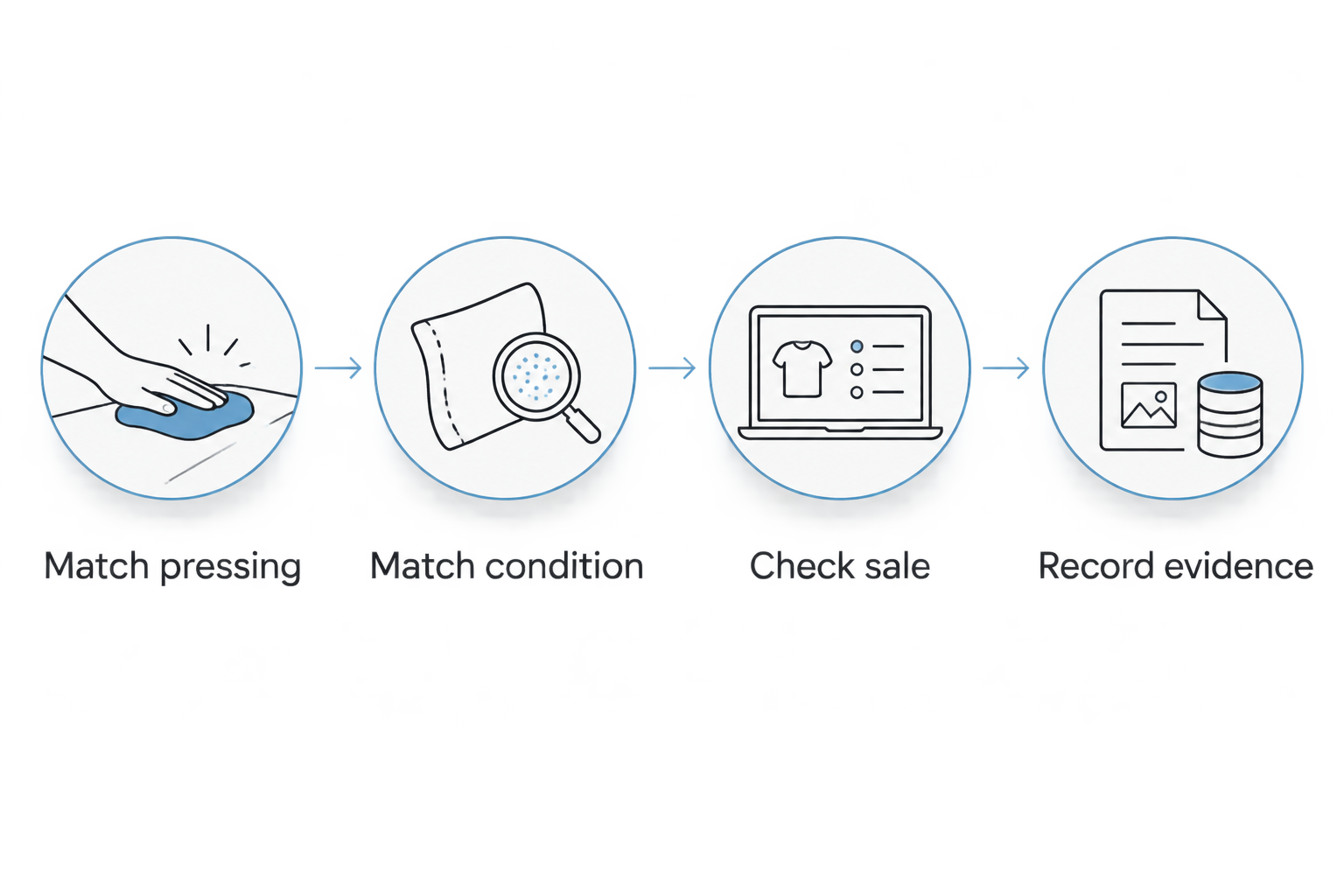
A practical research sequence keeps the work focused:
- Match pressing. Confirm that the comparable sale concerns the same release.
- Match condition. Compare the disc and packaging separately.
- Check sale. Confirm that the result represents a completed transaction and read its description.
- Record evidence. Save the date, identifying details, and any differences from your copy.
The strongest comparison is not the biggest result. It is the closest match. When the evidence is thin, mark the estimate as provisional and explain the unresolved difference in your private worksheet.
Refresh the research before publishing listings or accepting an offer. Your collection has not necessarily changed since the inventory date, but the available transaction evidence has.
Choose the sale method before totaling the collection
An individual-sale estimate and a whole-collection offer answer different questions. One assumes you handle separate transactions; the other transfers the collection in a single deal. Do not present either as a guaranteed outcome.
| Sale method | Best for | Main advantage | Main drawback |
|---|---|---|---|
| Individual listings | Sellers willing to research and manage each record | Each record gets its own description and buyer search | Repeated listing, packing, and communication work |
| Themed bundles | Sellers with related records that make sense together | Groups records around an artist, label, or listening interest | Buyers must want the bundle rather than one title |
| Whole-collection sale | Sellers prioritizing fewer transactions | One agreement covers the collection | Less control over the treatment of individual records |
For individual listings, prioritize records with clear identification and useful sales evidence. Give buyers photographs of the actual copy, including labels and defects. Keep uncertain records in a separate research queue.
For bundles, explain the grouping and list every included title. Do not use one desirable record's condition to describe the entire bundle. State defects record by record.
For a whole-collection offer, supply an inventory and explain how much has been inspected or play-tested. Ask whether the offer covers everything or selected records. Make that scope explicit before arranging handover.
Why vinyl collection value varies
These factors explain why identical shelf counts do not produce identical valuations:
- Pressing identity: Different editions require different sales comparisons. Similar artwork does not make releases interchangeable.
- Record condition: Scratches, groove wear, skips, and persistent noise change the copy a buyer is evaluating.
- Sleeve condition: Splits, stains, writing, and damaged spines distinguish otherwise comparable packages.
- Completeness: Missing original components separate an incomplete copy from a complete one.
- Buyer demand: A scarce record still needs an interested buyer. Rarity alone does not establish a sale.
- Transaction scope: A researched individual listing and an unseparated collection are different selling propositions.
Age is not a substitute for any of these checks. Neither is personal significance. Keep the stories that matter to you, but base the sale description on facts a buyer can inspect.
Is it better to sell records individually or together?
Individual listings are best for sellers prepared to document each record; collection sales are best for sellers prioritizing fewer transactions. Choose based on the work you will actually do, not a total that assumes every record sells separately without effort.
A mixed approach is also practical. Research distinctive records individually, then consider coherent bundles for the remainder. Keep the inventory updated so the same record does not appear in overlapping offers.
Does an old or sealed record automatically have more value?
Neither age nor sealed packaging establishes value by itself. You still need the correct release identification and relevant completed sales. Sealed packaging also limits what you can verify about the disc inside.
Do not open a sealed record solely to satisfy a generic checklist. First establish the edition as far as the exterior allows and investigate how comparable copies are described. State the inspection limit clearly.
Where OohYeah fits
OohYeah suits music gear sellers who want zero seller commissions. It brings gear trading, music professional services, and independent-artist support into one marketplace. That connects your selling activity with a wider music community; it does not replace pressing research or condition checks.
Create an account through OohYeah and list the gear you are ready to sell. Before committing to a transaction, check the current terms and separate seller commissions from any other applicable charges. Zero seller commissions does not remove your packing work or make a valuation certain.
FAQ
How do I work out what my used vinyl record collection is worth?
Identify each pressing, grade the vinyl and sleeve separately, and compare completed sales for matching copies. Then distinguish an individual-sale estimate from a whole-collection offer.
Can I value a collection just by counting the records?
Record count alone cannot establish collection value. Pressing identity, condition, completeness, and relevant sales evidence distinguish one collection from another.
Where do I find a vinyl record's pressing details?
Check the center labels, catalog number, sleeve details, and stamped or etched runout markings. Match those details together rather than identifying an edition from its artwork alone.
Should I grade the sleeve separately from the record?
Yes, grade the sleeve and record separately. Describe sleeve damage independently from audible or visible faults on the disc.
Do I need to play every record before selling?
Play-testing is necessary when you claim verified playback condition. If you only inspect visually or sample part of a record, disclose that limit rather than implying a full play-test.
Should I clean records before checking their condition?
Remove loose contamination using a record-safe method before assessing the surface and playback. Avoid household solvents and abrasive materials, and do not describe cleaning as a repair for scratches or groove wear.
Does OohYeah charge seller commissions on gear sales?
OohYeah emphasizes zero seller commissions. Check the current transaction terms separately for any other applicable charges and account for your own packing and selling work.
Should I update my collection estimate in 2026?
Update your collection estimate in 2026 before listing or accepting an offer. Keep the research date and comparable-sale details so you can distinguish current evidence from older results.
One last thing
Finish the sentence “This is the same pressing because…” before trusting a comparable sale. If your answer is only “the cover matches,” keep checking. The runout markings and label details deserve another look.
Before listing gear on OohYeah or arranging a collection sale, save a final copy of your 2026 inventory. Preserve the photos, condition notes, and included-item list alongside it. That record keeps your description consistent from the first message through handover.