Can you sell scratched vinyl? Grading damage and setting a price
Sell scratched or damaged vinyl records with honest grading. Learn how to test playback, disclose defects, and compare completed sales before listing.
November 19, 2026
FRANKLY with Frank Lee
Yes, you can sell scratched or damaged vinyl records when you describe the damage accurately, grade conservatively, and find a buyer who accepts that condition. Scratches that cause clicks, skips, or repeating grooves need explicit disclosure; a recognizable album title does not make a damaged copy collectible. This 2026 guide shows you how to test playback, separate record condition from sleeve condition, and choose defensible sales comparisons.
- You can sell scratched or damaged vinyl records, but disclose audible defects and distinguish tested playback from visual inspection.
- Grade vinyl and sleeves separately; cleaning removes contamination, not damaged grooves.
- Compare completed sales for the same pressing and condition, not clean copies or unsold listings.
- OohYeah suits music-gear sellers seeking zero seller commissions; accurate condition descriptions still come first.
Can you sell scratched or damaged vinyl records?
Yes. Sell the condition you can demonstrate, not the condition you hope the record has. A scratched record that plays through and a record that repeatedly skips are different purchases, even when both have the same cover.
Use this table to choose your listing approach. These are damage descriptions, not automatic grading assignments.
| Condition observed | Best for | Selling advantage | Limitation to disclose |
|---|---|---|---|
| Light surface marks; playback checked | Listeners comfortable with cosmetic wear | Buyer can assess appearance against actual playback | Any audible noise, including between tracks |
| Audible clicks; record plays through | Listeners who accept a compromised copy | Playback remains usable on the tested setup | Affected tracks and whether clicks repeat |
| Skips, repeating grooves, or severe distortion | Buyers knowingly seeking damaged copies | Exact defect disclosure identifies the intended purchase | Record does not provide uninterrupted playback |
| Damaged sleeve; record plays well | Listeners prioritizing the disc over packaging | Sleeve damage does not automatically mean groove damage | Splits, writing, missing inserts, and moisture damage |
| Cracked disc or severe deformation | Craft or display buyers, if suitable | Non-playing use can be stated plainly | Do not recommend playback or imply restoration is assured |
Selling a collection rather than a single disc? Start with the guide to selling a vinyl record collection online, then document damaged copies individually.
Why this matters
Buyers cannot hear a photograph. A bright reflection can hide a scratch, while harmless-looking groove damage can produce repeating noise. Your description needs to connect what you see with what you actually heard.
For a 2026 listing, keep the evidence together: pressing identification, separate condition grades, playback notes, and photographs. A lower grade with useful detail is more defensible than an optimistic grade with no explanation.
How do you inspect and test a scratched record?
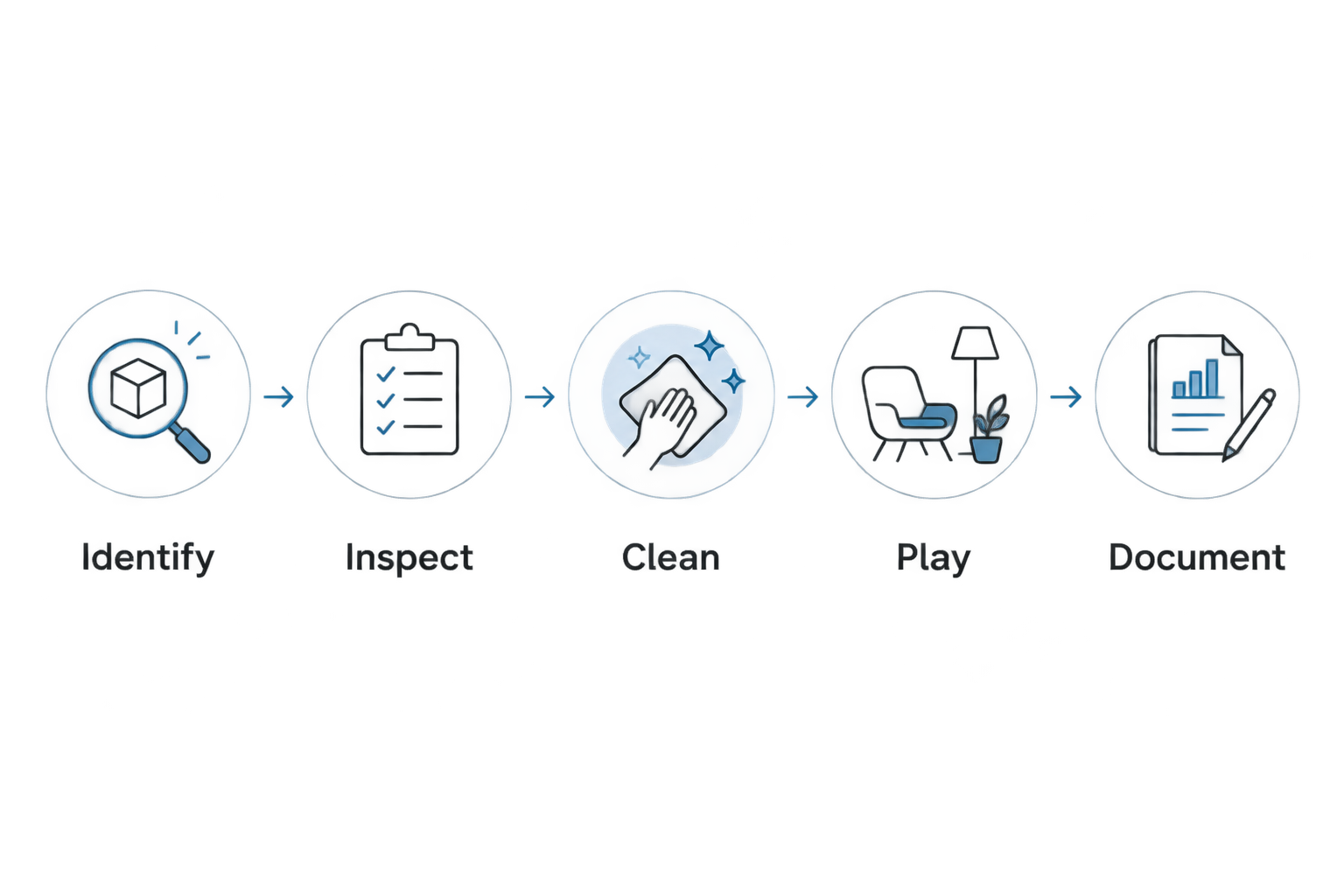
Work in this order. Stop if the disc is cracked, badly deformed, or otherwise unsuitable for safe playback.
- Identify the pressing. Match the artist, title, label, catalog number, format, and runout markings. Runout markings are the letters and numbers near the center label, outside the recorded music.
- Inspect before cleaning. Use angled light to look for scratches, cracks, warping, residue, and embedded dirt. Photograph obvious defects before handling the record further.
- Clean appropriately. Use a record-cleaning method suitable for the material. Do not scrape grooves, apply household polish, or treat cleaning as scratch repair.
- Play both sides. Check playback from beginning to end on a correctly set up turntable. Listening only to the opening track does not establish the condition of the whole disc.
- Write playback notes. Name affected tracks and describe clicks, crackle, skips, repeating grooves, or distortion. Separate what you observed from what you have not tested.
- Grade and photograph. Assign separate grades to the disc and sleeve using the grading system required by the selling venue. Add detail that the grade alone cannot convey.
A test log should follow this sequence: Identify, Inspect, Clean, Play, Document. Keep it with your listing draft so photographs and playback notes describe the same copy.
Use the speed specified for the release. A 12-inch record is not automatically a 33⅓ rpm record; some play at 45 rpm. Record size alone does not establish playback speed or pressing identity.
Light scratches: describe appearance and playback separately
A visible surface mark does not tell you exactly how a record sounds. Describe the location and appearance, then report the playback result. Avoid calling a scratch cosmetic unless testing supports that description.
Under Goldmine's widely used grading framework, Near Mint is not a catch-all for records that look mostly clean. Very Good Plus allows limited signs of handling, but playback and the full grading definition matter. Check the complete standard rather than upgrading a copy because its cover looks attractive.
Best for: listeners who accept visible wear when playback is documented. The advantage is a clear distinction between looks and sound; the limitation is that your test describes your setup, not every possible turntable.
Audible scratches: name the noise and affected tracks
A click that repeats with each revolution is more informative than a vague claim about age-related wear. State whether it continues through a track, occurs in a short passage, or appears between songs. Do not bury the information beneath praise for the album.
Goldmine's Very Good grade permits more obvious wear and audible surface noise than Very Good Plus. That does not mean every noisy record qualifies as Very Good. Assess the entire disc against the standard, including whether defects interrupt playback.
Best for: buyers comfortable with audible wear who can judge your description. The advantage is usable listening despite imperfections; the drawback is noise that remains part of the experience.
Skipping or cracked records: disclose a nonstandard purchase
A record that skips or locks into a repeating groove needs that fact near the beginning of the listing. Do not describe it as playing well overall and leave the interruption for the final sentence. Uninterrupted playback and interrupted playback are not interchangeable conditions.
Goldmine's Good and Good Plus descriptions still expect a record to play through without skipping. A skipping copy therefore needs assessment against the lower grades, not an automatic Good label. A cracked record should not be offered as an ordinary playable copy.
Best for: buyers deliberately seeking a damaged collectible, replacement packaging, or suitable craft material. Those uses explain a possible purchase, not a promise that the item will sell or can be repaired.
How do you set an asking level without guessing?
Start with the exact pressing and its actual condition. Then examine completed sales, separating completed transactions from unsold asking listings. For your 2026 research, record when each comparison sold so you do not mistake an old transaction for current evidence.
Use this checklist before choosing your asking level:
- Match the release. Confirm catalog details, country, format, and relevant runout information. Matching cover artwork is not enough.
- Match the condition. Separate clean copies from scratched copies and playable copies from those with skips.
- Match the contents. Note whether the original sleeve, inserts, posters, or other stated components are included.
- Check the evidence. Prefer listings with clear condition descriptions over unexplained grades.
- Separate delivery. Account for packing and delivery when assessing what you would retain from a sale.
Do not apply an invented discount to a clean copy and call the result a valuation. If you cannot find comparable damaged copies, say less about the record's supposed value. A rare pressing and a desirable album are not the same thing.
Why damaged-record value varies
Damage is only part of the decision. These factors determine which comparisons belong in your research and which buyer your description serves:
- Pressing identity: Different editions of the same album are not interchangeable comparisons.
- Playback impact: A faint background tick and a locked groove create different listening experiences.
- Damage location: Damage affecting recorded music differs from scuffing outside the playing area.
- Sleeve condition: A clean disc with damaged packaging needs separate grading, not an averaged condition.
- Completeness: Missing inserts or mismatched sleeves change what the buyer receives.
- Test quality: A complete playback check provides more evidence than a visual inspection or short sample.
For your 2026 selling plan, prioritize the records you can identify and document. Do not spend hours writing a collectible narrative before establishing whether the disc plays through.
What should your listing actually say?
Lead with the pressing, the record grade, and the sleeve grade. Follow with the most consequential playback defect. Put a skip before minor ring wear; put a crack before a description of the cover art.
Your condition note should include:
- Whether grading is visual, playback-based, or both.
- Whether you played both sides completely.
- Where audible defects occur and what they sound like.
- Whether the disc skips or repeats on your setup.
- Sleeve splits, writing, stains, missing parts, and other visible defects.
- Any limits to your inspection.
For a 2026 condition note, do not copy another seller's description—even for the same pressing. Their clean copy does not establish anything about your scratched one.
Photograph the labels, both disc surfaces, sleeve front and back, and significant defects. Use angled light and more than one view where reflections conceal scratches. Keep audio demonstrations unprocessed so noise reduction does not hide the defect you are documenting.
Where does OohYeah fit your selling plan?
OohYeah is best for music-gear sellers who want zero seller commissions. That seller benefit does not remove the need to identify an item accurately or explain its defects.
Create an account on OohYeah and review the appropriate listing category before posting gear. OohYeah's zero seller commissions should not be read as a claim that packing, delivery, or every other selling expense disappears. Document condition first; write the listing second.
Can I sell a scratched record without a turntable?
Yes, but describe the record as visually inspected and untested rather than claiming it plays well. Photograph the marks and state that you have not checked for audible noise, skips, or repeating grooves.
A visual grade is not a playback report. Buyers need to know which evidence supports your description.
Should I sell damaged records individually or together?
Sell individually when pressing identity and condition justify a detailed listing. Group records only when you can still explain what is included and identify known serious defects.
A bundle reduces individual listing work, but it does not turn untested records into tested ones. Do not hide a skipping disc behind a general description of mixed condition.
FAQ
Can I sell scratched or damaged vinyl records online?
Yes, you can sell scratched or damaged vinyl records online when the selling venue permits the item and you disclose its condition accurately. State whether playback was tested, identify audible defects, and grade the sleeve separately.
Does cleaning a vinyl record remove scratches?
Cleaning removes contamination, not damaged grooves. It can help you distinguish dirt-related noise from persistent damage, but it does not justify promising scratch repair.
Can a record that skips be graded Good?
A skipping record does not meet Goldmine's Good or Good Plus expectation of playing through without skipping. Assess the lower grades and disclose the affected track and playback behavior.
Should I grade the record and cover separately?
Yes, grade the record and cover separately. A clean sleeve does not improve damaged grooves, and a damaged sleeve does not automatically reduce the disc's playback grade.
How do I work out what a damaged record is worth?
Compare completed sales for the same pressing in a similar condition. Exclude clean-copy comparisons when your record has audible scratches, skips, or missing packaging.
Is it okay to sell an untested vinyl record?
Yes, provided you disclose that it is untested and follow the selling venue's rules. Describe visible defects without claiming uninterrupted playback or quiet surfaces.
Is OohYeah commission-free for music-gear sellers?
OohYeah offers zero seller commissions for music-gear sellers. That does not establish that delivery, packing, or other selling expenses are absent; assess those separately.
One last thing
The sleeve and the disc tell different stories. Before you dismiss a damaged record—or oversell a clean-looking one—check that the label, catalog details, and packaging belong together. A mismatched sleeve is another fact the buyer needs, not a detail to leave out.