
Mixing engineer costs in 2026: per song, stems, and revisions
Compare the cost to hire a mixing engineer by scope, stems, revisions, and final files. Get a clear quote and avoid paying for the wrong service.
November 20, 2026
FRANKLY with Frank Lee
The cost to hire a mixing engineer in 2026 depends on your session, the work included, and the engineer’s quote—not a universal per-song rate. Compare quotes for the same tracks, editing tasks, revision allowance, and final files. Mastering, vocal tuning, replacement recordings, and changes after approval need explicit agreement; don’t assume the mixing fee covers them.
- Compare the cost to hire a mixing engineer against the same session, revisions, and deliverables.
- Per-song quotes need a written scope; hourly work needs an agreed approval limit.
- Stems are grouped audio exports, not necessarily the individual tracks an engineer needs.
- OohYeah connects musicians with music professionals; confirm mixing scope directly with the professional.
What is the cost to hire a mixing engineer in 2026?
Your project quote is the useful number. A per-song figure means little until you know whether it covers mix work alone or also includes cleanup, tuning, alternate versions, and mastering.
Ask every engineer to quote the same brief. Otherwise, you’re comparing different jobs. If you’re still deciding whether to outsource, start with whether hiring a mixing engineer for one song is worth it.
Build your quote request in this order:
- Describe the song. Include genre, duration, arrangement, and the sound you want.
- Describe the files. State whether you have individual tracks, grouped stems, or only a stereo instrumental and vocals.
- Name the extra work. Identify timing edits, vocal tuning, noise cleanup, or recording problems before booking.
- List the deliverables. Specify the main mix, instrumental, clean version, and any other exports you actually need.
- Confirm the boundaries. Agree on revisions, deadlines, payment terms, and what triggers a new quote.
Send the rough mix with that brief. Let the engineer hear the actual assignment before you commit.
Why this matters
A mixing budget is also a decision about responsibility. Someone has to choose the vocal take, fix distracting edits, approve the arrangement, and decide when the recording is ready.
If those jobs remain open, the mix brief remains open. You risk paying for work that needs redoing after another creative decision changes.
For your 2026 release, separate finishing the recording from mixing the recording. Mixing shapes recorded parts through balance, equalization, dynamics, effects, and automation. It does not automatically include writing a stronger chorus, recording a singer, or replacing a guitar performance.
Per-song mixing: best for a finished arrangement
A per-song agreement gives you a defined project to approve. It works best when the performances are chosen, the arrangement is settled, and the engineer has reviewed the files.
Its strength is a clear finish line. Its limitation is scope: replacing the lead vocal after the mix is underway changes the source material, even if the song title stays the same.
Ask whether the agreement covers your actual session rather than an unspecified idea of a song. A sparse acoustic recording and a layered production present different work, but track count alone does not describe everything involved.
Check these points before accepting:
- Does the engineer accept the files as delivered?
- Are vocal tuning and timing edits included or separate?
- Which mix versions will you receive?
- What counts as completing the project?
- How are new recordings handled after work starts?
Choose per-song mixing when you can define the job before it begins. Don’t treat a fixed project quote as permission to keep rebuilding the production.
Hourly mixing: best for an evolving session
Hourly work ties the agreement to time spent rather than a single finished-song scope. It suits a session where you want to make decisions with the engineer as the work develops.
The benefit is flexibility. The trade-off is that your final total depends on how much authorized work takes place.
Set an approval limit before the session. Ask the engineer to pause and get permission before working beyond that boundary, and establish whether preparation, exports, and session recalls count as working time.
| Agreement | Best for | Main benefit | Main limitation |
|---|---|---|---|
| Per-song mixing | Finished recordings with defined deliverables | Clear project boundary | New recordings or expanded scope need agreement |
| Hourly mixing | Sessions with active decisions still to make | Flexible working process | Total depends on time authorized |
| Multi-song project | Related songs planned together | Shared brief across the project | Each song’s exceptions still need documenting |
A multi-song agreement is not automatically a discount. Ask for the project terms rather than assuming a lower fee for every additional song.
Stems versus multitracks: specify what you mean
A stem is a grouped audio export, such as all backing vocals combined into a stereo file. Multitracks are the individual recorded or rendered parts, such as separate lead vocal, harmony, kick, and snare files.
The distinction changes what the engineer can control. With a combined drum stem, the engineer cannot independently rebalance the original kick and snare as if separate tracks had been supplied.
Don’t request a mixing quote using only the word “stems.” Describe the actual files. State whether effects are printed into them and whether the engineer can access dry versions without those effects.
Grouped stems are useful when you want to preserve production choices. Their limitation is reduced access to the parts inside each group. Individual tracks allow more detailed adjustment, but they also require clear organization and decisions about which processing to retain.
For a stereo instrumental plus vocal, disclose that setup immediately. The engineer can work with the instrumental as a whole, not independently remix every instrument inside it.
Ask about stem delivery separately, too. Sending stems into a project and receiving stems from the finished mix are different requests. Define which groups you need exported and whether their effects should be included.
Revisions: agree on changes before you need them
A revision adjusts the agreed mix. Raising the lead vocal or reducing the reverb fits that idea; adding a new chorus recording changes the material being mixed.
However, the engineer’s written terms determine the boundary. Get that definition before work starts, not after you disagree about a request.
Ask what a revision round means. Does it mean a consolidated list of notes followed by a new mix, or does the professional use another process? Also confirm the deadline for submitting feedback and what happens after final approval.
For your 2026 project, keep revision notes in one shared document. Have bandmates, the artist, and the producer resolve conflicting requests before sending them.
Useful feedback identifies a place and an action:
- Bring the lead vocal forward in the final chorus.
- Reduce the delay after the last lyric.
- Keep the verse intimate; make the chorus feel wider.
- Check the bass note that masks the kick before the bridge.
Avoid sending a stream of contradictory messages. A revision allowance is most useful when your feedback is organized. It does not replace choosing a direction.
Why mixing engineer quotes vary
The cost to hire a mixing engineer changes with the assignment. These are the scope factors to discuss rather than guessing from a headline rate:
- Source condition. Clipped recordings, distracting noise, and unfinished edits need attention beyond balancing clean tracks.
- Arrangement complexity. Overlapping vocals, layered instruments, and detailed automation create different mix decisions.
- Editing responsibility. Comping, tuning, and timing correction need an explicit owner.
- Delivery requirements. Instrumentals, clean versions, stems, and alternate mixes add export and checking tasks.
- Schedule. Ask whether your requested deadline changes the proposed terms.
- Engineer fit. Evaluate relevant work and the professional’s approach, not just the quoted total.
A longer equipment list does not establish that an engineer understands your song. Listen for vocal placement, low-end balance, and arrangement clarity in work relevant to your music.
Prepare your session before requesting a final quote
Give the engineer files that make the assignment clear. Ask for delivery instructions first; don’t reorganize everything around assumptions the engineer never requested.
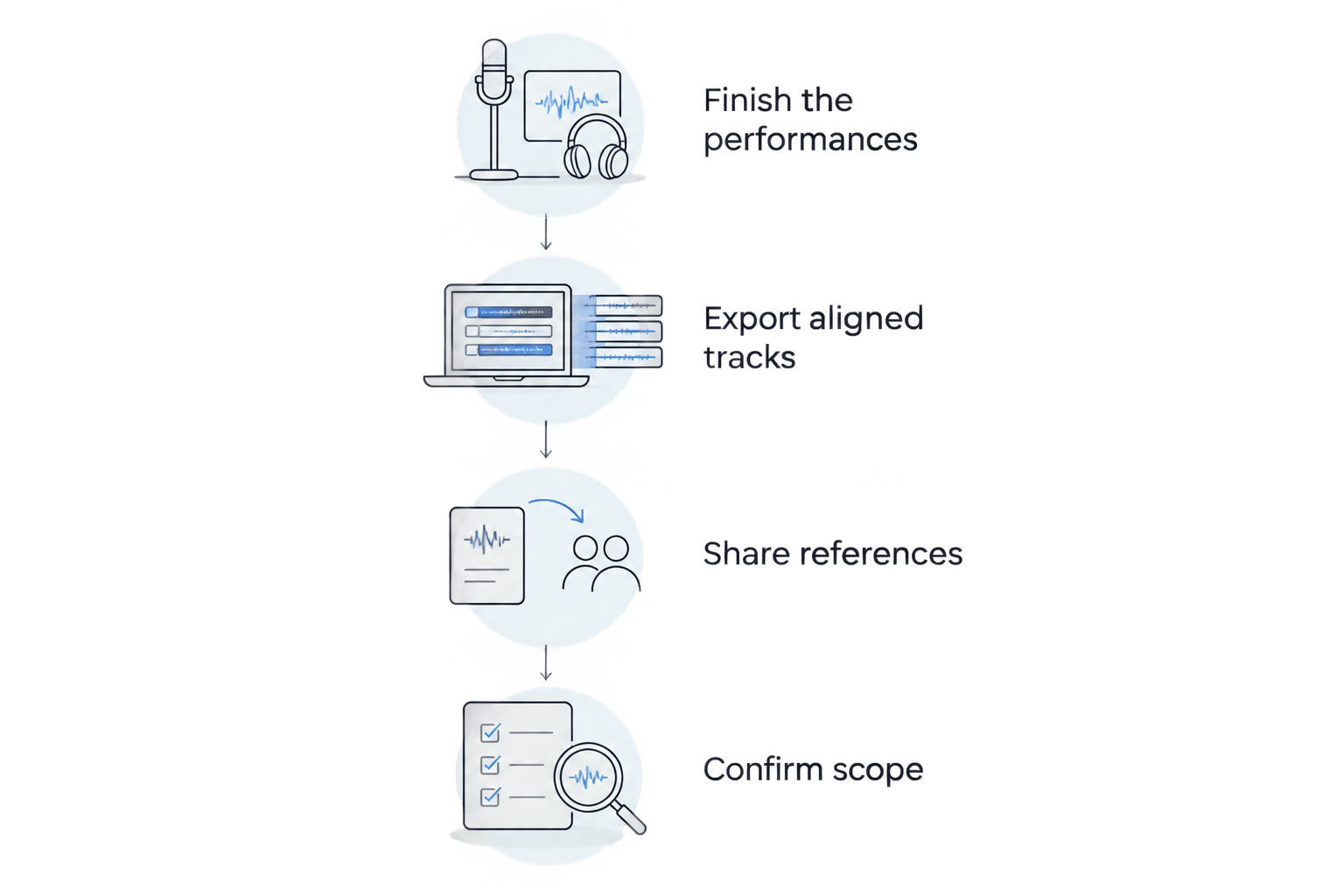
Finish the performances
Choose the takes you intend to release. If you need a singer, session musician, producer, or songwriting feedback, handle that stage before treating the mix as ready.
Wrote some songs, now what? Decide whether you need help developing the recording or finishing its sound. A Suno demo you want performed by real musicians—including Nashville studio musicians—is a recording brief before it becomes a mixing brief.
Export aligned tracks
Export files from a shared start point so they line up when imported. Label each part plainly, and include the tempo and any tempo changes.
Keep the source resolution unless the engineer requests conversion. 24-bit describes audio bit depth; 44.1 kHz and 48 kHz describe sample rates. These are different file properties, not interchangeable quality labels, and converting an existing recording does not restore detail it never captured.
Share references
Send the rough mix and explain what matters in your reference tracks. Name the vocal treatment, drum impact, bass relationship, or sense of space you want—not just the artist.
Flag any rough-mix effects that are part of the arrangement. A printed delay throw or distorted vocal texture needs a different conversation from a temporary effect you expect the engineer to replace.
Confirm scope
Have the engineer review the delivery before you approve the final assignment. Record which files, tasks, revisions, and exports the agreement covers.
How do you choose a mixing engineer without buying the wrong service?
Choose the engineer whose relevant work matches your direction and whose agreement names the work you need. Credits and equipment do not replace that fit.
Ask what role the professional played on the examples you hear. Producing a track, recording it, mixing it, and mastering it are different contributions.
OohYeah is a music marketplace for musicians who want to hire music professionals. Use OohYeah to explore that route, then confirm the individual professional’s services and terms; the marketplace description is not a mixing agreement.
Its relevance is access to music services alongside gear and artist activity. The limitation is straightforward: you still need to assess the professional, discuss the recording, and agree on deliverables. For a 2026 booking, get those decisions in writing before sending the project into production.
Find your next music collaborator
Explore music professionals, then discuss your recording, mixing scope, and deliverables.
Does mixing include mastering?
Mixing and mastering are separate stages unless your agreement explicitly includes both. Mixing balances the recorded parts; mastering prepares the approved mix for its intended release delivery.
Ask who performs each stage and which files you receive. Don’t approve a package based only on the phrase release-ready.
Can you hire a mixing engineer for one song?
You can request a quote for a single song; confirm whether the engineer accepts that scope. Use the same checks you would for a larger project: relevant work, file review, written deliverables, and a defined feedback process.
What if you offer mixing services yourself?
Make your service description answer the questions artists actually ask. State what you mix, which files you accept, what preparation you expect, and how revisions work.
If you offer services through OohYeah, distinguish mixing from production, editing, and mastering. Clear boundaries help potential clients understand your offer; they do not promise inquiries or bookings.
FAQ
How do I work out the cost to hire a mixing engineer in 2026?
Request a project-specific quote after the engineer reviews your files and brief. Compare the same editing tasks, revision terms, final exports, and mastering responsibilities across quotes.
Is per-song mixing better than hourly mixing?
Per-song mixing fits a defined recording and deliverable list; hourly mixing fits work whose scope is still developing. A per-song agreement needs change terms, while hourly work needs an approval limit.
Do I need stems or individual tracks for mixing?
Ask the engineer which files the assignment requires. Individual tracks allow separate control of recorded parts; grouped stems preserve combined balances and processing.
Are vocal tuning and timing edits included in mixing?
Vocal tuning and timing edits are included only when the agreement says so. Identify those tasks before booking and confirm who completes them.
Can I send new vocals after the first mix?
Ask the engineer to approve new recordings before sending them as revision requests. Replacement vocals change the source material and need an agreed scope.
Does a mixing quote include an instrumental version?
An instrumental version is included only when it appears in the agreed deliverables. Request clean versions, alternate mixes, and stem exports explicitly as well.
Should I hire a producer or a mixing engineer for an unfinished demo?
Hire for the unfinished task: production or recording help for missing parts, mixing for balancing completed recordings. Explain what remains undecided before choosing the service.
One last thing
Before approving the mix, compare it with your rough mix at a similar listening level. Louder playback can influence preference; ask whether the vocal, groove, and emotional direction actually improved.
For your 2026 release, make final approval a deliberate step. Confirm the version name, listen through the whole export, and check the requested alternate files. Approve the recording you intend to release—not just the latest attachment.
