
How to find session musician jobs with songwriters on OohYeah
Find session musician jobs by showing songwriters what you deliver. Build relevant samples, clarify recording briefs, and set clear terms before you record.
November 20, 2026
FRANKLY with Frank Lee
To find session musician jobs with songwriters, offer a clearly defined recording service, show relevant performance samples, and agree on the song brief before you record. Use Music Pros to connect around specific musical needs—not as a promise of open jobs, steady work, or guaranteed bookings.
- OohYeah connects musicians offering music professional services with songwriters seeking collaborators; bookings are not guaranteed.
- For session musician jobs, show the instrument, style, and recording deliverables you offer.
- Match your samples to the songwriter’s needs, then agree on scope, revisions, credits, and usage.
- Treat Suno demos as references; clarify what real musicians should preserve, change, or replace.
How do you find session musician jobs with songwriters on OohYeah?
Start with OohYeah and its Music Pros section for music professional services. Create an account, then describe the work you want songwriters to hire you for. Keep the offer specific: acoustic guitar accompaniment, lead vocals, harmony arrangements, live bass, or another service you can demonstrate.
OohYeah’s Music Pros section is best for songwriters seeking collaborators and musicians offering music professional services. The relevant fit is clear; the limitation is equally clear: presenting your service does not guarantee a booking.
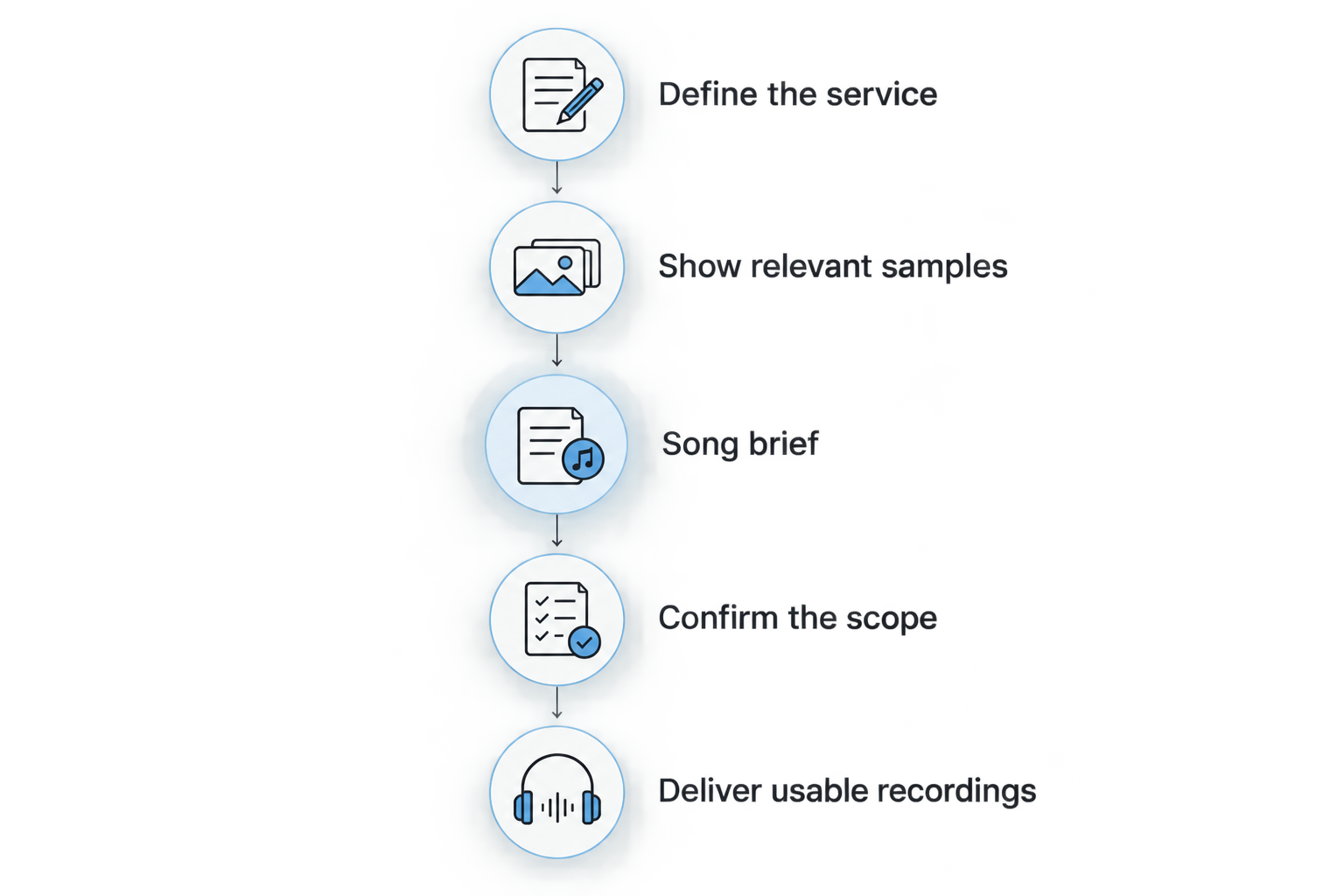
Build your approach around these steps:
- Define the service. Name your instrument or voice, musical strengths, and whether you work remotely or in person.
- Show relevant samples. Let a songwriter hear how you support a vocal, follow an arrangement, and finish a part.
- Ask for the song brief. Establish what exists already and what the writer needs you to add.
- Confirm the scope. Agree on deliverables, revisions, deadlines, credits, usage, and payment terms before recording.
- Deliver usable recordings. Follow the agreed file specifications and explain what each file contains.
Why this matters
A songwriter needs to understand what you bring to the song. Playing skill matters, but your service description must also explain whether you perform an existing part, write an instrumental arrangement, sing a supplied melody, or help shape the recording.
For your 2026 service description, lead with that distinction. “I record bass parts that support your vocal and drum arrangement” tells a songwriter more than a long list of influences. Describe the musical job, then provide evidence.
This also protects your time. A request for guitar accompaniment is different from a request to produce a finished track, even when both begin with the same voice memo.
Make your recording service easy to understand
Lead with the musical result
Name the role you can perform confidently. A singer might offer lead vocals, doubles, and harmonies; a guitarist might offer rhythm parts, melodic overdubs, or acoustic accompaniment. Only include services you can actually deliver.
Explain unfamiliar terms briefly. A double is another performance of the same vocal part, while a harmony uses different notes that support the main melody. Clear language helps first-time songwriters brief you without guessing.
Separate performance from writing. If you also create melodies, lyrics, or arrangements, discuss those contributions explicitly instead of burying them inside a general recording offer.
Show your contribution, not just the finished song
Choose samples that make your role audible. If a full production hides your playing, add a permitted excerpt where the listener can hear the instrument or vocal more clearly. Identify exactly what you performed.
Use only recordings you have permission to share. For collaborative work, distinguish your contribution from the songwriter’s, producer’s, and other performers’ work; do not imply that a polished mix proves you handled every stage.
A useful 2026 portfolio explains the musical problem each sample solves. Label a restrained verse accompaniment differently from a busy instrumental feature so the songwriter can judge fit.
Be honest about your recording setup
Explain whether you deliver recorded audio or attend an outside session. For remote work, describe the recording capabilities relevant to the service, without turning the description into an equipment inventory.
A singer needs a suitable recording environment. A bassist delivering a direct instrument recording needs a clean, usable signal. If you cannot provide the requested format or recording conditions, resolve that before accepting the brief.
Match your service to the songwriter’s actual need
“Help me finish my song” is a starting point, not a complete assignment. Ask which part of the process needs attention, then establish whether your service fits.
| Role | Best for | What to demonstrate | Limit to clarify |
|---|---|---|---|
| Session instrumentalist | Songwriters needing performed instrument parts | Timing, tone, phrasing, and arrangement awareness | Instrument recording does not automatically include full production |
| Session singer | Songwriters needing a vocal performance | Delivery, diction, range, and stylistic fit | Singing does not automatically include melody or lyric writing |
| Music producer | Songwriters needing direction across the recording | Relevant production examples and a clear process | Production scope must specify which recording and editing tasks are included |
| Song-feedback professional | Writers seeking critique before recording | Relevant experience and a defined feedback focus | Feedback is not the same service as performing or producing the song |
Choose the role by the missing contribution, not the job title alone. These roles can overlap, but the overlap needs agreement. A session guitarist who also produces should still identify which service the songwriter is requesting.
For musicians seeking work, the practical move is simple: make your main service obvious. Add related skills as separate capabilities rather than promising to handle everything.
“Wrote some songs, now what?” Turn the demo into a brief
Start with the recording the songwriter already has. A voice memo, rough piano performance, or produced demo can communicate the song, but each leaves different questions unanswered.
Before recording, ask for:
- The current song version. Confirm which demo and lyric sheet are authoritative.
- The requested contribution. Identify the instrument, vocal role, arrangement help, or production task.
- The musical direction. Ask what should feel similar to the reference and what should differ.
- The structure. Mark verses, choruses, bridges, stops, and endings.
- The handoff requirements. Confirm file format, alignment, naming, and whether processing is wanted.
- The working agreement. Set the deadline, revision scope, credits, usage, and payment terms.
For a 2026 remote session brief, put those decisions in writing before tracking. If the songwriter supplies conflicting versions, ask which one controls the session rather than choosing silently.
Respond with a plan, not a generic introduction
When discussing a genuine project, explain what you hear and what you would contribute. Identify the requested role, point to a relevant sample, and ask the question that prevents you from quoting or recording against an unclear brief.
For example, a bassist can ask whether the songwriter wants the demo’s bass movement preserved or a new part built around the vocal. A singer can ask whether phrasing must match the guide exactly. Those questions demonstrate attention without promising an unpaid custom performance.
Turning a Suno demo into a human performance
A Suno demo can communicate mood, structure, and a rough arrangement. It is not automatically a playable chart or a complete session instruction. Listen for the intended musical idea, then ask what the songwriter wants retained.
Separate the reference into decisions: melody, lyrics, chords, groove, instrumentation, and form. Do not assume every generated detail is intentional or that a musician should reproduce it exactly.
Ask the songwriter to confirm that they have the permissions needed for the material and intended release. Keep that discussion separate from your performance scope; agreeing to record a part does not establish rights to the underlying material.
For your 2026 service description, offer a defined contribution such as replacing a guide vocal or recording a real bass part. Avoid promising an exact recreation before reviewing the reference and agreeing on what is musically achievable.
Working with Nashville studio musicians
If a songwriter wants Nashville studio musicians, clarify what “Nashville” means for the project. The request might concern an in-person session, a musician’s location, or an arrangement style. Those are different requirements.
Ask whether the session is remote or studio-based, who handles engineering, and what preparation the player receives. Do not assume every musician reads notation, uses number charts, or works in every genre; confirm the skills the arrangement requires.
Musicians offering these services should describe their actual location and experience accurately. A geographic label is not a substitute for relevant samples, and it should never imply credentials or session credits you do not have.
Why session musician opportunities vary
The same service will not suit every songwriter. Use these factors to decide which projects deserve a detailed conversation:
- Musical fit. Your instrument, tone, and stylistic strengths must match the song’s needs.
- Project readiness. An unfinished melody requires different work from a settled arrangement.
- Recording requirements. Remote audio delivery and studio attendance involve different responsibilities.
- Schedule fit. Confirm that you can meet the requested deadline before committing.
- Scope fit. Performance, arranging, editing, and production need clear boundaries.
- Usage expectations. Establish how the recording will be used and what permissions the agreement requires.
These are project-selection criteria, not booking predictions. Accept work you can define and deliver; clarify or decline work that depends on assumptions.
Deliver recordings the songwriter can use
Agree on technical requirements before opening the session. Audio sample rate describes how frequently audio is sampled; bit depth describes the resolution of those samples. Neither setting fixes a poor performance or an unsuitable recording environment.
A project might request 24-bit WAV files at 48 kHz, while another uses 44.1 kHz. These are examples of established audio formats, not platform requirements. Follow the receiving engineer’s specification and avoid changing settings without a reason.
For multitrack delivery, confirm whether files should share a common start point so the engineer can import them in alignment. Ask whether the client wants dry recordings, processed versions, alternate takes, or a reference mix. Dry means without effects such as reverb or delay.
Use descriptive file names and distinguish approved takes from alternatives. Before sending, listen through the actual exported files—not just the session playback. The remote session musician file requirements guide covers the handoff in more detail.
How do I agree on revisions without leaving the job open-ended?
Define a revision as a change to the agreed performance, and distinguish it from a new assignment. Adjusting phrasing within an approved arrangement differs from replacing the song structure or recording a newly written section.
Confirm how feedback should be delivered and when it is due. Ask the songwriter to consolidate notes against the same reference version so you are not chasing conflicting instructions.
Should I offer songwriting as part of session work?
Offer songwriting only when you intend to provide that service and have agreed on its terms. Performing a supplied melody and contributing a new melody are different activities.
Discuss credits and ownership before contributing new writing. Do not assume a session agreement settles every question about the composition or recorded performance; seek qualified advice when the terms are unclear.
FAQ
How do I start looking for session musician jobs on OohYeah?
Start with OohYeah’s Music Pros section and describe the recording service you offer. Show relevant samples and confirm the brief before accepting work; a service offer does not guarantee bookings.
Can I offer session vocals without being a producer?
Yes, you can offer session vocals as a distinct service. Specify whether you perform supplied melodies, create harmonies, or also offer songwriting, and agree on each contribution separately.
Do I need a home studio for remote session work?
You need access to recording facilities that meet the project’s requirements, not necessarily a home studio. Confirm the recording environment, equipment access, and delivery specifications before agreeing to remote work.
Can session musicians turn my Suno demo into a real recording?
Session musicians can perform agreed parts using a Suno demo as a reference. Clarify the arrangement, permissions, and which elements should be preserved or changed before recording.
How do I hire Nashville studio musicians for my song?
Define whether you need an in-person Nashville session or remote recording, then assess relevant samples and experience. Confirm the lineup, preparation materials, engineering responsibilities, and recording deliverables.
Should I send dry or processed session recordings?
Send the versions agreed with the songwriter or receiving engineer. Clarify whether effects are part of the intended sound and whether separate dry recordings are also required.
One last thing
Before adding another showpiece to your 2026 portfolio, check whether a songwriter can hear how you support a lead vocal. An exposed solo demonstrates technique; a well-judged accompaniment demonstrates a different service.
On OohYeah, make that distinction clear. Name the part you can deliver, show it in context, and invite a conversation about the song—not a guaranteed result.
