Music Streaming Royalty Calculator: How It Works
A music streaming royalty calculator estimates a share of a royalty pool, not a fixed rate. See the inputs, splits, and why payouts change.
November 21, 2026
Music Marketplace Advisor
Buying & SellingSpotify paid approximately $10 billion to music-industry rights holders in 2024, according to its Loud & Clear report, as reported by Music Week. That's a payment to the rights-holder economy, not a direct deposit into artists' bank accounts. A useful music streaming royalty calculator explains the distance between those two things: how listening becomes an allocation, who owns that allocation, and when any remaining money becomes spendable.
Why Streaming Totals Are Not Your Payout
Global recorded-music revenue reached US$29.6 billion in 2024, growing 4.8% year over year, while streaming generated US$20.4 billion, or 69.0% of the total, according to IFPI's global recorded-music revenue announcement. Those figures establish why artists need to understand streaming income. They don't establish what any particular artist earns.
Say your band releases a track and the dashboard shows growing activity. You might reasonably expect a larger payment, especially when headlines describe a growing industry. But your payment depends on where that activity happened, which revenue it drew from, and what rights your band controls.
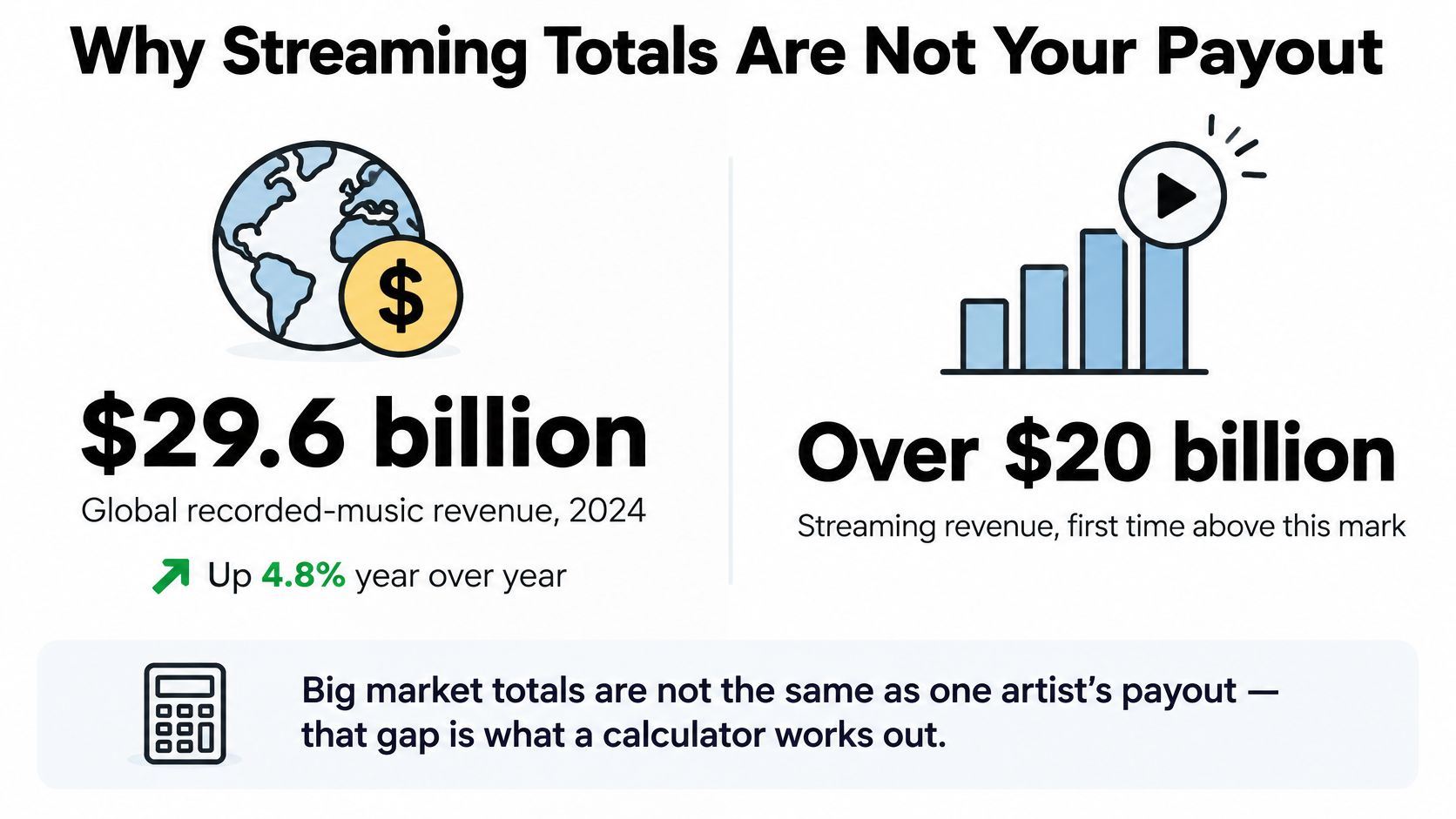
A larger shared jar doesn't guarantee a larger share
Think of a shared tip jar. The amount inside can grow while your slice gets smaller if other performers account for more of the activity used to divide it. You need to know both the size of the jar and the rule for sharing it.
Streaming also combines different sources of money. A paid subscription and an advertising-supported listening session don't contribute to revenue in the same way. A worldwide revenue total hides those differences rather than resolving them.
Start with the right question: What revenue could this listening generate for the rights I actually control?
A calculator should answer that question without treating industry growth as an artist earnings forecast. It should also let you distinguish a release you own outright from a release governed by a label agreement.
Treat every result as a labeled assumption, not a promise. The useful label identifies the service, territory, period, revenue type, and ownership position. Without those details, even a precise-looking result may tell you little about the payment you'll receive.
Where One Average Stream's Money Goes
UK government analysis covering 2012–2019 calculated average on-demand streaming revenue of approximately £0.011 per stream, with about £0.006 allocated to recording rights-holders, £0.002 to music-publishing rights-holders, and £0.004 retained by digital service providers, according to the Music Creators' Earnings in the Digital Era executive summary. These are historical averages, not current platform rate cards.
Average split of one UK on-demand stream, 2012–2019
| Recipient | Approx. amount | What it covers | Who should multiply it |
|---|---|---|---|
| Recording rights-holders | £0.006 | Master recording share of the stream | Master owner, then label, distributor and producer splits |
| Music-publishing rights-holders | £0.002 | Composition share, including songwriter and publisher interests | Songwriter or publisher, then co-writer splits |
| Digital service providers | £0.004 | Portion retained by the platform | Nobody on the creator side; do not add it to artist income |
The rounded amounts don't reconcile perfectly to the rounded total. That isn't permission to adjust a slice until the arithmetic looks tidy. Keep the figures labeled as approximate averages.
Choose the right before multiplying
A recording and a composition are different assets. The master recording is the recorded performance. The composition is the underlying song, including its music and lyrics.
If you own the master, the recording-rights line is the relevant starting point for that asset. If you performed on a recording owned by a label, your entitlement comes from your agreement, not automatically from the entire recording allocation.
A songwriter who doesn't own the master starts with the composition side. An artist who owns both assets can model both, but should keep the calculations separate because the recipients, collection routes, and deductions may differ.
For each release, record:
- Master entitlement: Identify the owner and your contractual share of recording revenue.
- Composition entitlement: Identify your songwriting share and any publisher or administrator interests.
- Collection route: Name the distributor, publisher, or collection organization expected to report each payment.
Gross rights revenue isn't personal income
Multiplying streams by a rights-holder average produces, at best, a gross rights-revenue scenario. It doesn't automatically account for distributor fees, label participation, producer royalties, co-writer shares, collection deductions, or recoupable advances.
Don't put every deduction into an unexplained percentage. A producer's participation may use a different calculation base from a distributor's fee, and recoupment may affect whether an otherwise earned royalty becomes payable.
A calculator should show what the rights earned before it shows what the artist can withdraw.
Read agreements before assigning ownership or revenue shares. Our Artist Agreement is required before publishing artist content or enabling artist monetization on OohYeah; a streaming forecast also needs the terms of whichever distribution, recording, and publishing agreements govern the release.
The practical output is a short ledger: gross recording revenue, gross composition revenue, each applicable deduction, and your remaining entitlement. That structure makes an estimate explainable instead of merely impressive.
Inputs That Replace a Single Per-Stream Rate
Pro-rata allocation is sharing a tip jar, not pricing a coffee. The platform establishes a royalty pool for a particular market and accounting period, then allocates it according to eligible listening. Your effective amount per play is an outcome of that calculation, not necessarily a price fixed beforehand.
The simplified calculation is:
Gross rights allocation = relevant royalty pool × your eligible streams ÷ all eligible streams in that pool
Keep every term on the same basis. A country-specific numerator can't be divided by a worldwide denominator, and a monthly stream count can't be matched to an unrelated reporting period.
The process is easier to follow when the pool and the listening share stay visible.
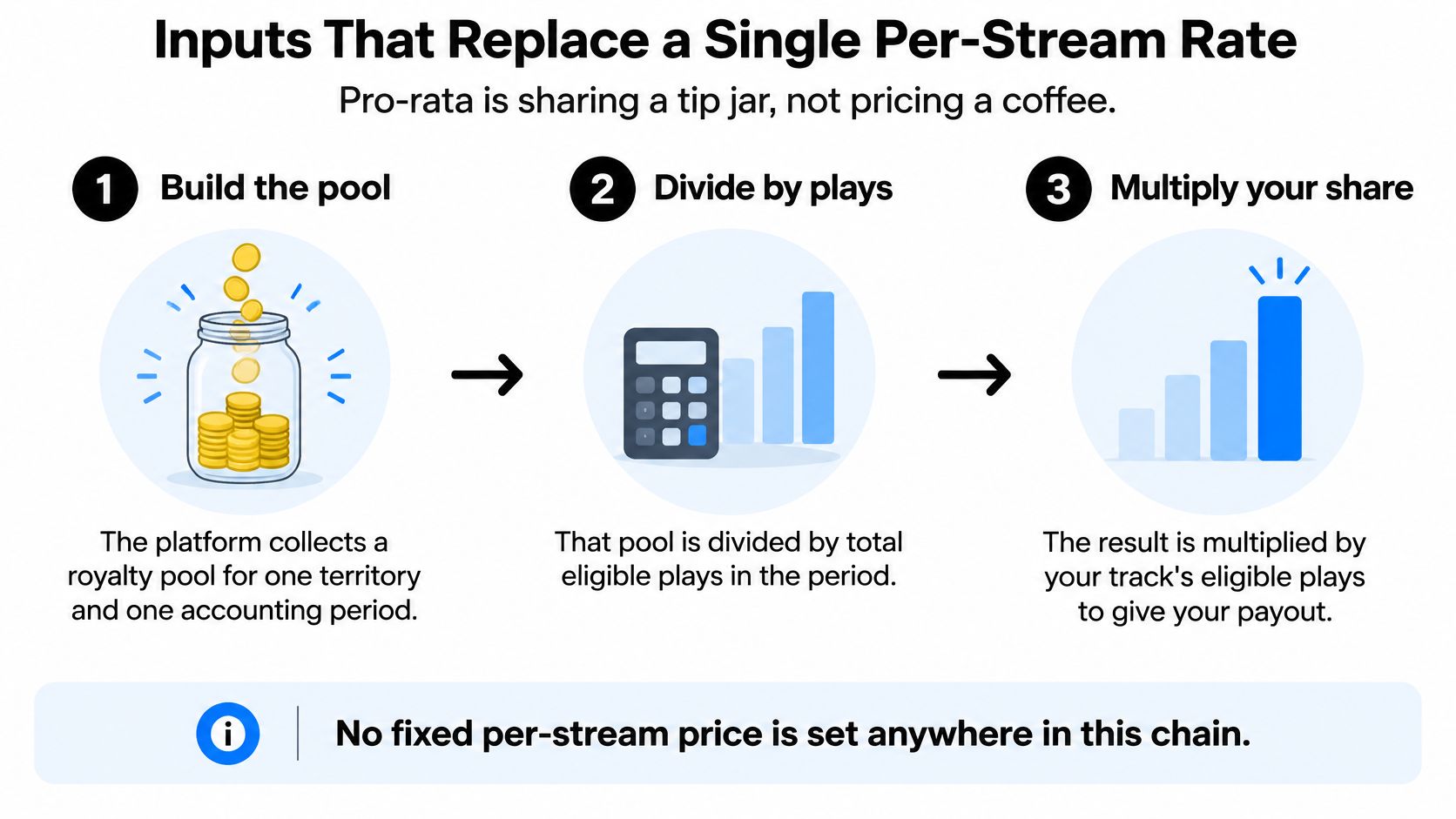
Build a market-level input sheet
A serious model needs these inputs in order:
- Territory: Separate listening by country rather than assuming that all listeners contribute to an identical pool.
- Service tier: Separate subscription and advertising-supported activity wherever the reporting allows it.
- Accounting period: Match revenue and listening to the period you're estimating.
- Eligible work streams: Use the plays that qualify for the allocation, not every visible dashboard play.
- Total eligible platform streams: Use the denominator for that same market, tier, and period.
You also need the relevant royalty pool. If the pool or total eligible plays isn't available, the calculator must substitute an assumption. That can support planning, but the result should be labeled a scenario rather than an estimated settlement.
For a mixed audience, calculate market-and-plan rows separately, then add their rights allocations. Changing the country mix should change the estimate through those rows, not through an unexplained adjustment to a global average.
Separate recording and mechanical calculations
Recording royalties compensate the master rights. Composition royalties follow their own rules and collection routes.
For US statutory interactive-streaming mechanicals, the revenue-percentage component rises from 15.1% to 15.35% across 2023–2027, within the broader calculation specified in Title 37's interactive-streaming royalty provisions. Don't treat that percentage as a songwriter's personal share or apply it to the master royalty.
Only after the platform-level allocations should the model apply contractual label, distributor, publisher, and collaborator shares. If you need help interpreting those terms, our Music Pros directory includes publishing administrators, royalty specialists, and music-business professionals.
Before trusting the output, confirm country mix, plan mix, right being estimated, ownership share, and reporting period. Leave missing information visibly marked as an assumption rather than allowing the calculator to conceal it.
Pro-Rata Versus User-Centric Payout Scenarios
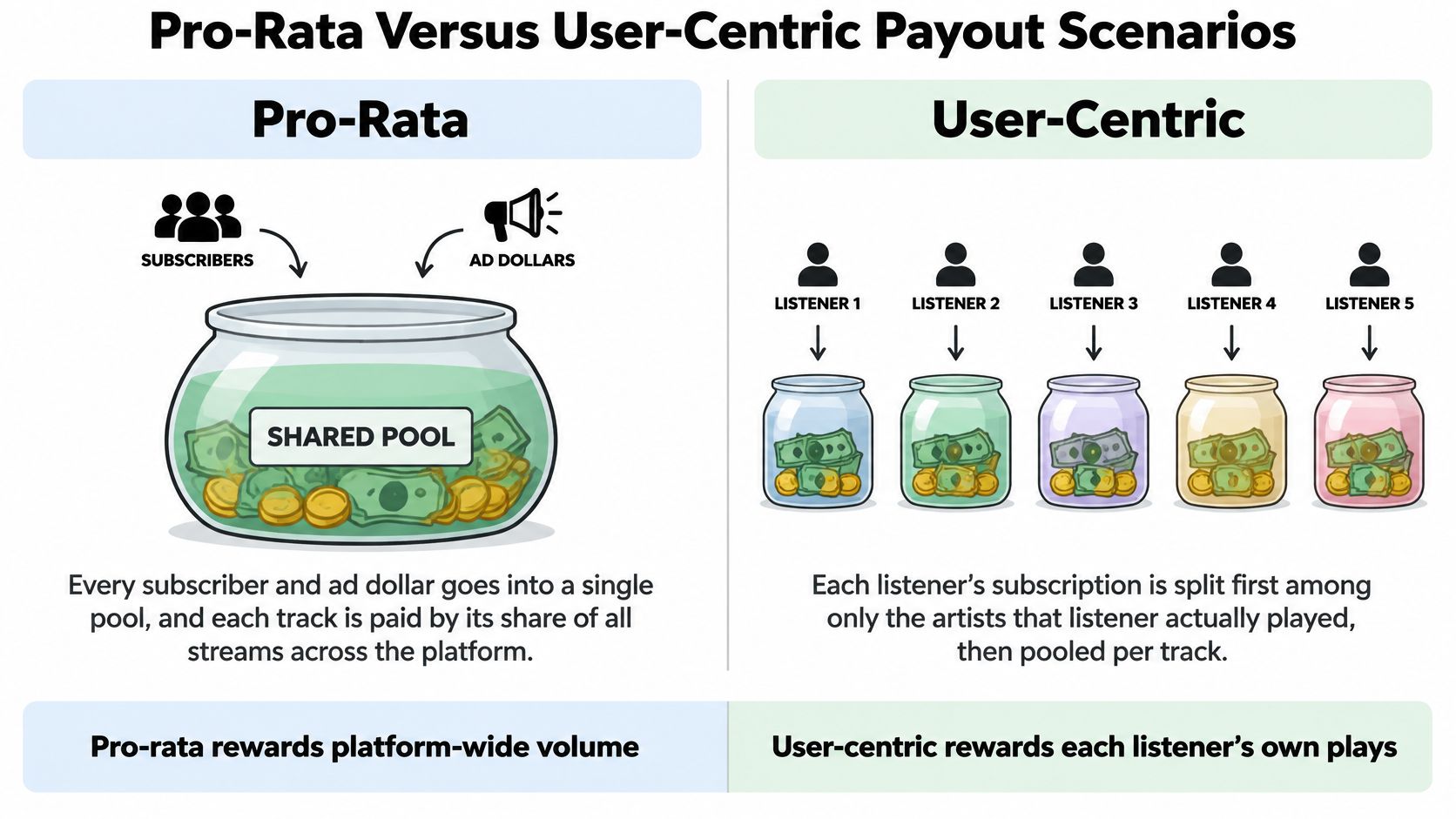
Pro-rata distributes a shared pool according to each track's share of eligible streams. User-centric starts with each listener's contribution, allocates it among that listener's plays, and then adds the allocations together. The distinction is whose listening determines the division: the wider pool's audience or the individual subscriber.
The same revenue can therefore produce different outcomes. A dedicated fan who listens sparingly isn't equivalent to a heavy listener when each subscriber's contribution is allocated separately.
Pro-rata and user-centric scenarios compared
| Model | How the money is split | Who tends to gain | What the calculator needs |
|---|---|---|---|
| Pro-rata | Subscriber and ad revenue in the relevant pool is shared by each track's share of total streams | Heavily streamed superstar catalogues | Territory, tier, period, your streams, all streams, and pool value |
| User-centric | Each listener's subscription is split across that listener's plays, then added up | Niche genres, local artists, and artists supported by sporadic listeners | Per-subscriber listening histories and attributable revenue, rarely available in a public tool |
What a change in allocation can mean
An academic analysis of streaming remuneration models reports German listener-based modeling of annual user-centric gains of approximately €66 million for rock, €36 million for metal, and €30 million for classical, alongside a Norwegian analysis reporting an overall 13% increase for local artists. Those are modeled outcomes for particular listening populations, not a forecast for every artist in those categories.
The practical lesson is narrower than declaring a winning system. Genre labels alone don't reveal how fans listen, what their subscriptions contribute, or how much of their listening goes to other artists.
The comparison below illustrates the different paths from listener revenue to track allocation.
Model the difference without promising a raise
Say your listeners subscribe primarily to hear your catalogue and play little else. Under a user-centric scenario, their allocated subscription contributions would stay concentrated on the music they choose. Under pro-rata, your allocation follows your share of the broader pool's streams.
Now consider an artist whose tracks appear throughout heavy listeners' daily listening. Strong platform-wide volume can support that artist's pro-rata share, so a user-centric switch shouldn't be assumed to increase their payment.
Scenario safeguard: If you don't have subscriber-level listening and revenue information, label the user-centric result illustrative.
A useful comparison displays the difference by territory, listener segment, and catalogue type. It doesn't add a genre bonus to an existing estimate.
Neither allocation method removes ownership splits or guarantees spendable cash. The calculator's job is to isolate the effect of the allocation model while holding the other assumptions steady, so you can see what caused the difference.
Why the Same Stream Count Pays Differently
Visible plays can produce no recording allocation or produce money that isn't payable yet. The Born Creative Audio streaming royalty calculator guide describes Spotify's exclusion of tracks below 1,000 streams in a 12-month period from recording royalty allocation and notes that distributor payments may arrive 30–90 days after streams occur. Eligibility and payment timing belong in the calculation, not in fine print beneath it.
A track-level eligibility test must happen before the model forecasts recording income. A catalogue total can conceal ineligible individual tracks, while a lifetime count can conceal whether activity falls within the qualifying window.
Why one stream count becomes three different results
| Factor | What changes | Typical effect |
|---|---|---|
| Listener country | Value of that market's royalty pool | High-price markets can support higher effective amounts per play |
| Subscription versus ad-supported | Which pool the play draws from | Premium listening can contribute more than free-tier listening |
| Under the Spotify annual eligibility minimum | Recording-royalty eligibility | Recording allocation can be zero despite visible plays |
| Distributor payment lag | When cash arrives | Payment follows activity rather than arriving immediately |
| Deal, collaborator and tax splits | Net versus headline gross | Artist take-home can be a fraction of rights revenue |
The Özün Altun royalty calculator's explanation of payout variables identifies country, subscription type, platform economics, and rights-holder contracts as reasons a blended estimate can miss the actual result. For an artist with an international audience, separating those inputs is more informative than endlessly refining an average.
Apply deductions on the correct bases
Start with the rights revenue reported to the receiving party. Record the distributor's fee and the label or deal entitlement according to the agreement, then calculate producer and collaborator participation on their specified bases.
Publishing administration and collection deductions belong on the composition ledger where applicable. Recoupment, currency conversion, and withholding taxes need their own entries rather than disappearing inside a general artist-share field.
The sequence isn't universally identical. A contract may define a producer's entitlement before another deduction, or require a particular treatment of costs. Build the calculation from the agreement's definitions rather than assuming every percentage applies to the shrinking balance.
Accrued royalties aren't available cash
Accrued royalties are earnings attributed to activity in a period. Payable cash is the amount available for payment after reporting, eligibility checks, contractual treatment, and any applicable payment conditions.
Keep separate spreadsheet columns for activity month, statement month, and expected payment date. If an advance remains unrecouped, a statement can show royalty activity without producing a withdrawal.
Run conservative, base, and optimistic scenarios by changing named assumptions: audience mix, pool value, eligibility, deductions, or payment timing. Don't create a range merely by adding an arbitrary margin around the same opaque estimate.
For budgeting, use the payable-cash forecast. For evaluating audience growth, inspect gross rights revenue and market mix as well. Those views answer different questions, and neither should be mistaken for the other.
Worked Estimates From a Thousand Streams Up
Use the following as hypothetical arithmetic exercises, not current service quotes. Assume a historical UK-style recording allocation of £0.006 per eligible stream and a composition allocation of £0.002, with no deductions applied yet. The combined result belongs to the relevant rights-holders, not necessarily to one artist.
Keep the calculation beside the release paperwork so ownership and deductions remain visible.

A small release and a growing catalogue
Scenario A assumes 1,000 eligible streams. Multiplying those hypothetical inputs gives £6 recording revenue and £2 composition revenue, or £8 combined before personal splits. This historical UK-average exercise says nothing about whether a particular platform would consider those plays eligible.
If the track fails the applicable recording-eligibility test, replace the calculated recording allocation with zero. Put any surviving entitlement in an expected reporting and payment period, not automatically in the month the plays happened.
Scenario B assumes 100,000 eligible streams. The same historical UK-average inputs produce £600 recording revenue and £200 composition revenue, or £800 combined before splits. An outright master owner starts from the recording amount before applicable fees and taxes; a signed performer starts from the entitlement defined in the recording deal.
For a purely hypothetical contract paying the performer a quarter of that recording amount, their recording entitlement would be £150 before further contractual adjustments. Don't add the composition amount unless they also control the corresponding songwriting or publishing interests, and don't budget the entitlement before its expected payment date.
A larger release still needs a ledger
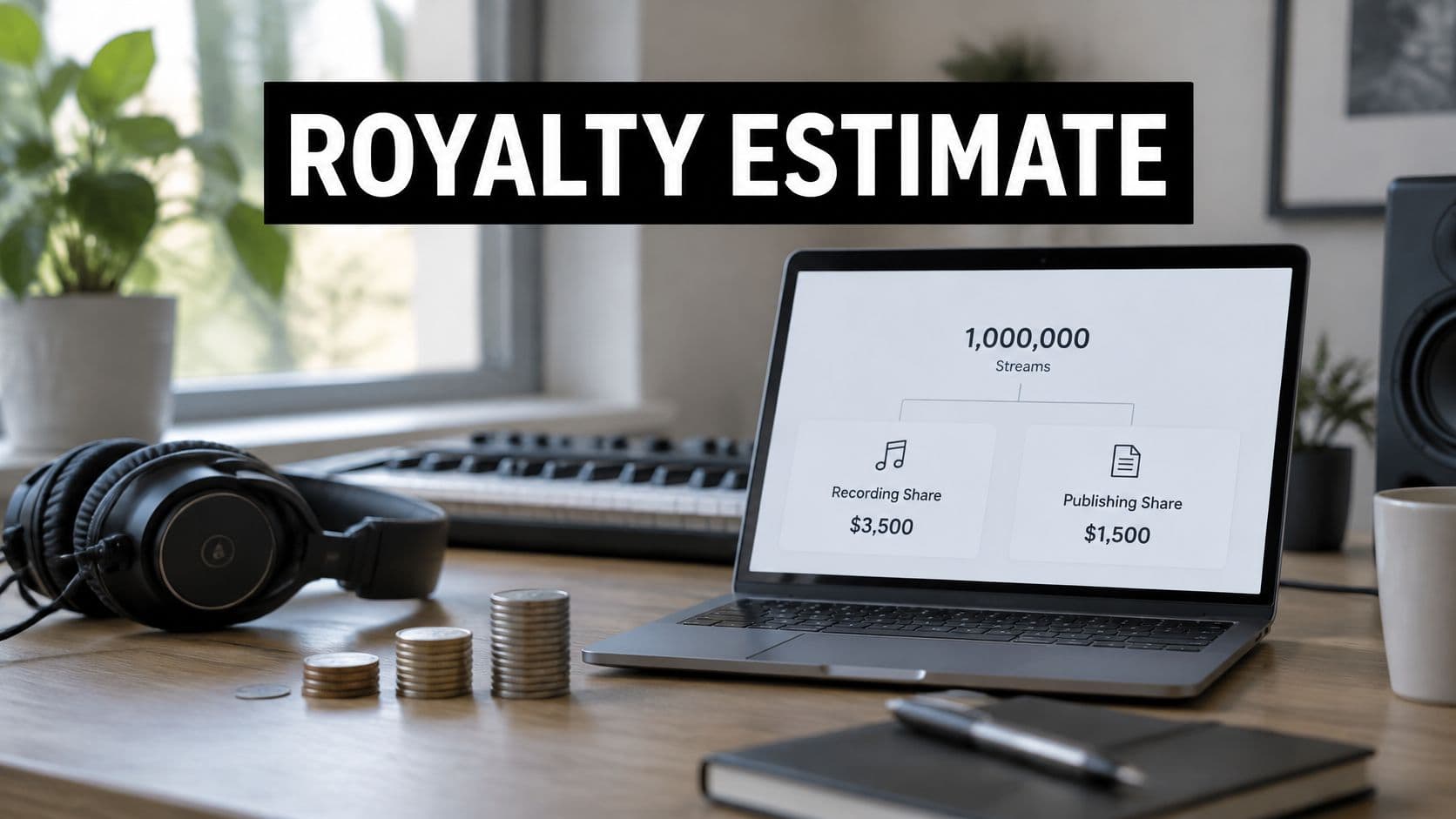
Scenario C assumes 1,000,000 eligible streams. Using the same historical UK-average inputs gives £6,000 recording revenue and £2,000 composition revenue before ownership splits and deductions. At this scale, entering the wrong collaborator share or overlooking an unrecouped balance can distort the forecast far more than displaying extra decimal places.
Keep the recording and composition balances separate, confirm eligibility, and assign each an expected payment period. A larger accrued balance still isn't permission to spend money before it becomes payable.
Use the video alongside your worksheet, keeping your own assumptions explicit.
For each scenario, create a reconciliation row containing streams, activity period, country assumption, right controlled, contractual share, gross allocation, deductions, and expected pay date. When the statement arrives, compare each field with the forecast and explain the difference.
That habit improves the next estimate. Searching for a supposedly universal rate doesn't tell you whether the mismatch came from audience mix, ownership, eligibility, or timing.
Reconcile the Estimate Then Fund the Music Directly
Use your latest royalty statement as the starting point for the next forecast. Match its scope before judging whether a calculator was accurate.
- Match the reporting basis. Align the statement's period, territory, service, and right with the scenario.
- Separate earnings from withdrawals. Record accrued royalties independently from cash already payable, including any unresolved recoupment.
- Check track eligibility. Stop forecasting recording allocations for activity that doesn't meet the applicable platform conditions.
- Give fans a purchase option. Evaluate direct income alongside streaming rather than treating pool share as the only measure of audience value.
Add a purchase path without replacing discovery
OohYeah is a music marketplace that adds a direct purchase path and doesn't replace streaming. Fans can discover an artist, buy something that artist chooses to offer, and help fund recordings, musicians, touring, and merchandise.
Artists keep 100% of eligible sales, minus payment processing. We take no commission on marketplace sales and charge sellers a subscription instead. Every artist chooses what to make available, so offerings differ by profile.
For a release with a defined funding goal, PledgeBox's guide to crowdfunding strategies for musicians offers a useful companion to cash-flow planning. Keep campaign commitments and delivery costs separate from royalty expectations.
Compare a month of estimated streaming cash with a month of direct-sale proceeds from the same audience. Include the relevant costs and timing in both columns so a growing audience isn't mistaken for growing disposable income.
Our support artists guide explains the direct-support path. The decision is practical: retain streaming discovery, make a clear offer, and measure what remains available to fund the next release.
OohYeah lets fans buy music, merchandise, and other artist-selected offerings directly, complementing the income you model with a music streaming royalty calculator. Visit OohYeah to explore that purchase path, choose what you'll offer, and compare direct-sale proceeds with your next streaming cash forecast.