Band T Shirt Merchandise: Pricing, Design and Direct Sales
Band T Shirt Merchandise guide: price your tees, choose durable prints, fit shirts to cut returns and sell direct to fans. Read on to earn more.

November 23, 2026
Music Marketplace Advisor
Buying & SellingIn a 2025 e-commerce dataset summarized by Kodif's apparel and footwear returns guide, 54% of shoppers who returned products attributed the return to incorrect sizing. For an independent band, that reframes the merchandise brief: a striking graphic won't rescue a shirt fans can't comfortably wear.
Good band T-shirt merchandise needs to work through its whole lifecycle, from the first purchase to repeated washing and eventual resale, repair, or retirement. Treat the tee as a product rather than a promotional surface, and you can make better decisions about pricing, production, inventory, and fan trust.
Why Band T-Shirts Still Lead Artist Merchandise
Band T-shirt benchmarks in major live-music markets
The following concert merchandise benchmarks come from atVenu's 2025 merchandise analysis; its dataset also found that 21% of concert attendees purchased merchandise, averaging 2.1 items per merchandise buyer.
| Merchandise item | Share of items sold | Average pre-tax price |
|---|---|---|
| T-shirts | 56% | About US$37 |
| Pullover hoodies | 6.5% | About US$70 |
| Hats | 5.5% | About US$33 |
| Koozies | 3.5% | Price not reported |
| Posters | 3.4% | Price not reported |
The shirt is the volume product, not an accessory you add after planning everything else. It gives fans a more accessible purchase than outerwear, while putting the artist's identity somewhere other people can see it. That visibility matters whether someone wears it to another show or appears in a photograph online.
These benchmarks aren't a purchase order for your band. An audience that wants a restrained logo tee may ignore an elaborate tour illustration, and a cold-weather run may support more hoodies than a summer festival schedule. Use the category mix to prioritize your attention, then use your own sales records to allocate stock.
Build depth before adding designs
Every new design splits your inventory across another set of sizes and colors. A table full of options can still disappoint fans if the shirt they want isn't available in their size. A focused range with dependable stock is often more useful than a broad range with gaps.
For practical assortment ideas, Cobra DTF's band merch tips for apparel shops offers a useful starting point for discussing garments and production with a printer. Keep the conversation tied to your audience rather than copying another artist's range.
The commercial purpose should be equally clear. Our support artists guide explains how direct purchases help fund what artists make next, a useful foundation for communicating why merchandise matters without turning every announcement into a fundraising appeal.
Inventory rule: Don't order another graphic just because the merchandise table looks sparse. Check whether fans are asking for another design or simply for missing sizes.
Before committing to production, check share of items sold, average selling price, and items per buyer in your own records. Separate shirts from accessories, and record discounts rather than treating every transaction as a full-price sale. Those measures help you decide whether to deepen stock in an established design, introduce an alternative, or leave cash available for the next release.
Designing a Shirt Fans Will Actually Wear
Print methods compared for band T-shirt durability
A 2023 textile study summarized in Dirt Cheap Product's print durability guide compared printing on cotton and polyester, finding screen printing and DTF most resistant after 20 wash cycles, while offset prints showed lower stability after 15 cycles.
| Print method | Best for | Wash durability in the 2023 study |
|---|---|---|
| Screen printing | Larger runs with simpler artwork | Most resistant after 20 wash cycles |
| Direct-to-film (DTF) | Short-run drops with detailed multicolor artwork | Most resistant after 20 wash cycles |
| Offset printing | Consider only after exact-garment durability testing | Lower stability after 15 wash cycles |
DTF lets you produce detailed, multicolor artwork without setting up a separate screen for every color. That makes it a practical option for a small release whose demand isn't established. Screen printing is a strong candidate when you're producing a larger run of simpler artwork, but setup costs and print locations still belong in the quote.
Neither method guarantees a good shirt. A large DTF transfer can feel noticeably different from the surrounding fabric, while an unsuitable screen-print application can leave a heavy, uncomfortable graphic. Ask to handle a printed sample, not just approve a photograph.
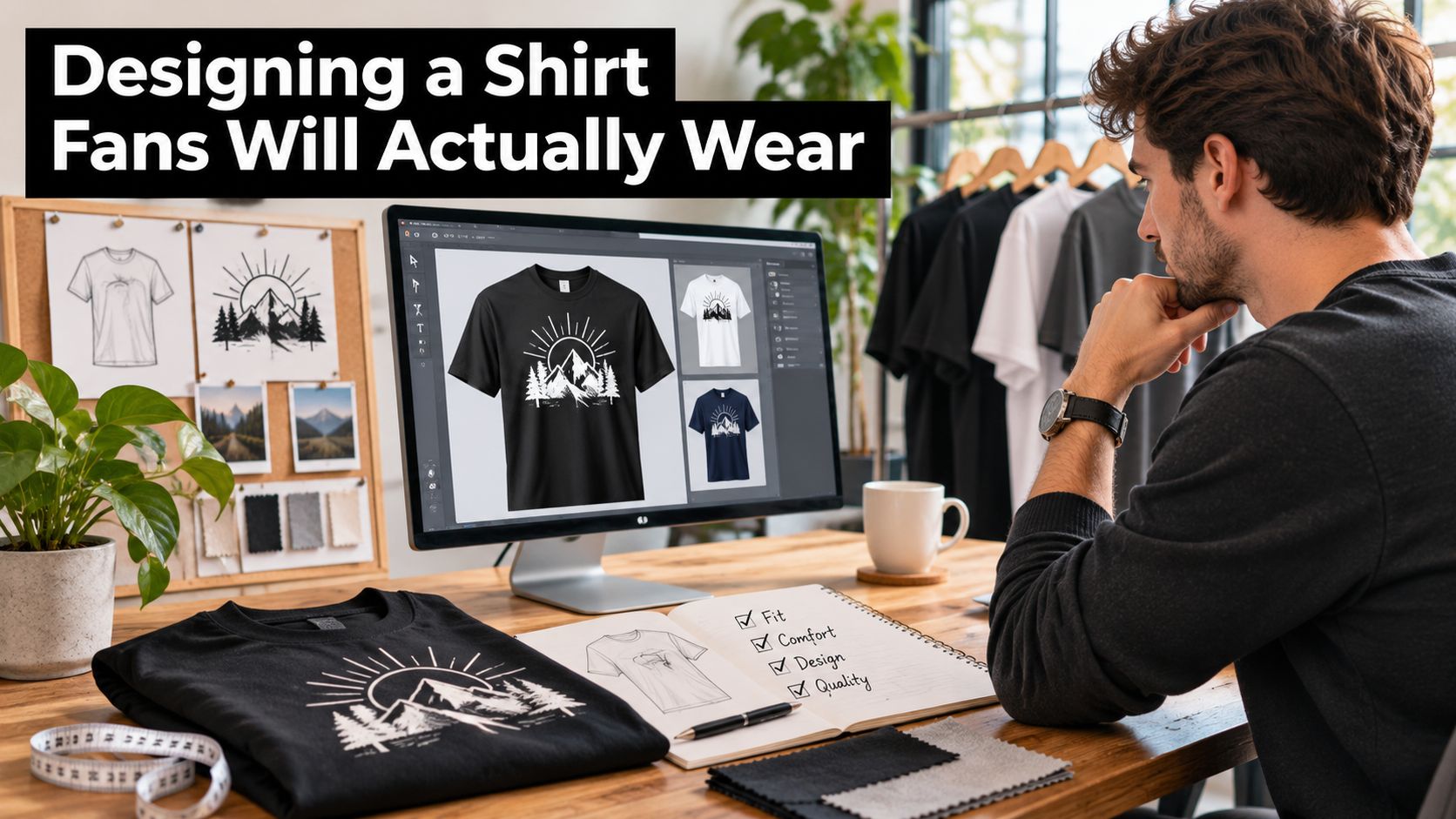
Choose the canvas before finishing the art
- Select the blank first. Compare fabric weight, cut, color, collar construction, and opacity. A graphic that looks balanced on a relaxed heavyweight blank may look cramped on a narrower garment.
- Simplify with the production quote open. Keep a clear focal point and readable lettering. For screen printing, ask the printer how color separations, an underbase, and additional print locations affect the job.
- Test the exact combination. Use the intended blank, print process, ink or transfer, and placement. A substitute garment can conceal problems you'll encounter in production.
- Wash the sample. Turn it inside out, use cold water, and air dry it. Photograph the graphic before and after, checking edges, fine lines, color, and adhesion.
- Publish care instructions before launch. Explain washing and drying plainly. Hot washing and high-heat tumble drying can accelerate color loss, cracking, and adhesion failure.
Supplier selection should include these questions, not merely a unit-price comparison. Striped Circle's guide to choosing merch suppliers for bands is a useful prompt for building that conversation into your purchasing process.
Approve production, not just a mockup
Get the artist's sign-off on a production packet:
- Print files: Final artwork, outlined fonts, transparent backgrounds where needed, and printer-approved file formats.
- Placement: Actual print dimensions and position on the garment, including how placement works across sizes.
- Sample record: Blank identity, process details, and photographs of the approved physical shirt.
- Wash results: Any observed changes and the care wording that will accompany the product.
If the print lifts or cracks during sampling, stop the order. A deadline doesn't make a failed application acceptable, and reprinting finished stock is a poor substitute for validating the job first.
Pricing a Band T-Shirt Without Losing Money
Price benchmarks for band T-shirts
Concert prices give a reference point, not a price your band must match. atVenu's 2022 concert merchandise analysis reported US$25 to US$39 genre-level average tee prices and an overall concert tee average of US$34 in 2022. atVenu's 2025 merchandise analysis gives more recent average prices for common items.
| Benchmark | Value | How to use it |
|---|---|---|
| Genre-level concert tee average | US$25 to US$39 | Check positioning against your genre |
| Overall concert tee average in 2022 | US$34 | Historical benchmark for a standard tee |
| Average pre-tax T-shirt price in 2025 | About US$37 | Reference point for your base tee |
| Pullover hoodie in 2025 | About US$70 | Premium or upsell product |
| Hat in 2025 | About US$33 | Accessory priced near the tee |
A benchmark shows what buyers encountered, not what your costs allow. Budget for artwork, extra print locations, venue deductions, damaged stock, and postage subsidies. A shirt can sell well yet leave too little cash for a reorder.
Calculate contribution before choosing a price
Start with the blank, printing, packaging, and fulfillment costs. Add payment and platform fees where applicable, along with any postage you absorb rather than charge separately. Keep fixed production costs visible in your pricing decisions.
Then set a contribution target that leaves cash for operating expenses and the next release. Markup isn't margin: markup compares profit with cost, while margin compares profit with selling revenue. Confusing the two can make a price look healthier than it is.
Use the table's base-tee reference in a simple worked calculation:
Contribution per shirt = US$37 − total variable cost
If the printer adds a cost increase of ΔC, contribution becomes US$37 − total variable cost − ΔC. Unless you change the selling price, garment specification, or another expense, that added cost reduces contribution by the same amount. The calculation helps compare options without assuming one production quote fits every band.
A higher selling price doesn't create scarcity. A genuinely limited production decision does, and fans should be able to understand the difference.
A standard tee and a premium colorway can serve different buyers when the premium has a clear reason, such as a distinct garment, additional artwork, or a restricted release. Don't use limited-edition language to disguise an ordinary product with an inflated price. Price and production choices affect more than the first sale: a shirt fans trust enough to keep can hold its value as a collectible, while a poor fit or failed print risks returns and weakens that trust.
Make the purchase terms legible
Use the seller guide for preparing a product listing when assembling the listing. Clearly identify the seller, price, and relevant purchase information before a customer buys.
Show what the displayed price includes and what checkout adds. Leave enough room in your pricing to cover a returned, damaged, or reprinted shirt.
Getting Fit Right to Cut Returns
A shirt's fit record follows it from listing to delivery. Accurate measurements help fans choose confidently, reduce avoidable size-related returns, and protect the shirt's value as a piece of band merchandise they may keep.
Fit measurements to publish for every T-shirt listing
| Measurement | How to capture it | Why fans need it |
|---|---|---|
| Body width, pit to pit | Lay the shirt flat after laundering and measure across the chest | Shows garment width, separate from chest circumference |
| Length, shoulder seam to hem | Measure from the top of the shoulder seam to the hem | Helps fans match length to their preference |
| Sleeve length | Measure from the shoulder seam to the cuff | Helps fans assess sleeve coverage |
| Fabric weight | Record grams per square meter from the blank supplier | Helps explain how substantial the fabric feels |
| Model height and worn size | Photograph a model of known height wearing a stated size | Shows how the cut sits on a real body |
| Shrinkage guidance | Wash a sample and record the change in each direction | Helps fans allow for laundering changes |
State whether the blank is standard, relaxed, oversized, or unisex, then describe its shape. Unisex identifies the intended wearer range, not an exact silhouette. Say whether the shirt has a narrow torso, dropped shoulders, or a longer body so buyers can judge the cut against their preferences.
Industry summaries of Coresight Research cited in SizeMarker's size-related returns guide report a 24.4% U.S. online apparel return rate, with approximately 52–58% of apparel returns attributed to size or fit issues. These apparel-wide figures are not a forecast for a band's webstore. They do show why clear fit information belongs in the listing, not just in a return policy.
Build a garment-specific fit record
- Buy a sample of each proposed blank. Nominally matching sizes can have different dimensions.
- Wash it using the published care method. Record measurements before washing so shrinkage guidance reflects the garment's change.
- Measure after laundering. Smooth the shirt without stretching it, and use the same measuring points each time.
- Publish production tolerances. Get the blank supplier's tolerance information and compare it with samples. Avoid precision the production process cannot maintain.
- Retain the method and recheck substitutions. Keep photographs showing tape placement. Update the listing if the supplier or garment changes.
For international buyers, give measurements in centimeters and inches rather than relying on regional size labels. Ask fans to compare them with a shirt they already like, measured the same way. That makes the sizing guidance useful at the point of purchase.
Use photographs to clarify the cut
Plan on-model photography that supports the measurements. Pair front and side views with the model's height and worn size, and avoid styling that hides the garment's length or width. A photograph helps buyers understand how a cut looks; it cannot replace measurements.
If using generated or composited imagery, do not present it as proof of a physically tested fit. For a limited drop, accurate sizing guidance matters especially because replacement stock may be unavailable. Fit errors can cost a fan the chance to get the shirt, as well as weaken trust in the next release.
For physical goods, returned items must be in the condition stated in the listing, with included parts and reasonable packaging. State the applicable condition before purchase. Clear terms and a consistent fit record help fans make an informed choice and give the shirt a better chance of being worn, kept, and valued as a collectible.
Making Merch Fans Keep for Years
An organic-cotton label isn't a complete sustainability plan. It says something about the material, but it doesn't tell a fan whether the graphic will last, whether unsold shirts have a destination, or whether the garment can stay in use after its first owner moves on.
UN-Habitat's zero-waste materials report approximately 92 million tonnes of global textile waste annually, with fewer than 15% of textiles recycled and more than 73% landfilled or incinerated. Treat end-of-life handling as part of the product decision, not an optional marketing paragraph.
Make longevity part of the specification
A poorly fitted shirt with a green label isn't automatically the lower-impact choice. If a fan doesn't wear it, the material claim hasn't solved the problem of producing an unwanted garment. Without a product-specific lifecycle assessment, don't claim that one option has a smaller environmental footprint than another.
Ask the printer for documentation behind ink, transfer, recycled-content, or organic claims. Keep the wording narrow enough to match that documentation. Avoid broad terms such as environmentally friendly when you can state the actual material or process instead.
Made-to-order production limits your commitment to unproven demand, but it introduces waiting time and can cost more per garment. Bulk production can improve unit economics and make show stock available immediately, while exposing the band to leftovers. Choose the model based on demand certainty and fulfillment capacity.
Lifecycle check: Before ordering, decide where an unsold shirt goes and what a worn-out shirt's owner can realistically do with it.
Give fans and stock a practical next step
- Put care instructions on every listing. Make them easy to find after purchase, not buried inside launch artwork.
- Test demand with a small made-to-order release. Confirm the production schedule before accepting orders, then use actual purchases to assess a bulk commitment.
- State your overstock plan. Decide whether remaining garments will stay available, be repurposed, donated where appropriate, or handled through another clearly described route.
Consider repair guidance for small seam failures and resale or trade-in options only if you can support them. Don't promise textile recycling without confirming what the receiving program accepts, particularly for printed or blended garments.
A collectible should carry a recognizable design and a credible product history. Keep accurate records of the blank, artwork version, and production run so a later reissue doesn't become indistinguishable from the original.
Selling Direct to Fans Online and at Shows
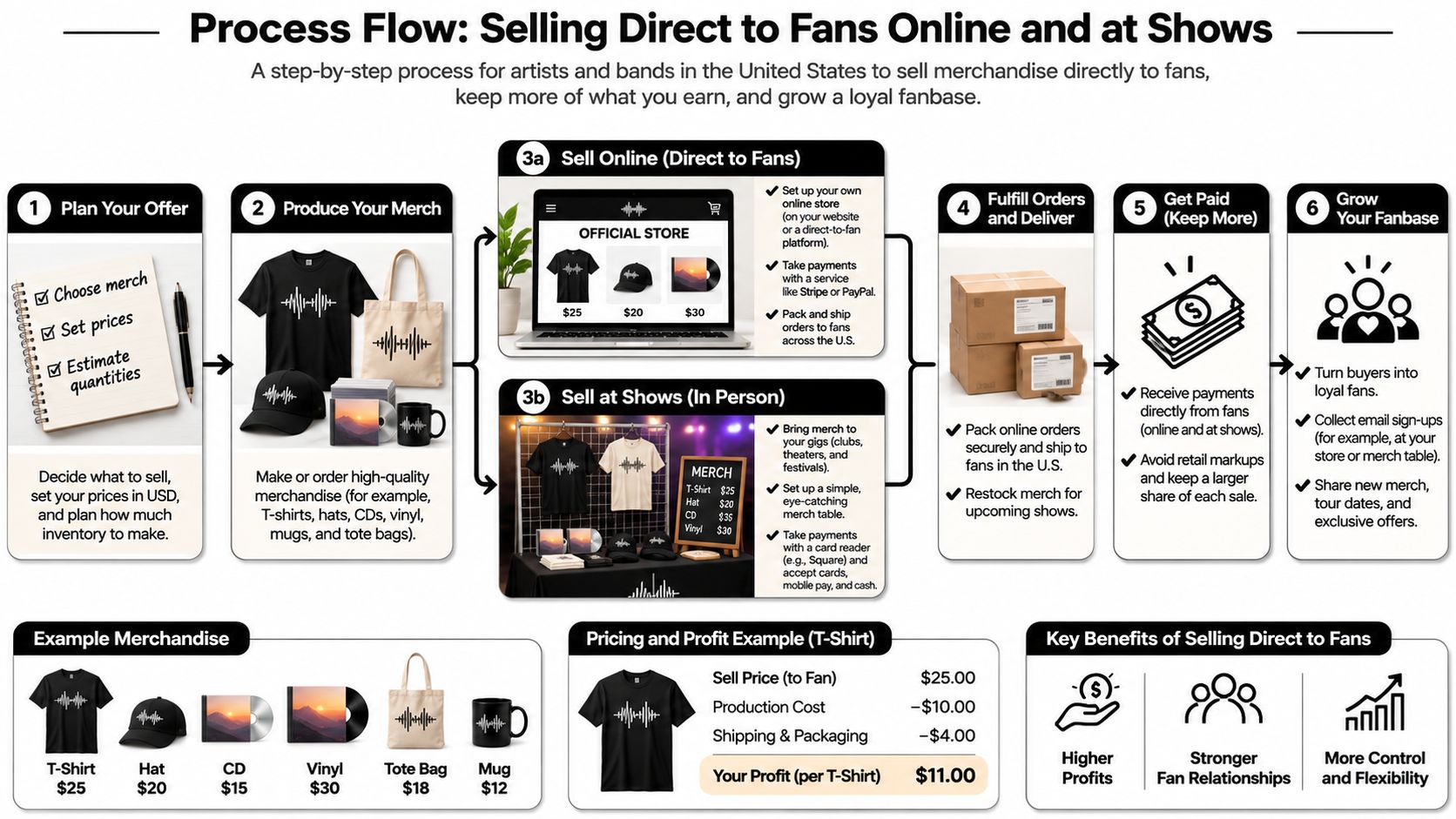
The buying path has a straightforward sequence: stream to discover the artist, buy something the artist makes available, and help fund what comes next. Direct purchases fund recordings, musicians, touring, and merchandise. Your job is to connect those stages without making fans work to find the product.
Our music marketplace lets fans buy music, merchandise, and other products directly from artists. Sellers can offer music downloads, merchandise, digital products, subscriptions, exclusives, instruments, pro audio gear, and other music-related products, but a shirt launch benefits from a focused offer rather than an overcrowded announcement.
Run the launch as an operational routine
- Set the production commitment and drop date. For stocked goods, define the run size. For pre-orders, define the ordering window, supplier capacity, and what happens if production is delayed.
- Finish the listing before announcing it. Include product photographs, the fit specification, care notes, seller identity, price, and relevant purchase information. Confirm that each size option matches the stock you can fulfill.
- Notify the mailing list and community before launch. Give fans the opening time and a clear reason for the design. Use the same garment details across posts so nobody receives conflicting information.
- Connect the merchandise table with the online listing. Bring a card reader and display a QR code for the shared order destination. Test both on a phone before doors open.
- Ship within the stated window. Organize orders by SKU, check the garment against the order, and record dispatch. If the schedule changes, communicate before fans need to chase you.
- Review early sell-through before reordering. Track units sold against units made available for each size and colorway. Treat the first-week review as an early signal, then assess the opening fortnight before committing to replenishment.
These are operating choices, not universal deadlines. Choose a schedule your printer and fulfillment setup can reliably meet.
Give each channel a distinct job
Shows let fans inspect the shirt and leave with it immediately, but you can only sell the stock you brought. Keep the display sample separate from sellable inventory and record every transaction, including cash. Assign someone to stock control rather than expecting the performer to reconcile sales after loading out.
Online drops reach fans who can't attend, but packaging, postage, customer communication, and returns become part of the work. Reserve web orders before transferring stock to the next venue. A shared order destination doesn't prevent overselling unless someone maintains the inventory record.
Pre-orders can reduce speculative stock, but they transfer the uncertainty into your delivery promise. Don't spend the receipts as if every order were already fulfilled; retain enough cash to complete production and resolve problems.
Reorder only the sizes and colorways that sold through during your opening two-week review, unless clear unmet demand supports another choice. This month, list a single design and track its sell-through for two weeks before deciding on a second run. Record questions and return reasons alongside sales so the next order improves the product, not just the quantity.
OohYeah offers a music marketplace where fans can buy merchandise directly from artists. Visit OohYeah to prepare a band T-shirt listing with clear photos, garment measurements, care instructions, and purchase details, then use that design to test demand before expanding your range.