Artist Record Sales: How Counting and Payouts Work
Learn how artist record sales are counted, how revenue is split across distributors and labels, and what artists actually keep from each format.

November 22, 2026
Music Marketplace Advisor
Buying & SellingGlobal vinyl sales grew 13.7% in 2025, according to Variety's coverage of IFPI's annual industry figures. That sounds like a reason to press records. It isn't enough to establish whether an independent artist should, because category growth says nothing about the cost of manufacturing an album, finding its buyer, or delivering it.
Artist record sales measure different things depending on who's counting. A chart compiler measures qualifying consumption, a distributor reports receipts, and an artist needs to know what remains available to fund the next release. Treating those measures as interchangeable can turn an impressive sales report into a misleading business plan.
How Each Format Counts Toward Sales
A physical album, a purchased download, and a streamed recording represent different listener behaviors. Chart and certification systems can translate eligible activity into album-equivalent units, allowing purchases and listening activity to contribute to a common measure.
That common measure isn't a common payment. An equivalent unit describes consumption under a reporting system's rules, not the amount deposited into an artist's account.
The first task is therefore to identify the reporting system. Don't apply a conversion ratio until you've established the chart or certification program, territory, reporting period, and eligible activity. A ratio without that context creates precision without reliability.
Format to Album Unit Conversion Rates
The following table identifies the rule to obtain before making a conversion. It isn't a substitute for the applicable chart or certification documentation.
| Format | Units Per Album Equivalent | Revenue Note |
|---|---|---|
| Physical Album (Vinyl/CD/Cassette) | Qualifying album purchase under the reporting program's rules | Retail price, manufacturing expense, and retained margin are separate from chart credit |
| Digital Album Download | Qualifying complete-album purchase under the reporting program's rules | The artist's receipt follows the store, distribution, and rights agreements |
| Individual Track Download | Eligible track purchases divided by the program's track-to-album divisor | Track purchases can contribute to an album total without producing album-purchase revenue |
| Premium On-Demand Stream | Eligible premium streams divided by the program's premium-stream divisor | Royalty allocation follows service and rights-holder agreements |
| Ad-Supported Stream | Eligible advertising-supported streams divided by the program's ad-supported divisor | Don't assume the same unit weighting or commercial return as premium listening |
Read the physical row as a distinction between format eligibility and economics. Vinyl, CDs, and cassettes can be grouped as album purchases for reporting purposes, while their production and fulfillment costs remain different.
The digital-album row separates a complete purchase from individual tracks. For track downloads, use the eligible count and the divisor specified by the reporting program, rather than treating every download as an album.
For streaming, preserve the premium and advertising-supported categories until the applicable rules tell you how to convert them. Combining those raw counts prematurely can prevent you from reproducing the reported total.
Build a conversion worksheet, not a payout estimate
A useful worksheet keeps the original activity beside the converted result:
Album equivalents = qualifying album purchases + converted eligible track purchases + converted eligible premium streams + converted eligible ad-supported streams
Keep revenue in a separate column. If a distributor statement supplies receipts but no chart eligibility information, don't infer chart units from the money received.
Practical rule: Use album equivalents to compare qualifying consumption. Use settlement statements to calculate earnings.
Before adding reports across release periods, check whether the methodology changed. Keep a copy of the rules used for each calculation, including exclusions and adjustments, so a later comparison doesn't combine incompatible measures.
The analytical payoff is straightforward: an artist can have stronger reported consumption without a proportionate improvement in cash income. The conversion system answers how activity counts, not how well that activity funds the artist.
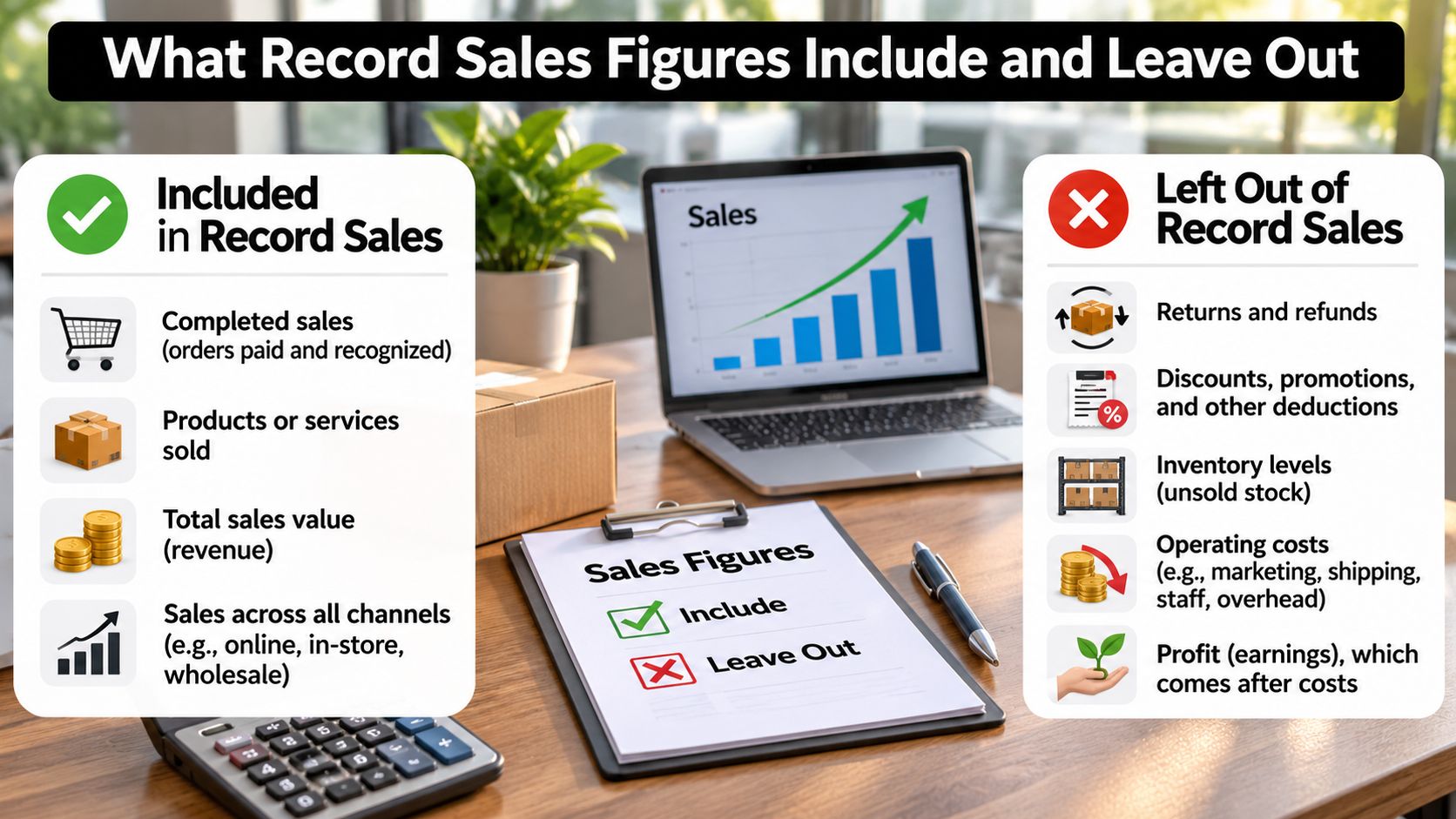
What Record Sales Figures Include and Leave Out
Global recorded-music trade revenue reached US$29.6 billion in 2024, up 4.8%, while streaming supplied 69.0% of the total, according to IFPI's annual revenue announcement. Album Equivalent Units are a chart metric for qualifying consumption; Trade Revenue measures industry revenue. Neither is a statement of an individual artist's take-home income.
This financial distinction is easier to follow when the measures are separated visually.
What the headline actually measures
A recorded-music revenue total combines income from different channels, including physical products, downloads, paid streaming, and advertising-supported streaming. Unlike a chart total, it combines money rather than converting listening into equivalent albums.
That distinction changes the question an artist should ask. A revenue increase describes a larger commercial market, but doesn't establish that an artist's contractual share improved, their costs fell, or their payments arrived sooner.
Think of a sales headline as a stadium attendance figure. It tells you something about the scale of activity, but not what each ticket netted the band after the venue and other participants received their shares.
What the total can't tell you
Industry totals don't supply a personal earnings reconciliation. To build one, an artist needs the relevant agreement, sales ledger, deductions, rights allocations, and expense records.
For artists operating as sole traders, Snyp's guide to tracking sales receipts for sole traders offers useful bookkeeping context. Recording a sale and reconciling the cash received are separate tasks, particularly when a platform settles transactions after deductions.
Use these questions whenever a headline or dashboard presents a sales figure:
- Whose revenue is it? Identify whether it belongs to a retailer, distributor, label, rights holder, or artist.
- Where is it counted? Establish whether the figure describes consumer spending, trade receipts, or an artist settlement.
- What has been deducted? Find out whether it's gross revenue, revenue after specified fees, or profit after costs.
Keep those questions in mind when watching discussions of music-sales economics.
A large market can create opportunities without telling you which opportunity is profitable for your release. That decision requires an artist-level ledger, not an industry-level total.
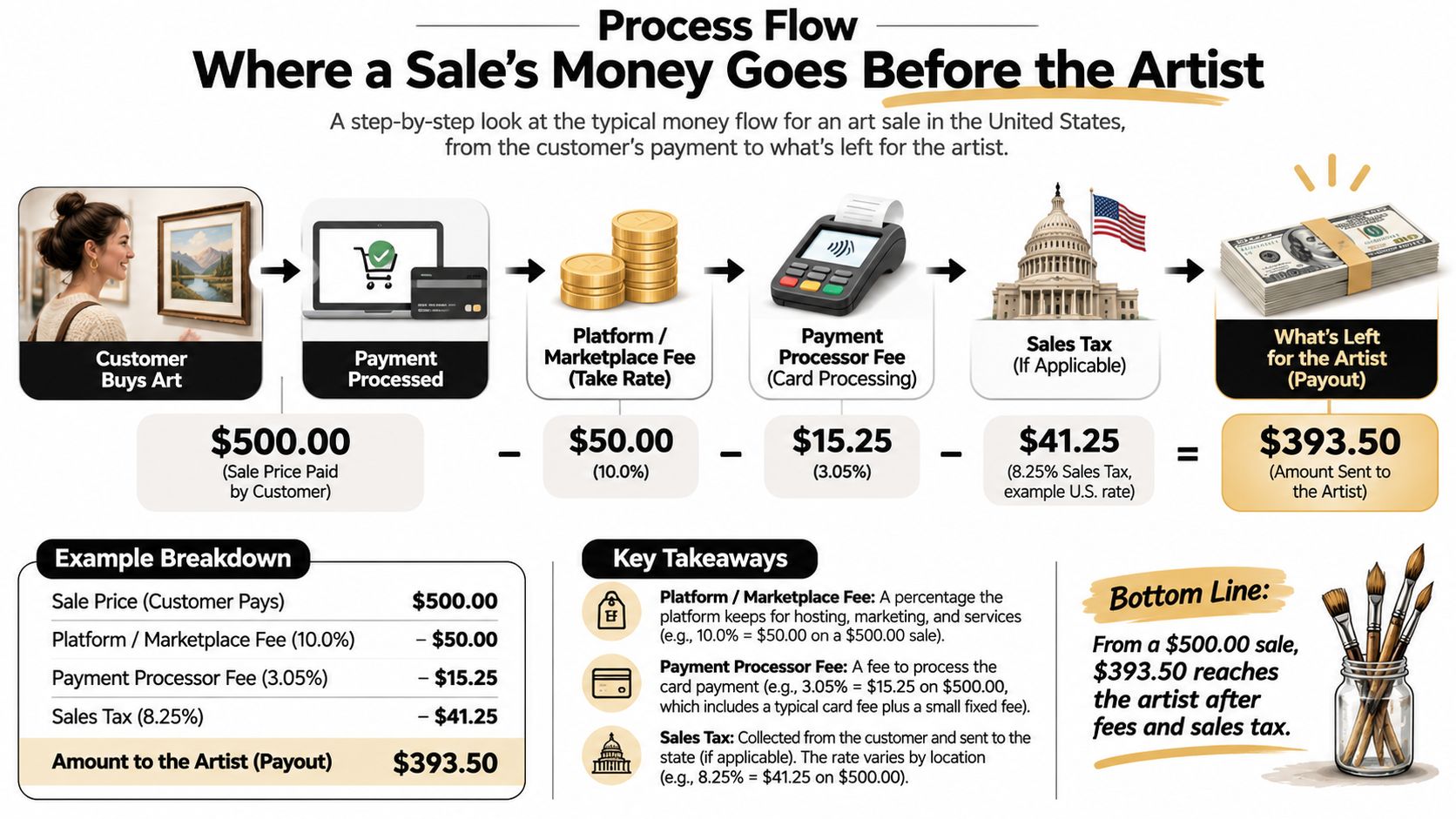
Where a Sale's Money Goes Before the Artist
Start with a fan buying an album at the listed checkout price. The payment isn't automatically the artist's revenue, and the artist's revenue isn't automatically profit. Each agreement determines which participant receives money, what they deduct, and when they settle.
Global recorded-music revenue reached $31.7 billion in 2025, up 6.4% year over year, according to Music Business Worldwide's coverage of the annual industry results. Those aggregate figures don't establish the share individual artists retained.
Use this flow diagram as a checklist of possible deductions, not a universal payout schedule.
Trace the payment through the agreements
At checkout, establish who acts as the seller and whether the store or marketplace deducts a fee. Separate the product price from shipping and any tax collected, rather than treating the entire checkout amount as music income.
The payment provider may deduct processing charges. Check the settlement record to see whether those charges have already been removed before the store reports the artist's balance.
Next, examine distribution. A distributor may charge through a revenue share, a flat fee, or another contractual arrangement. Don't subtract a percentage from every transaction if the agreement instead charges a separate service fee.
A label or licensor then accounts according to its contract. The royalty base matters as much as the stated rate: a share of gross receipts isn't the same as a share calculated after permitted deductions. Recoupment can also affect whether credited royalties become payable cash.
Producers, co-writers, and other collaborators require particular care. Master-recording participation and composition income are different rights, so don't model every collaborator as a deduction from the same album-payment balance.
Finally, reconcile tax treatment and the artist's settlement. Withholding, tax collected for remittance, and the artist's eventual income-tax liability shouldn't be merged into an unexplained deductions line.
Distinguish a payout from spendable profit
Some purchases won't pass through every participant described above. Other arrangements introduce reserves, refunds, or additional contractual deductions. The correct sequence is the sequence documented in the actual agreements and statements.
We require an Artist Agreement before publishing artist content or monetization. Review the artist agreement alongside your rights and fulfillment obligations before preparing a release budget.
For physical products, separate the settlement calculation from inventory expenses. SellerAI's discussion of how to improve margins after storage and returns offers a useful comparison for those cost categories, though its fulfillment context shouldn't be treated as music-industry fee guidance.
| Payment stage | Question to resolve |
|---|---|
| Checkout | Who sells the product, and what does the reported price include? |
| Processing | Which charges appear in the settlement, including refund-related charges? |
| Distribution | Is the charge transaction-based or billed separately? |
| Label or licensor | What royalty base, deductions, and recoupment terms apply? |
| Collaborator accounting | Which rights and receipts does each agreement cover? |
| Taxes | What was collected, withheld, or left payable later? |
| Artist settlement | Does the statement reconcile to the bank deposit? |
The reliable result comes from matching contracts, statements, and deposits. A contract defines entitlement; a reconciled ledger shows what arrived.
How Streaming Revenue Reaches Artists
In the United States, streaming generated approximately $9.75 billion in 2025, representing about 84.5% of recorded-music revenue, according to the RIAA's annual revenue announcement. That establishes streaming's commercial importance. It doesn't establish a universal payout for an artist's next stream.
The assumption to challenge is simple: more streams must mean proportionately more artist income. That conclusion only holds when the underlying revenue allocation, rights position, and contractual terms remain comparable.
Why equal listening counts can produce unequal receipts
Streaming revenue is pooled and allocated under rights-holder agreements. An artist can't reliably turn a public stream counter into personal income without knowing how the relevant receipts reach them.
The main variables are:
- Rights ownership. Master-recording income and composition income follow different rights and accounting paths.
- Territory. Preserve geographic information when analyzing receipts instead of assuming every listener contributes identical commercial value.
- Service mix. Separate subscription and advertising-supported activity, along with the services generating it.
- Contractual splits. Identify what the artist retains after the applicable rights-holder and distribution arrangements.
Consider artists with matching stream counts on the same service. An artist who controls the master and receives the associated receipts isn't in the same financial position as an artist paid a contractual royalty by a label.
That comparison still isn't complete without expenses. The master owner may have funded recording, promotion, and administration directly, while the signed artist's arrangement may allocate those obligations differently. Compare retained income and investment, not ownership labels alone.
A stream count measures listening activity. It doesn't reveal the artist's share of the resulting receipts.
Test whether attention becomes support
For an independent release, streaming can serve both as a revenue source and as an audience-acquisition channel. Don't assume either role is sufficient without measuring the outcome.
Use a spreadsheet or bookkeeping export to calculate revenue per active fan, repeat purchase rate, and listener-to-paying-supporter conversion. Define an active fan before making comparisons, and use a consistent observation period so a release-week spike isn't compared with an established catalog's longer sales history.
For direct-sales comparisons, use actual retained contribution rather than a generic per-stream estimate:
Required direct purchases = target retained contribution ÷ contribution per direct purchase
For streaming, use your own matched accounting statement to establish the receipts associated with the activity being evaluated. Don't present an estimated platform-wide payout range as an artist's guaranteed return.
This approach can support different conclusions. Strong catalog receipts may justify continued streaming investment; weak supporter conversion may call for a clearer direct offer. The useful strategy is the one supported by your accounts, not a blanket instruction to prioritize or abandon streaming.
Direct Sales Break Even and Net Revenue Math
U.S. vinyl-record revenue reached $1.04 billion in 2025, increasing 9.3% from 2024, according to RIAA figures reported by RouteNote. For an artist considering a pressing, however, the relevant evidence is the release budget and credible purchasing demand.
A physical format becomes financially defensible when expected retained contribution can cover the costs committed to producing and selling it. Enthusiasm, followers, and category growth aren't purchase commitments.
Calculate contribution before break-even
Start with the amount each completed sale contributes toward fixed costs:
Contribution per sale = selling price − variable product cost − seller-paid fees − seller-paid fulfillment − collaborator participation
Then calculate the required sales volume:
Break-even units = fixed release costs ÷ contribution per sale
Round the result up to a whole sale. If contribution per sale isn't positive, additional sales won't recover the fixed costs under that pricing model.
Bookkeeping and Accounting of Florida's break-even walkthrough provides useful context for separating fixed costs from variable costs. That separation is especially important when a pressing quote combines setup work with manufactured inventory.
Don't count the same manufacturing expense twice. If you treat a prepaid pressing batch as an upfront project cost, don't also subtract the full prepaid manufacturing charge from every unit when calculating that project's cash recovery. For ongoing format comparisons, allocate product costs consistently so retained margins remain comparable.
Compare what each supporter contributes
A fan-level comparison should expose cost differences rather than hide them behind retail prices.
| Purchase type | Amount to calculate | Cost commonly missed in a release budget |
|---|---|---|
| Track download | Receipt after applicable transaction charges and rights participation | Fixed processing charges relative to the transaction |
| Digital album | Retained receipt, with release-production costs tracked separately | Artwork, mastering, and promotion |
| Merchandise bundle | Bundle receipt less all included products and fulfillment | Packaging, replacements, and seller-paid postage |
| Recurring subscription | Retained receipts across actual paid periods, less delivery obligations | Content-production work, cancellations, and support |
Digital products don't require physical inventory, but that doesn't make their creation or promotion costless. Similarly, subscription receipts aren't pure profit when the artist promises continuing content or other benefits.
To compare recurring support with a merchandise purchase, divide the bundle's retained contribution by the subscription's retained contribution per paid period. Don't use subscription revenue before costs on one side and merchandise profit after costs on the other.
Inventory test: Commit to a production quantity only when credible demand supports recovering the cash you must put at risk.
Convert audience evidence into a production decision
Calculate expected buyers as reachable engaged fans × purchase conversion rate. Use your own comparable campaign results where available, and treat an untested conversion assumption as a scenario rather than a forecast.
Preorders provide stronger purchasing evidence than expressions of interest, but they also create fulfillment obligations. Budget for cancellations, damaged shipments, replacement stock, and unsold inventory before committing cash.
Our support-artists information explains how direct purchases help fund artists' work. In your own accounts, assign those receipts to specific obligations so money needed for fulfillment doesn't get spent on the next recording.
Choose vinyl, CDs, or a digital offer by comparing demand evidence, cash exposure, and contribution. The most attractive format isn't necessarily the one with the highest selling price. It's the one your audience will buy at terms that leave the project financially workable.
Choose the Sales Model to Measure First
Start with the sales model where you control the price, can identify the supporter relationship, and can reconcile what you keep. That gives you a practical baseline for evaluating other channels without pretending they perform identical jobs.
Don't begin by expanding every format. A manageable release with clear accounting will tell you more than a broad catalog of offers whose costs you can't separate.
Make the measurement repeatable
Use this checklist in order:
- Label each figure. Mark receipts as gross, net of specified fees, or contribution after variable costs. Keep profit as a separate calculation after the remaining expenses.
- Reconcile the main release. Match checkout records, contractual allocations, settlement statements, and bank deposits. Investigate unexplained differences rather than hiding them in miscellaneous expenses.
- Measure supporter value consistently. Compare formats over the same period, including repeat purchases and the work required to deliver promised benefits.
- Test physical demand. Compare break-even requirements with paid commitments and a cautious estimate of additional buyers.
- Review and decide. Keep a format when its contribution and workload meet your target. Change the price, simplify fulfillment, or stop offering it when they don't.
Set the target before reviewing the outcome. Otherwise, it's easy to justify an expensive release because the gross sales look encouraging.
Keep the initial commitment narrow
On OohYeah, artists keep 100% of eligible sales, minus payment processing. Direct purchases fund recordings, musicians, touring, and merchandise, but artists still need to account for their own production costs and obligations.
If you're preparing to join as an artist, choose a release and a direct format you can cost accurately. Establish a review date before launch, record the work involved in fulfilling the offer, and decide whether expansion is justified only after reconciling the results.
The first number to track is retained contribution per paying supporter. It connects the commercial offer to the money available for your work without confusing popularity, receipts, and profit.
OohYeah offers a marketplace where fans can buy music, merchandise, and other products directly from artists. Visit OohYeah to explore a direct offer for your next release, set a price against your actual costs, and begin measuring what each sale leaves available to fund what comes next.