Music Subscription Prices Explained: Tiers and Benchmarks
Compare music subscription prices by tier, see what increases do to fans, and learn how to set a fair price for an artist-led subscription on OohYeah.
November 6, 2026
Music Marketplace Advisor
Buying & SellingPaid subscription streaming revenue rose 11.2% in 2023, while the typical US individual plan sat near ten dollars a month and verified student plans near half that. Duo and family tiers raise the headline price but lower the cost per listener. Total streaming revenue reached US$19.3 billion and represented 67.3% of the global recorded music market, according to the IFPI Global Music Report 2024 State of the Industry.
The list price is only the entry point. The useful tests are whether that monthly charge fits different incomes, how many subscribers a provider can lose before a price increase stops adding revenue, and how much of each sale reaches the artist.
Current Music Subscription Prices at a Glance
Paid music access in the United States clusters around $10.99 a month for one listener, with student access near half that level and multi-person plans priced higher in total but lower per listener.
That clustering is the baseline for the affordability and churn math that follows. The table below shows US monthly list prices as typical levels observed in August 2026. Prices differ by country, currency, and billing period, and annual billing, carrier bundles, taxes, and introductory offers change what a household pays.
Monthly Music Subscription Prices by Plan
| Plan | US monthly price | Who it suits | Notes |
|---|---|---|---|
| Individual (Spotify Premium) | $10.99 | One listener | Typical individual list level |
| Duo (Spotify) | $14.99 | Two accounts at one address | Typical shared plan for two listeners at one address |
| Family (Spotify) | $16.99 | Up to six accounts at one address | Lowest typical cost per person at full use |
| Student (Spotify) | $5.99 | Verified students | Typical student list level at about half the individual price |
| Individual (Apple Music) | $10.99 | Listeners in the Apple ecosystem | Typical individual list level |
| Family (Apple Music) | $16.99 | Up to six accounts | Typical family list level |
| Individual (YouTube Music Premium) | $10.99 | Listeners who want background play | Typical individual list level |
| Free ad-supported tier | $0 | Casual listeners | Ads and limited on-demand features |
List prices have been revised over time, so use this table as a starting point and confirm the current offer before you subscribe.
How to Read the Table
Start with active listeners, not the headline price.
One listener maps to one individual price. Two listeners at $14.99 pay an effective $7.50 per person. Six active listeners at $16.99 pay an effective $2.83 per person. That single division explains why the highest headline price often produces the lowest household cost, and why unused seats erase the apparent saving. Student pricing follows the same test. The discount only holds for listeners who can verify enrollment and keep that verification current.
Comparison rule: Divide the plan price by the number of active listeners, then compare that figure, not the headline price.
The same per-seat test applies when you compare IPTV subscriptions in Canada, where device count and household use change real value. For music, match active seats, eligibility rules, and billing period first. Then weigh affordability against retention risk and artist payout in the sections ahead.
Why Music Subscription Tiers Are Priced the Way They Are
Think of tiers as coffee sizes on a cafe menu. You don't choose in isolation. You judge each option against the one beside it, and the menu is built to steer that judgment.
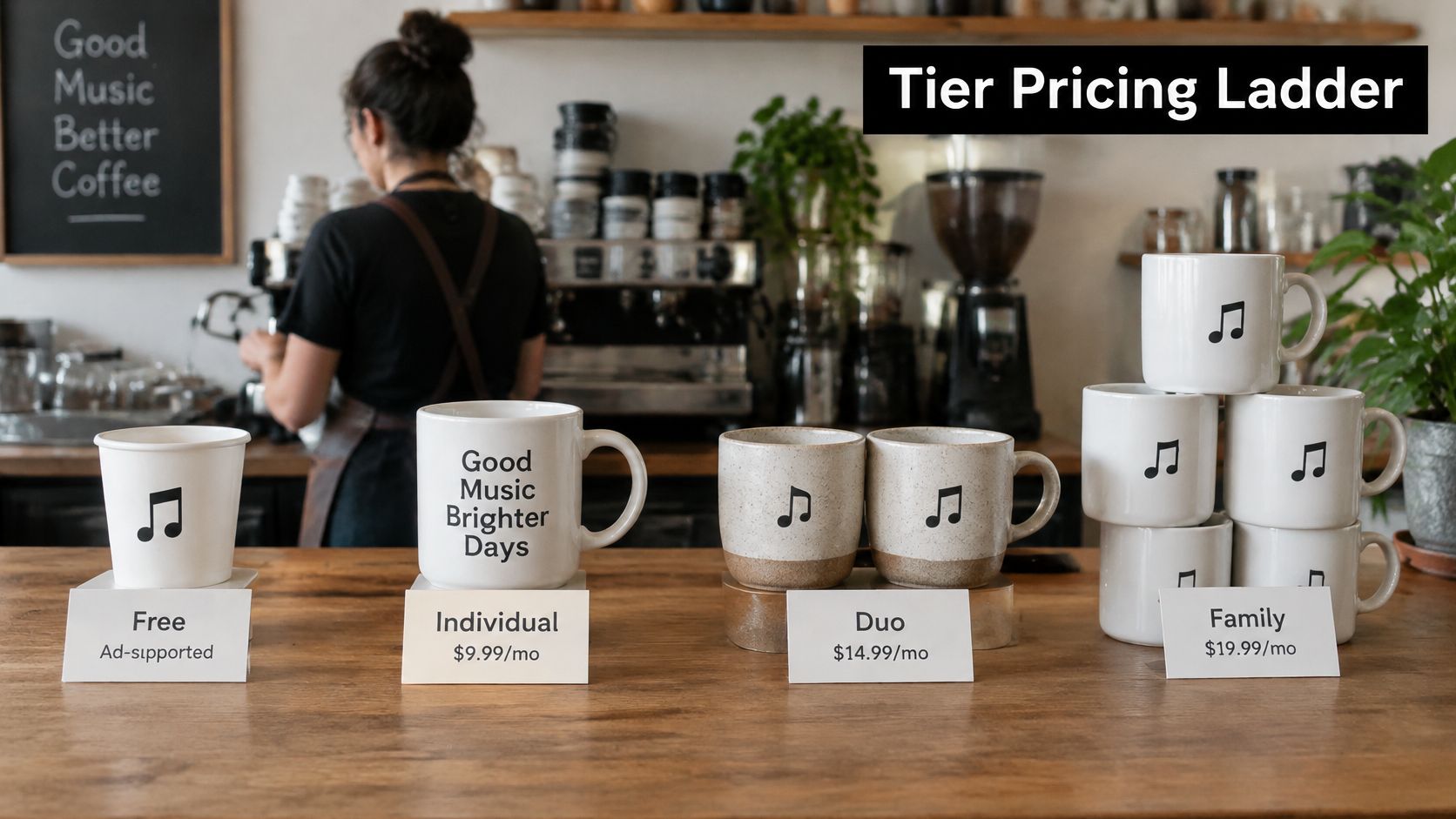
The free ad-supported tier brings people in. It gives casual listeners a way to sample a catalog without committing, and it gives the service an audience it can later convert. The individual plan then becomes the anchor, the reference price every other tier is judged against.
The Anchor Sets the Ladder
Once $10.99 is your reference for one listener, $14.99 for two accounts looks like a modest step up, not a separate purchase decision. The family plan works the same way. At $16.99, it's only a few dollars above Duo, yet it covers more accounts. That gap is deliberate.
This is also where the decoy effect appears. A plan priced close to a more useful option can make the more useful option look sensible. If Duo feels cramped but Family costs only slightly more, Family becomes the easy choice, even if you don't use every seat on day one.
The student plan plays a different role. It's a targeted discount for a price-sensitive group that might otherwise stay on free listening or share someone else's account. The service accepts less revenue now to build a paying habit that may continue after graduation.
Why Prices End in .99
Charm pricing keeps the number in a lower mental bracket. $10.99 reads as a ten-dollar commitment, while $11.00 reads as eleven. The one-cent gap doesn't change your budget in any meaningful way, but it can change whether the price feels routine.
A tier ladder isn't a list of independent prices. Move the anchor, and every upgrade, discount, and household calculation moves with it.
That's why a $1 rise matters beyond the individual plan. It resets the reference point for Duo, Family, Student, gift cards, and competing services. Fans don't just ask whether they can afford another dollar. They ask whether the whole ladder still makes sense.
For artists setting their own tiers, copy the logic, not the exact numbers. Price the tier most fans will choose, then build simpler and richer options around it. An impressive top tier that nobody buys doesn't fund recording. A clear middle tier with benefits fans use every month does. If you sell through OohYeah, read the OohYeah Subscription Terms before you publish, because the promise beside the price is part of the offer.
Affordability Across Incomes and Markets
At $300 of monthly disposable income, a $10.99 plan takes 3.7% of the budget. At $1,500, the same plan takes 0.7%. A monthly list price is not a verdict on affordability. The calculation is monthly plan price divided by monthly disposable income, and the result changes more than the price does. That ratio is the number to compare across markets. A plan priced at $10.99 in the US and converted to local currency in a lower income market can look equal on a price sheet while taking a much larger share of a fan's monthly budget.
Run the Share of Income Test
Plan share of monthly income at $10.99
| Monthly disposable income | Share spent on $10.99 plan |
|---|---|
| $300 | 3.7% |
| $500 | 2.2% |
| $1,000 | 1.1% |
| $1,500 | 0.7% |
| $3,000 | 0.4% |
Use disposable income, not gross pay. Rent, food, transport, debt, and other subscriptions compete for what remains. A plan that looks small beside a salary can still be the easiest bill to cut when several entertainment renewals land in the same week. The music did not change. The budget pressure did.
That pressure is already visible. The Deloitte Digital Media Trends dashboard found that nearly 75% of consumers were frustrated by continuing entertainment price increases and about 40% had recently reduced entertainment subscriptions because of financial pressure. Frustration alone does not cause cancellation. It lowers the patience fans have when a renewal arrives without a clear new benefit.
Growth Is Coming From Different Budgets
The next subscribers are more likely to come from markets where a US dollar list price fits local budgets poorly. That points to a practical conclusion. Copying US pricing into every market is not consistency if the fan pays a different share of income after conversion and local taxes. A local price is only affordable if it fits the way fans pay. In markets where card billing is less routine, a prepaid option can matter more than a small discount on a recurring plan.
Compare these items market by market:
- Local currency price: Check what the fan pays after conversion and local taxes, not the US list price.
- Prepaid access: Look for options that do not require a recurring card commitment.
- Family sharing: Count active seats, because sharing can cut the per-person burden sharply.
- Student eligibility: Confirm who qualifies, how verification works, and when the discount ends.
- Billing period: Compare monthly flexibility against any annual saving.
Cheapest is not always best value. A higher priced direct-to-artist membership can replace several fragmented purchases if it bundles exclusive material, interaction, and downloads into one predictable payment. The test is replacement value. If the membership does not replace spending or add something fans cannot get free, the lower global plan wins.
How Price Increases Change Fan Behavior
A price rise works like a leak in a dam. A small leak may pass unnoticed because the structure still holds for subscribers. Widen it, and fans start inspecting what they're paying to keep.
The chart below separates a minor rise from the point where listeners actively reconsider.
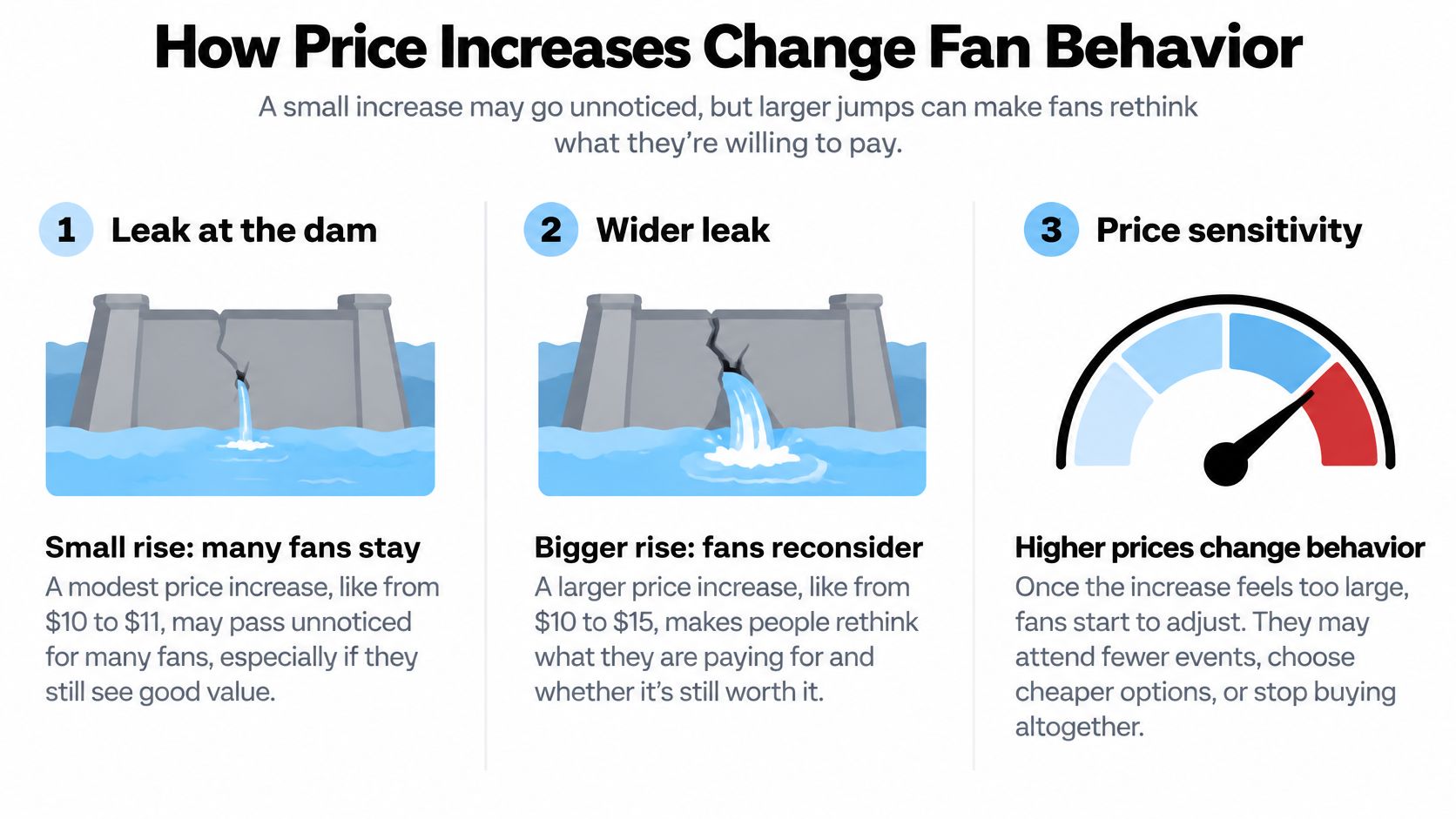
Consumer research reported by Ecoustics on global paid music subscriptions found that 61% of people would be likely to cancel a favorite entertainment service after a $5 monthly increase, and around 40% have already cut back because of financial concerns. That doesn't mean every service loses most subscribers after a large rise. It means a big increase turns a passive renewal into an active decision.
The Break-Even Test
Do the arithmetic before you announce anything. A $1 rise from $10.99 to $11.99 adds revenue only if subscribers fall by less than about 8%, calculated as 1 divided by 11.99. Lose more than that share, and the higher price produces less recurring revenue than the old one.
Decision rule: Tie each increase to a named benefit, announce it with time to adjust, and know your break-even cancellation rate before the first new bill lands.
Then ask what the extra money buys. Better audio, downloads, exclusive releases, community access, or a materially higher payout to the artist can justify a rise. A vague promise of improvement usually can't. In platform-wide streaming, a fan's payment enters a shared system. In a direct fan subscription, the link between payment and one artist is visible, so the benefit must be visible too.
The short video below is useful context for how fans discuss value when a familiar service changes its terms.
Watch three signals after any rise. First, track cancellations in the first billing cycle, when the new price becomes real. Second, track downgrades to a cheaper tier, which show fans still want access but reject the new value trade. Third, read support messages asking what the extra money pays for, because repeated wording often reveals the missing benefit.
If you're on the fan side and the new price fails that test, use a clear guide to manage Spotify Premium cancellation before the next renewal rather than letting an unused plan roll forward. Artists should treat that same moment as data, not betrayal. Fans are telling you where perceived value ended.
What Revenue Share Means for Artists
Start with one $10 sale. In a commission marketplace, the platform takes a percentage of every transaction. At a 30% commission, the platform takes $3 and the artist keeps $7 before other costs.
In a commission-free marketplace, the seller pays a fixed subscription instead and keeps the full sale price, minus that subscription spread across all sales. The artist's outcome therefore depends on volume. One sale may not cover the fixed cost. Many sales can make the fixed cost small per order.
What a $10 Sale Leaves Behind
What a $10 sale or a $10.99 subscription leaves the artist
| Model | Fan pays | Artist keeps |
|---|---|---|
| Commission marketplace (30% commission) | $10 | $7 |
| Commission-free marketplace with seller subscription | $10 | $10 minus the seller subscription spread across sales |
| Platform streaming subscription with pooled royalties | $10.99 | Artist's share of total plays from the pool |
The third row works differently. A fan's $10.99 streaming payment doesn't travel directly to the artists that fan played. It's pooled, and royalties are paid according to each artist's share of total plays. That's why streaming income can't be read as a simple per-fan figure. If you want the mechanics in more detail, Spotify streaming payouts explained walks through how pooled royalties differ from a direct sale.
This distinction matters when fans ask where their money goes. A direct purchase has a traceable path to one seller. A pooled subscription spreads value across listening on the whole platform, including artists a particular fan never played.
Find Your Break-Even Point
Use this method before choosing a model:
- Start with the fixed cost: Write down the seller subscription for one billing period.
- Find average net sale value: Use the amount you keep from a typical order after direct costs you already know.
- Divide fixed cost by net sale: The result is the number of sales needed to cover the subscription.
- Compare with realistic volume: Use a conservative sales count, not your best launch week.
Say your fixed subscription costs the same as three average sales. The first three sales cover access to the marketplace. Sales after that point carry no commission deduction under that model. If you expect only one sale, a commission model may leave you better off despite the percentage.
OohYeah takes no commission from marketplace sales and charges sellers a subscription instead. Confirm that no-commission claim against current seller terms before publishing your own pricing page. Direct purchases fund recordings, musicians, touring and merchandise, which is why fans who want a clearer link between payment and production often prefer buying from the artist. You can see how that support path is framed on the page where fans support artists on OohYeah.
A low tier that sells many times beats a high tier that rarely sells, because fixed costs shrink per sale while fan habit grows.
Price for repeat purchase, not for a single impressive checkout. The model only helps if enough fans cross the break-even point with you.
Pricing and Launching an Artist-Led Tier
Launch one clear tier first. A crowded menu makes fans compare your tiers against each other instead of deciding whether to support you at all.
The process below puts benefits before numbers, which is where most artist-led pricing either becomes credible or falls apart.
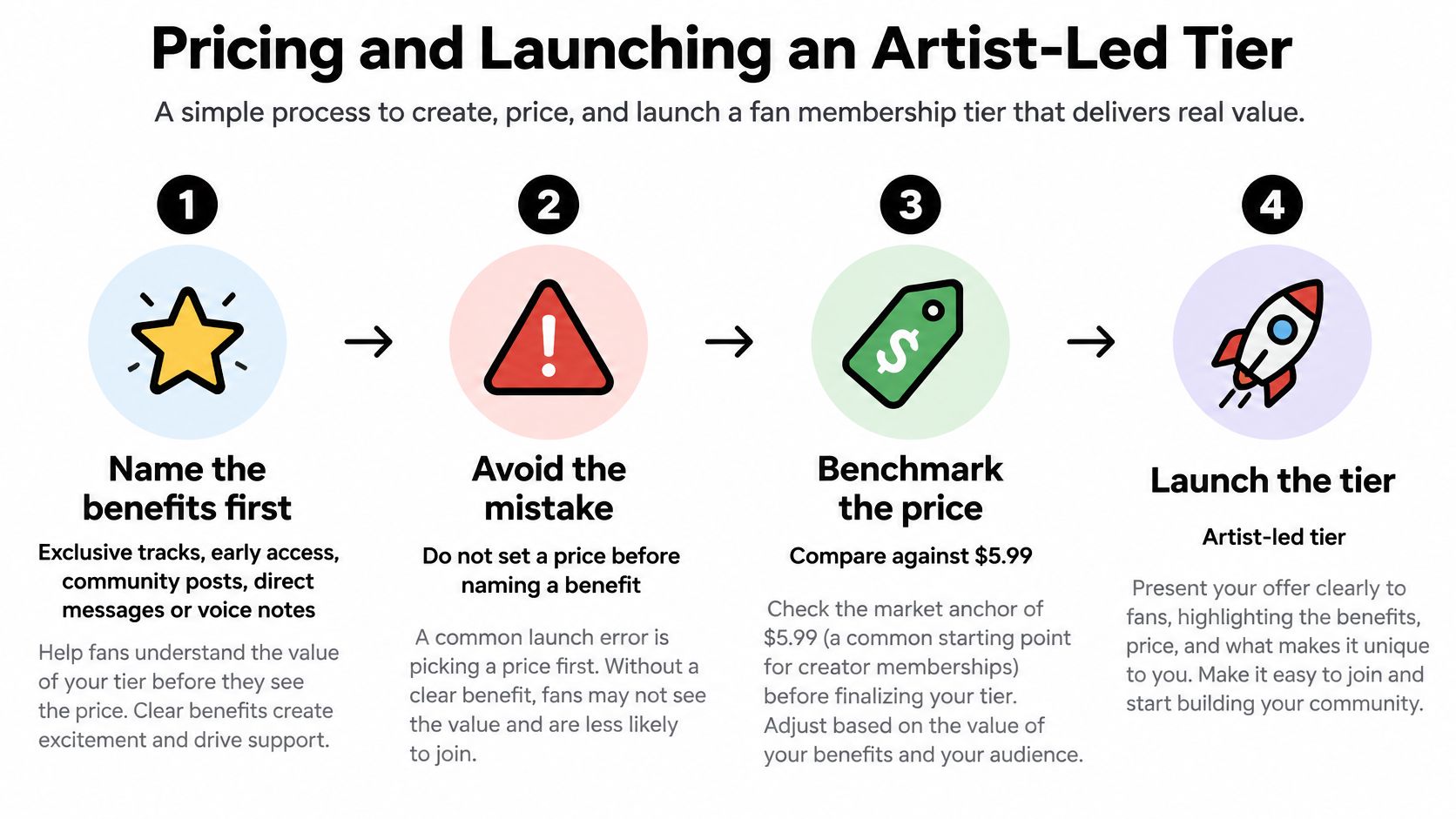
Step 1 Name the Benefits Before the Price
List what supporters receive. Strong benefits are specific and repeatable: exclusive tracks, early access, community posts, direct messages, or voice notes. Write the delivery rhythm beside each one. A monthly unreleased demo is a promise. Exclusive content is a label.
Don't set a price before naming a benefit. That's the most common launch mistake because it forces you to invent value after fans have already judged the number. If you can't describe the first month's delivery in two sentences, the tier isn't ready.
Choose benefits you can sustain during touring, recording, and quiet release periods. A voice note after each studio session may be easier to maintain than a polished exclusive track every week. Reliability builds renewals.
Step 2 Benchmark Against Familiar Prices
Compare your draft price with reference points fans already understand: $0 for free ad-supported listening, $5.99 for student access, and $10.99 for a full individual streaming plan. Your tier doesn't need to match them. It does need to explain why it sits below, between, or above them.
Don't compare only with your own costs. Fans don't renew because your studio bill was high. They renew because the membership gives them access, identity, convenience, or closeness they can't get from a general catalog.
Say you're considering a supporter tier near the student benchmark. Ask what a fan receives that a global catalog doesn't provide. Early demos, a named thank-you, and a monthly community post may be enough. If the answer is only general support, keep the tier low and be honest that it's patronage.
Step 3 Build Two or Three Distinct Tiers
Use a simple ladder:
- Supporter: Early announcements, community posts, and one exclusive track or demo in each release cycle.
- Fan: Everything in Supporter, plus early access to releases and members-only voice notes.
- Inner circle: Everything in Fan, plus direct messages, limited listening sessions, or first access to small merchandise runs.
Each tier needs a benefit the tier below doesn't share. Don't add tiers with no distinct benefit, because fans will choose the cheapest and you'll still carry the admin work for three offers. Distinct doesn't have to mean expensive to produce. Timing can be the difference, such as hearing a track before public release.
Practical rule: If you removed the tier names, a fan should still be able to sort the offers by value from the benefits alone.
Keep the middle tier as the intended choice for most supporters. The lower tier gives hesitant fans an entry point. The upper tier serves your most engaged fans without forcing everyone else to subsidize time-intensive access.
Step 4 Check Profile Type and Billing Period
Subscription plan prices vary by profile type and billing period, and they're shown before you subscribe. Check both fields before you publish screenshots, social posts, or a launch email. A monthly price beside an annual billing setting creates refunds and distrust.
Don't leave the billing period unclear. Write whether the fan pays monthly or annually, when renewal occurs, and what happens when they cancel. Place that information beside the price, not in a separate help page fans must hunt for.
State the refund rule plainly. A paid period already started is not ordinarily refunded, and digital access and subscriptions can have different limits. Clear wording protects fans from surprise and protects you from disputes based on assumptions.
Step 5 Confirm Payment Setup
PayPal handles payments and subscriptions for OohYeah. Confirm your payment setup before you announce a launch date. Test the full path with the eyes of a fan: price display, billing period, confirmation, access delivery, and cancellation route.
Don't promote a tier while payment or access still depends on manual follow-up. A fan who pays and then waits for a message has already received a weaker product than promised. Fix access first, then promote.
Step 6 Read the Terms Before Publishing
Subscription Terms apply before starting a recurring plan on OohYeah. Read them as part of product design, not as legal housekeeping after launch. Your tier copy, refund wording, renewal notice, and benefit schedule should all match those terms.
When you're ready, use the route to join as an artist on OohYeah and publish only after the offer passes the checklist below. A one-day delay to correct billing copy is cheaper than a month of support messages.
Step 7 Run the Tier Before Changing the Price
Run one tier for two or three billing cycles. Then compare cancellations, downgrades, benefit use, and support questions before changing the price. First-cycle excitement isn't proof of durable value. Third-cycle renewal is stronger evidence.
Don't react to one loud complaint or one generous supporter. Look for patterns. If fans cancel after receiving the main exclusive, your delivery rhythm may be front-loaded. If they downgrade but stay, the relationship works and the upper tier value doesn't. If they ask what's included after joining, your sales copy failed before pricing did.
Pre-Launch Checklist
- Price within a benchmark range: You can explain the price against free, student, and individual reference points.
- Each tier names an unshared benefit: No tier exists only to make another look better.
- Billing period and profile type visible: Fans can see both before they subscribe.
- Cancellation rule beside the price: Renewal, cancellation, and refund limits are written in plain language.
- First month already prepared: The first exclusive, post, or voice note is ready before promotion begins.
- Review date scheduled: You'll assess cancellations and downgrades after two billing cycles.
Publish one supporter tier this week, set a review date after two billing cycles, and change the price only when cancellation and downgrade signals say so. That's how music subscription prices become a tested artist income stream instead of a hopeful number on a profile page.
Launch your supporter tier with transparent pricing, named benefits, and direct fan access, then review renewals before you change the number. Visit OohYeah to set up your artist-led subscription and sell music, merchandise, and exclusives without sending fans through a pooled, one-size-fits-all price.