Music Download Best App Compared for Offline Listening
Find the music download best app for your needs. Compare offline access, audio quality, pricing and legality to choose the right download approach.

September 22, 2026
Music Marketplace Advisor
Buying & SellingThe most popular advice about the music download best app usually starts with a catalog size or a download icon. That approach misses the decision that causes the most frustration: are you saving a file you own, or only caching access inside an app? Both options can work offline, but they behave very differently when a subscription ends, a device changes, or you want to move a track into another player.
A permanent download is an audio file you can generally store, back up, and transfer according to the seller's terms. Offline listening in a subscription service is usually app-controlled access, often encrypted and tied to an active account. That distinction matters more than a polished playlist screen.
This comparison evaluates the main app types by ownership, portability, legality, pricing model, offline reliability, audio quality, and privacy. It also considers the listener's actual job, whether that's commuting with a broad library, preserving hi-res purchases, supporting artists directly, or finding a lawful free option. If you want a broader starting point for music services and discovery tools, OohYeah is one platform worth examining alongside the established streaming and download-store models.
Introduction Why Finding the Right Music Download App Matters Now
A download button does not establish ownership. In a subscription app, it may create an offline cache that plays only inside that service. Cancellation can disable those files even while they remain visible on the device. A purchased, transferable audio file has a different outcome: it may remain usable after cancellation, subject to the store's licensing and file terms.
The right choice therefore depends on the listening job, not a universal ranking. A commuter may prefer a broad catalog, fast syncing, and reliable playback over a transferable file. A producer, collector, or audiophile may instead prioritize format, provenance, backup rights, and continued access after changing services. Someone buying from an artist may value direct creator support and releases unavailable through a mass-market subscription.
Streaming's dominance, detailed in the market overview below, makes this distinction easier to miss. It also narrows the role of download-focused products. They are most relevant when listeners want control, permanence, high-quality files, direct artist transactions, or access that isn't dependent on a monthly subscription.
The practical comparison is between two kinds of offline access. App-bound caching improves convenience across supported devices, but cancellation and platform rules can end that access. File downloads require more attention to storage, backups, and format compatibility, yet they offer greater portability when the terms allow it. Services such as OohYeah can be considered alongside streaming platforms and download stores, but the same ownership question still applies.
The practical question: Don't ask only which app downloads music. Ask what remains usable after cancellation, device migration, and loss of internet access.
The sections ahead compare these outcomes instead of naming one universal winner. A service may suit offline discovery while providing no transferable files. Another may preserve durable files while demanding more manual organization.
How the Music Download Market Has Changed
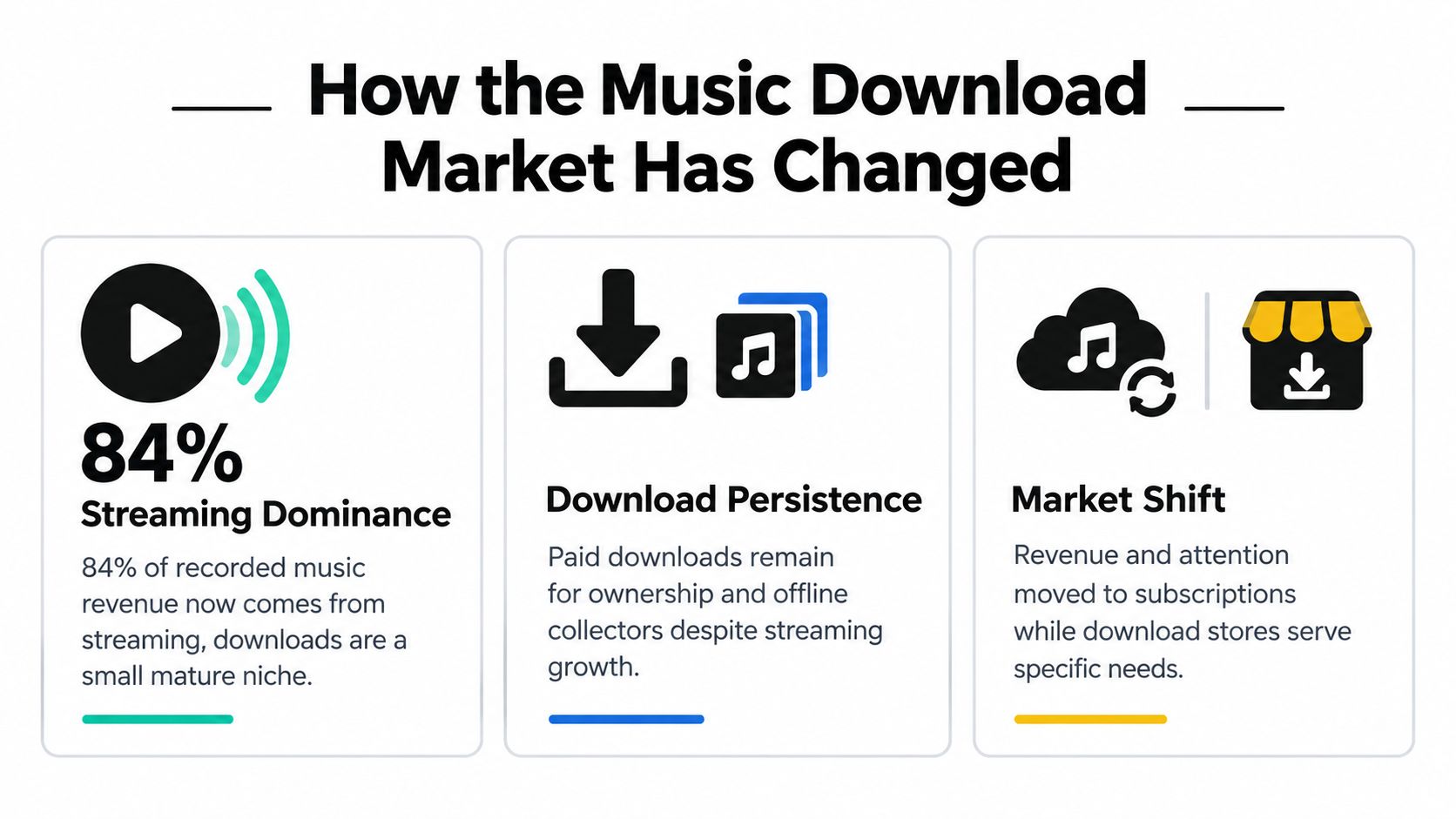
The music download market did not disappear when streaming took over. It became more selective. Streaming now handles broad access and recurring listening, while downloads serve listeners who need files they can retain, move, back up, or use outside a platform's subscription rules.
The market data supports that narrower role. Rather than repeating global revenue totals, the useful question is what the shift changes for app design. Streaming services optimize for discovery, recommendations, synchronized libraries, device continuity, and licensed catalog size. Download products must answer different questions: Does the buyer receive a transferable file? Which format is supplied? Can the purchase be restored? Does the transaction create a direct payment path to the creator?
The United States shows why download apps should be assessed as specialist tools rather than the default way to consume music. An IBISWorld estimate for US digital music downloads projects 2026 revenue at about US$256.7 million, with the category declining 7.6% that year and recording a -16.5% compound annual growth rate between 2021 and 2026. Supplied market data also reports first-half US download revenue of US$121.0 million in 2026, compared with US$138.6 million in the first half of 2025.
Why a smaller market can demand better scrutiny
Declining demand makes the transaction's terms more important, not less. A smaller download market gives buyers fewer reasons to assume that every app provides the same form of access. The relevant test is whether the purchase solves a specific listening job after cancellation, device changes, or a move to another player.
- Ownership: A downloaded file can remain usable instead of expiring with a subscription permission.
- Portability: Compatible files can move to other players, storage systems, or production workflows.
- Quality: Format choices can suit casual listening, DJ preparation, or archival storage.
- Creator economics: A direct purchase can make the connection between fan payment and artist revenue clearer.
Streaming has won the scale contest, while downloads retain advantages in specific control contests. Offline caching is efficient for temporary access across supported devices. File downloads require storage, backups, and format checks, but can provide greater independence from a platform. The best app therefore depends on whether the listener values low-friction access or a usable file that survives a service change.
Understanding Your Options for Downloading Music
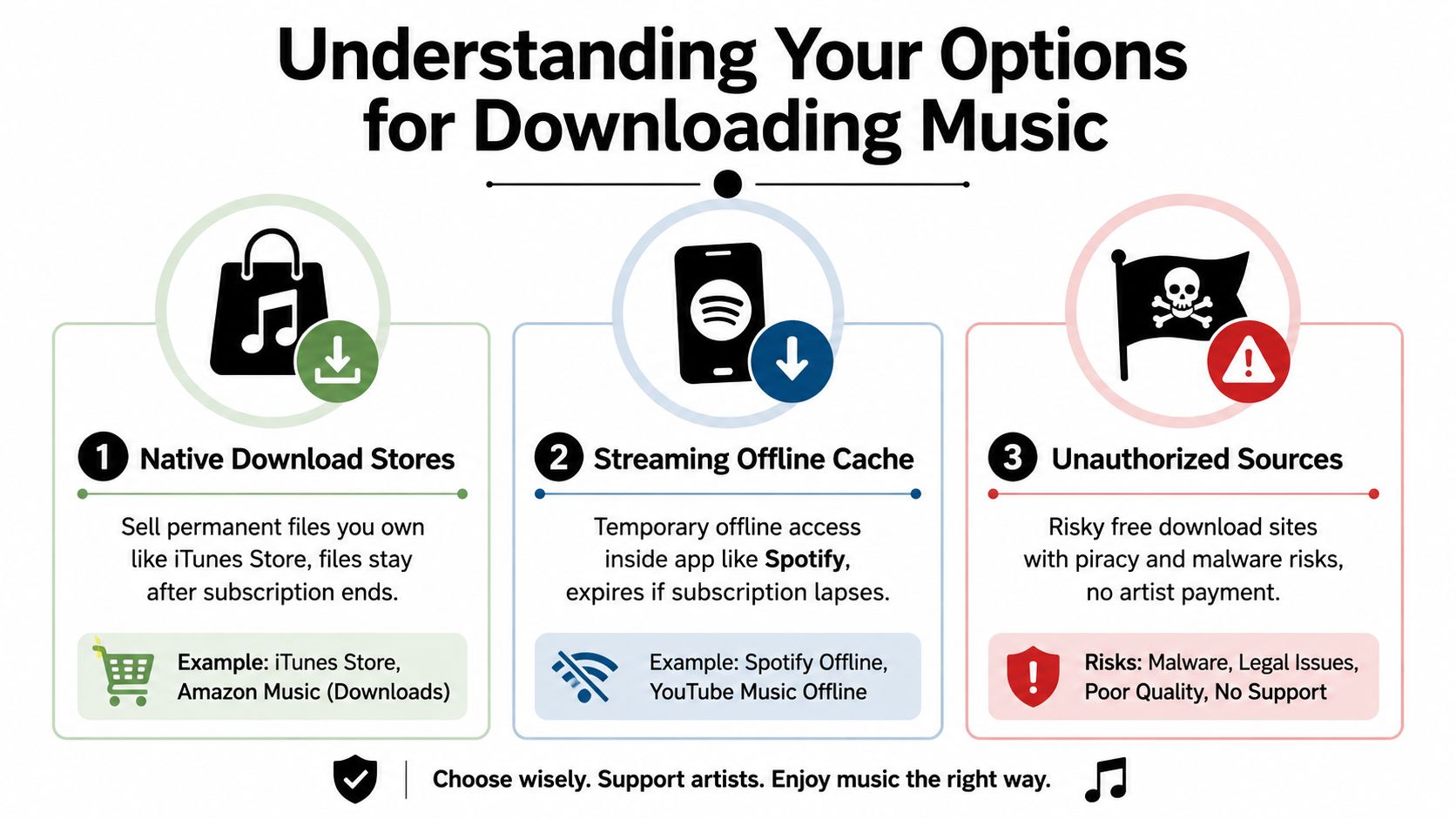
The word “download” hides two different outcomes. One creates an audio file that may remain usable after a service change. The other creates an app-controlled offline copy that works only within a subscription and supported player. Choosing the right music download best app starts with separating those outcomes.
Native download stores sell music as a purchase. The listener receives a file or downloadable package governed by the store's terms. Qobuz is the clearest technically differentiated example here because it combines permanent music purchases with Hi-Res options and playback support up to 24-bit hi-res, as described by Premierely's comparison of music download apps. This model fits listeners building an archive, but they still need to check format, DRM, redownload rules, and regional availability.
Streaming offline caches serve a different job. Subscribers save tracks for playback without an active connection, then listen inside the service's supported apps. Spotify Premium offers a large catalog, paid-tier offline downloads, and quality up to 320 kbps, according to SaveDelete's music downloader comparison. That breadth makes discovery and playlist access efficient. The saved tracks remain tied to the service, so they are not equivalent to transferable files and normally stop working when subscription rights end.
Creator marketplaces connect direct sales with artist-controlled offerings. They suit listeners seeking a particular release, exclusive material, merchandise, or a more direct relationship with the person who made the music. Catalog coverage is less uniform than a global subscription service, but the purchase can be more intentional and may support a specific creator.
| Priority | Best-fit model | What you keep | Main compromise |
|---|---|---|---|
| Broad catalog and simple offline listening | Subscription offline cache | App-controlled access | Access normally depends on the subscription |
| Archival ownership and hi-res purchases | Native download store | Purchased audio files, subject to terms | You buy releases individually |
| Direct artist support and special releases | Creator marketplace | Purchased digital products, subject to seller terms | Catalog breadth varies by creator participation |
| Free access | Licensed ad-supported or authorized downloads | Usually app-based access or selected files | Availability, formats, and offline rights are limited |
| Unlimited commercial MP3 extraction | Unauthorized source | Unclear or risky file provenance | Legal, privacy, security, and quality concerns |
Match the model to the listening job. If playback must continue after cancellation, choose purchased files rather than a subscription cache. If immediate access to nearly any mainstream song matters more than portability, a small direct marketplace will not replace a broad streaming service. Readers comparing broader services may also find this best alternative to Spotify useful, provided they verify whether “offline” means cached access or a file they can retain.
Detailed Comparison of Leading Music Download Approaches
The three approaches solve different listening jobs. Ranking them on one scale confuses ownership, app-bound access, and direct artist purchases.
Subscription offline caching
Spotify Premium suits listeners who need large-scale offline access with little file management. Its value is breadth and convenience: you save a playlist or album, then play it inside the app across supported devices and environments.
The compromise appears when circumstances change. Cached tracks are not ordinary files for unrestricted backup, transfer, or use in another player. Subscription cancellation, device changes, and account synchronization can therefore matter more than the download button. Check whether saved music remains available after a lapse, and whether the service permits the device setup you use.
Best for: commuters, travelers, and listeners who value a broad repertoire over permanent files.
Permanent download stores
Qobuz addresses a different requirement. A purchase can form part of a personal archive, subject to the store's terms, rather than remaining tied to an active subscription. That makes redownloading, local backup, and playback through chosen software more relevant evaluation points than catalog size alone.
Ownership still creates work. Buyers must manage storage, maintain backups, confirm file compatibility, and distinguish a high-resolution purchase from the capabilities of the playback chain. A store may provide the file, but it does not organize an archive for you or guarantee that every device handles it identically.
Best for: collectors, audiophiles, producers, and listeners who need access that can continue after cancellation.
Creator marketplace apps
A creator marketplace changes the transaction. Instead of paying for access to a standardized streaming catalog, fans purchase digital releases directly from participating artists or sellers. OohYeah's marketplace fits this model for listeners seeking artist commerce rather than a general subscription library.
The trade-off is uneven availability. A marketplace may provide special releases or a closer connection to the creator, while catalog breadth, metadata, file format, redownload rules, and delivery method can vary by product. Review the seller's terms before treating a purchase as an archival copy.
| Criteria | Subscription Offline Caching | Permanent Download Store | Creator Marketplace App |
|---|---|---|---|
| Access after cancellation | Usually stops when entitlement ends | Purchased files may remain usable under store terms | Depends on seller and platform terms |
| Redownload and backup | Often tied to account and app | Usually better suited to local backup, subject to terms | Varies by product and seller policy |
| File portability | Usually limited or app-bound | Stronger when transferable files are supplied | Depends on the delivery method |
| Catalog breadth | Broad mainstream repertoire | Broad store catalog, bought release by release | Depends on participating artists |
| Audio quality | Depends on service tier and app | Depends on the purchased release and playback chain | Depends on the uploaded product |
| Creator relationship | Indirect | Store-mediated | More direct |
| Best use | Convenient offline listening | Ownership and archiving | Artist-specific releases and exclusives |
The useful question is not which app lists the most songs. It is which access model survives the event that matters to you. A subscription cache handles a commute efficiently. A permanent store supports a library you can back up. A creator marketplace makes sense when the purchase and the artist relationship are part of the listening job.
Which Music Download App Fits Your Listening Style
The best choice becomes clearer when you describe the listening job rather than the app you already know.
The commuter who needs dependable playlists
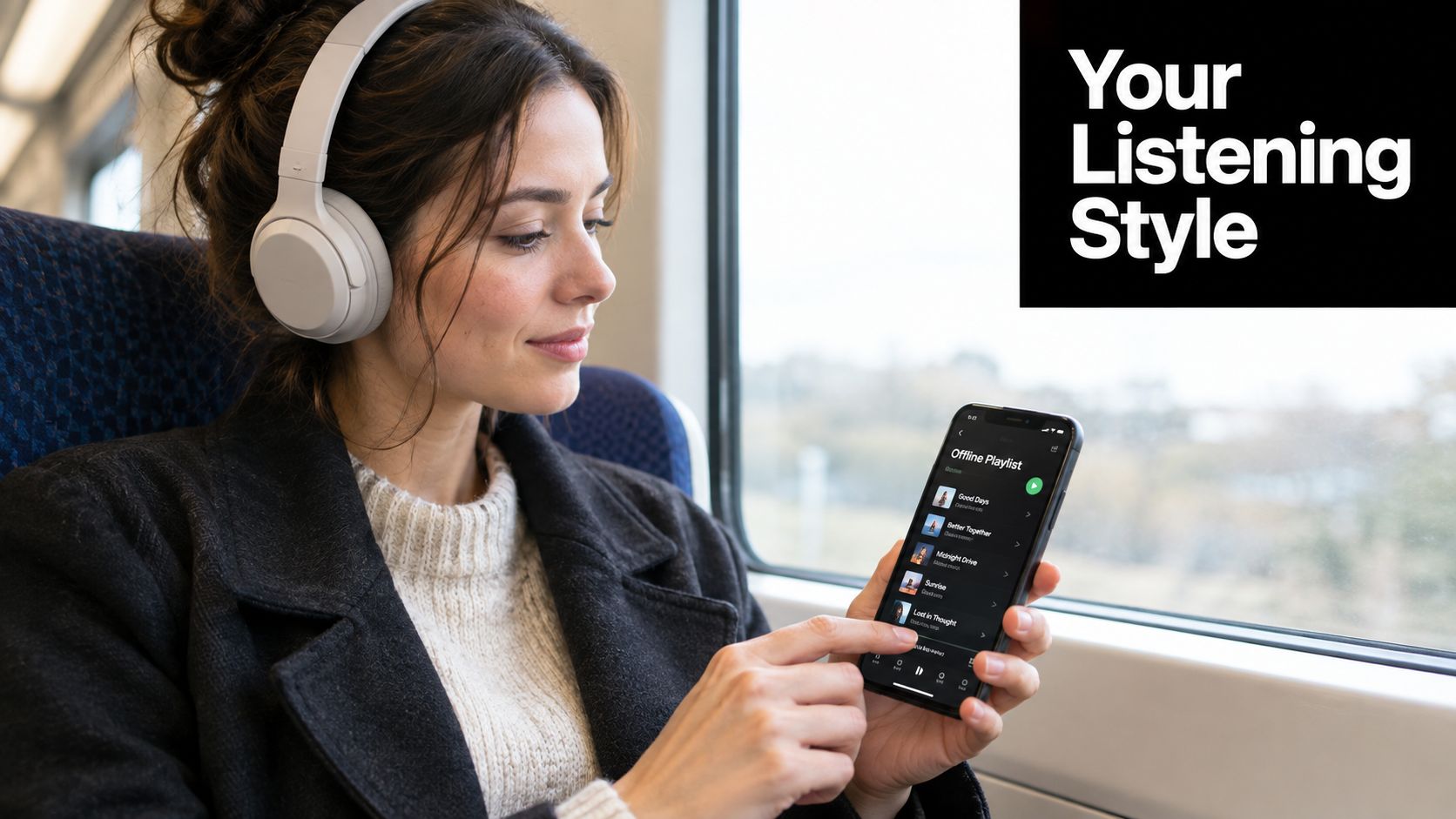
You need music available during train rides, flights, or weak-signal journeys, and you may switch between phone and desktop. A subscription offline cache is usually the most practical fit because it reduces file management and offers a broad repertoire. Spotify Premium is a strong example of that model, with offline downloads on paid tiers and playback quality listed up to 320 kbps in the supplied comparison source.
The important check is cancellation behavior. Test one saved playlist in offline mode, then read the service's rules for subscription lapses, device changes, and library synchronization. If your work depends on playing tracks in another application, this model may frustrate you.
The audiophile building an archive
Your priority is not merely hearing music without a connection. You want a file that can be backed up, inspected, and played through equipment you choose. A permanent download store with Hi-Res options is better aligned with that job than an encrypted subscription cache. Qobuz's permanent store and support for up to 24-bit hi-res make it the technically differentiated option in this comparison.
Storage and backup become part of the listening workflow. Confirm the supplied format, metadata, download location, redownload policy, and whether the files contain DRM before paying.
The fan supporting independent artists
You may care about exclusive releases, direct communication, or ensuring the transaction is closer to the artist. A creator marketplace can fit better than a mass-market service when the desired release is available there. OohYeah's model combines direct digital downloads with artist-controlled offerings, so it suits fans who want a marketplace relationship rather than only a passive stream.
Don't assume every marketplace product has identical download rights. Read the individual listing and preserve the original purchase information with the downloaded file.
The budget-conscious listener
Free access requires the most careful separation of categories. Independent guidance on legal music downloads notes that lawful free options can include ad-supported licensed catalogs, artist-authorized downloads, and Creative Commons or public-domain music. Those options are narrower than an unrestricted commercial catalog.
A free app is therefore a fit only if its offline rules are clear and its catalog is licensed. Be skeptical of any service promising every commercial song as a standalone file at no cost.
How to Evaluate Legality Privacy and Audio Quality Before You Download
A polished interface can't compensate for unclear rights or unsafe permissions. Before installing any music download best app, identify exactly what the app supplies, who licensed it, and whether the result is a file or an in-app cache.
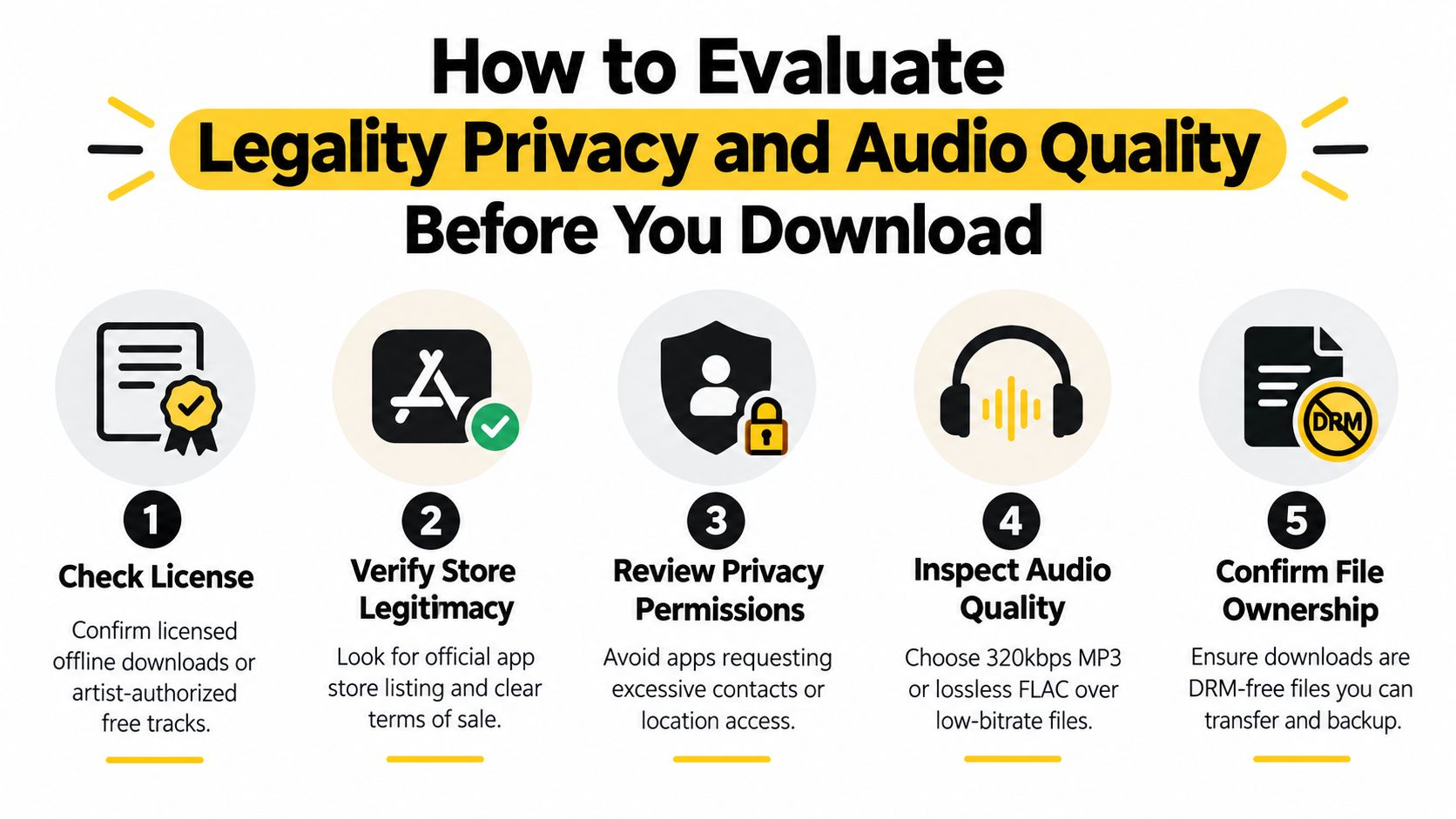
Check the license. Look for licensed offline listening, an official store purchase, or an artist-authorized free download. Recent legal-download guidance separates those paths from third-party extractors that may operate in a gray or prohibited zone.
Verify the seller. Use an official app-store listing and read the terms of sale. A legitimate store should explain refunds, redownloads, account access, and the format supplied. Vague promises about unlimited MP3 files are a warning sign.
Review permissions. A music player may need storage, audio, or account access. It shouldn't need unrelated access to contacts or precise location for a basic download workflow. Review the developer, privacy policy, and data controls. For an artist-first platform, consult the published OohYeah privacy policy before creating an account.
Inspect quality claims. 320 kbps and 24-bit hi-res describe different things, and neither guarantees that the original recording was supplied at that quality. Check whether the file is MP3, FLAC, or another format, and distinguish upscaled audio from a genuine high-resolution source.
Confirm ownership. Download a test purchase or authorized file, then try backing it up and opening it in a compatible player. If the track works only inside the original app, treat it as offline access, not portable ownership.
A reliable test: Put the device in airplane mode, cancel nothing, and check whether the saved track appears as a normal file outside the app. Then read the cancellation terms before building your library around it.
Our Recommendation for Choosing the Music Download Best App
There isn't one universal winner because “download” describes two incompatible outcomes. Choose subscription offline caching when your main requirement is a broad catalog, fast playlist syncing, and low-friction listening across supported devices. Spotify Premium fits that job, but its offline tracks should be treated as app-controlled access rather than permanent files.
Choose a permanent download store when cancellation independence, archival control, and file quality matter more than automatic access to everything. Qobuz is the clearest fit in this comparison for listeners who want permanent purchases and Hi-Res options up to 24-bit hi-res, although you should still verify the exact file and purchase terms before buying.
Choose a creator marketplace when the release, the artist relationship, or direct support is the purpose of the transaction. This model won't replace a global streaming catalog for every listener, but it can provide a more direct route to artist-supplied digital products and special content.
Use this final check before committing:
- Need convenience: Confirm offline access, supported devices, and subscription expiration rules.
- Need ownership: Confirm DRM status, file format, transfer rights, and backup options.
- Need creator connection: Confirm who sells the file, what you receive, and how the artist controls the offer.
- Need free access: Confirm that the catalog is licensed, artist-authorized, Creative Commons, or public domain.
The strongest answer to the music download best app search is therefore conditional. Match the app to the consequence you care about most, then test one track before migrating your library.
OohYeah offers direct artist marketplace downloads and creator-controlled music products, which makes it relevant if you want more than app-bound offline listening. Visit OohYeah to explore its artist-first approach and compare direct purchases with the subscription model you already use.