How to Find Musicians: Local, Online and Vetted Options
Learn how to find musicians through local scenes, online communities and music platforms, and how to vet them before you commit to a session or band.
November 19, 2026
Music Marketplace Advisor
Buying & SellingYou've got the songs, the studio days are booked, and there's a hole where the drummer should be. The bass player you found online stopped replying four days before the session, the horn arranger is on tour until October, and the budget only stretches to so many false starts. Or maybe there's no deadline yet, just a room, a rig and the growing suspicion that the players you need aren't on the platforms you keep refreshing.
Finding musicians is rarely a visibility problem for the people doing the hiring. It's a fit-and-trust problem. The loudest profiles aren't the best players, and the best players often have a Facebook page with three posts from 2019 and a phone that rings constantly through word of mouth. What follows is how I'd work a search from a blank page to a signed session, including the checks that stop a promising name from becoming an expensive afternoon.
Where Musicians Work and Where to Look First
Write the brief before you open a single tab. One sentence covering the instrument or role, the genre, the skill level, whether the job is a one-off or ongoing, and the date you need the player. Something like "bass, soul and funk, strong reader, three gigs in June plus one rehearsal" filters harder than any search box, and it keeps every channel pointed at the same target.
The channel you choose decides the kind of player you meet. That's not a small detail. IFPI's 2022 Engaging with Music study found video streaming used for music by 82% of respondents, audio streaming by 74%, radio by 71%, short-form video by 68% and social media by 49%. Listeners scatter across all of those places, and so do musicians. A player who never posts a clip is still findable through a venue bill, a conservatoire roster or a producer's phone.
Search behaviour backs that up. In IFPI's 2021 study of 43,000 respondents across 21 countries, 67% said they discovered new music or artists weekly, and 68% searched for specific songs more than once a week. People go looking for names they've heard. If your players have no searchable footprint at all, you need a human route to them instead.
Musician sourcing channels compared
| Channel | Best for | Signal to check | Main risk |
|---|---|---|---|
| Local open mics and venue bills | Gigging players and cover bands | Booking calendar and recent set lists | Players may already be booked elsewhere |
| College music departments and conservatories | Students and early-career session players | Ensemble rosters and program listings | Availability changes every term |
| Community Facebook groups and city forums | Bands, producers and one-off gigs | Posted portfolios and responses to past requests | Unpaid requests and scams |
| Professional music directories | Hired session players and specialists | Ratings, reviews and completed work | Pricing and terms vary by provider |
| Referrals from producers and engineers | Hard-to-find specialists | Named projects you can verify | Slow and limited by your network |
Working rule: two channels worked properly beat five skimmed ones. Pick one local and one online, then stay with them until the shortlist is real.
Keep a plain document with every name, the channel it came from, and the date you found it. That log is what stops you re-checking the same three guitarists for a fortnight.
How to Run a Local Search Through Scenes and Networks
A strong local player may have little online reach. The useful clues are often on venue bills, in shared lineups, and in the recommendations of people who hire musicians. Scene momentum can show up in listening data before mainstream coverage, but follower counts alone won't tell you whether someone fits your sound or works well with others.
- List venues and promoters. Gather recent bills in your genre and area. Players who appear repeatedly are active in the local scene, and their bandmates and co-billed acts may lead you to other suitable musicians.
- Track recurring names and connections. Note who shares stages, plays in multiple projects, or appears on bills with musicians you already rate. Those overlaps reveal working relationships that a profile's follower count can't show.
- Watch a full set. Short clips can show tone or technique; a full performance also reveals how a player listens, keeps time, handles a mistake, and supports the band. If the set fits, speak briefly afterwards and ask what projects they're working on.
- Ask people who hire musicians. Producers, engineers, monitor techs, and record shop staff may know who arrives prepared. Ask who they would recommend for the role, then ask what the person is like to work with. That answer can tell you more than a list of credits.
- Write a clear local post. State the role, musical brief, pay or split, date, and a link to your own recording. “Musicians wanted” leaves people guessing about the commitment; specific terms help interested players decide whether to reply.
- Reply promptly and suggest a next step. A good player may have other offers, so avoid leaving promising replies unanswered. Propose a specific time and place for a conversation or rehearsal, then confirm the arrangement before anyone commits.
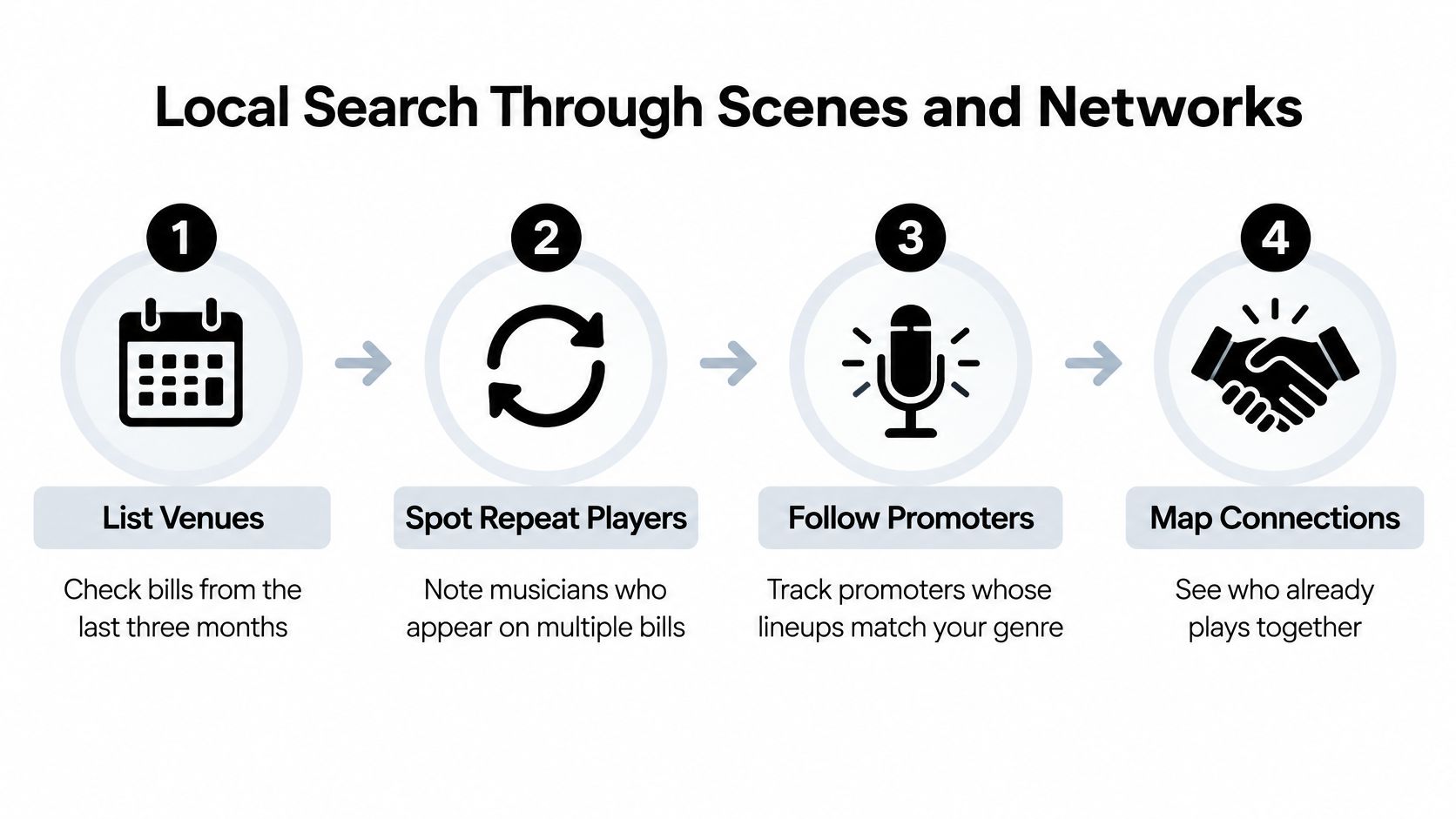
Keep a shortlist of five to ten names. For each, record where you found them, the projects or players they overlap with, and whether they have played live recently. The list is a starting point, not a verdict: check that the musician's current availability, sound, and working style fit your project before booking.
Using Online Communities and Music Platforms
Digital search works when you know what each platform proves. Treat every profile as a source of names, not evidence of skill. The evidence comes later, in the vetting pass.
The scale of online discovery is hard to argue with. MIDiA Research's 2025 analysis of its global consumer survey found 52% of global consumers in 2024 named YouTube among their top three places for finding new music, against 40% for streaming platforms and 37% for TikTok. Deloitte's Digital Media Trends study put it more sharply for younger buyers: 82% of Gen Z consumers and 70% of millennials reported discovering new artists or music through social media or user-generated video in 2024. Your next guitarist is probably in that number somewhere.
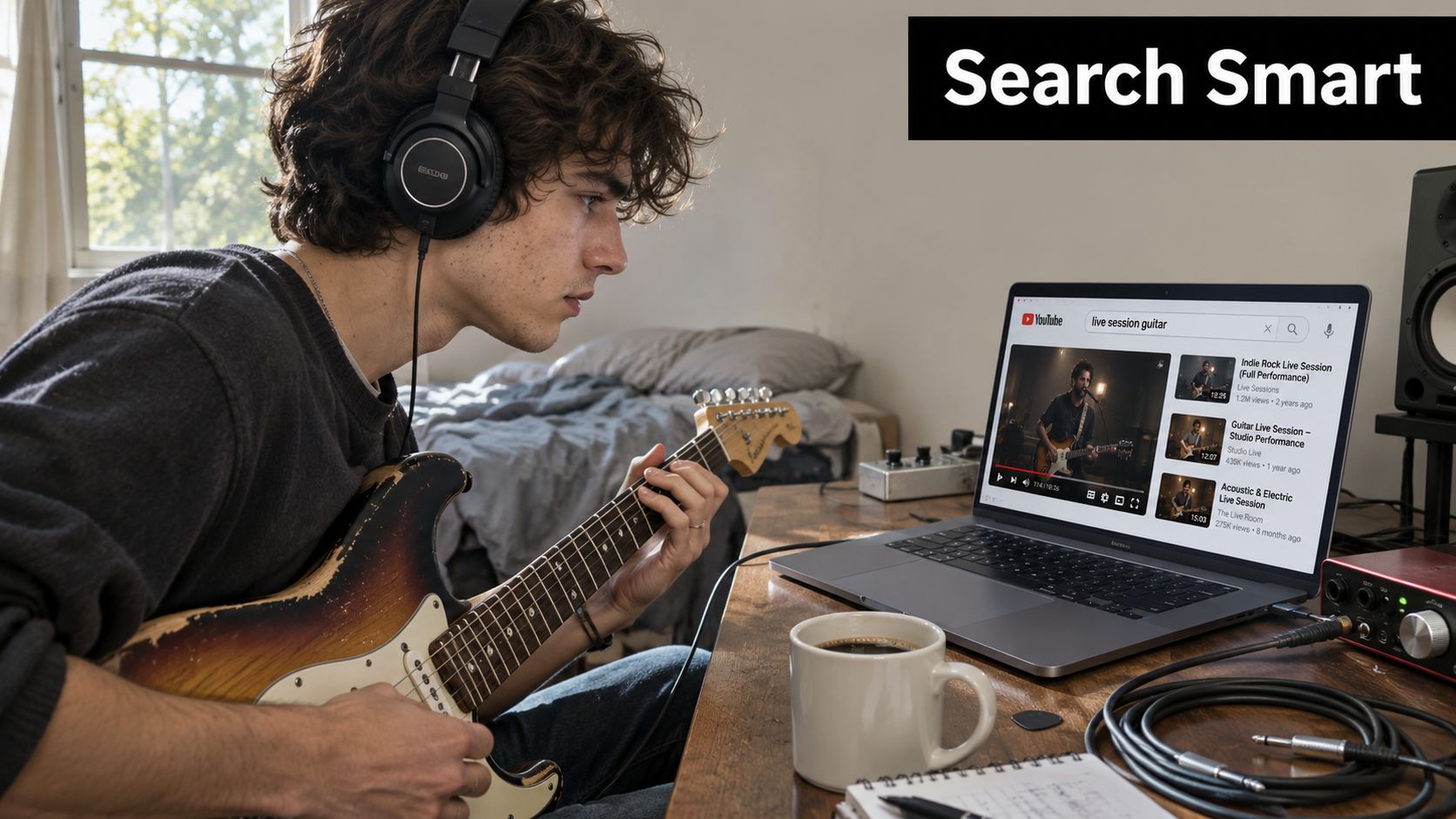
Start with YouTube and search your genre plus city plus "live session", then sort by upload date. Recent uploads tell you who's active this month rather than who was busy in 2021. On Bandcamp and SoundCloud, search genre and location tags, then read the credits. A release that names the drummer, the engineer and the guest keys player is a working network you can step into. Instagram and TikTok reward consistency over virality, so look for the account that has posted steadily for months rather than the one clip with 400,000 views and silence since.
What each online platform proves
| Platform | What it proves | Check before contacting | Main risk |
|---|---|---|---|
| YouTube | Live performance and current activity | Upload date and live session recordings | Old footage or heavily edited clips |
| Bandcamp and SoundCloud | Released work and collaborator network | Credits naming other musicians | Self-released tracks with no credits |
| Instagram and TikTok | Visual presence and consistency | Regular posts over several months | One viral clip with no follow-up |
| Reddit and Facebook city groups | Local availability and reliability | Reply speed to past requests | Unpaid requests and scams |
City subreddits and Facebook groups need the rules read before you post. Many ban job ads outright, and the ones that allow them are full of "exposure" offers that waste your time and annoy the regulars. Post the role, dates, pay and deadline in the first two lines.
For a visual pass over the same process, the walkthrough below covers how a search like this plays out in practice.
Save the five strongest profiles and message each one with a specific track you liked and a direct question about your date. Browsing the OohYeah marketplace is a faster route when you want to see who's actively listing work rather than scrolling feeds.
Finding Strong Players With Little Online Presence
Some of the best players you'll ever hire have no brand at all. Session drummers, worship musicians, theatre pit regulars, wedding band members and the students of a respected teacher often keep a low profile because the work comes to them. A search built on follower counts will miss every one of them.
Recent scholarship says the same thing from the other direction. A 2025 study in the journal Cultural Sociology argues that platform-based scouting increasingly rewards musicians who can build visibility and manage a personal brand, which can sideline artists whose playing is stronger than their posting. The same research, looking at women and gender-nonconforming musicians, found that sustaining professional contacts was the most frequently reported career challenge, particularly after a break. Neither finding says anything about ability. Both say a great deal about who disappears from search results.
Look where skilled work happens:
- Church and worship teams. Sunday players read charts cold, transpose on the fly and play to a click with a congregation watching. Reliability is usually essential there.
- Theatre and orchestra pits. Pit musicians read, count and hold tempo under pressure for two hours a night. Ask the musical director who deps for them.
- University ensembles and teachers' rosters. A teacher knows which student is gig-ready and which one needs another year. Ask for two names plus what each has played recently.
- Studio session lists. House engineers keep informal lists of players who deliver without drama. One phone call replaces an afternoon of searching.
Judge the player on the work, not the wrapper. A quiet profile with ten years of pit work outperforms a polished feed every time the count starts.
A short paid trial settles more than any interview. Book two hours, send one track and one chart, and watch what happens. Does the player arrive early, ask for the tempo, and send a rough bounce the same evening? That tells you more than any amount of scrolling.
Vetting Candidates Before You Reach Out
Shortlisting means testing every candidate against the same signals, in the same order. Viberate's survey of 125 music-industry professionals, reported by Music Business Worldwide, found 63.2% of A&R respondents used streaming services for artist discovery daily and 29.6% weekly, with Instagram used by 75.3%, TikTok by 49.5% and specialist analytics tools by 46.5%. The people doing this professionally lean on platforms to generate names, then manually audit the tracks. Copy that order.
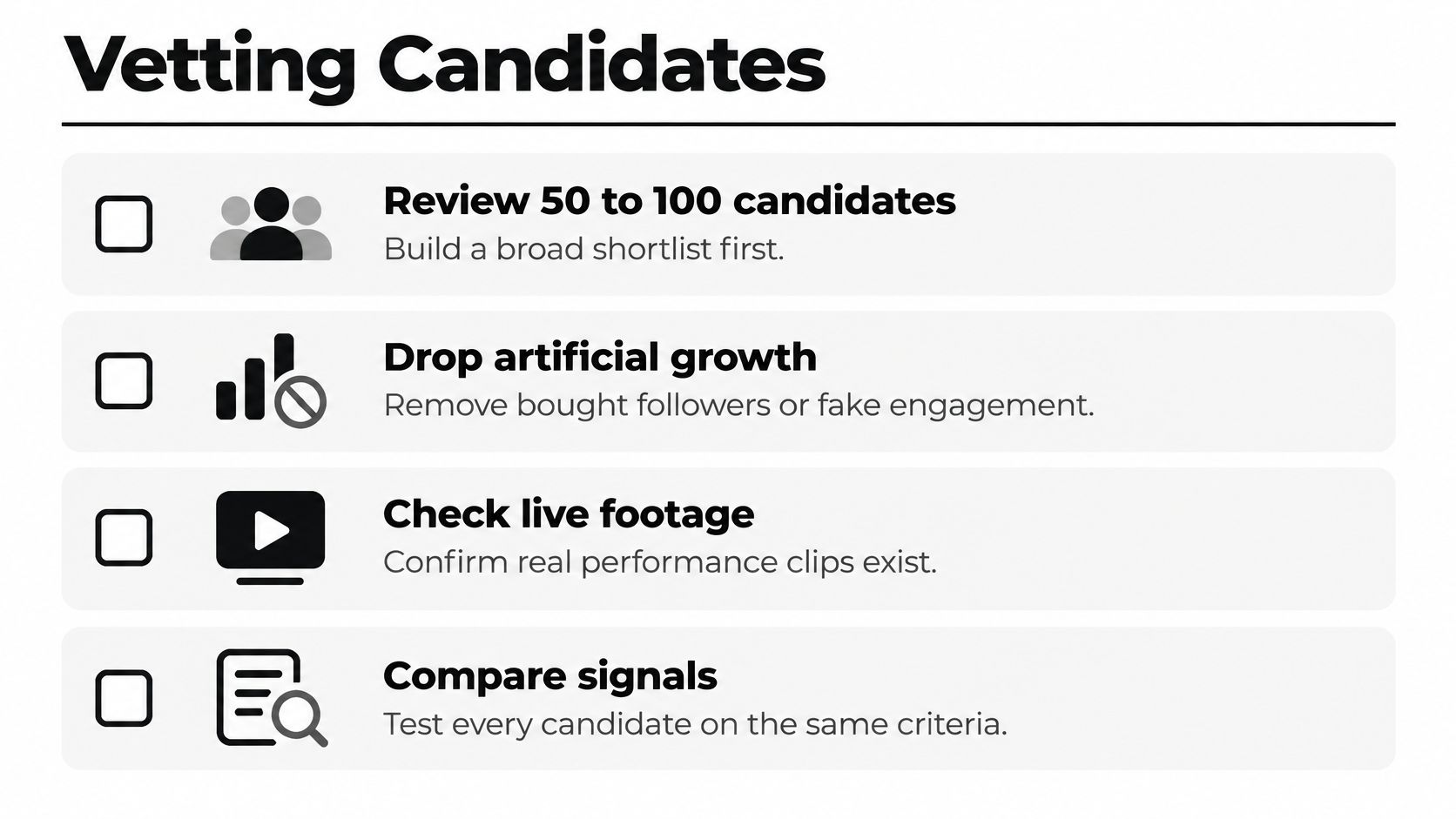
Review 50 to 100 candidates, drop the accounts with obvious artificial growth, and advance only the people showing at least two independent signals, such as recent live dates plus organic engagement, or local ticket demand plus repeat listeners.
Vetting signals and what they look like
| Signal | Good sign | Red flag |
|---|---|---|
| Live performance | Recent full set or live session video | Only heavily edited clips or old footage |
| Reliability | Replies within a few days and arrives on time | Long silences or last-minute cancellations |
| Catalog depth | Several finished projects or releases | One track carried by heavy paid promotion |
| Collaboration history | Credits with named acts, venues or producers | No names you can verify |
| Genre fit | Plays in your style and knows your references | Strong in a different genre from your brief |
Raw play counts are the most misread number in this process. A large playlist placement can create a burst of streams from listeners who never come back, which looks like traction and behaves like weather.
Benchmarks exist, but keep them in proportion. Research on an artist-detection algorithm using geographically tagged peer-to-peer music queries produced shortlists of emerging artists of whom roughly 30% eventually reached the study's defined national-success potential. That's a ceiling from one narrow data set, not a forecast for your shortlist. The same field gives you better tools than a hit rate: precision@10, meaning how many of your top ten picks are relevant, and recall@500, meaning how many of the relevant people appear in your first 500 results. And digital tools only do so much, since industry analysis estimates they account for about half of talent discovery, with networks and word of mouth carrying the rest.
For anyone you'd hire through a platform, the same instinct applies. OohYeah publishes trust and safety guidance that's worth reading before you message a stranger about money.
Finish by asking each finalist for a recent live recording, or booking a short paid trial, then comparing everyone against the original brief side by side. One page, same criteria, no favourites.
Confirm the Terms and Book Your First Session
Match the channel to the brief. Local networks win for a regular band member you'll rehearse with weekly. Online search wins for a one-off part on a track. When you need a specialist quickly, a professional directory is faster than either. Music Pros on OohYeah is a directory of musicians, producers, engineers and studios for exactly that case, and you can filter listings by rating at 4 & up, 4.5 & up or 4.8 & up so you're choosing from providers other buyers have already rated.
Remote session work has widened the pool considerably. Buyers can hire online session musicians, including guitarists, bass players, drummers, pianists, string players, horn sections and vocalists, to record studio-quality tracks from home studios, which is how a tight deadline stops being a crisis. Get at least three quotes so you know the going rate for the role and the region, and compare listed prices yourself rather than accepting the first number you see.
Nothing starts until the terms are in writing. A short document covers everything that goes wrong later.
Agreement terms to confirm
| Term | What to agree | Why it matters |
|---|---|---|
| Scope | Deliverables and parts required | Prevents extra work at the same rate |
| Revisions | Number of rounds included | Avoids open-ended edits |
| Rate or split | Fee, or percentage per gig or track | Sets pay before work starts |
| Payment timing | Deposit and final payment dates | Protects both sides |
| Delivery date | Final file or live date | Ties payment to the deadline |
| Recording ownership | Who keeps the master and publishing | Avoids disputes later |
If you'd rather not draft it from scratch, download a UK service agreement template and adapt the scope and ownership clauses to your session. Publishing services on OohYeah requires a music pro agreement as well, which sets out the same basics in the platform's own terms.
Pay through a method that leaves a record, and never send money before you've heard the trial. Then run the test properly: same brief to every finalist, one short paid session, and book the full work only when the result matches what you asked for. The players who pass that test are the ones you'll call for the next five years.
When the search is done, the next job is keeping those players in reach. OohYeah's Music Pros directory puts musicians, session players, producers, engineers and studios in one place, with ratings and filters so you can go straight to the people who've done the work before. Post your brief, compare quotes and book your first session at OohYeah.