Best Band Merchandise That Actually Sells in 2026
Find the best band merchandise for artists and fans in 2026. Compare apparel, vinyl, bundles, and digital goods to choose items that fit your brand and margins.
October 11, 2026
Music Marketplace Advisor
Buying & SellingMost “best band merchandise” lists are popularity contests disguised as business advice. They rank famous graphics, nostalgic tour tees, and collectible pieces, but ignore the details that decide whether an independent artist makes money or ships a pile of returns.
The best item isn't automatically the loudest design or the heaviest blank. It's the product with clear intellectual-property ownership, predictable fit, durable decoration, and a margin that survives production, fulfillment, platform costs, and customer service. A beautiful shirt that cracks after a handful of washes is a refund waiting to happen. A cheaper-looking tee that fits reliably and keeps its print can become the item fans wear for years.
This guide treats merch like the business it is. You'll find practical recommendations for apparel, physical music, bundles, digital goods, and subscriptions, followed by the production specifications and customer details that separate genuine fan products from disposable promotional stock.
What Best Band Merchandise Really Means
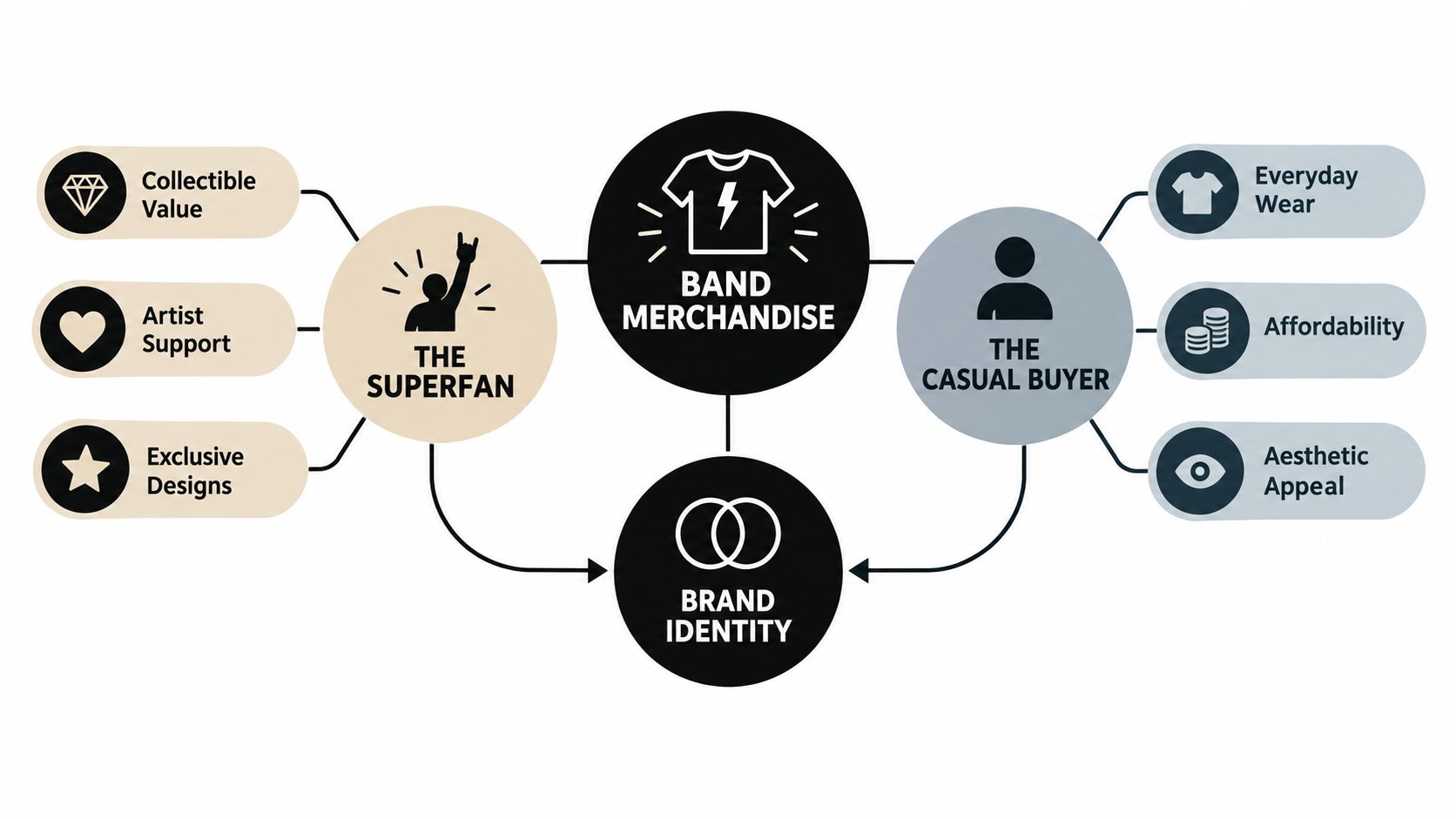
“Best” means different things to the person buying the shirt and the artist selling it. A fan may judge a tee by the artwork, cultural meaning, or whether it feels like a piece of a particular era. A band manager has to ask harder questions: Who owns the design? What happens after laundering? Does the garment fit consistently? How much revenue remains after every cost?
Popularity is a weak operating metric. A famous design can sell because of the artist's cultural reach, but an independent band needs a repeatable product decision. The right shirt should look good at a venue counter, feel comfortable in ordinary life, survive regular washing, and give the artist enough room to cover inventory risk and fulfillment.
The three tests that matter
Ownership comes first. Merchandise extends the band's identity into a physical product, so the artist needs control over the artwork, logo, photographs, masters, and any licensed elements. If a designer, photographer, label, manager, or collaborator owns part of the asset, the contract should define who can reproduce it, where, for how long, and on which products.
Durability protects the sale. A new sample tells you almost nothing about long-term quality. You need fabric specifications, print-process details, and laundering results. A shirt that looks impressive on a product page but loses its graphic quickly damages trust with the buyer and creates support work for the artist.
Margin is the final judge. Revenue per unit is not profit per unit. Subtract the blank, decoration, packaging, shipping, payment processing, storage, marketplace deductions, staff time, damaged stock, and returns. The remaining contribution determines whether the product deserves another run.
Manager's rule: If the product can't survive a quality check and a margin check, the design is irrelevant.
That's why a $35 tee with verified wash-test data can be a better decision than a $22 photorealistic tee that fails after five washes. Those prices and the five-wash example are decision scenarios, not universal benchmarks. The principle is universal: best band merchandise is the item that delivers dependable value to the fan while preserving the creator's economics.
The Merch Business in Historical Context
Band merchandise became a serious commercial system before today's direct-to-fan tools existed. The modern business grew from professional artist licensing in the 1950s and 1960s, when managers began treating an artist's name and image as assets that could travel beyond recordings and live shows.
Elvis Presley's manager, Colonel Tom Parker, helped establish an early large-scale model in the mid-1950s by signing a merchandise agreement with a Beverly Hills company for $40,000. Elvis-branded products appeared widely within weeks, showing that a performer's identity could be distributed through products rather than only through tickets and records. The history is documented in this account of band T-shirts and artist merchandise.
The Beatles made the system more repeatable. In 1963, manager Brian Epstein assigned lawyer David Jacobs to organize official licensing, and licensees were reportedly charged 10% of profits. One account estimates that granting only 10% of merchandising rights ultimately cost the group about $100 million. The lesson isn't that every artist needs a complicated corporate licensing department. It's that a seemingly small contract concession can determine who owns the upside when demand grows.
The contract creates the margin
The 1960s made band T-shirts more visible through festivals and youth culture. The 1970s expanded merchandise into a central part of touring economics. AC/DC is widely credited with becoming the first band to earn more from merchandise than ticket sales, a milestone that demonstrated how branded apparel could outperform admission revenue.
The numbers explain why artists should treat merch as an IP and distribution business. The global music-merchandise market reached approximately $3.1 billion in 2016, up 9.4% from $2.83 billion in 2015, according to figures reported by the BBC's overview of band T-shirt economics. The same source reported $3.1 billion in global merchandise sales against $4.88 billion in worldwide concert gross revenue in 2016, a broad comparison that placed merchandise at roughly 64% of concert revenue.
Merchandise isn't a giveaway attached to the music. It's another product line built on the artist's identity.
Two rules follow. Control the license before you approve the design, and negotiate ownership, territory, term, pricing authority, and customer access before a printer receives a purchase order. The printer can improve execution, but it can't repair a contract that gives away the value.
Comparing the Five Core Merch Formats
No format wins for every band. Apparel often creates the strongest visible identity, physical music can deepen collector value, bundles raise the perceived value of a transaction, digital goods reduce fulfillment, and subscriptions create recurring contact. The right choice depends on the audience's buying behavior and the artist's capacity to deliver.
| Format | Typical margin | Fulfillment effort | Fan-data capture | Repeat-purchase |
|---|---|---|---|---|
| Apparel | Strong when priced and produced directly | Medium to high, especially with inventory | Strong through direct checkout | Seasonal, drop-based, and tour-driven |
| Vinyl and physical music | Variable, often inventory-heavy | High for storage, packing, and shipping | Strong if sold through an owned storefront | Release-led and collectible |
| Bundles | Strong when components share packaging and shipping | Medium | Strong, with a larger order signal | High around releases and campaigns |
| Digital goods | High after creation, with minimal unit handling | Low | Strong if access is tied to a fan account | Repeated around releases and exclusives |
| Subscription tiers | Recurring potential, but delivery-intensive | Medium to high depending on benefits | Very strong through ongoing member access | Built into the format |
These are qualitative operating profiles, not guaranteed margins. A premium garment can lose money through overproduction, while a low-cost digital item can consume substantial creative labor. Calculate contribution at the SKU level rather than trusting the category.
Apparel
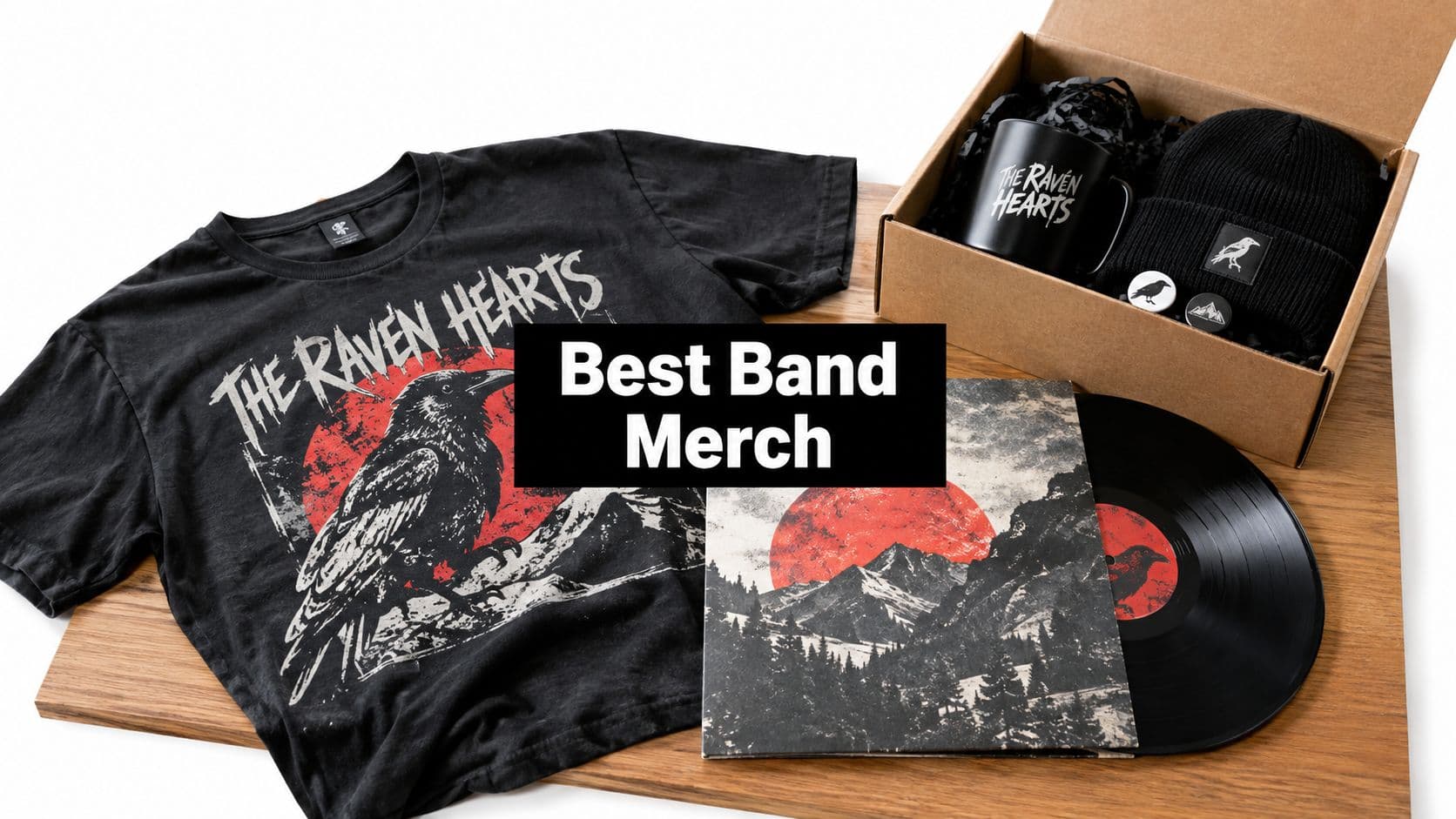
A hero tee or hoodie works when the design has a clear visual hook and the garment feels wearable away from a show. Apparel needs upfront inventory, size planning, storage, and customer support, but it also turns the band into a visible identity. A four-piece indie band with a modest email list shouldn't launch a broad collection just because a printer offers more options. One well-tested tee is easier to explain, photograph, stock, and reorder.
Vinyl and physical music
Vinyl gives collectors a tangible artifact, but it creates the most operational friction. The band must manage pressing, packaging, storage, breakage, shipping, and cash tied up in stock. Use it when the release itself has collector value, not as a default accessory for every listener.
Bundles
Bundles work because they combine a main product with a reason to buy now. A shirt paired with a download, signed insert, poster, or other owned item can make the transaction feel complete. Keep the bundle simple enough for a buyer to understand at a merch table and simple enough for a fulfillment team to pack without errors.
Digital goods and subscriptions
Digital products remove physical handling, but they don't remove the need to create value. Exclusive demos, stems, voice notes, private posts, and direct messages can support a relationship-based offer. A subscription should feel like continuing access to the artist, not an automatic discount club.
Artists comparing storefront options can review the OohYeah marketplace alongside other direct-sales tools, then check who controls pricing, customer information, fulfillment rules, and the final presentation.
Production Specifications That Separate Real Merch From Promotional Stuff
“Use a good printer” isn't a production brief. A serious brief gives the printer measurable requirements and gives the artist something to inspect when the samples arrive.
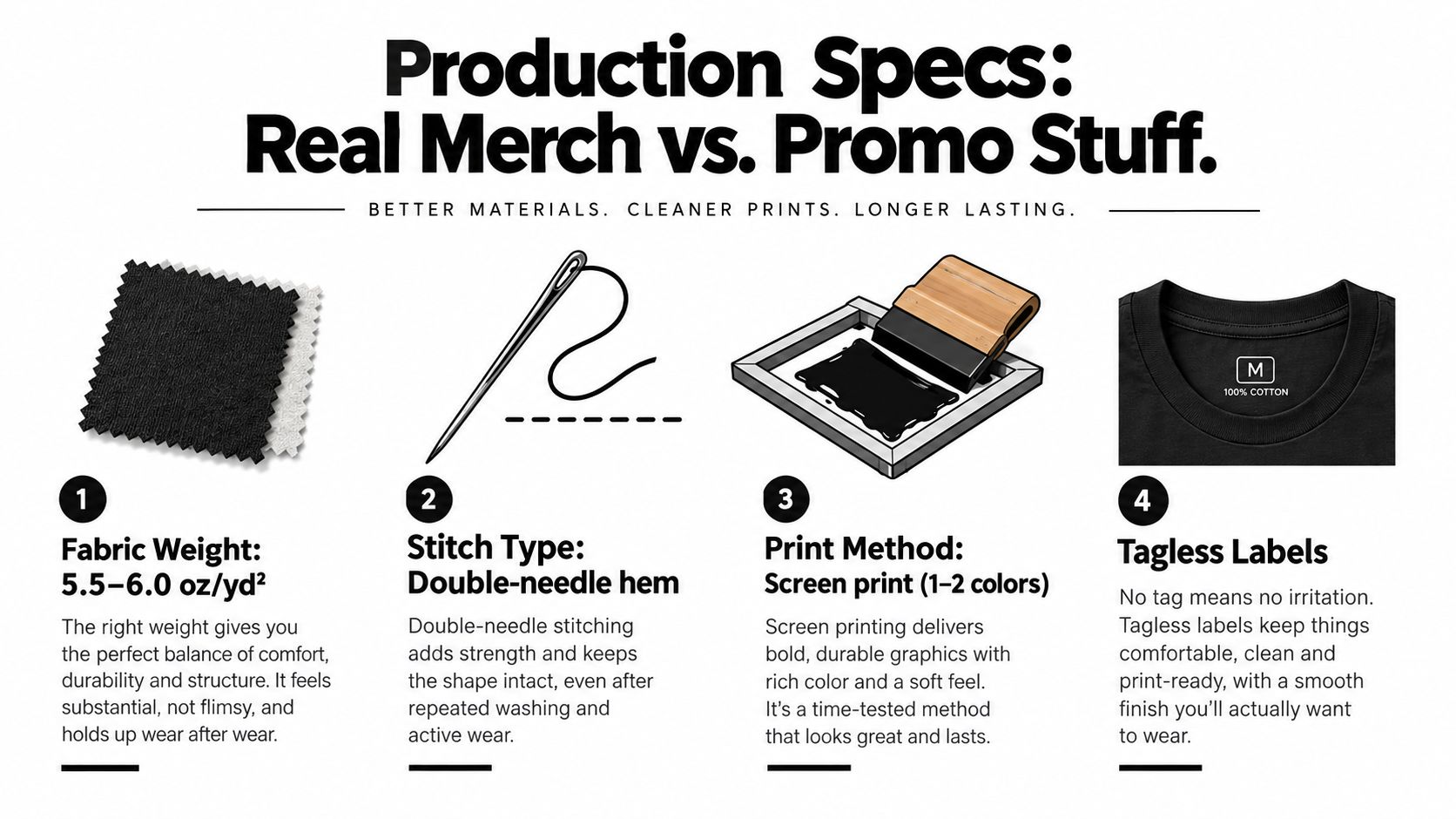
Start with fabric weight. For everyday retail shirts, specify approximately 160 to 180 GSM. For premium streetwear or oversized fits, specify 200 GSM or more. Ask the supplier to verify actual weight using ASTM D3776, with at least five readings and a commonly targeted customer tolerance of ±5%, as outlined in this textile measurement guidance.
Put the fabric on a test sheet
Weight alone doesn't guarantee a good garment. Request the fiber composition, construction details, measurements, seam information, and post-wash shrinkage data. Measure chest width, body length, and sleeve length before and after laundering using a consistent wash protocol.
A printer should also state how the ink is cured. The entire ink film needs to reach its required curing temperature. Insufficient curing can cause abrasion and print loss after roughly five to six washes, according to guidance from the Screenprinting & Graphic Imaging Association. Request cure-temperature records rather than accepting “high quality” as an answer.
Test the finished product
Test production samples through at least 5 to 10 standardized wash cycles, inspecting cracking, peeling, fading, and edge abrasion after each interval. Independent textile-printing research reported that screen-printed cotton retained 91.5% of its initial film thickness after 10 wash cycles, while polyamide retained 41.6%, showing why the substrate matters for print longevity. Review the textile-printing research on wash durability with the printer, then ask how its own process compares.
Cotton or cotton-rich substrates are the sensible starting point when graphic durability is the priority. For a broader explanation of decoration choices, this guide to t-shirt print methods compared can help you distinguish screen printing, direct-to-garment, heat transfer, and other approaches before requesting quotes.
Production standard: Approve the garment only after you've inspected the fabric, measured the fit, reviewed curing evidence, and washed the actual decorated sample.
Fit, Sizing, and the Hidden Cost of Returns
A striking graphic can't rescue a shirt that fits badly. Buyers compare measurements across manufacturers, eras, and cuts, while labels such as S, M, and L mean different things across US, UK, European, and Asian sizing systems.
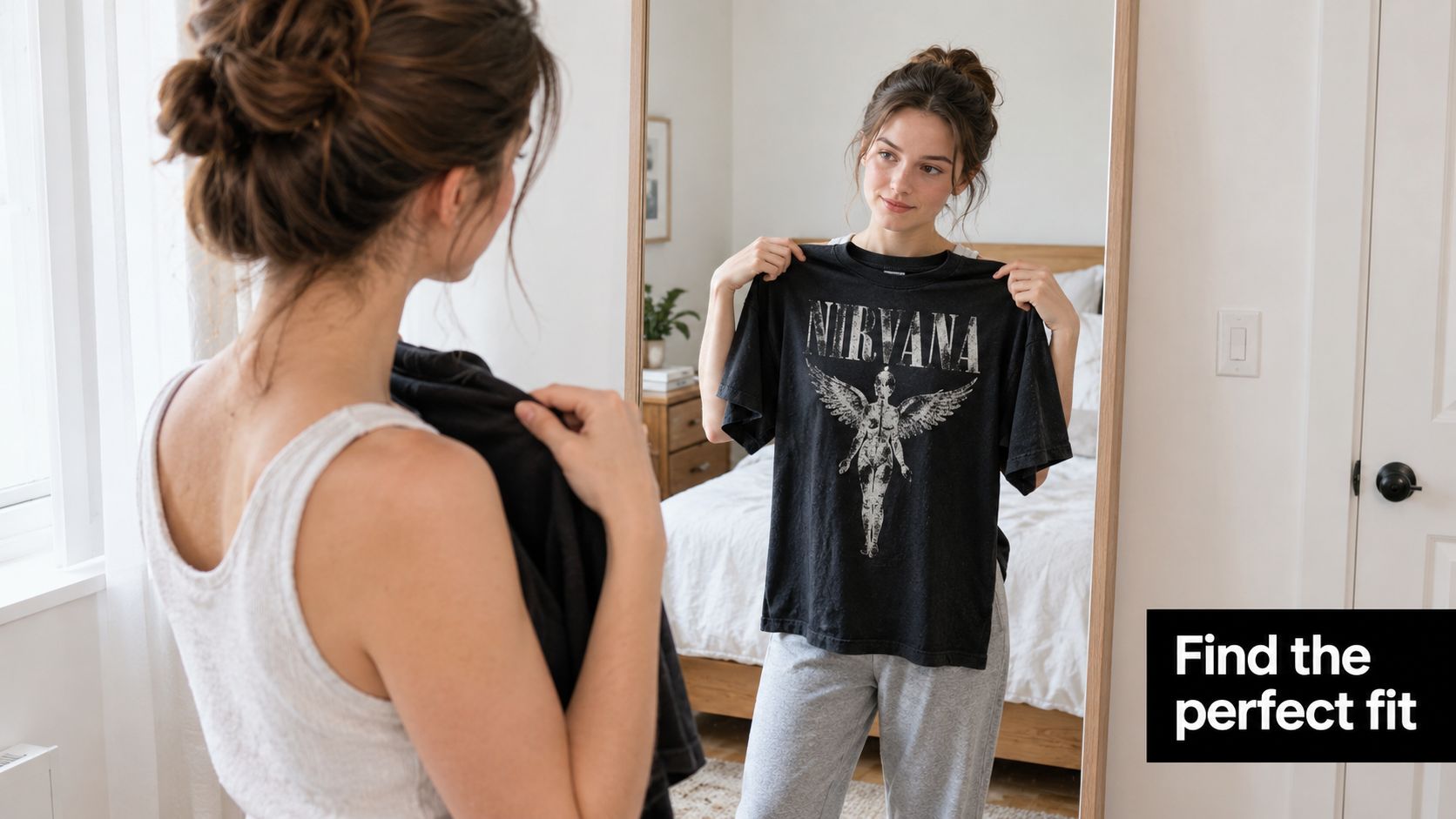
Publish the garment's chest width and body length for every product. Identify whether it's unisex, fitted, oversized, or a youth cut. Add model measurements and the size worn. If the garment changes after washing, disclose that before checkout rather than forcing the customer to discover it.
Make the product page do the fitting work
A dependable sizing policy can be short:
- Measure a shirt the buyer already likes, laid flat.
- Compare chest and length against the product measurements.
- Choose the cut first, then choose the size.
- Read the shrinkage note before ordering.
- Contact support before purchase if a measurement falls between sizes.
Use fit photos that show the garment from the front, side, and back. A visual sizing tool such as the Robosize three size guide can support comparison, but it shouldn't replace actual measurements.
Returns cost more than postage. They consume packing time, create stock uncertainty, and can leave a garment unsellable if the customer removes tags or damages the print. A less dramatic shirt with reliable fit can therefore outperform a more exciting design because the artist keeps more of the original contribution and earns greater buyer trust.
Place your OohYeah return policy where buyers can find it before payment. State the eligible conditions, timing, customer responsibility, and exchange process in plain language. A clear policy won't eliminate every return, but it prevents avoidable arguments at the exact moment a fan is deciding whether to buy again.
The video below offers another visual reference for how shoppers think about size and garment comparison.
Fan Scenarios That Change Which Merch Wins
The same fan can buy differently depending on the moment. A person at a concert has limited time, limited attention, and a strong emotional response to the performance. An online collector has time to inspect materials and editions. A subscriber wants evidence that the relationship continues after the transaction.
The impulse concert buyer
Only about 21% of fans buy merchandise at concerts, according to the market guidance summarized by Alibaba's band T-shirt wholesale overview. That makes every show purchase important, but it also means the counter needs a clear offer rather than a crowded product wall.
Give this buyer one immediately readable hero item. A $20 to $35 tee is a practical scenario range, not a universal price rule. The shirt should have a strong front or back graphic, a visible size range, and minimal friction at checkout. Keep the packaging easy to carry and make the price legible from a short distance.
The dedicated online collector
This buyer responds to scarcity, documentation, and detail. Numbered editions, a precise garment description, production notes, clear fit measurements, and a product page that explains why the item exists can justify waiting and paying for a more considered piece.
Don't fake scarcity. If the edition is limited, state what is limited and how fulfillment works. If the item is made to order, say so. Collectors value confidence, and confidence comes from specific information.
The subscriber
A subscriber isn't buying just another product. They're paying for an ongoing connection. Useful benefits might include demos, stems, voice notes, member-only drops, direct messaging, or private community posts. The artist has to deliver consistently, so the subscription should match the actual production rhythm.
The strongest lineup serves all three moments without pretending they're identical. A show tee can create recognition, a collector item can deepen ownership, and a subscription can extend the relationship. Fans often move between these modes as their interest changes.
Choosing Your Merch Stack and Owning the Result
Build around one hero apparel SKU first. Make it fit predictably, specify the fabric and print process, test it after washing, and price it from the full cost backward. Add vinyl or a physical bundle only when the release gives fans a reason to own the object and the artist can carry the inventory risk.
Digital goods make sense when they're exclusive and easy to deliver. Subscriptions should be treated as relationship products, not discount products. The promise is access and continuity, so the band needs a realistic publishing and communication schedule before opening paid memberships.
A broader idea bank such as Dirt Cheap Product explains band merch can help generate formats, but ideas aren't the operating system. The artist still needs to own the IP, set the price, capture fan information lawfully, and understand every fulfillment cost.
Use this launch checklist:
- Confirm ownership: Document rights to artwork, logos, photography, music, and licensed assets.
- Demand specifications: Get fabric weight, dimensional tolerance, cure records, and wash-test results.
- Publish measurements: Show chest, length, cut, model details, and shrinkage information.
- Capture the relationship: Make checkout and post-purchase communication support direct fan contact.
- Review the economics: Revisit unit cost, shipping, returns, platform deductions, and pricing quarterly.
Artists can review OohYeah for artists as one option for selling merchandise alongside music and exclusive content while retaining control over pricing and distribution. The principle matters more than the platform name: the best band merchandise is a stack you control, not a single item you chase.
OohYeah gives artists a direct place to sell merchandise, music downloads, and exclusive content while keeping control over pricing and distribution. Build your hero product, publish the specifications buyers need, and visit OohYeah to turn that merch plan into a storefront fans can use.