Band Merchandise Hoodies: Styles, Fabrics and Sizing
Choose band merchandise hoodies by style, fabric weight, sizing and sales model, with specs, print durability and production planning for independent bands.
November 15, 2026
Music Marketplace Advisor
Buying & SellingA single Madison Square Garden date on Kanye West's 2016 Saint Pablo tour reportedly brought in about $780,000 in merchandise, with hoodies on that run priced around $95, as Glossy documented when musicians started selling clothes like fashion drops. That night is not an independent-band result. It does show why band merchandise hoodies stopped behaving like cheap souvenirs. Fans treat them as clothes they keep, and a missed sale on a high-ticket garment costs more than a missed sticker.
I plan a first run in one order: style, fabric, measurements, quantity, price, then sales model. Artwork still sells the idea. Fit, fabric weight, and return risk decide whether the hoodie gets worn, returned, or left in a box.
Hoodie Styles That Match Your Band and Fans
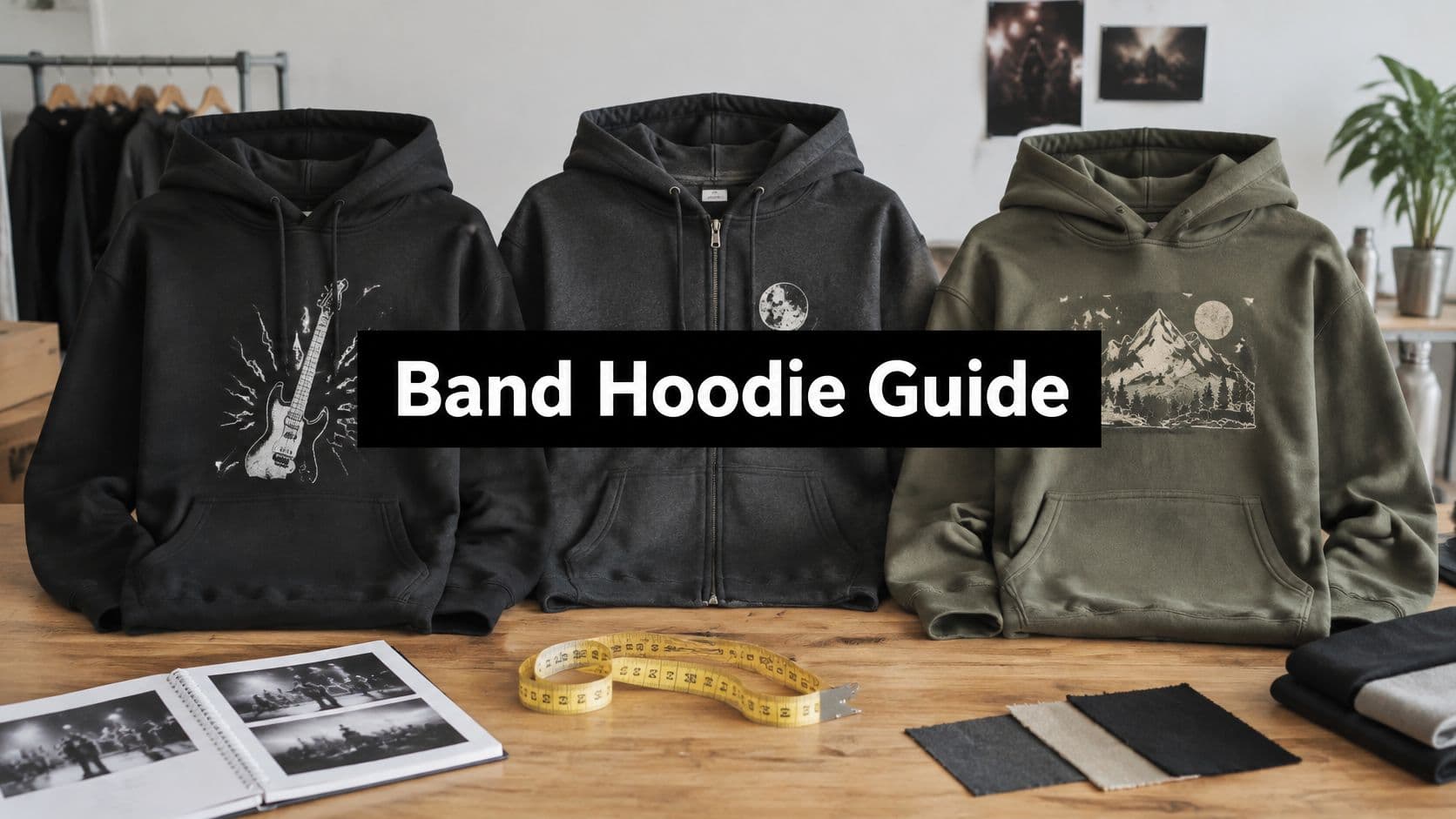
I would start with a midweight pullover in a regular fit. It reads clearly as band merchandise, and it works through most of the year without asking fans to learn a new silhouette. Genre is a weak filter. Check audience age and the sales channel first.
16–24-year-olds under-index for T-shirts but over-index for hoodies and other non-T-shirt merchandise, and nearly half of surveyed buyers mainly purchase merchandise from larger, established artists, according to Hypebot's write-up of MIDiA's merch and ticket buyer survey. A newer band should lead with one hoodie and test demand before widening the range.
Five cuts, one first choice
| Style | Fabric Weight | Fit | Best For |
|---|---|---|---|
| Classic pullover | Midweight fleece | Regular, standard sizing | Core catalogue item for most bands |
| Zip-up hoodie | Midweight fleece | Regular, layers well | Fans who wear it as an outer layer |
| Oversized pullover | Heavyweight fleece | Dropped shoulders, boxy | Streetwear-led and fashion-minded fans |
| Cropped hoodie | Lightweight jersey | Short body, fitted | Younger fans and fashion collaborations |
| Tour-date back print hoodie | Midweight fleece | Regular | Tour-only drops where the date carries the value |
The classic pullover belongs at the centre of most catalogues. Letter sizes map to what fans already own, and the front print stays readable in a photo and on a body. A zip-up earns a slot when the venue runs cold and the buyer wants an outer layer they can open between sets. It layers cleanly over a T-shirt, which is why it sells on autumn and winter dates more reliably than in midsummer.
An oversized pullover, with dropped shoulders and a boxy body, pulls streetwear-minded fans. It also creates the most sizing complaints, because the shoulder sits lower than a regular blank and the chest looks bigger than the letter implies. A cropped hoodie on lightweight jersey suits younger fans and short fashion collaborations, but the short body limits who it fits and how many months it stays useful. A tour-date back print turns the garment into a souvenir. Use it only when the date itself is the reason to buy, and keep it off the standing shop.
Practical rule: Match the style to the fan you already reach, not to the genre you hope to be filed under.
Pick one core style, name its weight, and name its fit before you brief a decorator. Add a second style only after requests or sales records show people asking for it. If you can't say those three things out loud, the run isn't ready to cost money.
Fabric Weight and Print Durability That Hold Up
Print life is a three-part system. The blank, the ink, and the cure have to agree. A sharp graphic on a soft, thin fleece still cracks if the fabric flexes harder than the ink film can tolerate. Three Layer's blank-hoodie testing guide puts the split in plain numbers. Lightweight 4–6 oz hoodies, about 135–200 GSM, flex more in wear and washing, which stresses the print. Properly cured plastisol can withstand more than 50 washes on suitable heavyweight cotton. Water-based prints on lightweight garments may show noticeable degradation around 15–20 washes.
What each blank can honestly promise
| Blank Weight | Print Method | Expected Wash Life | Recommendation |
|---|---|---|---|
| Lightweight 4–6 oz (approx. 135–200 GSM) | Water-based print | Noticeable degradation around 15–20 washes | Avoid for collectible runs |
| Lightweight 4–6 oz (approx. 135–200 GSM) | Plastisol print | Shorter than heavyweight cotton; approve only after wash tests | Flexing stresses the ink; test before approval |
| Heavyweight cotton blank | Properly cured plastisol | More than 50 washes | Preferred for collectible merchandise |
| High-polyester blend | Print with low-bleed underbase | Dye migration possible after a few washes | Disclose polyester content to the printer |
Lightweight blanks are fine for a single-season shirt-weight piece or a low-stakes test where the design isn't meant to outlast the tour. They are a poor home for a collectible. Heavier, dimensionally stable fleece holds its shape, so the ink film isn't pulled apart every time the wearer bends an elbow or the garment hits a dryer. That stability is the spec I want on anything fans will keep past one winter.
High-polyester blends need a separate warning. Dye migration can show up after only a few washes if the printer skips a low-bleed underbase. Tell the decorator the polyester percentage before they price the job, not after the first samples come back with a halo around the ink. If you want a reference for how heavyweight fleece is already sold as off-stage clothing, surf-to-sand weekend hoodie options from California Cowboy show the blank category fans wear when nobody is selling them a logo.
The wash test that approves a batch
Require the decorator to write down ink type, cure temperature, and wash-test results before you accept a quote as final. Then run your own check. Wash production samples on one defined household cycle, the same temperature and the same detergent, and repeat it. Inspect for cracking, peeling, fading, shrinkage, and seam distortion. Approve the batch only against numbers you wrote down in advance, such as maximum shrinkage and no cracks through the top colour.
A pretty strike-off on the table is not a durability test. The dryer is.
Your spec sheet line should read as blank weight, fibre content, ink system, cure temperature, and the wash count the sample survived. Anything missing from that line is a guess you'll pay for in reprints.
Sizing and Fit That Cut Costly Returns
An S-to-XL label is not a size system. It is a habit. Hoodies fail it faster than woven shirts because a relaxed body, a dropped shoulder, and thick fleece change how the same chest number feels. A large apparel-sizing study built five standard size charts containing 93 size groups and reported coverage of 95.08% of the measured population, as published in Expert Systems with Applications. Coverage improved because the charts followed body-measurement distributions instead of arbitrary grade rules. Copying one universal chart won't get you there. Body proportions differ by population and by product category, and commercial sizing still leaves a lot of people between letters.
The cost of guessing shows up in returns. Average U.S. online apparel returns reached 23.4% in 2025, European online clothing returns are estimated at about 20%, and poor fit or perceived style causes roughly 70% of European clothing returns, as set out by Texfash. A returned hoodie isn't a neutral event. You pay outbound freight, inbound freight, and often a garment you can't resell as new.
Four measurements fans can actually use
Publish garment measurements beside every nominal size, taken flat.
| Measurement | How to take it | Fan check |
|---|---|---|
| Chest width | Armpit to armpit, flat and doubled | Compare with a hoodie that already fits well |
| Body length | Shoulder seam to hem | Check against the usual hoodie length |
| Sleeve length | Shoulder seam to cuff | Check that cuffs cover the wrist |
| Shoulder width | Seam to seam across the back | Key driver of dropped-shoulder fit |
Tell fans to lay a hoodie they already like flat and compare those four numbers, rather than trusting the letter they buy in a T-shirt. A fit word such as true-to-size or boxy helps them skim the page. It doesn't replace the tape. Identify the main audience region, check samples on bodies from that region, and log exchanges by the measurement that triggered them. When one dimension keeps showing up in complaints, change the chart or the blank. Don't add another letter size and hope the problem moves.
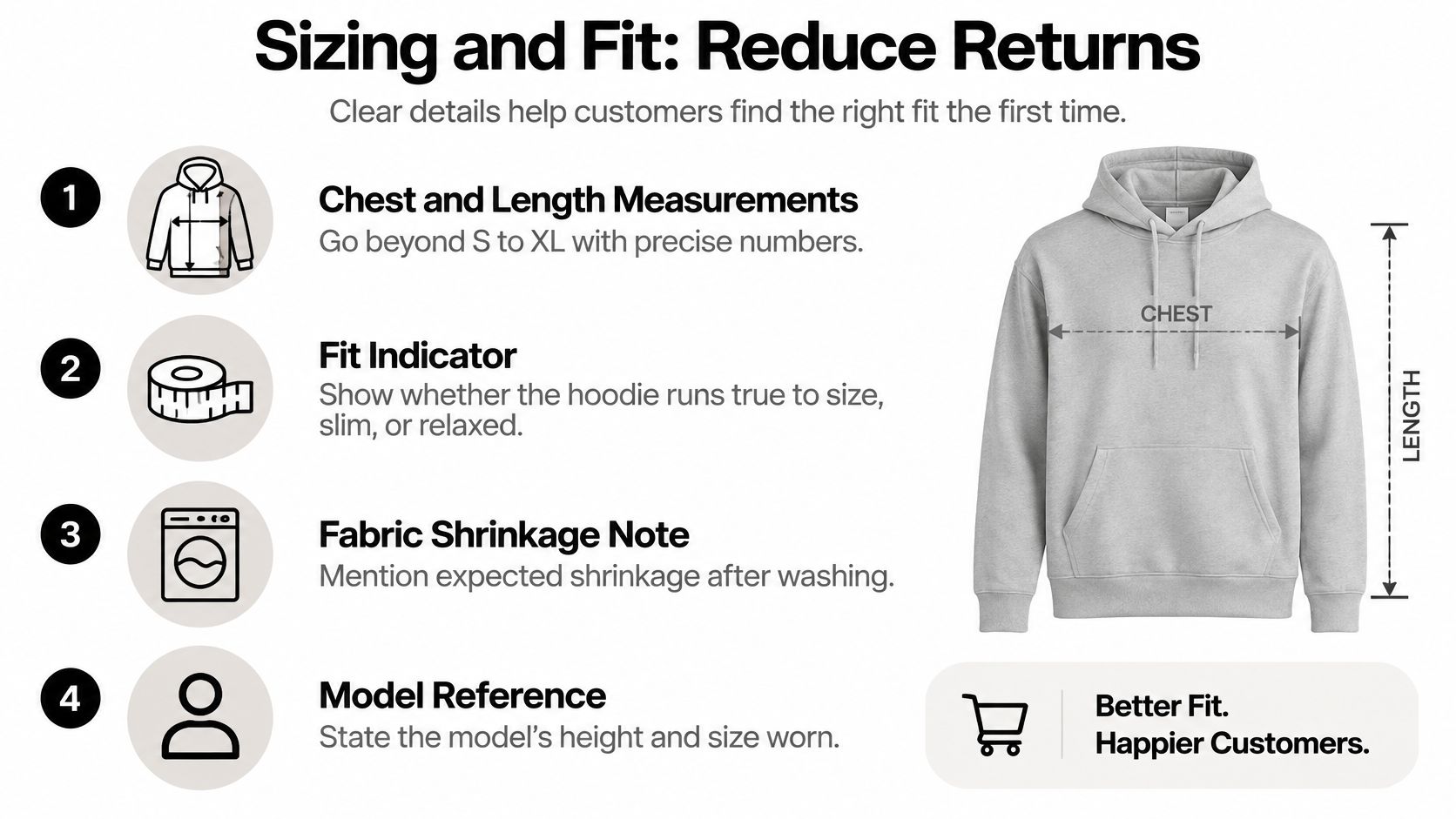
State model height and the size worn, note expected shrinkage after a first wash, and say whether the cut runs slim, true, or relaxed. Put the exchange window in the same place as the chart. A clear return policy stops a wrong size from becoming a one-star review about the band.
Planning Quantities From Sales History
Hoodies can move in volume when the room is already there to buy them. In a 2021 report on venue merchandise operations, one artist described selling approximately 200 hoodies per concert and completely selling out after only three shows, which Rolling Stone recorded while looking at how tour merch leaves the building. At that rate the artist would have moved at least 600 hoodies across those opening dates, before other apparel was counted.
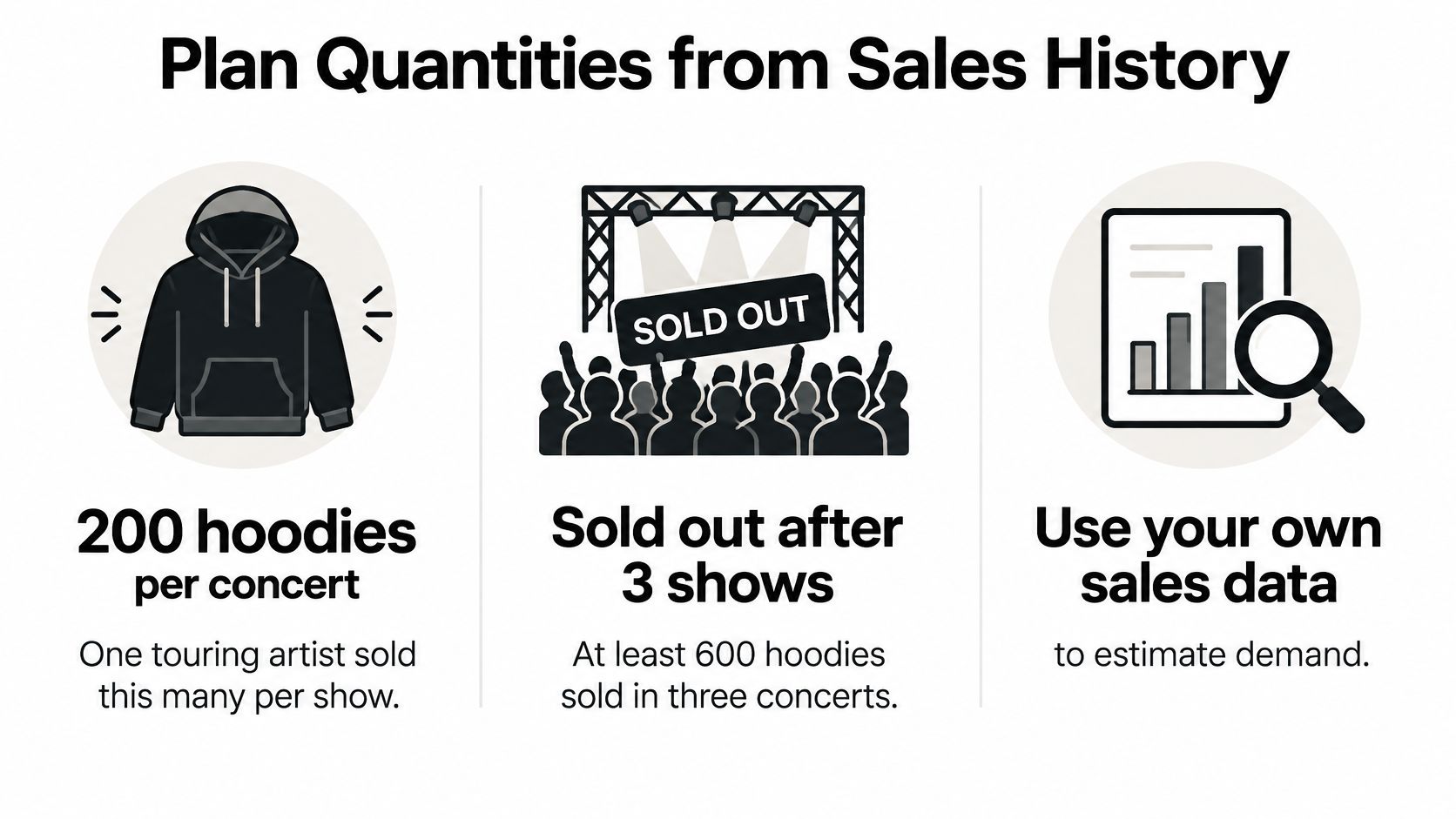
Two lessons sit in that pace. Demand bunches around the live date, and a show night can empty the rack. A hoodie also carries a higher transaction value than paper goods or a small accessory, so each empty size is lost revenue you don't make back on a button. Don't copy 200 units as your forecast. Use it as proof that a wearable design can clear faster than a poster.
Build the first batch
Break past sales down by venue, audience size, city, season, and design. Take units per show from a comparable date, adjust for a bigger or smaller room and for a city that has bought before, then multiply by the number of dates. Add a safety buffer based on how much those past nights varied, not on a round percentage you like. A band with no tour history should start from its strongest market and keep the buffer modest.
Split production into two batches. The first covers opening dates. The second follows what those dates sold, including which sizes emptied. When one design will travel across several cities, a preorder or staged replenishment beats a single bulk buy that you haul home unsold. Track what portion of units you received left the building. Inventory sell-through metrics for merchants from Chartsy are a clean way to see whether the first batch was sized to demand or to optimism.
A short walk-through of how venue merch tables turn a design into units sold is worth watching before you lock a number.
You should be able to state expected sales per date, the date count, and how many units sit in batch one. If those three numbers aren't written down, you don't have a quantity plan.
Pricing Between Accessible and Premium Hoodies
In 2025, pullover hoodies represented 6.5% of music-merchandise items sold and had an average price of US$70 before tax, according to AtVenu's year-in-review. Treat US$70 as a reference, not a target you must hit. I would price the core hoodie near that level so a fan can buy it without treating the purchase like a special occasion. A premium piece can sit above it only when something real justifies the gap. That something is a limited run, a heavier blank, or a collaboration, not a higher number on the same fleece everyone else is using.
Heavier fabric and small drops raise what the garment feels worth. They also shrink who can afford it and how many units you can expect to move. An independent band that copies a fashion-drop price on a first design usually learns that the fans who wanted a wearable logo didn't come along for the scarcity story.
What the unit actually costs
Add the full cost before you publish a price.
- Blank: the fleece at the weight you specified, not the cheapest substitute.
- Decoration: screens or transfers, underbase if the blend needs one, and sample washes.
- Packaging and outbound shipping: mailers, and the freight you eat on a free-shipping offer.
- Bad-fit returns: a share of units that come back because the chart was thin.
- Unsold units: the cost of batch-one stock that never leaves.
The core price has to clear that total before platform fees and still leave a margin you can live with. If it doesn't, change the blank or the print method before you raise the shelf price and hope.
A two-tier shelf
Keep two prices, not a ladder. The core sits near the reference and stays in stock in the sizes your chart supports. One limited design tests whether fans will pay up for weight, a collaboration, or a short window. Review it against units sold, not against compliments. If the premium piece stalls while the core moves, you have your answer. Don't add a third tier until one of those two has a sales record.
Choosing a Sales Model for Hoodie Drops
The sales model is a cash decision dressed up as a merch decision. Bulk stock ties up the most money before a single fan pays. Preorder and made-to-order push printing until demand is visible. A tour-only drop sits in between, with a hard end date and a story attached to the dates.
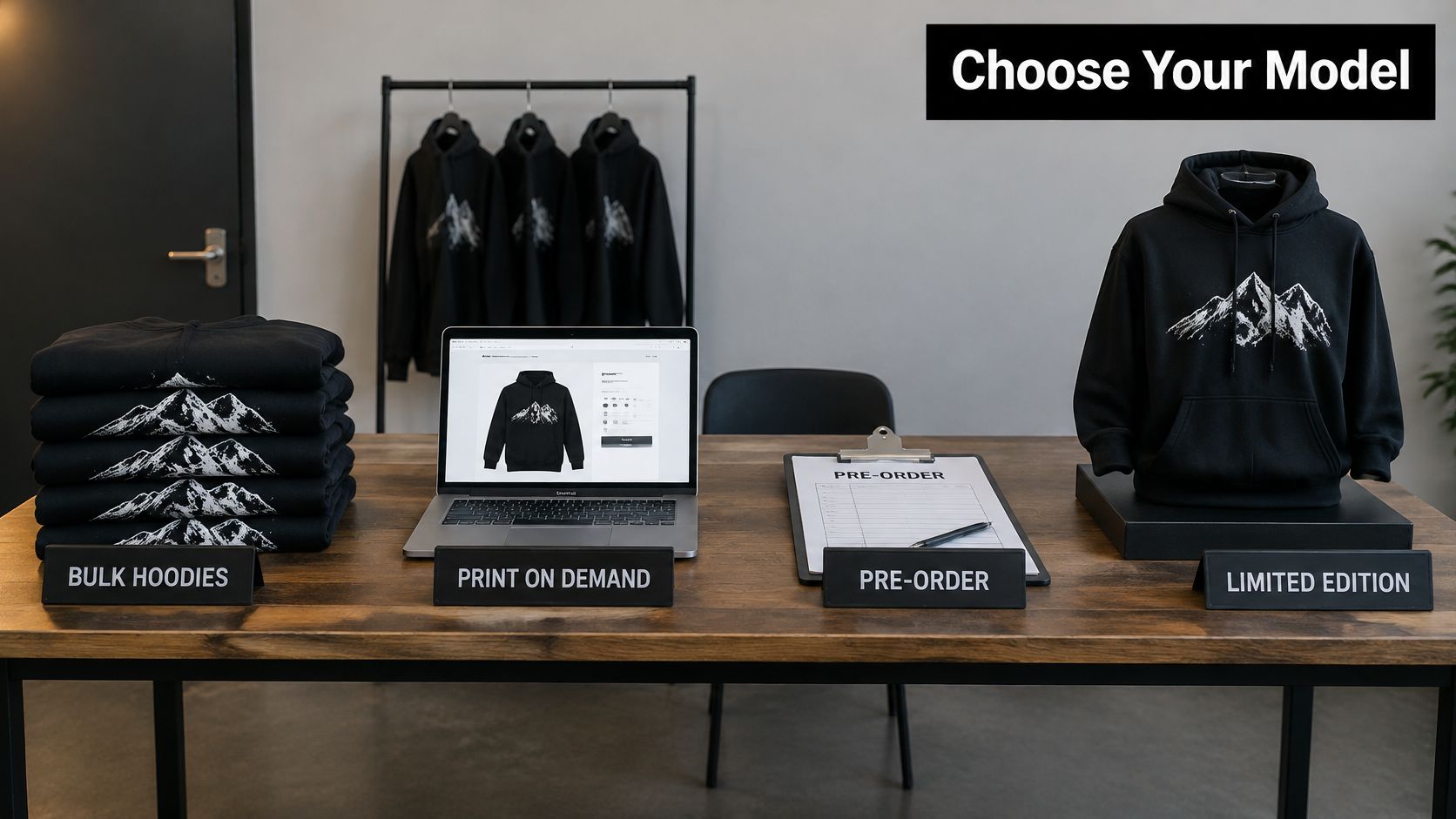
Four models on the same criteria
| Sales Model | Upfront Cost | Unsold Stock Risk | Best When |
|---|---|---|---|
| Bulk stock run | High | High | Past sales show proven demand and a large fan base |
| Preorder | Low to medium | Low | A new design or new band is testing demand |
| Made-to-order | Low | Very low | Many sizes or colourways and a small fan base |
| Tour-only limited drop | Medium | Medium | A souvenir tied to specific dates and a fixed sales window |
A bulk run suits a band that has already sold this kind of garment to a large audience. You get a lower unit cost and stock on the table the night of the show. You also own every unsold large and every colour that looked good on a screen. A preorder collects payment before the printer starts, which is the cleanest test for a new design or a new band. Unit cost is higher than a big bulk order, and fans wait. That wait is cheaper than a closet of hoodies.
Made-to-order keeps risk very low when you offer many sizes or colourways to a small audience. You won't win on unit cost, and turnaround has to be honest on the product page. A tour-only limited drop creates a souvenir with a fixed window. Scarcity helps, but anything left after the last date has no natural second life unless you planned one.
Direct purchases fund recordings, musicians, touring, and merchandise, so the model you pick is also how the next recording gets paid for. List the drop where fans already buy from you. On our marketplace, that path is selling directly to fans once the price and the size chart are ready.
Start on preorder or made-to-order. Move to bulk stock only after a run has sold through.
Sales history points to bulk. A first design points to preorder. A long size range and a small audience point to made-to-order. Don't promote yourself to bulk because the unit price looks better on a spreadsheet.
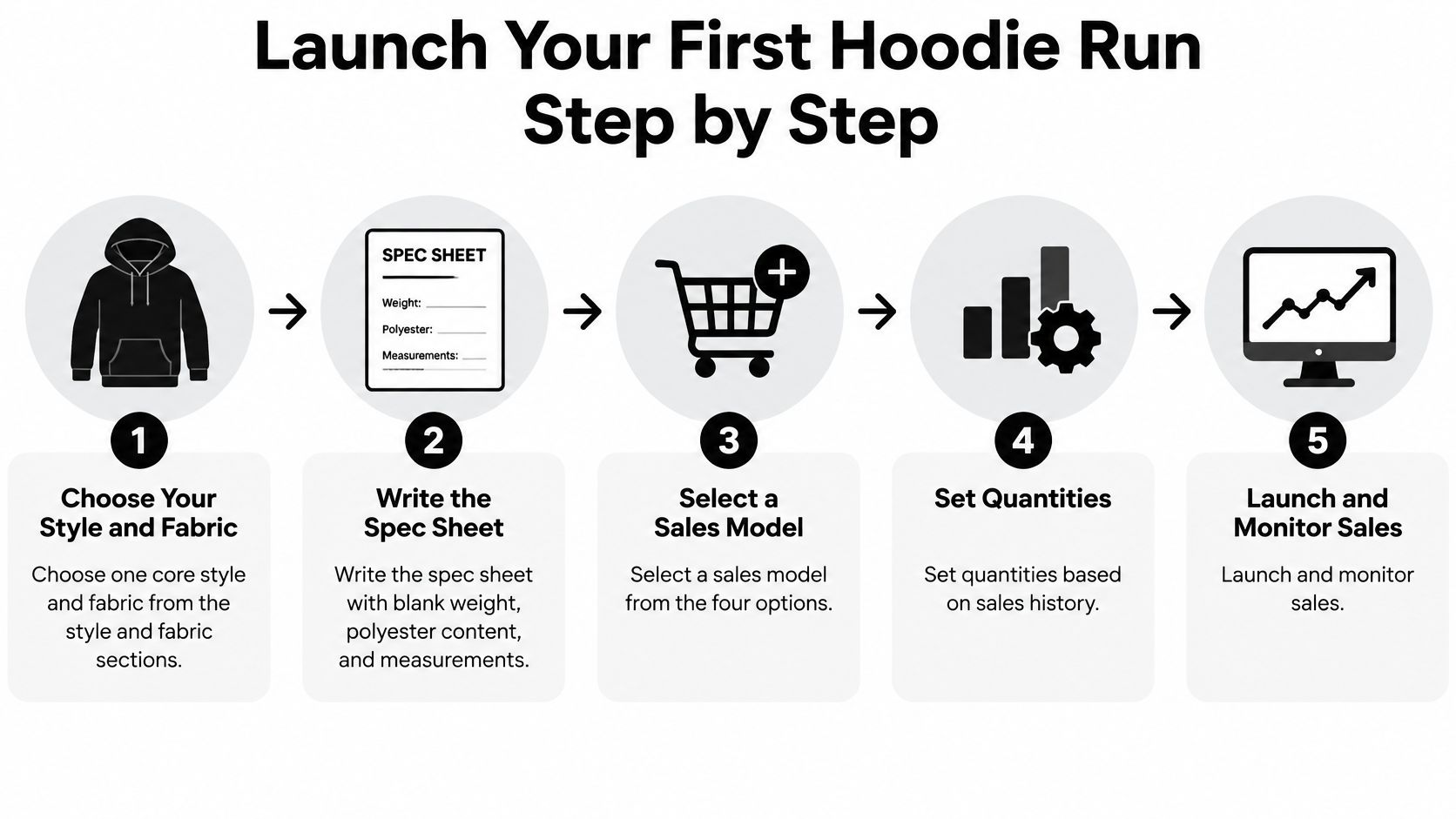
Launch Your First Hoodie Run Step by Step
Work in this order. Each line points at a decision you should already be able to name.
- Choose one core style and one fabric weight, and write the fit in the same sentence.
- Write the spec sheet with blank weight, polyester content, ink type, cure temperature, and the tolerances you'll accept.
- Order wash-tested production samples and check fit on people from the audience you sell to.
- Publish chest, body length, sleeve, and shoulder beside every nominal size.
- Forecast batch one from past sales or from a preorder, then hold a second batch until those numbers come back.
- Set the core price near the market reference, and decide whether one limited premium design is worth a test.
- Pick the sales model that matches your risk, then list the hoodie.
- After the run, sort sizing complaints and returns by measurement, and update the chart before you reorder.
After the first units leave
Watch which size comes back, not only how many units sold. A fast sellout in medium with returns piled in extra-large is a chart problem, not a victory. Email is how you tell buyers the chart changed and how you bring them back for the next drop without reprinting a design that already failed. Real email flows driving repeat purchases from Class A Media are a useful look at sequences that ask for a second order instead of a single announcement.
Sellers can offer music downloads, merchandise, digital products, subscriptions, exclusives, instruments, pro audio gear, and other music-related products. You can join OohYeah to sell music gear, join Music Pros, or join as an artist, and the seller guide walks through listing once the spec sheet and the price are real. Leave this process with three things written down: the named first hoodie, the spec sheet, and the sales plan that funds the next batch.
OohYeah is a music marketplace where fans buy music, merchandise, and other products directly from artists, including band merchandise hoodies you price and describe yourself. List the core style once the measurements, the fabric spec, and the sales model are set, and keep more of each sale because the marketplace is built without intermediary fees. Visit OohYeah and put the first hoodie where your fans already come to support the music.