How to Find Unsigned Artists: A Scouting Workflow for 2026
Learn how to find unsigned artists with a two-stage scouting funnel, a vetting scorecard and outreach steps that separate real momentum from viral noise.
November 12, 2026
Music Marketplace Advisor
Buying & SellingYou're halfway through a Tuesday playlist when a track stops you. The artist page shows a few thousand listeners, a handful of songs, and no label name in the credits. By Friday that clip may be gone, or it may be the start of a catalog people return to. Learning how to find unsigned artists is less about scrolling harder and more about deciding which leads deserve a second listen. A small A&R team can't hear everyone. What works is a short set of channels, a scorecard that ranks fan intent above follower counts, and a habit of treating a viral spike as a lead to verify. What doesn't work is calling an act a prospect because the monthly listener number looks big, or assuming "unsigned" because the bio never mentions a deal.
Where Unsigned Artists Surface Before They Trend
A track can be earning before it appears on a major chart. In 2024, nearly 12 million artists had music available on Spotify, up roughly 2 million from 2023. About 71,200 artists, approximately 0.6% of the total, generated at least $10,000 in Spotify royalties that year, according to Spotify's artist remuneration coverage. The same reporting says 8 million artists, more than 66% of the total, had uploaded no more than 10 tracks. Platform presence alone says little about ambition. Look for consistent releases, genuine engagement, geographic reach, collaborations, and signs of career development.
The biggest charts miss plenty of artists already earning. For a small scouting team, the useful question is where listeners, venues, and trusted peers are showing intent before a track becomes widely visible.
Discovery channels and what each one surfaces
You don't need to monitor every platform every week. Local gig listings, referrals from trusted curators, and one online source such as SoundCloud or emerging playlists can produce a manageable queue. Choose channels that show different kinds of evidence: recorded work, live activity, and a credible recommendation.
| Channel | What It Surfaces | Signal to Log | Best For |
|---|---|---|---|
| Spotify emerging-artist playlists | Early-career and DIY acts | Release date and listener growth | Large-scale scouting |
| SoundCloud uploads | Demos and unreleased work | Plays, comments and reposts | Producers and A&R on a budget |
| YouTube performance videos | Live sessions and visualizers | Views over time and comment quality | Judging stage presence |
| TikTok and Instagram short-form | Clips that turn into songs | Repeat use of a track and shares | Spotting early breakout moments |
| Local gig listings and venue bookings | Working live acts | Repeat bookings and door attendance | Regional managers and promoters |
| College and community radio | Local and genre-specific artists | Airplay frequency and DJ picks | Finding artists before playlists |
| Producer and beatmaker communities | Collaborators and featured vocalists | Credits and collaboration history | Finding artists through peers |
| Referrals from trusted curators | Pre-vetted talent | Who recommended the artist and their track record | Fast, qualified leads |
Specialist press can supply a focused referral. A roundup that helps you discover emerging guitar talent may surface players a chart playlist hasn't picked up. Record the outlet, date, and recommender so the lead has context when it reaches the team.
Pick three channels for the first week: one online, one live, and one referral. Log each lead's source before adding another platform.
For another place to hear artists' available work, browse the OohYeah music marketplace. Keep the lead record alongside it: a name without a source, date, and territory is difficult to assess in a team review.
Score Candidates on Fan Intent, Not Raw Reach
Sort the queue by sustained momentum and fan intent, not by monthly listeners. Reach tells you a track was played. Intent tells you someone saved it, came back, wrote something, or showed up. I would rather advance a smaller act with repeat behavior than a bigger one whose entire number sits on a single playlist.
For every candidate, calculate rolling 28-day and 90-day figures: listener growth, streams per listener, save-to-stream ratio, repeat-listen rate, comment and share rate, direct-message response rate, and merchandise or ticket activity where you can see it. A candidate whose streaming growth, short-form engagement, and live attendance rise together is generally more credible than one whose numbers depend on a single playlist or clip.
Vetting scorecard criteria and red flags
Use the same windows every session so a Monday spike doesn't outrank eight quiet weeks of real fans.
| Criterion | Measurement Window | What Good Looks Like | Red Flag |
|---|---|---|---|
| Listener growth | 28 and 90 days | Steady rise over 8–12 weeks | One spike followed by decline |
| Streams per listener | Rolling 28 days | Repeat listening across releases | Listeners who never return |
| Save-to-stream ratio | Rolling 28 days | Saves that track streams | Plays with almost no saves |
| Comments and shares | Per release | Discussion beyond passive likes | Likes with no comments |
| Cross-platform consistency | 90 days | Streaming, video and live attendance rise together | Growth from a single playlist or clip |
| Geographic plausibility | Per release | Listeners clustered near live dates | Sudden spikes from regions with no shows |
| Rights and identity | Before outreach | Recording and composition ownership confirmed | Unclear ownership or anonymous account |
The two criteria that mislead most often are listener growth and comments. A paid playlist can manufacture the first. A like button can fake warmth on the second. Saves, repeat streams, and a comment that names a lyric are harder to buy in bulk.
Curated channels are still worth watching, with a limit attached. Spotify's Loud & Clear takeaways report that more than 1,600 artists first surfaced through its Fresh Finds ecosystem later generated over $100,000 annually on the platform, and that more than one-third of artists generating at least $10,000 in 2025 royalties were DIY or began as DIY. That supports monitoring emerging-artist programs. It doesn't establish a success rate. Selection bias and platform-specific exposure are real pitfalls.
Checks before you rank
Build a queue of about 20–30 candidates per session. Then, before anyone moves up:
- Geography: Traffic should sit near cities where the act plays live or where a known scene matches the genre.
- Spikes: Write one sentence on every sudden jump. If you can't name a release, a show, or a placement, lower the rank.
- Followers: Look for bot-like patterns, such as huge follower counts with almost no saves.
- Ownership: Confirm who owns the recording and the composition.
- Contact: Ask for a direct artist or manager address, not only a comment thread.
Say an act shows 40,000 monthly listeners, nearly all from one playlist, with flat saves. A duo with 6,000 listeners spread across three cities and two sold-out room dates ranks above them. Rank the queue on momentum, fan intent, catalog depth, and whether fans already pay for something the artist sells directly.
Run the Scouting Funnel and Your First Week
Stage one builds a wide candidate list. Stage two checks evidence before anyone is contacted. Skip the second stage and you spend the week writing to playlist accidents.
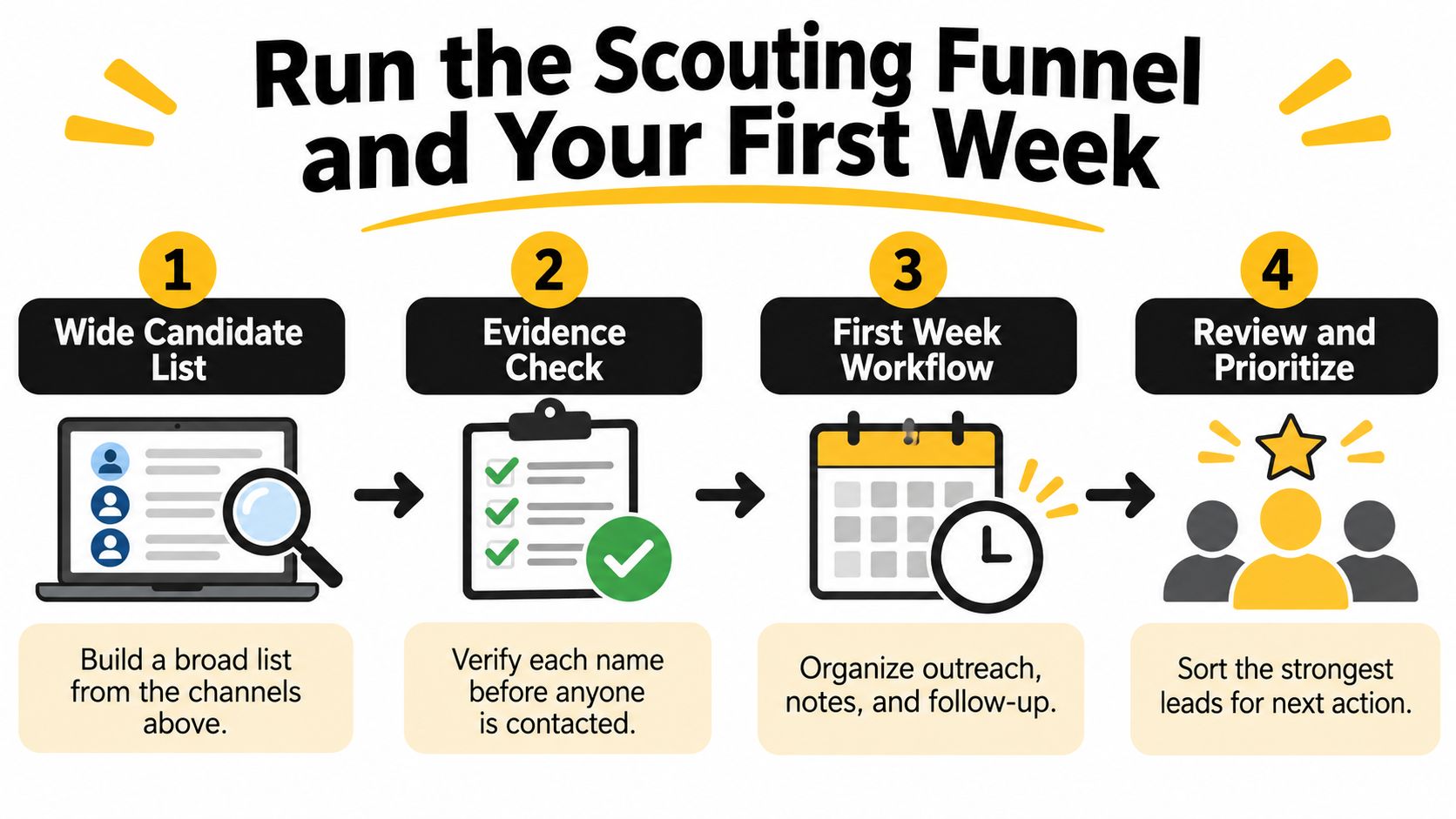
Water & Music's reporting on how A&Rs scout puts roughly 50% of talent discovery still on networks and word of mouth, while digital analytics have expanded the information available to A&R teams by more than tenfold over the past decade. Algorithms belong in the funnel, not on top of it. Research using 9,778 users and 4,136 newly discovered songs found that algorithmic recommendations generated 40% more repeat streams than playlists for low-popularity artists, though recommendations were weaker for completely unfamiliar artists than for known acts. Use the machine to widen the list. Use a person to decide who advances.
The weekly routine
- Build the list. Aim for 20 to 30 names per session from emerging playlists, recommendation surfaces, genre communities, SoundCloud, short-form video, local listings, and referrals. A longer queue gets shallow checks, which is how bots and one-off trends survive.
- Log every lead in one shared sheet. Capture source, date, territory, latest release, engagement, and whether you have permission to contact. Missing source data makes a later review impossible, because nobody can tell a referral from a paid placement.
- Watch 28-day and 90-day windows. A one-day number isn't momentum. If the sheet only stores today's listeners, you're scoring a screenshot.
- Advance on two independent demand signals. Sustained listener growth plus meaningful fan interaction is the practical benchmark. A single viral spike isn't proof of career potential. This cut removes false positives from playlist exposure, paid promotion, bots, and one-off trends.
- Review the strongest names by ear. Listen through the catalog, read the artist page for depth, and confirm at least one live date. If the second song doesn't hold up, the first one was the campaign.
- Write a one-line reason. "Grew for ten weeks in two cities and the comments quote lyrics" can pass. "Went viral on Tuesday" cannot.
Two slips show up on almost every small team. Scouting from one platform only, and advancing names because a playlist or a paid boost moved the graph. Both feel efficient. Both fill the shortlist with people you can't develop.
A first week you can actually finish
Pick three channels, one online, one live, and one referral. Run one session of about 30 candidates. Keep the top five. Verify rights and request a direct contact for the top three. Review the queue after 90 days. A shorter window can't separate momentum from a spike. A healthy weekly output is a shortlist of three to five artists, each with a written reason.
When a lead needs a mixer, a session player, or a studio rather than a signing conversation, Music Pros is a directory for finding musicians, producers, engineers, studios, and other music professionals. One OohYeah account may hold several roles, including fan, buyer, artist, seller, music professional, label, studio, manager, or business account, which keeps the scout and the artist on the same record. Industry people comparing notes can also start from joining as music pros.
Find Artists Through Live Shows and Local Networks
A 150-capacity room can reveal what a follower count can't. The opener may have a modest online audience, yet the front rows sing along and the crowd stays for the set. Treat that response as a lead to investigate, not proof of career potential.
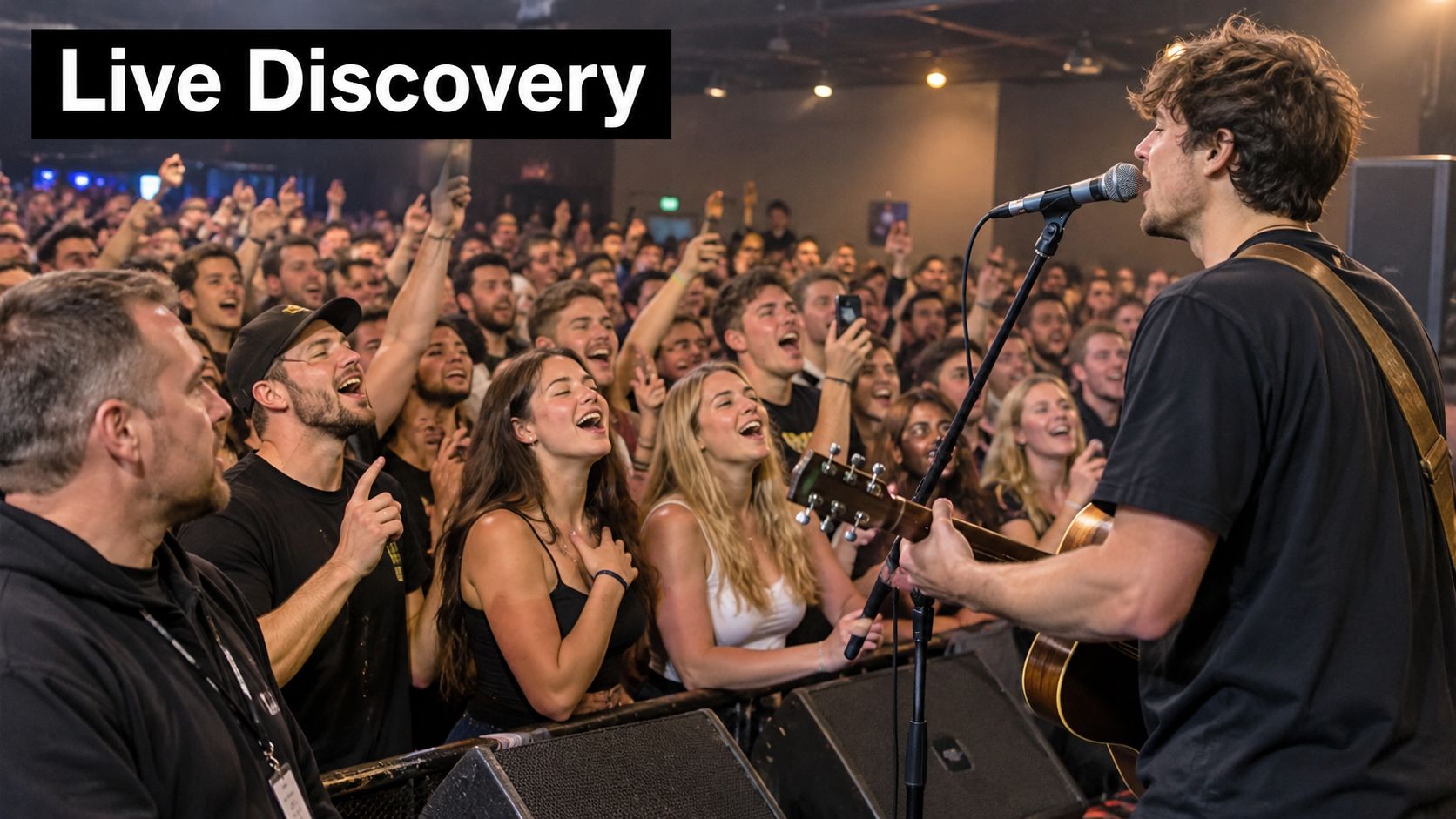
Creative Australia's 2025 Listening In research found that 62% of music-engaged respondents discover new music and artists at live events, 58% at music festivals, 44% through personal connections or word of mouth, and 66% on social media. Live discovery and online discovery can reinforce each other. The useful question is whether interest in the room turns into repeat attendance, song knowledge, and action after the show.
Where to spend the nights
Track venues that rebook the same act, festival open-call slots, college-station DJs, producer circles, and local curators whose past picks have held up. In a smaller market, a calendar of upcoming events near Taos can help surface working bills before an artist reaches a national playlist. Prioritize rooms where unfamiliar acts can build an audience, and ask promoters which performers bring people back.
How to test a live act
- Two shows, weeks apart: One strong night may reflect a special occasion. A second date gives you another chance to see whether interest persists.
- Returning faces: Notice whether people come back to see the artist, not just the venue or headliner.
- Lyric knowledge: A crowd singing beyond the part circulating in a clip suggests listeners are spending time with the songs.
- The room's verdict: Ask the sound engineer or promoter how the act draws, and whether the door reflects the guest list.
- Tickets you can see: Compare advance sales with walk-up attendance when the venue shares those figures.
A packed room matters less if the listeners don't return or engage with the music afterward. A smaller crowd that knows the songs, buys a ticket, and comes back can be a stronger signal than a viral spike. Check that the performance holds up in a recording, then log the date and venue alongside online leads so live evidence informs the same assessment.
Confirm an Artist Is Actually Unsigned
Before you spend a week on an act, check whether a label already holds the relationship. A label-managed artist needs a different door. Guessing from a casual bio is how teams embarrass themselves.
- Read the release credits. A phonographic copyright line and a label name mean a label is on the recording. An imprint on the release is involvement, not a rumor.
- Check the distributor. A self-release or an aggregator-only credit usually points to an unsigned act. A label's own distribution setup points the other way.
- Scan the profile and the catalog. A label-run artist page, or one label name across every release, suggests a deal rather than a one-off license.
- Look up publishing and performing-rights registrations. A publisher's name can mean a publishing deal even when the recordings look independent.
- Search recent news and the artist's own channels. Announced signings and partnerships show up there before they show up in your inbox.
Record the result on the lead sheet as unsigned, label-linked, or unclear. Unclear leads wait. Label-linked acts go to that label's A&R team, not to a cold message that pretends the contract isn't there. This check takes less time than a bad first email, and it keeps your outreach aimed at people who can say yes.
Turn a Promising Signal Into a Working Contact
A clip takes off overnight. Streams rise, comments pile up, and the follower count jumps. Treat that spike as a lead to verify, not proof of career potential. The useful question is whether listeners return, follow the artist, show up live, or buy something.
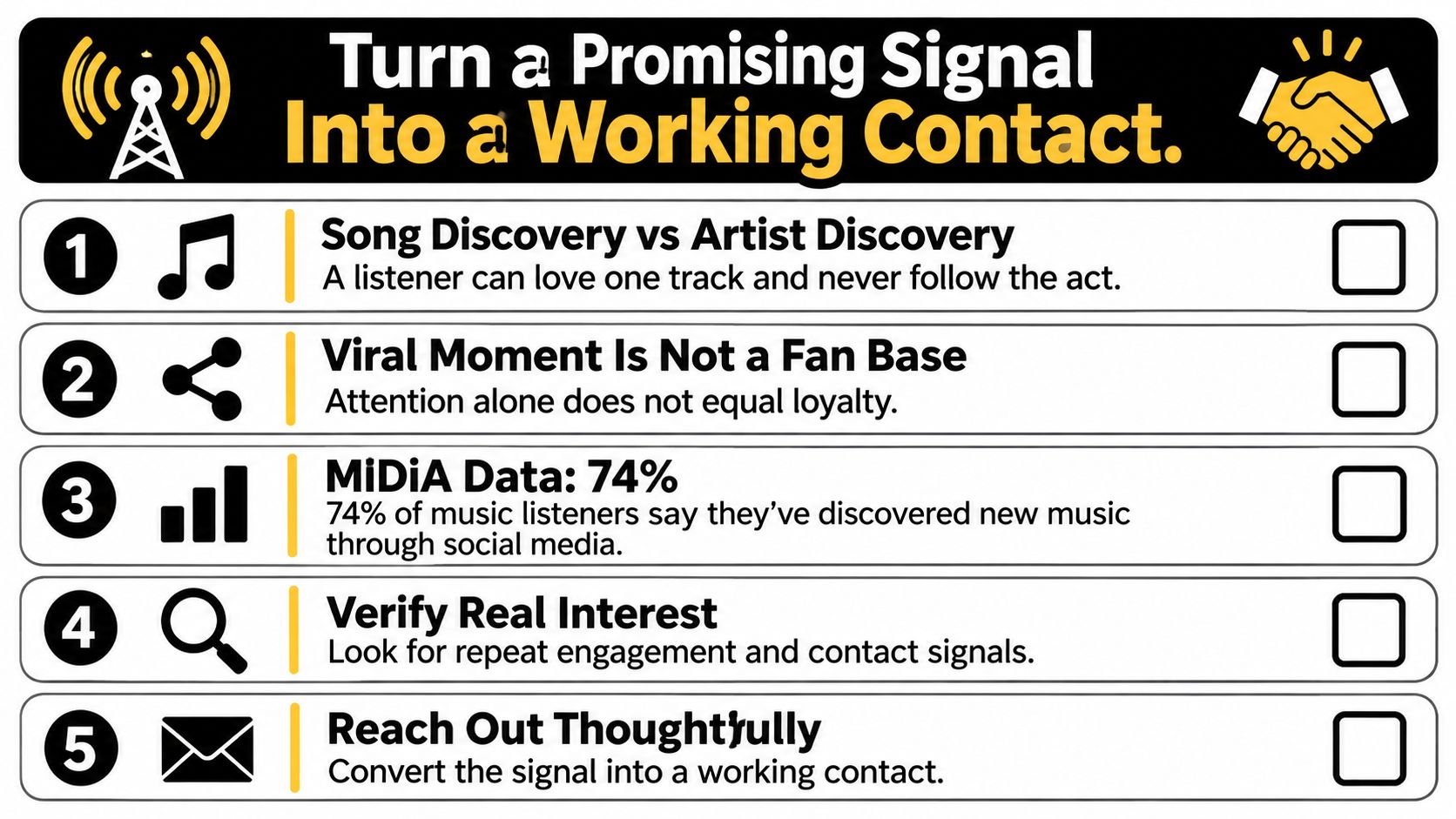
MIDiA's research on virality and fandom highlights the gap between discovery and sustained interest. YouTube was named among the top three discovery sources by 52% of consumers, compared with streaming services at 40% and TikTok at 37%. Although 87% hear music on social media, more than half had often encountered it elsewhere first. Among listeners aged 16–24 who discovered artists they loved, 19% went on to listen to more of that artist's music, compared with 24% of those aged 25–34. The contrast is also clear by discovery platform: 74% of people who prefer streaming for discovery listen to more from an artist afterward, versus 48% of those who prefer TikTok.
A clip can travel far before an audience commits. Look for the behavior that follows it.
A contact routine that respects their time
- Know what the artist is asking for. Before discussing a deal, clarify what they want to build and what kind of support they are seeking. A strong lead can still be a poor fit for your team.
- Write a short, specific note. Mention the track that caught your attention and the live performance or other signal that strengthened your interest. Ask one clear question about the artist's plans.
- Use a working contact. A manager's email or a direct artist address is easier to follow up on than a social DM buried among fan messages.
- Check whether attention converts. Look for returning listeners, follows, mailing-list signups, and ticket demand for a later show. A spike without repeat engagement is a reason to wait, not rush into a call.
- Log a decision. Advance, wait, or drop. A reply starts a conversation; it does not establish momentum.
OohYeah requires an Artist Agreement before artist content or artist monetization can be published. Artists ready to publish can review the steps for joining OohYeah as an artist.
The common time sink is treating one viral week as durable demand. Keep the call focused on evidence: who is returning, whether fans attend live, and whether listeners take an action beyond watching a clip.
For a concrete next step, browse the OohYeah marketplace for artists with music fans can buy. If your shortlist includes artists ready to sell their work, invite them to join as artists.