Music Streaming Promotion: A Campaign Guide for Artists
Learn how music streaming promotion works, which channels to use, and which metrics show real fan growth, with a campaign timeline and checklist.
November 11, 2026
Music Marketplace Advisor
Buying & Selling88% of tracks on streaming platforms received fewer than 1,000 streams during 2025, while the catalog expanded by approximately 39 million tracks in a single year, according to Unchained Music's reporting on the independent discovery crisis. That ratio is the honest starting point for any discussion of music streaming promotion. The constraint isn't effort or output. It's attention, and there is less of it per release every year.
The usual response is to release more and post more, which is how artists end up with a catalog of tracks that each got three days of noise and nothing afterward. I would argue the opposite. The campaigns that build careers treat a stream as the first step toward a relationship you own, then measure whether the audience came back. Everything below follows that logic: which channels do which job, how to sequence a release on a calendar, where playlist placement and short-form video move numbers, which metrics reveal real fans, when paid spend is justified, and how to run a four-week test that tells you whether any of it worked.
Streaming Promotion Channels at a Glance
Streaming isn't a channel bolted onto a music business. It is the music business. In 2024, streaming accounted for 69.0% of global recorded-music revenues, while paid subscription accounts reached 752 million worldwide, according to the International Federation of the Phonographic Industry's industry data. A release that doesn't move listening hasn't been promoted, no matter how many posts went out.
Five channels can move listening for a release, and each buys a different kind of attention at a different price. The comparison below is what I'd draw on a whiteboard before a campaign starts, because it forces the question of what each channel is for.
| Channel | Reach mechanism | Start timing | Cost level | Best for |
|---|---|---|---|---|
| Playlist pitching | Editorial and curator playlists | Submit at least 7 days before release | Free to pitch | Tracks with strong early saves |
| Short-form video | TikTok, Instagram Reels, YouTube Shorts | 2-4 weeks before release | Time, plus optional boosts | Hook-led songs and catalog tracks |
| Paid ads | Platform ad networks | Launch week and after | Set by your budget | Tracks with proven listener retention |
| Social posts and community | Instagram, X, Discord, OohYeah community | Ongoing | Time | Artists with an engaged following |
| Pre-saves | Pre-save links on streaming services | 2-4 weeks before release | Free | Building launch-day plays and momentum |
The logic underneath those rows matters more than the rows themselves. Playlist pitching runs on editorial and curator judgement, so it needs lead time and can't be bought outright. Money spent trying to shortcut it usually buys a slot on a playlist nobody streams. Short-form video manufactures discovery by putting the most recognizable eight seconds of a song in front of people who weren't looking for it, and it works hardest for catalog tracks that need rediscovery.
Paid ads scale reach in a straight line with budget, which is exactly why they only pay off when the track already holds listeners. Social posts and community compound over months, and they're the only channel here that leaves you with something you own. Pre-saves turn early intent into launch-day plays, and launch-day plays are the signal platforms read when they decide how much algorithmic reach to hand you.
The rule I'd give a first release: pick two channels, not five. One to create discovery, one to capture it. Running all five on a small budget produces movement without a result.
The daily grind differs by platform, and it's worth studying the cadence before you commit. Artists whose catalog lives on SoundCloud should read these daily promotion workflows for SoundCloud artists, because the rhythm of reposts, comments and playlist runs there has little in common with a Spotify-first plan.
Before spending anything, decide which channel carries the main goal. If the goal is discovery, short-form video and pitching lead. If the goal is a fan you can reach again next year, community and pre-saves lead. A campaign with two owners beats a campaign with five.
Plan a Release Campaign in Four Phases
Campaigns collapse on the calendar far more often than on the creative. The four phases below assume you're working a single release with a fixed date and a budget under a few hundred dollars. Each phase exists because the next one can't start without it.
Phase 1, four weeks out. Lock the master, artwork and metadata, and publish the pre-save link. Every later step copies those details, and a corrected title or a swapped master after a pitch has gone out means the pitch was wasted. Publishing the pre-save early also gives the link time to circulate before anyone has release-day fatigue.
Phase 2, three weeks out. Cut teasers from the strongest eight to fifteen seconds of the song and share them with your closest fans first. Your existing listeners are the cheapest test audience you'll ever get. If the clip doesn't stop them, it won't stop a stranger, and you've learned that before spending on reach.
Phase 3, two weeks out. Submit the playlist pitch and post the pre-save link across every channel you own. Editorial review runs on a lead time you can't compress, which is why the pitch has to leave early rather than the day before release. This is also the point where most artists discover their metadata is wrong.
Phase 4, release week and day seven. Post daily, reply to comments within hours, and only add paid ads to tracks already showing early saves or completions. Then, seven days after release, review the numbers, decide whether a paid boost is justified, and turn the best-performing clips into follow-up content instead of letting them die with the release.
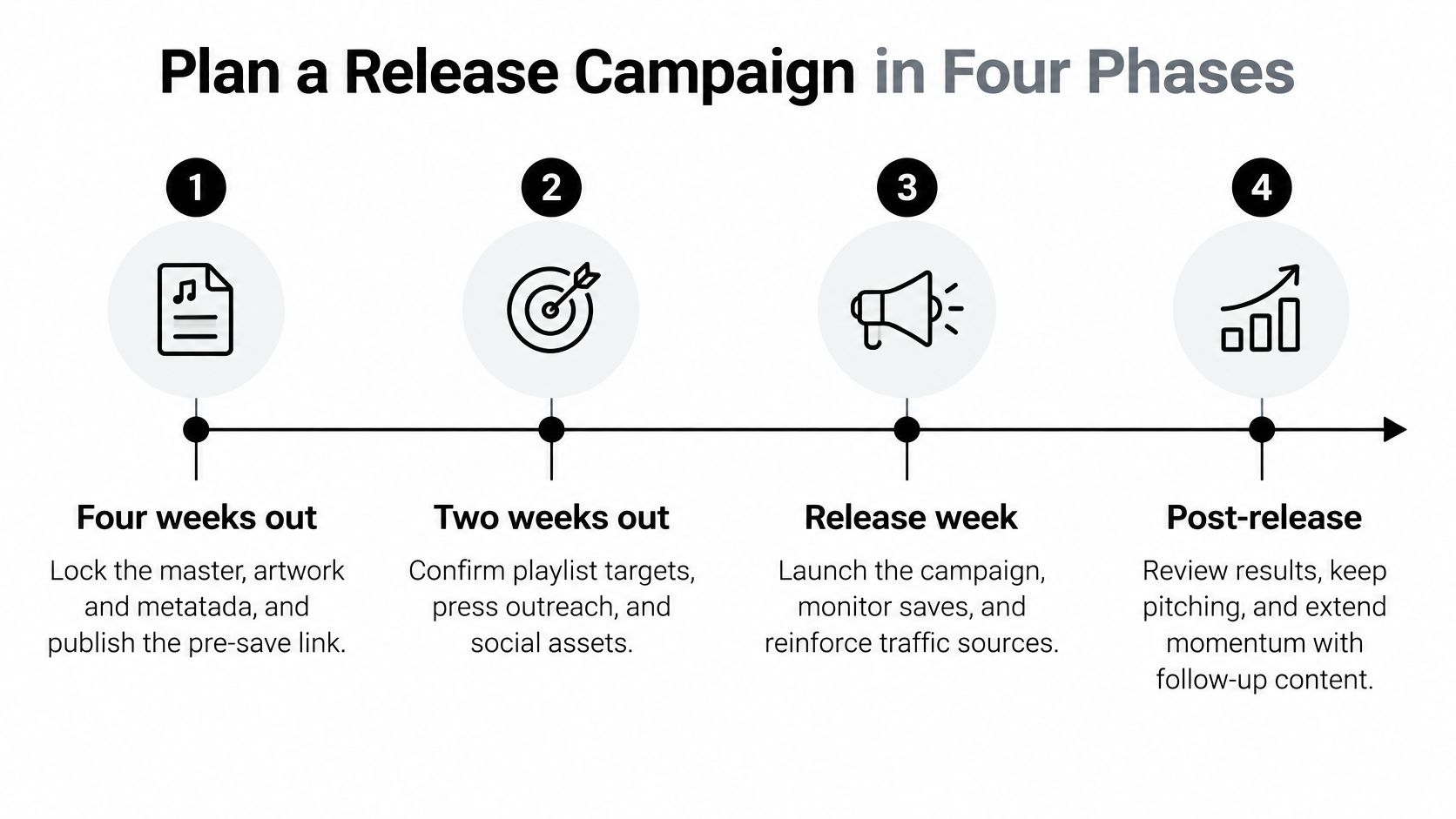
The day-seven review is the phase artists skip, and it's the one that pays. A week of data is enough to see whether saves are climbing, whether the first thirty seconds hold, and whether the clip that worked on TikTok worked at all on Reels.
Why day seven and not day one: launch-day numbers measure your existing audience and the algorithm's first guess. By day seven you're looking at what strangers did with the track, which is the only audience that grows a career.
If you want the operational detail behind each step, OohYeah's help center guides walk through publishing, profile setup and release mechanics without the guesswork.
Put every action above on a calendar with a fixed date before the campaign starts. A phase without a date is an intention.
Playlist Pitching and Editorial Placement
Placement is worth the effort because it creates a jump in listening rather than reflecting songs that were already popular. An NBER study of Spotify playlists found that adding a song to Today's Top Hits, then followed by approximately 18.5 million users, generated nearly 20 million additional streams, with the placement's monetary value estimated at roughly $116,000 to $163,000 during the study period. The same research found that New Music Friday inclusion materially increased the probability of success, including for new artists.
That's a causal result, not a correlation, and it's the reason pitching deserves real hours rather than ten minutes before bed. Here's the sequence I'd follow.
Finish the assets before you pitch anything. Final artwork, correct metadata, and a first ten seconds that survives a curator's short attention span. Curators judge the opening listen, and a track that takes forty seconds to arrive reads as a skip risk.
Submit through Spotify for Artists with the release date set correctly, at least seven days before release. The date field is the one artists get wrong most often, and a pitch attached to a release that's already live can't be routed to release campaigns at all.
Write a pitch that names the genre, the mood, the moment the song suits, and two or three comparable artists. Skip the mythology. A curator needs to place the track in a playlist within fifteen seconds of reading, and comparisons do that work faster than a story about the year you spent writing it.
After release, track the signals that came from somewhere other than the pitch. Saves, repeat plays and organic playlist adds tell you whether listeners who found the track on their own are staying. Those numbers are the honest read on whether placement created fans or just impressions.
A pitch is a request for exposure. It is not a distribution strategy, and it cannot rescue a track that listeners skip.
The limit is worth stating plainly. If the first thirty seconds lose people, an editorial add converts into a spike with a cliff on the far side, and the curator who took a chance on you remembers. Test the track with a small audience first, watch the completion rate, and only then send it to the people whose recommendation carries weight.
Short-Form Video and Social Discovery
Listeners move between platforms, and the evidence is unusually clean. When Universal Music Group recordings came off TikTok, a study of that removal covering representative samples of nearly 50% of the United States streaming market and 94% of the German streaming market, and analysing roughly 102 billion US streams and 34 billion German streams across nine weeks, found an average 2% to 3% increase in audio-platform streams. Exposure disappearing pushed listening elsewhere.
The average hides the part that matters. Older songs and tracks with less promotional support elsewhere lost streams when TikTok exposure vanished. Short-form content does its heaviest lifting for catalog that is not already prominent. If you are an independent artist with three releases and no radio play, that describes you.
The audience is already in the feed. In 2024, 82% of Gen Z respondents and 70% of millennials said they discovered new artists or music through social media or user-generated-content video sites, per Deloitte Insights. A stream that starts there is only the first step. The feed does not hand you a profile. It sends people to the single destination you choose, and that choice decides whether the play becomes someone you can reach again.
Cut three to five hook variations per track, each under fifteen seconds. Feature the lyric or the sound that makes the song recognizable in the first two seconds. A clip that needs context to work is not a hook. It is a teaser for people who already care.
Post the variations across two platforms in the same week. Pair TikTok with Instagram Reels, or TikTok with YouTube Shorts. Note which clip produces the most saves rather than the most likes. Saves are a strong signal of intent to return to a track. Likes mostly confirm the clip was easy to watch.
Point every clip to one destination with one clear action. Use the pre-save link before release and the artist page after it. Two calls to action in one caption dilute the reader's focus, so pick one. I would rather lose some views than split a caption between a pre-save and a second ask. After release, the artist page is the better landing spot because a follow or another play sits one tap from the clip.
Reuse the winning hook rather than starting from scratch. The clip that worked is now a format, and reformatting it costs a fraction of inventing a new one.
Platform behavior differs enough that the opening needs adapting. TikTok rewards a cold open with the sound already playing. Reels tolerate a half-second of context. YouTube Shorts can carry a link to the full track, which makes it the better destination when you want someone to hear the whole song rather than eight seconds of it.
If you are going to put money behind a clip, the structure of the ad matters more than the budget. Profitable video ads under 60 seconds covers how retention curves behave at that length, which is useful before you hand a platform your card details.
The trap is treating views as proof. Views and likes show that people watched the clip. They say nothing about whether anyone played the song or came back. A viral clip with flat streams is the most common failure in independent music promotion. The clip did its job only when it started a relationship you can reach without buying the same view again.
Metrics That Separate Real Fans from Passing Traffic
Total streams is the weakest number on your dashboard, because it can spike from one editorial add or one lucky clip while every listener leaves after a single play. A campaign that produces 200,000 streams and 40 returning listeners has bought traffic. A campaign that produces 8,000 streams and 400 returning listeners has bought a career.
The table below ranks what's worth watching, roughly in the order I'd trust it.
| Metric | What it signals | Healthy when | Next action if weak |
|---|---|---|---|
| Saves | Intent to return | Rising after each post or pitch | Revisit the hook and artwork |
| Repeat listens | Listener attachment | Second play within seven days | Improve the track opening or sequencing |
| Completion rate | Track holds attention | Stable or rising across sources | Shorten the intro or change the clip |
| Artist follows | Owned audience | Grows faster than total streams | Add a follow prompt to posts |
| Playlist adds from non-pitched sources | Organic curator interest | Adds appear without a pitch | Check pitch timing and metadata |
| Community joins and messages | Direct fan relationship | Steady weekly growth | Invite fans to a specific direct action |
| Paid-support rate | Monetization readiness | Rising among new listeners | Test the offer rather than adding reach |
Saves sit at the top because they're the cheapest honest declaration of intent a listener can make. Someone who saves a track has told the platform they want it again, and the recommendation system acts on that far more than on a play that ended in silence. Repeat listens go one step further: a second play within seven days means the song survived the gap between curiosity and habit.
The seven-day return is the core retention check for a campaign. Compare it by acquisition source rather than against your total. A listener who arrived through a pitched playlist and a listener who arrived through a clip are different audiences, and averaging them hides which channel produced people who came back.
Decision rule: if streams rise while saves, follows and repeat listens stay flat, you reached people but didn't build fans. Change the hook or the destination. Don't add reach.
Aggregate discovery numbers make this point vividly. TuneCore's Accelerator report credits its program with more than 21 billion new streams, 2.5 billion artist discoveries and 5.5 billion track discoveries in 2024. Those are real numbers at real scale, and none of them tells you whether a single listener played anything twice. Your dashboard has to answer the smaller question.
The doors listeners arrive through keep multiplying, which is exactly why source-level measurement earns its keep. MIDiA's research on music discovery finds TikTok is the leading discovery method among 16 to 24-year-olds, followed by YouTube, streaming services and social media, with fewer than 10% in that group discovering music primarily through television, film or personal recommendations. Radio's presence among consumers' top-three discovery methods fell from nearly half in 2022 to slightly over one-third in late 2024. Five different doors, five different kinds of listener, one blended number that hides all of it.
When Paid Ads and Pre-Saves Pay Off
Paid reach multiplies whatever the track already does. Put money behind a song that holds listeners and the spend can turn a play into a save, a follow, or a purchase. Put it behind a song people skip and you pay to teach the platform that this audience leaves.
I would not buy reach until the track has already earned a second listen from people who owe you nothing. The signals that justify a budget are local. Saves and repeat plays in the first days after release. A completion rate above your own average across the last three releases, not the rate of an artist you admire. An existing group of followers or community members, so the ad is not a cold introduction with no proof behind it. Rank those ahead of raw streams. Streams show arrival. Saves, repeats, and follows show whether anyone stayed long enough to become a fan you can reach again.
The money sits with the listeners who stay. Subscription revenue grew 9.5% in 2024 while ad-supported streaming formats grew only 1.2%, per the IFPI's 2025 Global Music Report, with total streaming revenue passing US$20 billion for the first time at US$20.4 billion. Spend should chase conversion into an owned action rather than free-tier volume. Streaming is the discovery step. A direct purchase path can sit beside it, and it does not replace the stream.
Fix the weekly budget before launch, while you are calm, and leave it alone at midnight after one good day. Build the audience from people who already saved or replayed, not from a wide interest category. Split the money. One ad set tells you whether the creative holds attention. The other tells you whether anyone you reached took an action you keep, such as a follow or a buy. When that spend needs a home, advertising on OohYeah can point a new listener from a play toward something the artist sells directly.
Write the stop rule down before the first day. Pause if saves stay flat after three days, and hold to it.
Pre-saves are the low-cost version of the same bet. They collect intent before release and give the platform an early signal on the day the track goes live. An artist with 300 pre-saves and no ad budget is ahead of one who spends $200 and has no early signal at all. Pre-saves only prove that people agreed to show up. Pair them with the retention check, or you will amplify a queue that never presses play twice.
Weak retention makes paid reach expensive fast. Skips raise the cost of every meaningful play and tell each platform you advertise on that this audience does not stick. If the second listen is missing, change the track or the hook. Do not buy a larger audience for a song that cannot keep the one it already has.
Set Up Your First Promotion Test on OohYeah
Recommendation produces an initial play. It doesn't produce attachment. A UK government-commissioned literature review on music recommendation describes systems that select from abundant catalogs using listener taste profiles, and the research it surveys on Spotify's Discover Weekly found algorithmic exposure alone generated limited attachment to newly discovered music. Heavily involved listeners showed some repeat-purchase intention. Casual listeners consumed recommendations passively.
That's the principle your first test has to encode: every promotion needs an owned action attached. Here's how to set one up.
- Pick one release, one primary channel from the channel comparison, and one secondary channel. One variable at a time is the only way to learn anything you can reuse.
- Record a baseline from your last release. Saves, repeat listens and follows, taken on the same day of the week, so this test has something to beat.
- Choose a single conversion action such as a follow, a download, a message or a merchandise purchase. One action, measured cleanly.
- Make that action obvious on your artist page. OohYeah artist pages carry Play latest release, Follow, Share artist, Radio, Shuffle and Message, so there's no ambiguity about where a new listener should land.
- Explain the buying path to your fans. They stream to discover the artist, buy something the artist makes available, and that purchase helps fund the next recording, touring and merchandise. Direct purchases add a path for fans and don't replace streaming, so position them alongside listening rather than instead of it.
- Run the test for four weeks and review on the day you set in advance, comparing each metric from the table against your baseline and noting which source produced the strongest retention.
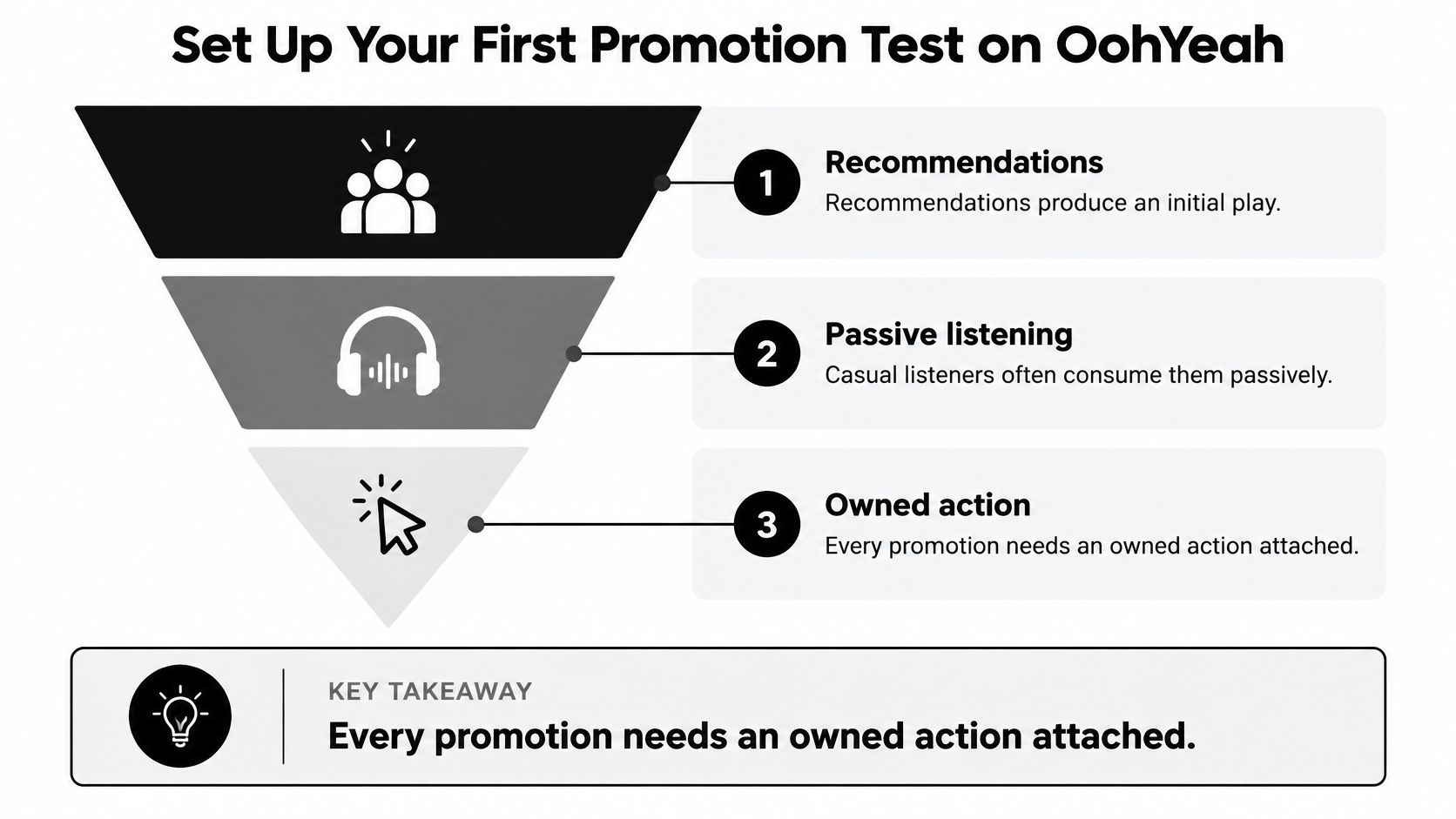
The test is small on purpose. Four weeks, two channels, one conversion action, one baseline. When it ends you'll know which channel brought listeners who stayed, and that answer is worth more than another round of posting into the void. Artists joining the platform can set up an artist profile here and have the measurement in place before the first post goes out.
Publish the calendar and the metrics table before the first post goes out. Both, in the same place, on the same day. A campaign you can't review isn't a campaign, it's a habit.
OohYeah is built for the part of this work that outlasts release week: artist pages where listeners can stream your latest release, follow you, share you, message you, and buy what you make directly instead of only renting attention from a platform. Run your next four-week test here and find out which source produced a fan rather than a play. Visit OohYeah to start your artist page and put the calendar in motion.