Band Merchandise Hats That Sell Out Fast
Learn how to design, price and sell band merchandise hats that fans love. Production, fit, pricing and OohYeah tips inside.
October 15, 2026
Music Marketplace Advisor
Buying & SellingYou've got a release coming up, a merch table to stock, and a familiar problem: shirts are easy to picture, but hats are harder to get right. A cap has to look good from across a crowded venue, fit different heads, survive repeated wear, and leave enough margin after production, shipping, and unsold inventory. Treating it as a last-minute add-on is how artists end up with attractive stock that fans don't buy.
The better approach is to manage band merchandise hats as a measurable product category. Choose a style that suits the audience, simplify the artwork for the decoration method, document the fit, test a physical sample, and track whether the hat adds to an order or replaces another item. Done properly, a cap becomes both merchandise and a durable reminder of the band long after the show.
Why Band Hats Earn Their Place on the Merch Table
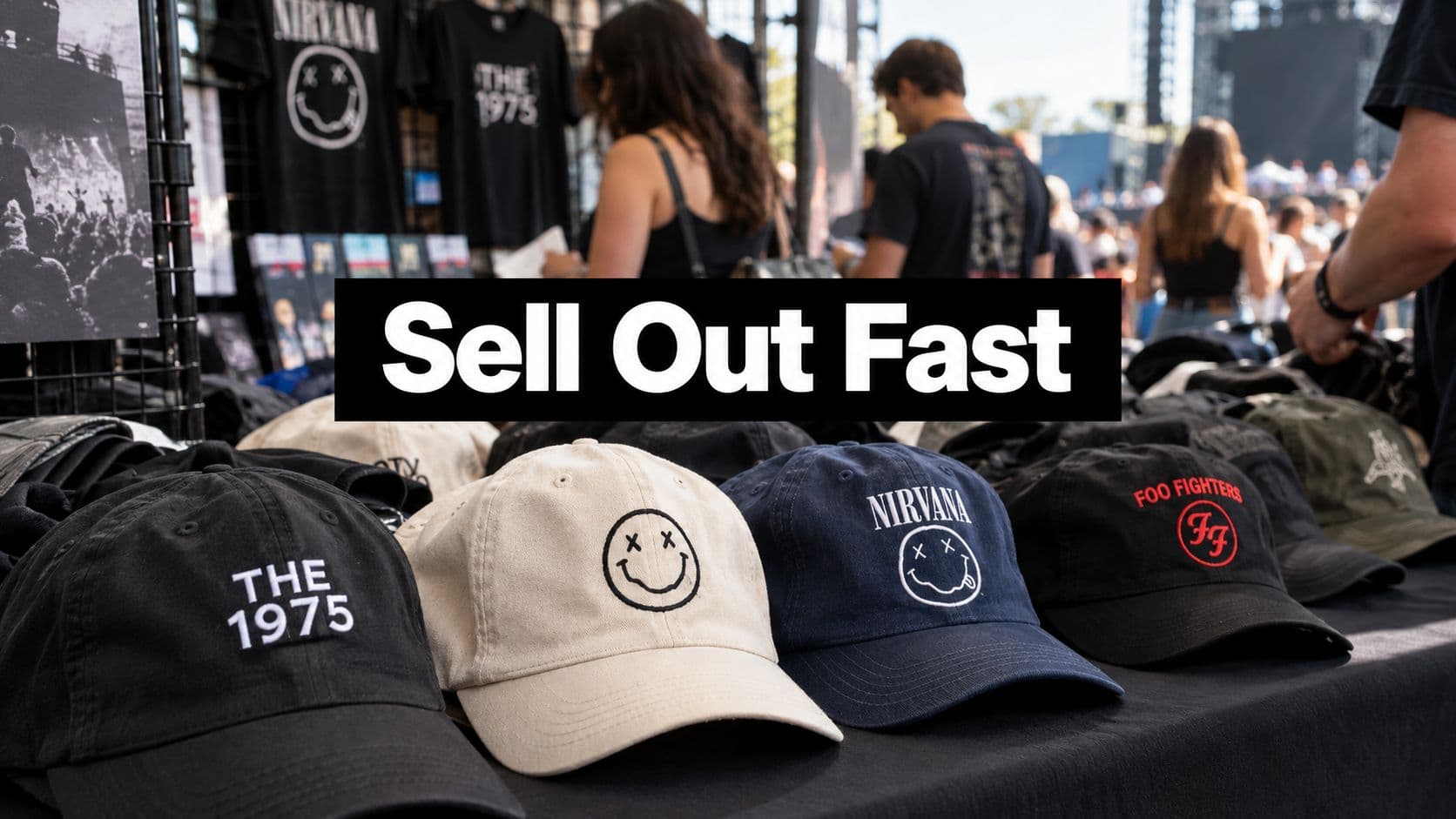
At a busy show, shirts usually draw the first glance. A fan tries on a cap, asks for a black version, and gives the table another sale from someone who does not want a second graphic tee. Hats work across seasons, cover a bad hair day, and show band identity without requiring a large front print.
The category is modest, but measurable. In 2019, hats represented 4% of all merchandise items sold at shows, with an average selling price of $34, as summarized in this concert merchandising economics overview. That placed hats behind T-shirts, at 50% of units, and long-sleeve shirts, at 5%, among the listed top-selling items. The same summary reported that apparel and accessories rose from 85% of merchandise sales in 2017 to 95% in 2019, pointing to stronger demand for items fans can wear rather than recorded media or static souvenirs.
For an independent act, a hat does not need to outsell a shirt to earn table space. It needs a distinct buyer and enough margin after the landed cost, including production, freight, fees, and likely unsold stock. A dark six-panel with restrained embroidery can serve someone who would skip a loud tour tee. A lightweight cap or trucker style may suit a hot outdoor market better than a heavy sweatshirt.
A small product with a long afterlife
A ticket is used once, and a digital download can disappear into a library. A cap stays in circulation. Each public wear creates a small brand impression through a logo, album symbol, lyric fragment, or tour mark. That visibility only helps when the hat feels wearable without the band name attached.
In 2025, hats ranked among the top ten items sold, accounting for 5.5% of units at an average price of $33, according to AtVenu's year-in-review merchandise data. The figure supports a controlled test, not a large automatic order. Record units sold, gross margin, sell-through, returns, and repeat demand before expanding the range.
Practical rule: Put one clearly differentiated hat style in the next drop, then judge it by sell-through, margin, returns, and repeat demand rather than by how quickly it sells compared with a shirt.
A headwear resource for corporate events can help compare common cap constructions and decoration approaches. Artists can also review OohYeah's artist page when considering how a physical release fits alongside music and fan communication. Include a hat when it has a clear visual role, a realistic landed-cost calculation, and a fit description fans can trust.
Designing Hat Artwork That Stitches Clean and Wears Well
A logo that looks sharp on a poster can fail on a curved front panel. Thin lines close up, small lettering becomes a dark block, and dense thread can make a soft cap feel stiff against the forehead. Start by rebuilding the design for the hat, not by sending the full-resolution artwork to a decorator and hoping the machine solves the problem.
Build the file around the cap
Create a cap-specific tech pack before requesting quotes. Include the panel count, shell fabric and weight, visor core, closure, decoration size, placement, backing, thread references, and acceptable tolerances. Add the inspection standard you expect, such as AQL 2.5, so the supplier knows how you'll assess crooked embroidery, loose threads, stains, and inconsistent placement.
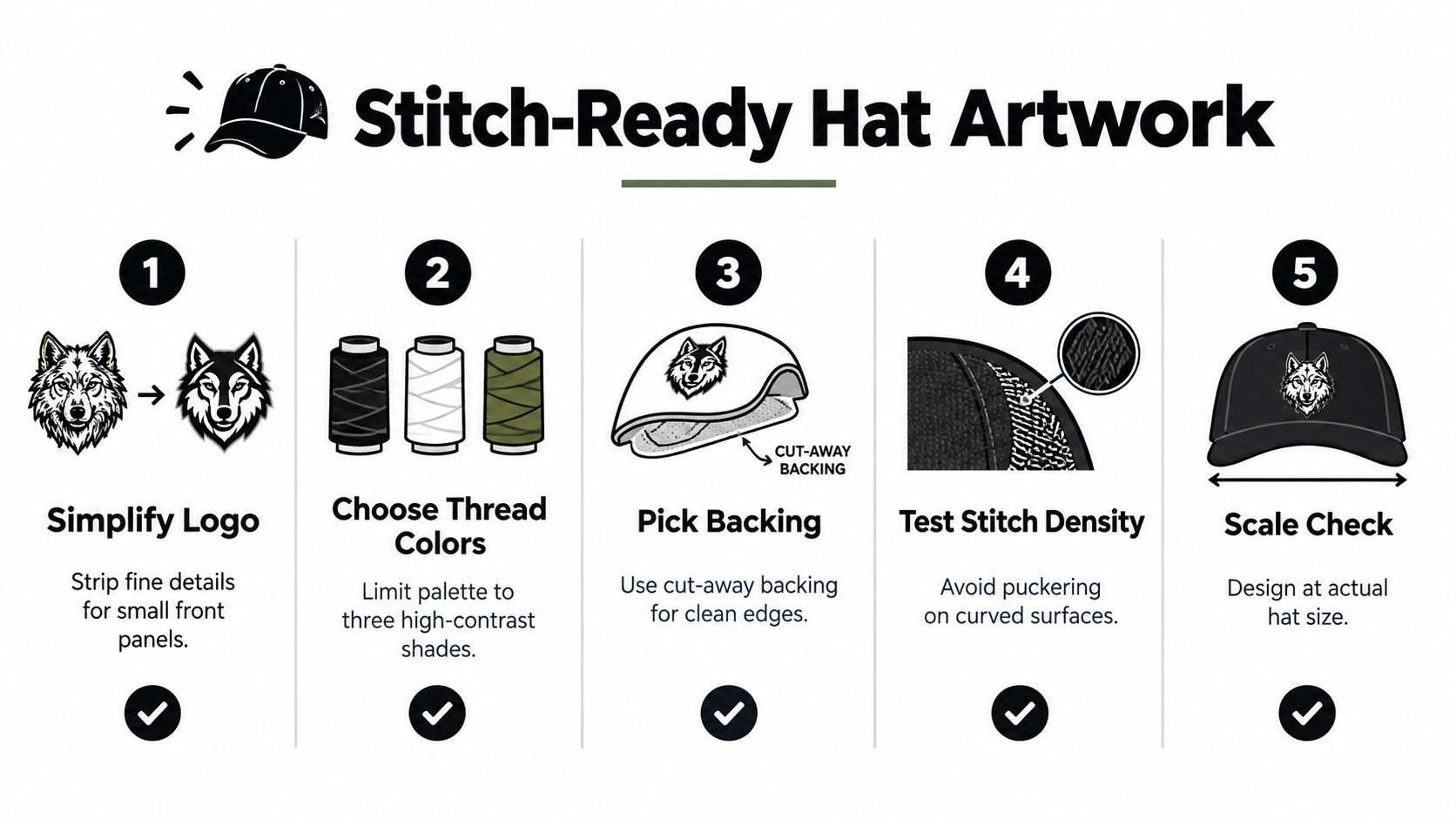
Simplify small lettering first. A compact band name usually needs heavier strokes, fewer interior details, and enough spacing to remain legible at the actual embroidered size. Print or display the artwork at production scale, then view it from normal standing distance. If the name only works when enlarged on a monitor, it isn't ready.
Use contrast with restraint. A dark crown with a light thread can read immediately, while three carefully chosen colors often outperform a crowded palette. Match the hat color to the release or tour identity, but keep at least one option easy to wear with ordinary clothing. A black, washed navy, stone, or muted earth tone can carry a strong graphic without turning every outfit into a costume.
Choose decoration for the product, not the mockup
Embroidery gives a cap texture and a premium hand-feel, but it also introduces density, stiffness, and puckering risk. A woven label can preserve fine detail with a flatter finish. A patch can create a stronger visual object, though it adds another material and attachment decision. Direct screen printing may suit a fashion-forward or distressed concept, but it needs testing on the actual crown fabric and can age differently from thread.
Stitch count affects both cost and comfort. A 6,500-stitch front logo and an 11,000-stitch logo demand different machine time and can feel noticeably different when worn. As a practical benchmark, structured six-panel caps can often support up to approximately 15,000 front-panel stitches, while unstructured caps are better limited to roughly 8,000 to 10,000 stitches with suitable backing, according to this cap tech-pack specification guide.
Ask for a physical pre-production sample before approving the bulk run. Inspect the front from several angles, rub the embroidery with a fingertip, bend the crown, try the closure, and wear it for long enough to notice pressure or stiffness. Check whether the design sits level across the seam and whether the thread color matches the approved reference under indoor and outdoor light.
A practical guide for custom hat shops is also useful when comparing transfer-based decoration with embroidery. The final tech pack should leave no major decision to interpretation. Specify the base style, artwork dimensions, decoration method, thread or ink references, backing, placement tolerance, sample approval process, and defect criteria before production starts.
How to Choose Production and Fulfillment Without Overstocking
Production route determines more than appearance. It affects minimum order quantity, landed cost, reorder speed, storage, packaging, and the number of decisions you must make when a design underperforms. For an independent band, the safest first run is usually the one that teaches you something without tying up the entire merch budget.
| Method | Best For | MOQ and Cost Signal | Durability |
|---|---|---|---|
| Embroidered blank cap | Recognizable artwork on a proven base style | Usually simpler to quote and test, with cost driven by the blank, decoration, stitch count, and shipping | Strong when the cap and backing are suitable |
| Woven label | Fine details, compact symbols, and a softer low-profile finish | Can simplify decoration, but adds label production and attachment work | Good when sewn securely |
| Sewn or heat-applied patch | Bold emblems, tour marks, and designs that benefit from a separate shape | Patch production adds a component, while the base cap can remain standardized | Sewn patches generally suit repeated wear better than weak adhesive attachment |
| Screen print or transfer | Flat graphic treatments and concepts that need a printed look | Sampling is important because crown curvature and fabric affect the result | Depends on ink, application, and washing or abrasion |
| Custom cut-and-sew | A distinctive silhouette, fabric, or panel construction | More decisions, longer development, and greater inventory exposure | Can be excellent, but only after the style has earned its complexity |
| Recycled-fiber blank | A material story that supports the artist's positioning | Compare the full landed cost and supplier documentation, not only the material claim | Varies by fabric, construction, and decoration |
The strongest first test often uses an existing cap blank with a custom decoration. It lets you focus the experiment on the artwork, color, and audience response instead of asking fans to validate a completely new construction at the same time. Custom cut-and-sew makes sense when the silhouette itself is part of the concept, but it carries more development risk.
Match fulfillment to the release
Tour inventory gives you immediate availability and avoids waiting for individual orders, but hats occupy more volume than folded shirts and need protection from crushing. Direct fulfillment gives you better control over packaging and customer data, although every parcel adds handling time. Print-on-demand can reduce inventory exposure, but quality, decoration choices, and delivery speed may be less consistent than a sample-approved supplier.
A small drop can use one color, one decoration method, and one clear reorder decision. Ask suppliers about sample timing, blank availability, decoration tolerances, replacement policy, packaging, customs handling, and whether the same base cap can be reordered later. Record the full landed cost, including production, freight, duties where applicable, packaging, payment processing, marketplace costs, and the labor needed to pack orders.
Recent venue data found that 23% of surveyed fans purchased merchandise in 2025, compared with 21% in 2024, while average merchandise spending reached $64 before tax and average items per transaction rose from 1.7 to 2.1, as reported in AtVenu's fan spending report. Those figures support testing accessories as part of a broader order, but they don't tell you how your specific audience will behave. Use a small initial run, set a reorder threshold before launch, and list the product through a music-focused channel such as OohYeah's marketplace if direct fan sales suit your workflow.
Nailing Fit and Sizing to Cut Returns and Win Trust
A hat can look perfect in a product photo and still feel wrong within minutes. “One size fits most” doesn't tell a buyer whether the crown is shallow, whether the front panel is rigid, or whether the closure leaves enough adjustment. Fit information should appear beside the design story, not buried below it.
Start with the construction. Structured crowns hold their shape and give embroidery a stable surface, while unstructured crowns feel softer and more relaxed but can show distortion around dense decoration. A low-profile cap sits closer to the head. A high-profile cap adds height and a more pronounced front shape. Neither is universally better, and genre, climate, hairstyle, and personal preference all influence the choice.
Closures also change the buying decision. A snapback uses plastic adjustment points, a strapback uses a fabric or material strap, and a fitted cap removes adjustment altogether. Measure the production sample rather than copying a supplier's generic label. Publish the usable head-circumference range in both centimeters and inches, explain where the measurement was taken, and state whether the listed range includes the closure at its loosest and tightest practical positions.
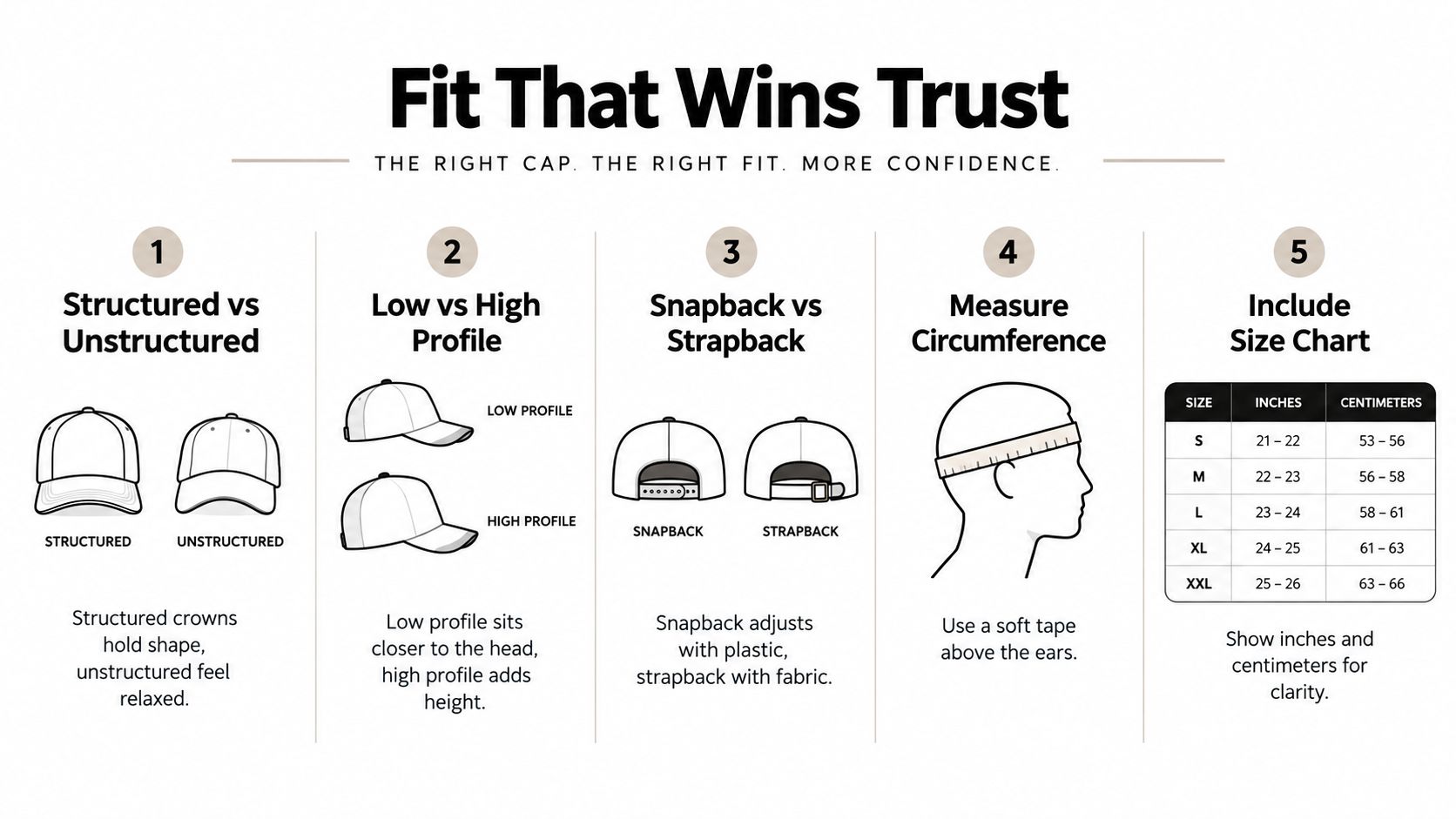
Build a fit block fans can use
Photograph the exact production sample from the front, side, back, underside, and top. Show the closure open and closed, include a close-up of the crown profile, and photograph the hat on more than one head size. Add the model's head measurement, the cap's crown depth, brim dimensions, shell composition, and a plain-language fit note such as “shallow crown” or “relaxed unstructured fit.”
Online apparel returns are commonly reported at approximately 25% to 40%, with fit among the dominant causes, and one academic e-commerce experiment reduced size-related returns by 4.3 percentage points for items judged too small and 6.6 points for items judged too large after adding size guidance, according to this e-commerce sizing experiment. The lesson is practical: better information can address avoidable exchanges, but it won't correct a badly constructed cap or uncomfortable embroidery.
Place this information in every listing:
- Construction: Structured or unstructured, plus low, mid, or high profile.
- Closure: Snapback, strapback, fitted, or another specific mechanism.
- Measurements: Head circumference, crown depth, brim dimensions, and adjustment range in centimeters and inches.
- Materials: Shell composition, sweatband details, and decoration type.
- Wear note: Shallow, deep, firm, soft, lightweight, or dense at the decorated area.
Embed the supplied fit video near the listing or buying guide so fans can see how cap shapes and measurements work in practice.
After launch, separate fit exchanges, general returns, defect complaints, and decoration failures. A fit problem needs clearer measurements or a different base style. Puckering, loose thread, or crooked placement belongs in supplier quality control. Publish the rules clearly through your return policy, and use the feedback to improve the next listing rather than hiding the problem behind vague sizing language.
Pricing Bundles and Promotions That Lift Every Order
A profitable hat price starts with the complete landed cost, not the blank cap. Add production, decoration, freight, packaging, transaction and platform costs, applicable taxes, likely replacements, and the labor needed to fulfill each order. Then set a margin that justifies the time pulled from music, touring, and customer support.
Concert merchandise data provides a useful reference point. In 2025, hats averaged $33 and represented 5.5% of items sold, while 21% of concertgoers bought merchandise and average merchandise revenue across all attendees was $10.24, according to AtVenu's year-in-review data. A hat priced in the low-to-mid $30 range can therefore work as an accessible entry product for fans who do not want a sweatshirt or jacket.
Treat that price as a starting hypothesis, not a guarantee. A cap may replace a shirt rather than add to the order, so compare orders containing only a hat with orders containing a hat and another product. Track average order value, gross margin, and units per transaction. The useful question is whether the promotion creates a larger basket or merely shifts the original buyer to a different item.
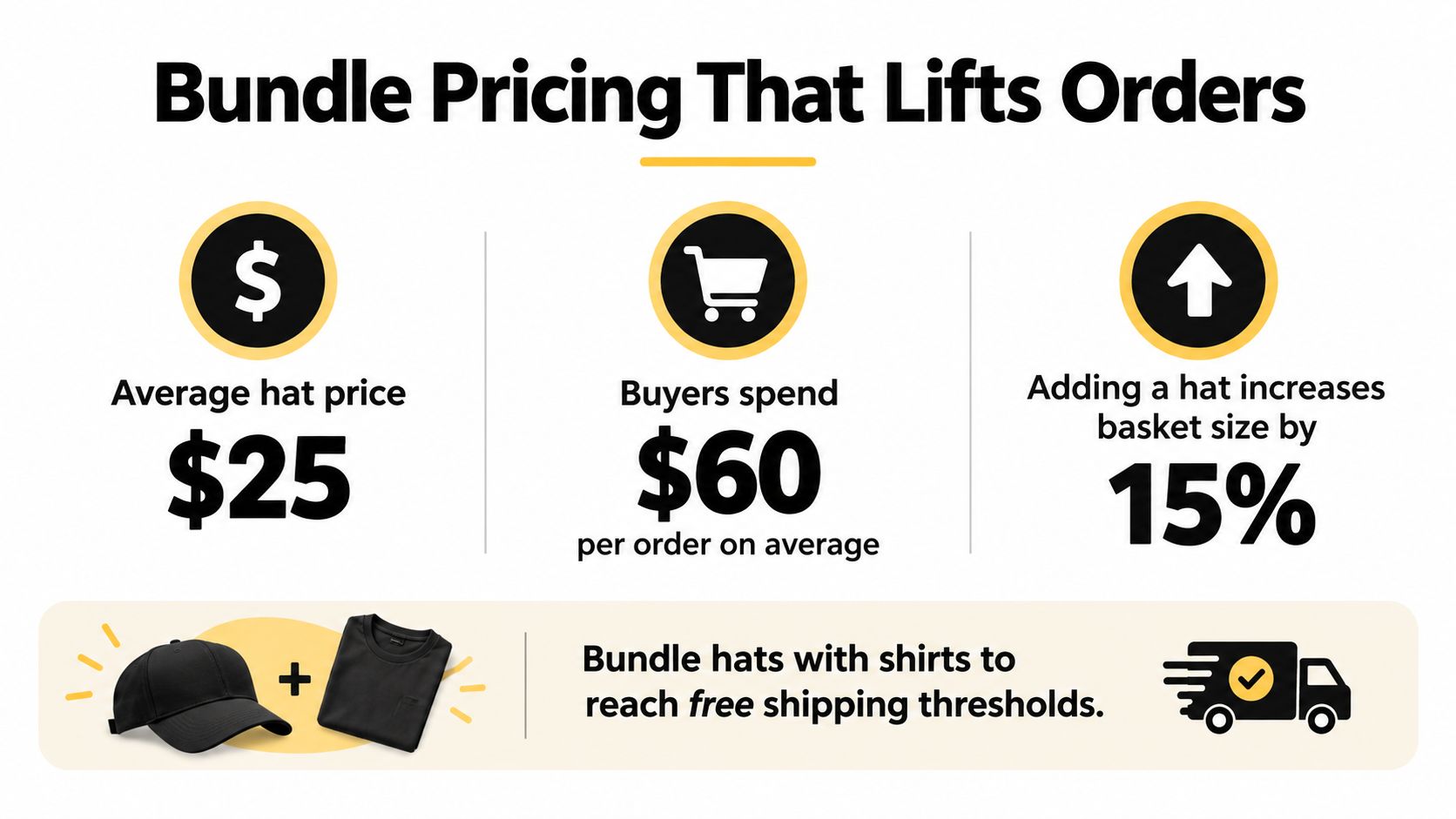
Use the hat as a deliberate add-on
A good bundle solves a clear buying problem. Pair the hat with a shirt from the same release, combine a cap with a digital album or fan-club access, or build a tour set around one visual system. Keep the saving easy to understand and protect the margin. A modest discount on a useful combination is often healthier than a deep discount that teaches fans to wait.
Scarcity should describe a real constraint. A tour color, alternate thread shade, or numbered patch can make a drop feel specific without requiring a new cap body. Define the quantity and reorder policy before calling an edition limited. Seasonality affects the offer too. A lightweight cap may suit summer outdoor dates, while a darker structured style can continue selling in colder months.
Margin check: If the bundle only works after you exclude packaging, fulfillment time, and replacements, it is not a profitable promotion. Recalculate with the complete landed cost.
Use this sequence:
- Set the standalone price from complete landed cost and the margin you need.
- Choose the companion product so the bundle feels intentional.
- Define the bundle saving while showing the original prices clearly.
- Set a shipping threshold only where a second item supports the economics.
- Promote the offer at a high-intent moment, such as a release, tour announcement, or fan-club window.
- Review order composition after the drop to see whether the hat added revenue or displaced another product.
The strongest promotion gives fans a reason to buy now without weakening trust in the regular price. A clear product story, accurate fit information, and a cap people will wear repeatedly can support repeat sales more effectively than a permanent discount.
Launch Your Next Hat Drop With Confidence
A successful hat drop doesn't begin with a social post. It begins with a sample that has passed inspection, a product page that answers fit questions, and a production decision you can afford if demand arrives slowly.
Use this launch sequence:
- Approve the physical sample. Check stitch density, thread color, panel alignment, crown comfort, closure function, brim shape, loose threads, stains, and packaging readiness.
- Lock the listing details. Show the exact cap style, decoration, fabric, head measurements, adjustment range, model measurements, and care guidance.
- Photograph the actual product. Include front, side, back, underside, crown profile, closure, decoration close-up, and worn images on more than one head size.
- Set the price from landed cost. Include every production, shipping, packaging, transaction, and fulfillment expense before deciding on margin.
- Plan the promotion. Tie the hat to a release, tour, fan-club window, or clearly defined small-batch color rather than posting it without context.
- Review the result. Track sell-through, gross margin, average order composition, exchanges, returns, defect complaints, and customer questions.
Avoid the common shortcuts. Don't approve bulk production from a digital mockup. Don't describe a cap as universal without measurements. Don't use dense embroidery on a soft crown without testing backing and comfort. Don't order additional colors before the first design proves that the audience wants the product rather than reacting to a launch announcement.
After the first release, decide whether to reorder, revise, or retire the design. A slow color with strong fit feedback may deserve a better shade. A popular design with repeated comfort complaints needs a new base cap before more inventory. A high return rate caused by unclear sizing calls for better photography and measurement copy, while crooked embroidery points back to the supplier and inspection process.
Band merchandise hats work best when they sit inside a wider direct-to-fan system. The cap should reinforce the music, give fans a wearable signal, and produce clean data about what they'll buy next. Launch one focused style, document the outcome, and let evidence shape the second drop.
OohYeah gives artists a music-focused place to sell physical merchandise directly alongside tracks, fan content, and artist communication. List your next hat with transparent pricing, clear fit details, and a focused release story by visiting OohYeah.