Choose Fan Subscriptions, Direct Sales, and Reserves for Steadier Income
Build predictable monthly income frameworks for independent musicians with fan subscriptions, direct sales, and cash reserves to weather slow months ahead.

November 9, 2026
FRANKLY with Frank Lee
More subscribers do not automatically mean steadier income. Predictable monthly income frameworks for independent musicians work best when subscriptions support a broader mix of revenue, not when an artist relies on recurring payments alone. Common mistakes include promising more exclusive content than you can sustain and creating tiers without a clear reason for fans to join.
Wanting reliable monthly earnings makes sense, especially when streaming, gigs, and other music income can fluctuate. Build a few complementary income streams, make fan subscriptions valuable and manageable, and set aside cash based on essential expenses.
This guide explains how to balance music revenue, design subscriptions fans can understand, and build a reserve for leaner months. It also covers how direct-to-fan downloads and merchandise give supporters practical ways to back your work and help you earn from the connection you have built with them.
Key Takeaways
- Combine several music income streams so one slow source doesn’t define your financial picture.
- Build fan subscriptions around an engaged audience and benefits you can deliver consistently.
- Set a cash reserve target from essential expenses, then build toward it with a steady plan.
- Use direct-to-fan downloads and merchandise to give supporters practical ways to buy from you; OohYeah! offers tools to host and sell them.
1. Diversifying income across music revenue streams
A release can earn through streaming, direct sales, licensing, live work, and teaching. Digital distribution places recordings on streaming services, but it doesn’t control how much each stream earns. OGRECORDS reported a median Spotify recording royalty of US$3.60 per 1,000 streams and a sample-weighted figure of US$3.30 per 1,000 streams for April–July 2026. Those figures are before distributor or label fees.
Separate recording income from publishing royalties. Recording royalties relate to the sound recording, while songwriting royalties are paid separately. Track both types for each release, then compare streaming with income you can actively shape. Selling downloads, licensing beats, booking performances, or teaching can reduce reliance on a single platform’s payouts.
Lessons and online courses can create repeatable income when you package a specific skill into ongoing instruction. Offer recurring lesson slots or build a course around a clear learning outcome, then reach students who want to develop that skill. Track your production time and teaching hours to keep the work sustainable alongside releases and performances.
For U.S. taxes, self-employed people generally need to make estimated tax payments if they expect to owe at least $1,000 after withholding and refundable credits, according to the Internal Revenue Service. The Internal Revenue Service lists the 4th payment as due Jan. 15, 2027. Track income and business expenses consistently; for 2026, the Internal Revenue Service sets the U.S. Solo 401(k) employee deferral limit at $24,500.
Build a simple income map: record each revenue stream, when it pays, its related expenses, and the work required to earn from it. Identify which sources can repeat without a new release or a spike in streaming. This gives you a clearer view of revenue, production costs, and where your next marketing effort may be most useful.
2. What Are Common Music Fan Subscription Mistakes?
A common mistake is launching before your audience understands what it will receive. Ask engaged listeners what would make ongoing support worthwhile, then shape benefits around what you can deliver consistently. Spotify followers may discover a release, but direct communication helps explain why a subscription offers more than a stream.
Keep the promise focused. A monthly subscription might include exclusive content, early access to a release, or a regular behind-the-scenes update. Avoid promising frequent custom work if production and marketing already fill your schedule. A simple plan you can maintain builds more trust than a crowded menu of benefits that becomes difficult to deliver.
Use predictable monthly income frameworks for independent musicians to balance subscriptions with crowdfunding, lessons, and direct sales. The best mix depends on your audience and the work you can sustain. For example, 100 supporters paying $10 per month generate $1,000 in monthly recurring revenue before applicable fees. Treat that as gross income, not spendable cash.
Pricing too low can leave little room for the time and costs behind each benefit. Pricing too high can make the value harder to explain. Offer a clear entry point, then distinguish higher tiers through meaningful access or recognition, not simply more promised work.
Patreon, Bandcamp, and other platforms may charge platform and payment-processing fees. Their fee structures vary, so calculate take-home revenue rather than treating every payment as spendable. A distributor handles music delivery, but a fan membership strategy needs its own explanation, benefits, and communication plan.
Retainers for live performances or session work should define the services, scheduling expectations, deliverables, and cancellation terms. Set the rate around the work and availability reserved, then explain the scope before accepting recurring payments. Strong predictable monthly income frameworks for independent musicians connect that clear scope with fan offers they can sustain. For direct-to-fan tools, explore ways to support your music.
3. Building a cash reserve based on necessary expenses
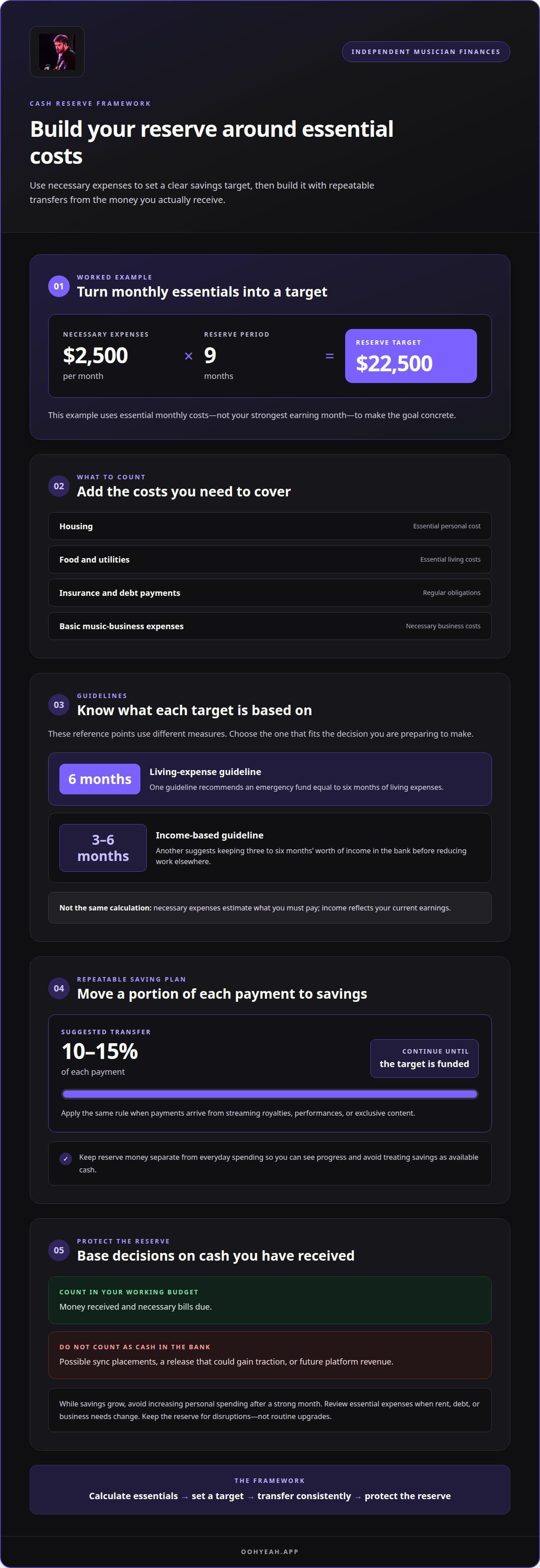
Set your reserve target from essential costs, not your strongest earning month. Add housing, food, utilities, insurance, debt payments, and basic music-business expenses. If necessary expenses total $2,500 per month, a nine-month reserve target is $22,500. That gives you a clear financial goal instead of an arbitrary savings number.
One guideline recommends an emergency fund equal to six months of living expenses. Another suggests keeping three to six months’ worth of income in the bank before reducing work elsewhere. These measures use different bases: necessary expenses estimate what you must pay, while income reflects your current earnings. Choose a target that fits the decision you are preparing to make.
Build the reserve with a repeatable transfer. Direct 10–15% of each payment to savings until the target is funded. If a month brings streaming royalties, a performance payment, or an exclusive-content payout, apply the same rule. Keeping reserve money separate from everyday spending makes it easier to see progress and avoid treating savings as available cash.
Do not count income that may arrive late or never arrive as money in the bank. A possible sync placement, a release that could gain traction, or future platform revenue should not form part of your current cash balance. Base your working budget on money received and necessary bills due; budgeting tools like Zenith Flow can make it easier to see what you can truly spend after accounting for upcoming commitments and savings. This distinction helps you make sustainable choices during an uneven career.
While the reserve grows, avoid raising personal spending after a strong month. The example of a musician choosing a $2,800 monthly paycheck while building savings shows how a steady draw can limit overspending. Review essential expenses when rent, debt, or business needs change, then update the target. Once the reserve is complete, decide how new savings should support taxes, retirement, or planned investments in production and marketing. Keep the reserve for disruptions, not routine upgrades.
4. Direct-to-fan sales and merchandise
Streaming can introduce independent artists to listeners, while direct sales give fans a way to support a record more actively. Digital downloads, physical merchandise, and exclusive experiences each offer a different reason to buy. Make every offer easy to understand, then connect it to a release, a live moment, or the story behind the music.
A simple example shows the potential scale: 1,000 fans spending $100 each per year generate $100,000 in annual revenue. That’s an illustration, not a forecast. The practical lesson is to build a community that values what you create, rather than relying only on broad reach. A smaller group of engaged supporters can respond to a focused offer.
Give each product a clear role. A digital album lets listeners own a release; a shirt or poster brings its artwork into everyday life. Pair merchandise with a release campaign and explain what makes the item meaningful to that record. Choose products that suit your audience and production capacity, so selling does not take attention away from making music.
Direct sales can also strengthen earnings. Artists can retain 100% of sales revenue from music and merchandise through the direct-sales model described here. Track sales by product and campaign, then use those results to plan future releases. Don’t treat a one-time purchase as recurring income by default. Invite buyers to follow your next release or join a fan-supported offer, while keeping every promise manageable.
Build a repeatable rhythm around your calendar: announce a release, share the story behind it, present a related product, and follow up with a community update. An artist profile can give fans a consistent place to discover music and offers. Use each campaign to learn which records, formats, and messages connect. To put direct music and merchandise sales at the center of your next release, start selling directly to your fans.
OohYeah!: Digital Music Downloads
OohYeah! gives artists a direct way to offer digital music downloads to fans. It can complement streaming and other income streams when you are ready to make a release available for direct purchase.
Artist Profile Hosting gives fans a place to find your music, while the Merchandise Marketplace supports direct merchandise sales. Exclusive Content Access can help you share material with supporters beyond a standard release. OohYeah! states that artists retain 100% of sales revenue from music and merchandise, with no commissions taken.
These tools support a simple path: present your work, give fans ways to support it, and build an ongoing connection around your music. Contact OohYeah! to discuss using its digital music downloads for your releases.
Make Your Next Release Work Harder
Start with one upcoming release. Decide how listeners can support it, what they will receive, and how the offer connects to your music. A focused plan makes it easier to see what fits your audience and apply those lessons to future releases.
Predictable monthly income frameworks for independent musicians are not one-size-fits-all. Build yours around the work you want to make and the ways fans prefer to support it. OohYeah! brings Artist Profile Hosting, Digital Music Downloads, and a Merchandise Marketplace together to help you present your music and offers directly to fans.
Ready to shape a direct-to-fan approach around your music? Contact OohYeah! to discuss your music. Keep building on your connection with listeners, one release and one clear offer at a time.
Frequently Asked Questions
What Are Common Music Fan Subscription Mistakes?
Common mistakes include launching without a clear audience need, offering benefits that take too much time, and leaving members unsure what they receive. Before opening subscriptions, write a short benefit description and set a realistic delivery rhythm. For example, promise a monthly studio note only if you can create it alongside recording, rehearsals, and release work. Clear expectations help fans decide whether membership suits them.
When Is the Best Time to Launch a Fan Subscription?
Launch when listeners already respond to your updates and show interest in supporting your work directly. A new release, tour announcement, or behind-the-scenes series can give you a natural reason to introduce membership. Share the idea with engaged fans first and note which benefits resonate. Then open subscriptions with a clear description of what members receive and how you will deliver it.
Why Do Most Music Fan Subscription Models Fail?
Fan subscriptions can lose momentum when their value is unclear or communication stops after launch. Membership needs a repeatable reason to stay, not just a sign-up announcement. Set a manageable publishing rhythm, welcome new members, and explain how their support connects to your music. Review cancellations and member feedback to spot confusing benefits or demands that take unsustainable effort.
How can musicians earn predictable monthly income from fan memberships and subscriptions?
Offer a recurring membership with benefits fans can access regularly, such as exclusive updates, early listening, or community participation. Estimate gross income by multiplying active members by the price of their chosen tier, then account for platform and payment-processing charges. Keep membership benefits distinct from one-off purchases, and communicate consistently so supporters understand what their ongoing contribution makes possible.
How much can independent musicians earn from streaming royalties per month?
Monthly streaming royalties depend on stream volume, the services listeners use, recording agreements, and any distributor or label deductions. Track recording royalties separately from songwriting royalties because they are different income sources. Treat a streaming estimate as one part of your forecast, then compare actual statements with expected payments. This helps you assess whether streaming can cover a specific expense or remains variable income.
What steps help musicians forecast monthly income and manage irregular payments?
Record each payment source, the date earned, its expected arrival date, and the business costs tied to it. Separate money received from bookings, royalties, or sales still pending. Review past income and upcoming commitments, then set a personal draw based on essential costs rather than a strong month. Update your forecast when payment dates shift, and keep tax and operating funds separate from spending money.