Pay What You Want Pricing for Independent Music: When to Set a Minimum
Explore the pay what you want pricing model for independent music, when to set a minimum, and how to balance fan access with reliable artist income.
November 29, 2026
FRANKLY with Frank Lee
A pay-what-you-want pricing model for independent music gives fans a choice: download for a set minimum or pay more to support the artist. It can make music more accessible while still giving fans a clear way to contribute. But the format alone won’t ensure strong sales or steady income.
It is reasonable to ask whether giving buyers control over the price helps artists earn more or simply leads to lower payments. The answer depends on how the offer fits the release, the relationship with fans, and the artist’s revenue goals.
Consider when this model may work, when setting a minimum can help, and what risks to weigh before choosing it. Access, audience connection, and clear framing all affect how listeners respond.
Key Takeaways
- Choose between free access, a required minimum, or a suggested contribution based on the role of the release and the support you want to invite.
- Consider how low or uneven payments could affect your income before relying on buyer-set pricing.
- Make any charitable contribution clear so fans understand how their payment supports the cause and the artist.
- Strengthen the offer with thoughtful release timing, clear messaging, and a direct connection with your listeners.
Does pay what you want pricing actually work?
The model can work when the pricing setup suits the release and audience. The trade-off is predictability: buyers gain choice, while artists accept less certain revenue.
Flexible Price Setups
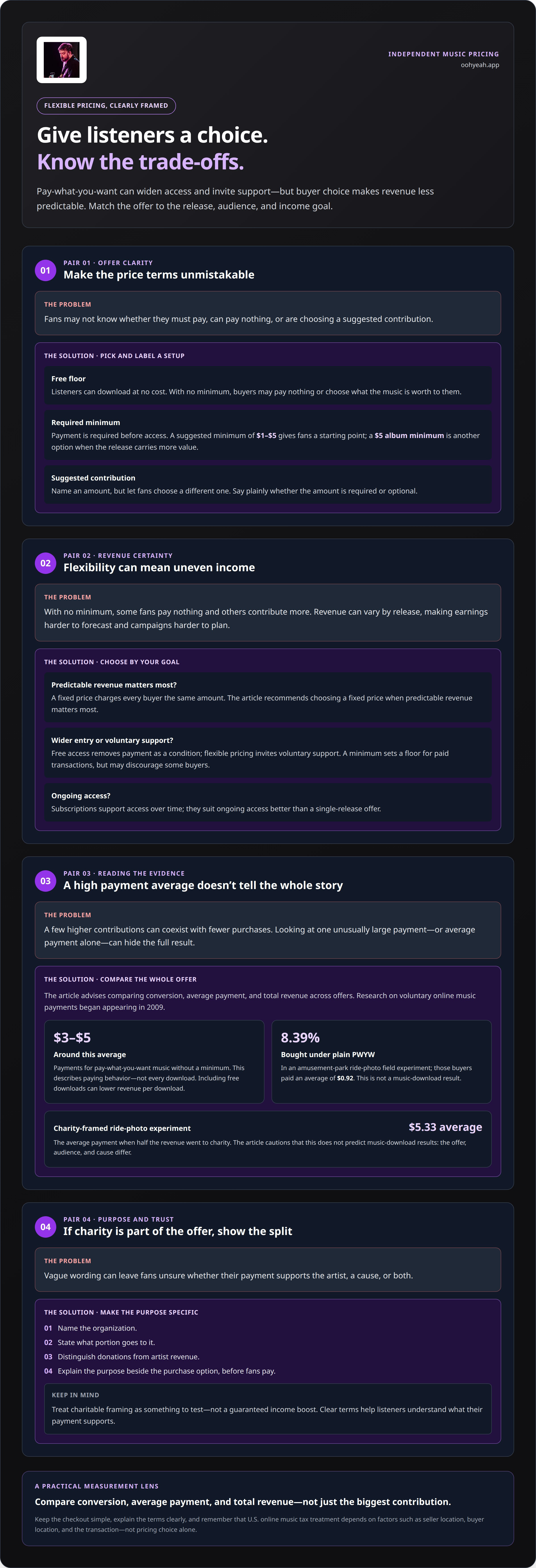
A free-floor offer lets listeners download at no cost, while a minimum-price offer requires payment before access. A suggested-price setup names a contribution but lets fans choose a different amount. With no minimum, buyers can pay nothing or decide what the music is worth to them.
For music, a suggested minimum of $1-$5 gives fans a clear starting point. A $5 album minimum is another option when the release carries more value. Keep the transaction simple, and explain whether the amount is required or optional. Independent artists can use platforms with digital-download checkout controls that allow artist-set prices; features vary by platform.
Artist Examples of Suggested and Self-Set Prices
The suggested amount gave fans a reference point without taking away their choice.
Jane Siberry has also offered songs at self-determined prices, putting buyers in control of what they pay. These examples show two ways to frame flexibility: suggest a contribution or let listeners choose freely. A clear prompt helps fans understand the terms before downloading.
Comparing Music Pricing Options
Fixed pricing charges every buyer the same amount, while free downloads remove payment as a condition. Pay-what-you-want sits between them, with or without a minimum. Subscriptions ask fans to support access over time rather than make a single purchase for a release.
Against a fixed low price, buyer-set pricing may reduce purchases: field experiments reported fewer buyers under pay-what-you-want pricing, according to the National Academy of Sciences. Choose a fixed price when predictable revenue matters most. Use free access to widen entry, or flexible pricing to invite voluntary support. A subscription suits ongoing access better than a single-release offer.
Risks of low payments and unpredictable revenue
An offer with no minimum can attract downloads without creating dependable income. Some fans pay nothing, while others contribute more, so revenue can vary from release to release. That makes earnings harder to forecast and campaign results harder to plan around.
For U.S. online music sales, tax treatment is separate from the pricing choice. Income and sales-tax rules can depend on the seller’s location, the buyer’s location, and the transaction. Pay-what-you-want pricing alone does not determine whether tax applies or who collects it.
Research on voluntary online music payments began appearing in 2009. Without a minimum, average payments for pay-what-you-want music tend to be around $3-$5. That average describes paying behavior, not what every download earns. Free downloads can pull revenue per download lower when you include them.
A field experiment on amusement-park ride photos found that 8.39% of riders bought under plain pay-what-you-want pricing. Those buyers paid an average of $0.92. The result shows why a high average among supporters can still accompany limited purchases. The National Academy of Sciences also reported fewer consumers bought under pay-what-you-want pricing than at a fixed low price.
A minimum sets a floor for each paid transaction. It can reduce downloads with no payment, but may also discourage some buyers. To encourage higher payments, explain what the music means to you, suggest a contribution, and connect the purchase to a clear benefit. Compare conversion, average payment, and total revenue across offers instead of judging by one unusually large contribution.
A clear digital download offer can make the payment choice easier to understand.
Charitable contributions and buyer-set pricing
Buyer-set pricing can let fans pay according to their means or appreciation. A charitable element gives them another reason to contribute, but artists should explain how payments are divided. Name the organization, state what portion goes to it, and distinguish donations from artist revenue. Clear terms show listeners what their payment supports.
Music examples show that flexible pricing has taken different forms. In 1980, Keith Green offered So You Wanna Go Back to Egypt through Last Days Ministries using a pay-what-you-want mail-order coupon. Jeff Rosenstock began releasing music through Quote Unquote Records in 2005, offering downloads free with donations optional. These approaches separate access from payment, giving listeners a direct choice.
Wheatus moved to pay-what-you-want pricing in 2008 for past and future albums where the band held the rights. That example shows how artists can apply buyer-set pricing across a catalog, rather than limiting it to one launch. For a charitable release, keep the purpose specific: explain whether the contribution supports a cause, the artist, or both.
One amusement-park photo experiment found an average payment of $5.33 when half the revenue went to charity. This result illustrates how a stated charitable purpose can shape payments, but it does not predict music-download results. The offer, audience, and cause all differ. Treat charitable framing as a choice to test, not a guaranteed income boost.
Start with a defined split and a concise explanation beside the digital purchase option. For example, say that a portion of each payment supports a named cause, then explain how the rest supports the release. Avoid vague wording such as “proceeds benefit charity” when fans need to know what that means. A buyer-set price works best when listeners can understand its purpose before paying.
Small contributions can also add up to more than expected. That single example does not establish a typical result, but it illustrates why artists may leave room for supporters to give more.
Factors that can support a successful pay-what-you-want model
A pay what you want pricing model for independent music works best when the offer has a clear purpose. Decide whether the release should introduce new listeners to your music, reward longtime fans, or fund a creative project. That purpose shapes the message and helps fans understand why you chose flexible pricing over a fixed amount.
Give listeners a concrete picture of the work behind the music. Mention a distinctive recording choice, the story behind a track, or what sets this release apart from earlier work. For example, explain why a live session captures a sound a studio recording could not, or highlight the musical background behind your arrangements—whether developed independently or through private lessons at alitalakepianostudio.com. Specific details help fans connect their contribution to the music.
Keep the purchase terms straightforward. State whether payment is optional or required, and describe added access only if the offer includes it. The pay what you want pricing model for independent music should make the exchange clear before checkout. Fans can then decide freely without mistaking a contribution for a promise of extra content.
Run a focused experiment rather than changing everything at once. Keep the release description consistent while testing a different suggested amount or payment prompt on a later offer. Compare downloads, paying buyers, average payment, and total revenue. Each measure answers a different question, so one generous payment is not proof that the overall approach works.
Make support easy to understand and share. Place the release details beside the payment choice, and give fans a concise line they can pass along. If listeners respond to a personal note more than a generic prompt, carry that insight into future releases. An artist profile can bring your music and its context together for fans.
OohYeah!: Digital Music Downloads
OohYeah! gives independent artists a place to share music through digital downloads and connect with fans. If you are considering flexible pricing, an artist profile can bring your release and its story together, while exclusive content offers supporters another way to engage.
Artists retain 100% of sales revenue from music and merchandise. Use digital downloads when you want to offer releases directly, and consider the Merchandise Marketplace when physical items complement the music. OohYeah! supports the connection between your work and the listeners who choose to support it.
If this is the right fit for your release, contact OohYeah! to discuss your next step.
Make your next release work for you
Your next release can help strengthen the relationship between you and your fans. Choose a pricing approach that reflects what you want the music to do: welcome new listeners, deepen support, or create a sustainable path for your work. A pay what you want pricing model for independent music should suit your audience and goals, not follow a trend for its own sake.
Use your next release as a focused test. Decide what you want fans to understand, make the offer clear, and use what you learn to shape future releases. You do not have to use the same approach for every song. Each choice can help build a more direct connection with the people who value your work.
OohYeah! can support artists building direct connections with listeners. Contact OohYeah! to discuss pricing and explore a next step for your music.
Frequently Asked Questions
What does PWYW mean?
PWYW means “pay what you want,” a pricing approach where the buyer chooses the amount. The artist may set a required minimum, suggest a contribution, or let listeners choose freely, including paying nothing. Before a fan downloads, the offer should make clear which arrangement applies and whether payment is required.
How does pay-what-you-want pricing work for independent music?
An artist offers a release through a sales page where listeners choose an amount under the stated terms. For example, a musician might let fans enter an amount above a required minimum or choose any amount for a download with no minimum. The checkout records the transaction, and the artist can review sales and downloads to understand how listeners responded.
How much do fans typically pay for pay-what-you-want music downloads?
Without a minimum, average payments for pay-what-you-want music tend to be around $3-$5. That figure describes the average payment, not every download or every release. Some listeners may pay nothing, while others contribute more. For planning, separate paid transactions from free downloads, then compare total receipts with the number of downloads.
How can musicians encourage fans to pay more without discouraging purchases?
Give fans a clear reason to support the release, such as a short note about its creation or the next project their purchase helps fund. Make the download terms easy to understand, and do not make optional support sound compulsory. A suggested contribution can guide fans, while a lower entry point keeps the choice accessible.
What are the risks and drawbacks of pay-what-you-want music pricing?
The main risk is uneven income: some listeners may download without paying, and paid amounts can vary. A minimum can protect the value of each sale, but may turn away buyers who would have paid less or downloaded for free. Another risk is treating a few generous contributions as a reliable pattern. Judge results across the full release campaign.
How do independent artists measure whether pay-what-you-want pricing is profitable?
Track paid transactions, total downloads, gross receipts, and average payment per paying buyer. Also calculate revenue per download by including free downloads in the total. Compare those measures with the costs of creating and promoting the release. A format can have a high average payment but weak overall returns if few listeners buy.