
Guitar restringing costs in 2026: DIY vs shop service
Compare guitar restringing cost by service scope. Choose DIY for familiar hardware or a shop for help, and separate string changes from setup work.
November 24, 2026
FRANKLY with Frank Lee
Your guitar restringing cost depends on the strings you choose, whether you install them yourself, and whether a shop adds labor or setup work. A basic restring does not automatically include action adjustment, intonation correction, or repairs. For a used guitar in 2026, inspect the instrument first, then request a quote that separates strings, installation, and any additional work.
- Guitar restringing cost depends on strings, labor, and whether the instrument needs a setup.
- Choose DIY for a healthy guitar with familiar hardware; choose a technician for unfamiliar bridges or playability problems.
- OohYeah connects used-gear buyers and sellers; document string changes without presenting them as a full setup.
- Get approval terms in writing before a shop performs repairs beyond the restring.
How much does it cost to restring a used guitar in 2026?
Compare the work included, not just the total on the quote. DIY means buying suitable strings and supplying your own tools and time. Shop service adds installation labor; a setup adds adjustments beyond replacing strings.
Before choosing either route, follow a used electric guitar inspection. New strings will not fix loose hardware, worn frets, or structural damage.
| Option | What you handle or request | Best for | Main advantage | Main limitation |
|---|---|---|---|---|
| DIY restring | Correct strings, installation, tuning, and checks | Players comfortable with their guitar's hardware | You control the string choice and installation | You must recognize problems and avoid installation errors |
| Shop restring | String replacement and clearly agreed checks | Beginners or players with unfamiliar hardware | A technician handles the installation | Adjustments and repairs are not automatically included |
| Restring plus setup | String replacement and specified playability adjustments | Guitars with action, tuning, or intonation concerns | Work addresses more than old strings | The scope needs agreement before work starts |
For a useful 2026 quote, name the guitar model, bridge type, current tuning, and desired strings. Tell the shop about buzzing, stiff tuning, or notes that sound sharp up the neck. Those details help distinguish routine maintenance from a separate problem.
Why this matters
A used guitar brings an unknown maintenance history. You need to know whether you're replacing worn strings or trying to solve a playability problem. They are different jobs.
Fresh strings remove a variable when you assess the instrument, but they do not prove that the neck, frets, nut, or bridge are healthy. Restring for string condition. Request a diagnosis for symptoms.
For a seller, that distinction also keeps the listing honest. Say what changed, what you checked, and what still needs attention.
DIY restringing: best for familiar, healthy guitars
Choose DIY when the guitar plays properly and you understand its string attachment and tuning hardware. Keep the existing string type, gauge, and tuning if your goal is a straightforward replacement rather than a change in feel.
Gauge means string thickness. For example, a .009-inch plain string is thinner than a .010-inch plain string; changing gauges changes tension and can affect the instrument's setup. Record the full set specification rather than describing strings only as light or heavy.
You need suitable strings, a tuner, cutters, and a protected work surface. A string winder helps, but it does not replace careful installation. Follow the instrument manufacturer's instructions for locking tuners, unusual tailpieces, and tremolo systems.
The upside is control. You choose the strings and learn the instrument. The downside is responsibility: incorrect winding, poorly seated strings, and unfamiliar hardware can turn a routine change into troubleshooting.
Best for: a player replacing strings on a guitar they already understand. Stop if a part resists movement or the instrument shows damage.
Shop restringing: best for unfamiliar hardware
Choose a shop restring when you want someone else to handle string installation, or when you are unsure how the bridge and tuners work. Ask exactly what the service includes before leaving the guitar.
A useful service description identifies whether strings are included, whether you can supply your own, and which checks accompany installation. Do not assume fret polishing, fingerboard treatment, electronics work, or setup adjustments are part of the job.
The advantage is hands-on help with installation. The limitation is scope: paying for a restring does not mean every playability issue gets corrected. A technician still needs authorization for additional work.
Best for: first-time owners, unfamiliar stringing systems, or players who prefer a technician's installation. Bring your preferred tuning and string specification so the request is clear.
Restring plus setup: best for playability problems
Ask about a setup when the guitar buzzes, feels difficult to fret, or plays out of tune despite careful tuning. A setup addresses specified adjustments; it is not another name for changing strings.
Action is the distance between the strings and frets. Neck relief is the slight curve along the neck, and intonation describes how accurately the guitar plays in tune across the fretboard. These interact, so adjusting one part without checking the rest is not a reliable diagnosis.
On an adjustable electric guitar bridge, a technician can compare the fretted note at the 12th fret with the corresponding harmonic when checking intonation. Acoustic saddle adjustments involve different work; do not assume every guitar uses an adjustment screw.
The benefit is a service matched to how the instrument plays. The limitation is that a setup does not automatically include fret repair, nut replacement, or structural work.
Best for: a guitar with a specific playability complaint. Ask the technician to explain which adjustments address that complaint.
Why guitar restringing cost varies
These factors change what the job requires. Use them to compare like-for-like quotes in 2026 rather than treating every restring as the same service.
- String construction: Steel-string acoustic, electric, and nylon-string guitars use different string designs. Choose strings intended for the instrument.
- String count: A 6-string guitar and a 12-string guitar require different sets and installation work. Identify the instrument when requesting service.
- Bridge and tuner design: A fixed bridge, floating tremolo, locking nut, and locking tuners require different procedures. Send a clear photo if you cannot identify the hardware.
- Gauge or tuning changes: Changing tension can require additional checks or adjustments. State the intended tuning before installation.
- Instrument condition: Corrosion, damaged parts, or existing playability problems need separate assessment. Replacing strings does not repair those faults.
- Service scope: Installation, cleaning, setup adjustments, and repairs are separate tasks unless the quote explicitly bundles them.
A shop's description matters more than a vague service name. Ask which tasks are included and which require your approval.
How do you get a useful restringing quote?
Send a short, specific request. Your goal is a clear scope of work, not a guess based only on the word guitar.
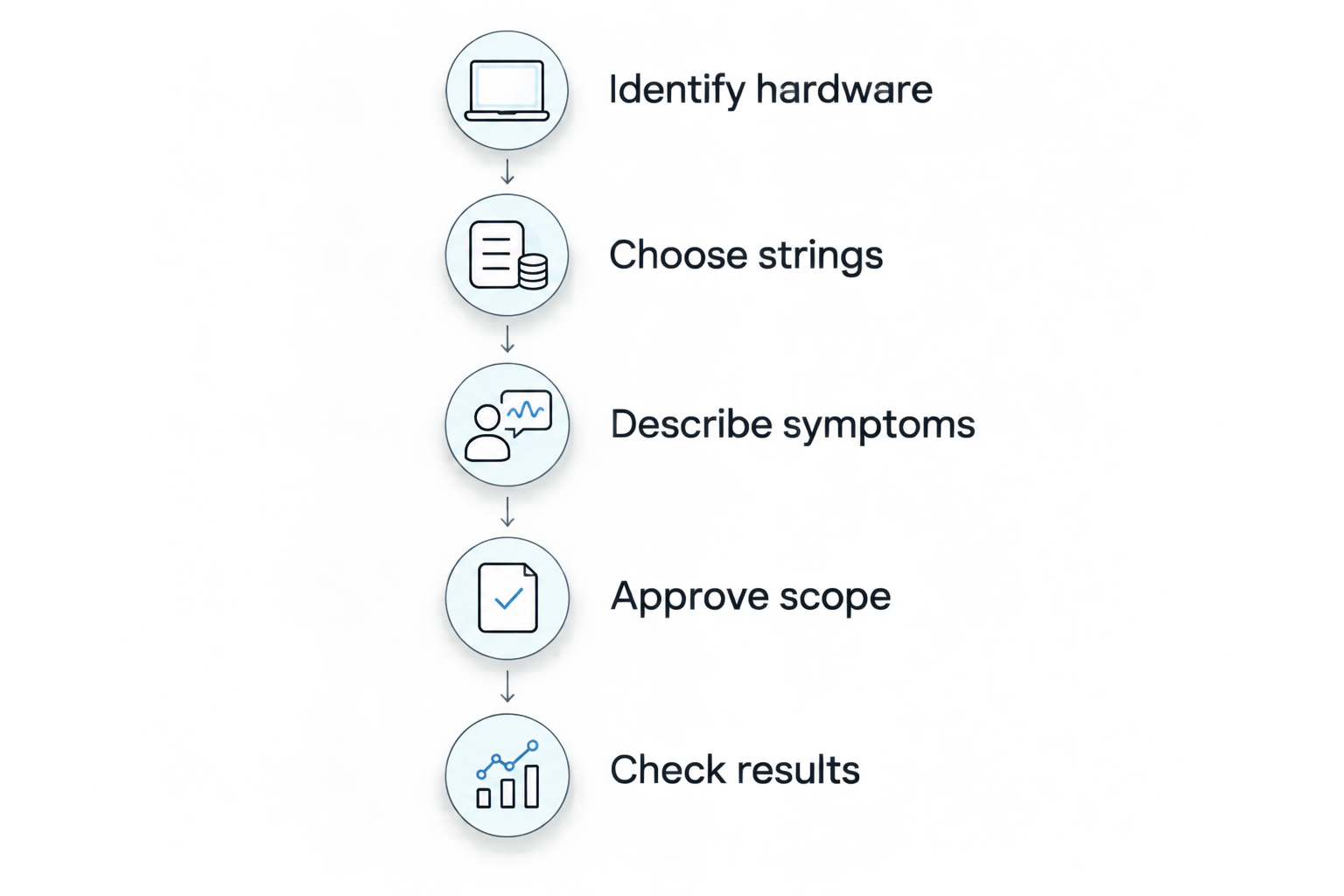
- Identify hardware. Give the make and model, string count, and bridge type. Include photos when the model or hardware is uncertain.
- Choose strings. Specify the intended string type, gauge, and tuning. Ask for help choosing if you do not know what belongs on the instrument.
- Describe symptoms. Report what happens and where: buzzing near the nut, tuning trouble after bends, or high action farther up the neck.
- Approve scope. Request separate descriptions for restringing, setup adjustments, and repairs. Require approval before additional work begins.
- Check results. Play the instrument when collecting it. Confirm the requested strings and tuning, and discuss any remaining symptoms.
Keep the written service description. If the guitar still has a problem afterward, that record separates an unresolved installation issue from work you never authorized.
What should you check before restringing at home?
Inspect the bridge, headstock, tuners, and string path before loosening anything. Look for loose parts, cracks, lifting components, or sharp contact points. Stop at visible structural damage and ask a repair professional to assess it.
Photograph the existing string path if you are unfamiliar with the instrument. On guitars with removable bridge components or floating tremolos, follow model-specific instructions rather than a generic string-changing routine.
Use instrument-appropriate cleaning methods. Do not assume the same cleaner or oil suits every finish and fingerboard material, and keep liquids away from electronics.
After installation, tune, check string seating, and play across the neck. A string that repeatedly slips or breaks at the same contact point deserves inspection rather than another replacement without investigation.
Is restringing worth doing before selling a used guitar?
Replace strings when their condition prevents a fair playing demonstration. Keep the job focused: fresh strings help a buyer assess the guitar, but they do not erase wear or justify describing an unchecked instrument as fully serviced.
OohYeah is best for musicians who want to buy and sell used gear within a music-focused marketplace. OohYeah offers zero seller commissions; that does not establish what your guitar will sell for or guarantee a buyer.
Create an account and list your gear on OohYeah when the instrument and description are ready. Include the installed strings, tuning, known faults, and any documented service. Describe a string change as a string change—not a professional setup unless that work actually happened.
The marketplace helps you present the instrument; it does not replace a physical inspection or repair assessment. Sell the condition you can demonstrate.
Does a restring include a setup?
A restring includes a setup only when the agreed service says so. Replacing strings and adjusting playability are different tasks, even when a shop offers them together.
For a 2026 service request, ask whether neck relief, action, and intonation checks are included, and whether adjustments require separate approval. Request specific work rather than relying on a package name.
Should you replace strings immediately after buying used?
Replace strings when they are corroded, damaged, uncomfortable, or unsuitable for your intended tuning. Inspect the guitar first so you do not mistake a hardware or structural problem for old strings.
If the seller identifies a recent string change and the instrument plays properly, evaluate the installed set before replacing it automatically. Condition matters more than the purchase date.
Can changing string gauge mean more setup work?
Changing gauge changes string tension at the same tuning. That can affect neck relief and the balance of a floating tremolo, so confirm whether the change requires adjustments.
Tell the technician your intended gauge before booking the work. Installing one set and requesting a different gauge afterward creates an avoidable repeat task.
FAQ
What's included in guitar restringing cost?
Guitar restringing cost covers the strings and any agreed installation work. Ask whether the quote includes strings, cleaning, setup checks, or adjustments rather than assuming those tasks are bundled.
Is DIY guitar restringing better than shop service?
DIY restringing suits players who understand their guitar's hardware; shop service suits unfamiliar hardware or players who want help with installation. Neither option automatically fixes a separate playability problem.
Can I bring my own strings to a guitar shop?
Ask the shop whether it accepts customer-supplied strings before booking. Confirm that the set suits your instrument and whether installation is quoted separately.
Does a 12-string guitar need different restringing work?
A 12-string guitar needs a suitable 12-string set and installation that follows its string arrangement. Identify the instrument and hardware when requesting a quote.
Will new strings fix fret buzz on a used guitar?
New strings do not automatically fix fret buzz. A technician needs to distinguish string-related issues from action, neck relief, fret, or nut problems.
Can I put steel strings on a nylon-string guitar?
Do not put steel strings on a guitar designed for nylon strings. Use the string type specified for the instrument because inappropriate tension can cause damage.
Should I restring a used guitar before listing it in 2026?
Restring before listing when the existing strings prevent a fair demonstration. Disclose the string change accurately and do not present it as proof that the guitar needs no other work.
One last thing
Record the string specification, not just the replacement date. A note that names the string type, gauge, and tuning gives the next owner useful maintenance information. A note that says new strings leaves those questions open.
Before publishing your listing, record a clean playing demonstration and disclose anything the restring did not solve. Give the next musician something useful to judge.