Music store trade-in vs private sale: how to compare offers
Music gear trade in vs private sale: compare net proceeds, store credit, shipping, and seller effort. Choose the offer that fits your next gear move.
November 24, 2026
FRANKLY with Frank Lee
Choose a music store trade-in when the written offer and simpler handoff beat what you expect to keep from a private sale; choose a private sale when the extra proceeds justify handling the listing, payment, and delivery yourself. Compare cash with cash—not store credit with an optimistic asking amount—and include transaction costs before deciding.
- Music gear trade in vs private sale comes down to net proceeds, usable store credit, and seller effort.
- A store trade-in suits sellers who prefer a negotiated handoff over managing a buyer.
- A private sale gives you control over the listing but leaves you responsible for completing the transaction.
- OohYeah is best for music gear sellers seeking a marketplace with zero seller commissions.
OohYeah is best for music gear sellers seeking a marketplace with zero seller commissions. That removes seller commission from the comparison, not the need to check payment costs, delivery arrangements, and transaction terms.
Music gear trade in vs private sale: how do you compare offers?
Compare what you keep, what you must spend, and what work remains. For your 2026 upgrade, put both routes on the same worksheet before accepting an offer or handing over your instrument.
| Decision point | Music store trade-in | Private sale |
|---|---|---|
| Best for | Sellers who prefer dealing with a store | Sellers willing to manage their own transaction |
| Main advantage | You can negotiate the old-gear handoff alongside the replacement purchase | You control the listing, negotiation, and buyer selection |
| Main limitation | Credit ties the proceeds to that store when the offer is credit-only | You handle inquiries, payment verification, and delivery |
| Amount to compare | Written cash offer or usable trade credit | Agreed sale amount minus seller-paid costs |
| Evidence to request | Inspection result, deductions, and credit conditions | Comparable completed sales and the buyer's agreed terms |
| Before committing | Separate the trade allowance from the replacement deal | Confirm payment and document the gear's condition |
A trade allowance is the amount a store assigns to your old equipment toward another purchase. It is not automatically a cash offer. Ask which one you are receiving.
Why this matters
A bigger headline offer does not automatically fund more of your next setup. Credit you cannot use, an expensive shipment, or a replacement purchase you did not need can change the result.
Set your 2026 upgrade budget around the complete transaction. Your goal is not to win a negotiation over the old pedal, keyboard, or guitar; it is to finish with the right equipment and an acceptable amount left to pay.
Music store trade-in: best for a coordinated gear swap
Choose a store trade-in when the complete deal suits your replacement plan. Bring the exact equipment you want assessed, describe known faults, and ask the store to explain its offer after inspection.
Request separate figures for a cash purchase and a trade allowance if the store offers both. Then ask whether the replacement item's terms change when a trade is involved. A verbal promise about the overall deal is harder to compare than an itemized written offer.
The advantage is a defined counterparty: you negotiate with the store rather than creating a listing and finding a buyer. The limitation is control. The store decides what it accepts and what it offers; credit-only terms also limit where you spend the proceeds.
Before accepting, confirm:
- Whether the offer is cash, store credit, or conditional trade credit.
- Whether the amount remains subject to another inspection.
- Which accessories must accompany the equipment.
- Whether credit has an expiration date or purchase restrictions.
- What happens if the replacement transaction does not proceed.
Do not assume every store handles these points alike. Get the actual terms for your gear.
Private sale: best for control over your transaction
Choose a private sale when you want to set the asking amount and negotiate directly with a buyer. You also take responsibility for the description, condition evidence, communication, and handoff.
For your 2026 comparison, use completed sales of genuinely comparable equipment where those records are accessible. An unsold listing tells you what someone wants—not what a buyer has paid. Match the exact model, condition, included accessories, and modifications before treating another sale as evidence.
OohYeah's music gear marketplace has zero seller commissions. Create an account and list your gear if you want to pursue that route, but do not treat zero seller commission as a promise that every part of selling is cost-free.
The upside is control over your terms. The downside is the work: photographing the gear, answering questions, screening offers, verifying payment, and arranging collection or shipping. A listing is not a completed sale, and an interested message is not money you can spend.
Keep the equipment until the agreed payment is verified through the payment service itself. Do not rely on a screenshot or an email alone.
Compare offers in a repeatable order
Use this sequence for every piece of gear. It keeps an attractive trade allowance from distracting you from the replacement purchase and keeps an optimistic private-sale estimate from pretending to be a firm offer.
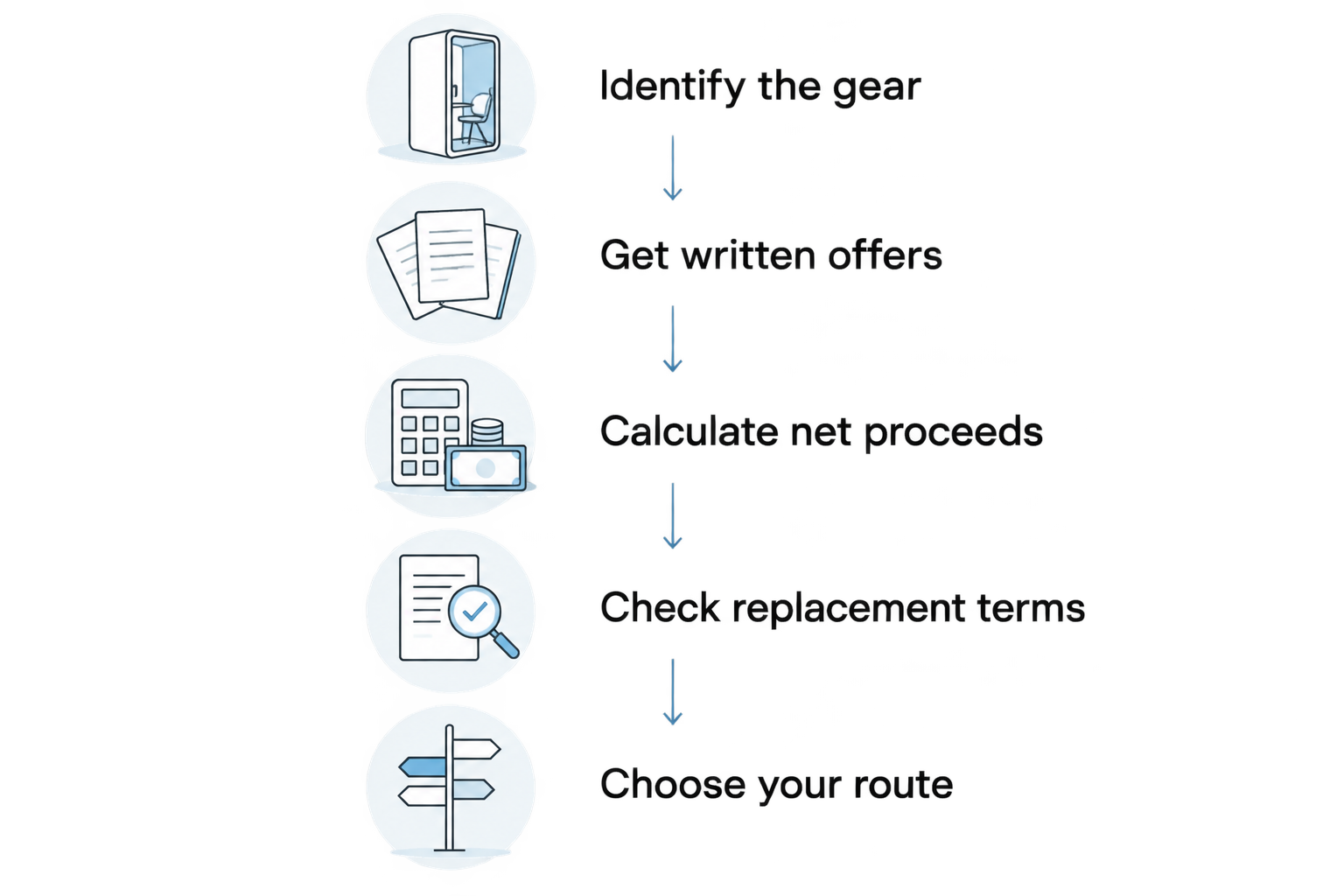
1. Identify the gear
Write down the exact manufacturer, model, version, and identifying details. Photograph the serial number for your records, and note modifications, repairs, faults, and included accessories.
Test the functions you intend to describe as working. For an instrument, that includes its relevant controls and outputs; for studio equipment, check the connections and functions you can test safely. Describe anything untested as untested—not as working.
2. Get written offers
Ask the store to separate its assessment of your equipment from the replacement purchase. Record any deductions and conditions rather than remembering only the headline allowance.
For a private buyer, confirm the agreed amount, included items, delivery method, and who pays each transaction expense. Until a buyer agrees, keep your expected private-sale proceeds labeled as an estimate.
3. Calculate net proceeds
Net proceeds means the money left after the seller-paid costs of completing the sale. Build the calculation from actual terms rather than applying a made-up percentage.
Private-sale net proceeds = agreed sale amount minus seller-paid transaction costs, packing, shipping, and any agreed preparation costs. For a store trade, compare the cash offer or the credit you will actually use, less any deductions stated in the offer.
Do not subtract the same expense twice. If shipping is already included in your seller-paid costs, it does not belong in another deduction line.
4. Check replacement terms
Compare the replacement purchase independently. Record what you would owe without a trade, then what you would owe with the trade under the store's written terms.
If you are selling privately, confirm how you will fund the replacement before the sale completes. Do not commit money you only expect to receive. For your 2026 gear plan, a realistic sequence matters as much as the projected proceeds.
5. Choose your route
Put the net result beside the remaining work. Decide whether the difference is worth writing a listing, answering buyers, arranging a safe handoff, or preparing a shipment.
Choose the route whose documented result fits your needs—not the route with the biggest unsupported promise. Keep the offer, messages, condition photos, and handoff record together.
Why the comparison varies
Your equipment and transaction terms determine the result. Do not apply a universal trade-in percentage or assume every private sale beats every store offer.
- Condition and test results. A disclosed fault belongs in both comparisons. Do not compare an inspected store offer with a private-sale estimate that assumes fault-free equipment.
- Exact model and version. Similar names do not make instruments or studio units equivalent. Match the version and configuration when reviewing completed sales.
- Included accessories. A case, power supply, mounting hardware, or other included item changes what you are offering. Use the same bundle for each quote.
- Payment and delivery costs. Count only the charges that apply to your chosen payment method and handoff. Get packing and shipping information before accepting a shipped offer.
- Credit conditions. Store credit is useful only to the extent that you can spend it on equipment you actually want under acceptable terms.
- Your deadline and workload. Decide how much selling work you are prepared to do. Do not assume either route will finish by a particular date without confirmation.
How do you make both offers comparable?
Give the store and prospective private buyers the same condition description and accessory list. Otherwise, you are comparing different bundles—or different versions of the truth.
Use 3 checks before accepting: condition, included items, and payment terms. These are decision checks, not market averages. If any one changes during negotiation, update the comparison instead of relying on the original result.
For example, a private buyer asking you to include a case changes the bundle. A store changing an initial cash discussion to credit changes the payment terms. Neither offer should stay on your worksheet unchanged.
Should you repair old gear before selling it?
Get a diagnosis before approving work intended to improve the sale. Separate cosmetic wear from functional faults, and avoid repairs you are not qualified to perform safely.
Then compare documented repair costs with evidence for the gear in repaired and disclosed-fault condition. Do not assume you will recover every repair expense through the sale. If you sell as-is, describe the known fault clearly and confirm what the buyer is agreeing to receive.
Cleaning and documentation are separate decisions from repair. Remove your personal information where relevant, photograph the equipment honestly, and keep service records that explain work already completed.
What should you document before handing over your gear?
Photograph the instrument or unit, its identifying details, included accessories, and visible damage. Save the final description and the agreement so the condition record matches what the buyer or store accepted.
For collection, agree on a suitable place and testing arrangement before meeting. For shipping, confirm the delivery details and packing requirements before you accept terms that leave you responsible for those tasks.
Use 2 separate records: one for condition and one for payment and handoff. Keep personal information out of public listing photos, and verify payment inside the relevant service rather than through a buyer-supplied link.
These records do not replace transaction rules or guarantee that a disagreement will disappear. They make the agreement clearer and give you a factual record of what changed hands.
When should you stop negotiating and list privately?
List privately when the store's documented terms do not meet your needs and you are prepared to manage the sale yourself. Set your acceptable net result before replying to offers so each negotiation has a clear boundary.
Start with an accurate listing, not a promise of perfect condition. Include the exact model, tested functions, known faults, accessories, and handoff options. Explain what a buyer receives without burying the limitations.
List the gear you no longer use
Create an account and list your instruments or studio gear with zero seller commissions.
FAQ
Is a music store trade-in better than selling privately?
A music store trade-in is better when its written terms and reduced selling work matter more to you than the potential private-sale result. Compare usable proceeds and the replacement purchase before choosing.
How much more will I get from a private gear sale?
There is no fixed extra amount you can assume from a private gear sale. Compare an actual buyer offer, minus your transaction costs, with the store's written offer.
Is store credit the same as cash when trading in gear?
Store credit is not cash because you must use it under the store's terms. Check restrictions, expiration, and whether the replacement purchase still makes sense independently.
Can I sell music gear without paying a seller commission?
OohYeah offers a music gear marketplace with zero seller commissions. Check payment, packing, shipping, and other applicable transaction costs separately before calculating your net proceeds.
Should I use asking amounts to value my used instrument?
Asking amounts show what sellers request, not what buyers have paid. Use comparable completed sales where accessible, then adjust your comparison for condition, model, and included accessories.
Should I accept a trade-in before testing my old equipment?
Test what you can safely test and disclose known faults before agreeing to a trade-in. Ask whether the written offer remains subject to inspection or deductions.
What should I do if neither offer feels worthwhile?
Keep the gear while you reassess the replacement purchase and your acceptable net result. You do not need to accept a store offer or a private buyer's terms simply because you requested them.
One last thing
Decide what the proceeds need to do before deciding where to sell. If your real 2026 goal is finishing songs, another piece of hardware is not automatically the next step.
“Wrote some songs, now what?” is a useful question before any upgrade. OohYeah also connects songwriters with music professionals, so your next move can be hiring a player, singer, producer, or engineer rather than replacing equipment that already works.