How much are used studio monitors worth? Pairs, age, and condition
Set your used studio monitors resale price from completed sales. Compare pairs, age, repairs, and condition, then build a clear listing buyers can assess.
November 24, 2026
FRANKLY with Frank Lee
Your used studio monitors resale price should track recent completed sales for the exact model and generation, comparing pairs with pairs and singles with singles. Adjust for working condition, documented repairs, and included accessories, then account separately for packing, delivery, and any selling costs.
- Base your used studio monitors resale price on completed sales, not unsold asking figures.
- Compare studio monitor pairs with pairs; identify the exact model and generation before judging value.
- OohYeah suits musicians selling used studio monitors who want zero seller commissions.
- Test both speakers, disclose repairs, and separate cosmetic wear from audio faults.
How much are used studio monitors worth?
A defensible valuation starts with comparable completed sales—not a fixed percentage of the original receipt. For a 2026 listing, match the model, generation, quantity, and condition before deciding where your monitors belong.
A stereo pair contains 2 speakers. A single-monitor listing contains 1 speaker. That distinction comes before age, cabinet finish, or accessories: a completed pair sale is not a direct comparison for an orphaned speaker.
Use this table to sort comparable listings before setting your asking figure.
| What you own | Best comparison | Useful advantage | Limitation to disclose |
|---|---|---|---|
| Working stereo pair | Same-model, same-generation pair | Buyer gets both monitoring channels together | Both speakers need individual testing |
| Working single monitor | Same-model single speaker | Best for replacing a missing or failed unit | Not a complete stereo setup |
| Pair with cosmetic wear | Working pair with similar visible wear | Audio function can remain intact despite cabinet marks | Photographs must show the damage clearly |
| Repaired pair | Comparable pair with documented repair history | Repair records explain what changed | An undocumented repair leaves the buyer unable to assess the work |
| Faulty or untested monitors | Listings with the same disclosed fault or testing limits | Best for buyers prepared to diagnose or repair equipment | Cannot be represented as fully working |
For a wider view of where comparable listings appear, read the used studio monitor buying guide. Keep completed transactions separate from advertisements that have not sold.
Why this matters
A monitor listing sells a specific working setup, not just a model name. A buyer needs to know whether the purchase supplies a usable stereo pair, a replacement speaker, or a repair project.
OohYeah is best for musicians selling used studio monitors who want zero seller commissions. That removes the seller commission from the transaction, but it does not establish your monitors’ market value or remove the need to check other applicable costs.
Working pairs: compare the complete setup
Best for: buyers building a stereo monitoring setup. Compare your pair with completed sales containing the same speakers, not a similar-looking cabinet from another generation.
Record each speaker’s model designation. Check the rear labels rather than relying on memory, and note any differences in controls, connections, or supplied accessories. Two cabinets sold together are not automatically identical units.
A complete pair lets the buyer assess both channels together. The drawback is that a fault in either cabinet changes the condition of the package; describe each speaker separately when their histories differ.
Avoid calling a pair “factory matched” unless you have documentation supporting that description. “Sold together as a stereo pair” states what you actually know.
Single monitors: value the replacement, not half a pair
Best for: buyers replacing a specific speaker or assembling a compatible setup. Use completed single-speaker sales wherever possible.
Dividing a pair’s transaction amount in half gives you arithmetic, not proof of a single speaker’s resale value. A replacement buyer needs the correct generation, connections, and operating condition—not merely the right brand badge.
Show the full model label and explain exactly what is included. Put “single speaker” near the beginning of the listing so nobody mistakes the offer for a pair.
The benefit is a clear replacement use. The limitation is equally clear: one cabinet alone does not provide a stereo monitoring setup.
Repaired or faulty monitors: describe the actual condition
Best for: buyers who can assess the disclosed repair or fault. Separate a verified repair from an unresolved problem.
A service invoice can establish what work was performed. It does not, by itself, establish that every function works today. Retest the monitor and describe the current result alongside the repair history.
For faulty gear, state the symptom plainly: no output, intermittent output, audible distortion, or a damaged connector. Do not diagnose a failed amplifier or driver unless a qualified assessment supports that diagnosis.
“Untested” means you have not established operation. It is not a substitute for disclosing a fault you already know about.
Why used studio monitor value varies
These factors determine whether another sale is a useful comparison. Use them to explain your asking figure rather than applying an unsupported depreciation formula.
- Exact model and generation. Match the complete designation. Similar names do not establish identical hardware or features.
- Quantity and configuration. Separate pairs, singles, active monitors, and passive monitors. Active monitors contain amplification; passive monitors require an external amplifier.
- Verified operation. Working drivers, inputs, controls, and power behavior give buyers specific evidence to assess.
- Age and service history. State the purchase date or documented manufacturing date accurately. Disclose repairs and replaced components.
- Physical condition and completeness. Show cabinet damage, driver damage, supplied cables, grilles, and other included items without treating every accessory as an automatic premium.
- Delivery terms. Distinguish collection from shipping. Packaging, carrier charges, and the agreed delivery arrangement affect the transaction beyond the speakers themselves.
For a 2026 valuation, a recent, closely matched sale is more relevant than your original purchase receipt. Keep that receipt as ownership or purchase-history evidence, not as the sole basis for today’s asking figure.
Build your valuation before you list
Follow this sequence. Each step removes a different source of confusion from the comparison.
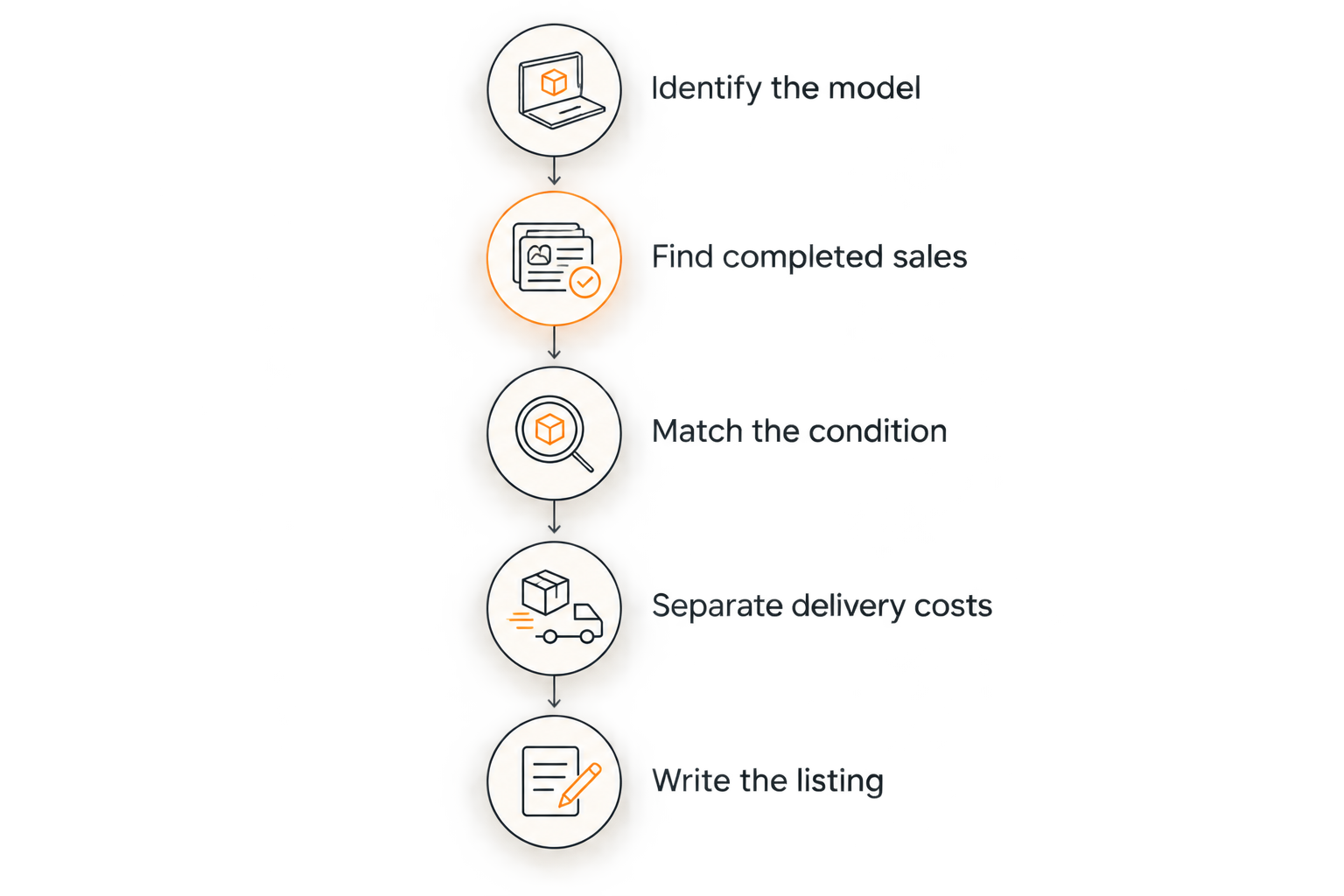
- Identify the model. Photograph the rear labels. Record the generation and whether the listing covers a pair or a single speaker.
- Find completed sales. Search for that exact configuration. Separate confirmed transactions from expired, withdrawn, or still-active advertisements.
- Match the condition. Read the description, not just the headline. Exclude comparisons with undisclosed testing, missing speakers, or materially different faults.
- Separate delivery costs. Note whether the transaction included shipping, collection, accessories, or other equipment. Do not compare unlike totals as though they cover the same package.
- Write the listing. Explain what works, what is worn, what was repaired, and what comes with the sale. Make the evidence easy to inspect.
Keep a private comparison sheet for your 2026 sale. Record the transaction date, model, quantity, stated condition, included items, and delivery terms. That gives you a reasoned basis for accepting or declining an offer without claiming your estimate is a formal appraisal.
Test both speakers before calling them working
Use the same signal path for both speakers. A comparison means little if you change the cable, source, playback level, and room position at the same time.
Make these 4 checks before writing the condition description:
- Inspect with power disconnected. Look for cabinet damage, loose connectors, damaged cones, and visible alterations. Do not open powered equipment or attempt internal repairs without the necessary qualifications.
- Test each speaker separately. Play familiar material at a sensible level through each cabinet. Listen for missing bass or treble, distortion, rattles, and interruptions.
- Swap the signal path. If a problem appears, exchange the cable or source channel while keeping the listening position consistent. Record whether the symptom follows the speaker or stays with the connection.
- Check controls and inputs. Test the functions you intend to describe as working, following the manufacturer’s instructions. State which inputs remain untested.
For a stereo pair, compare 2 channels using the same mono source and equivalent settings. Mono sends the same program material to both sides, helping you compare their output without confusing different musical content with a speaker problem.
A phone recording documents visible operation and obvious symptoms. It does not prove frequency response, calibration, or the absence of subtle faults. Use the used gear demo video guide to plan supporting footage without overstating what it proves.
Write a listing buyers can assess
Lead with the exact model, generation, and quantity. Follow with current operation, physical wear, service history, included items, and delivery arrangements.
Use direct descriptions. “Scratch on the left cabinet’s top panel” is more useful than “normal wear.” “Both speakers tested through the balanced inputs” is more useful than “sounds amazing.”
Photograph the fronts, rear panels, labels, connectors, and every disclosed defect. Keep the listing photos consistent with the equipment you will hand over; remove stands, interfaces, and cables from the included-items list unless they are actually part of the sale.
For a 2026 listing on OohYeah, create an account and list the gear with that evidence. Zero seller commissions are useful, but clear condition disclosures remain your responsibility. Do not interpret zero seller commissions as a statement about every possible transaction or delivery cost.
List your studio monitors
Create an account, describe the condition, and sell your gear with zero seller commissions.
Does age matter more than condition?
Documented operation matters more than an age label alone. Age describes time; it does not establish whether the drivers, amplification, inputs, and controls work correctly.
State how long you have owned the speakers separately from their manufacturing date. “Purchased used” does not tell a buyer when the units were built. Include service records when you have them, and avoid guessing about remaining lifespan.
Should I sell studio monitors as a pair or separately?
Sell a working stereo pair together when your comparison evidence supports that configuration. It gives a stereo buyer both speakers in the same transaction.
A single listing fits a replacement use, but disclose the exact generation and condition. If one cabinet is faulty, describe the pair accurately rather than presenting both as fully working.
Should I repair a monitor before selling it?
Get a diagnosis and repair estimate before deciding. Compare the proposed work with completed sales for working and similarly faulty examples.
Repairing equipment adds an expense that the sale must justify; leaving a fault unresolved means selling a repair project. Either approach requires an accurate description. Never promise that an unverified fault is an easy fix.
FAQ
How do I work out my used studio monitors resale price?
Base your used studio monitors resale price on recent completed sales for the exact model, generation, quantity, and condition. Separate delivery charges and included extras before comparing transactions.
Are used studio monitors worth more as a pair?
A pair and a single speaker serve different buying needs, so compare each with its own completed sales. A pair supplies both stereo speakers, while a single can serve as a replacement.
How old is too old for used studio monitors?
Age alone does not establish whether used studio monitors are usable. Check their operation, physical condition, service history, and the manufacturer information relevant to the exact model.
Can I sell studio monitors if one speaker is broken?
You can describe them as faulty equipment, clearly identifying which speaker has the problem and what symptoms you observed. Check the marketplace’s current rules before listing and do not describe the pair as fully working.
Does the original box increase studio monitor value?
Do not assign an automatic premium to the original box. Disclose it as an included item and assess whether its inserts and condition suit the intended transport arrangement.
Can a demo video prove studio monitors sound right?
A demo video can document visible operation and audible symptoms captured by the recording. It cannot establish calibrated performance or prove the absence of subtle faults.
Where can musicians sell used studio monitors without seller commissions?
OohYeah offers musicians a used music gear marketplace with zero seller commissions. Create an account, list the exact equipment, and check current transaction and delivery terms separately.
One last thing
A room problem can masquerade as a speaker problem. Reflections and placement affect what you hear, so compare cabinets in the same position before concluding that different bass response proves a fault.
For your 2026 sale, document the test conditions as carefully as the cabinet marks. Sell what you can demonstrate. Describe everything else honestly.