Wedding DJ costs in 2026: hours, travel, and equipment extras
How much does a DJ charge for a wedding? Compare itemized quotes for hours, travel, ceremony sound, and equipment extras before you sign a contract.
October 27, 2026
FRANKLY with Frank Lee
A wedding DJ’s charge depends on the coverage you book: performance hours, event locations, travel, sound equipment, and any agreed extras. For your 2026 wedding, request an itemized total that identifies overtime, setup, teardown, and ceremony audio rather than treating the reception package as the whole bill.
- How much does a DJ charge for a wedding? Compare itemized coverage, hours, travel, and equipment—not package names.
- Separate ceremony audio, reception music, and microphone duties before requesting wedding DJ quotes.
- OohYeah connects musicians with music professionals; confirm wedding DJ experience and event coverage with each professional.
- Get overtime terms, equipment responsibilities, and the named performer into the agreement before booking.
How much does a DJ charge for a wedding?
The useful figure is the total for your actual event—not a headline fee attached to an undefined package. Give every DJ the same brief, then compare what each written quote includes. Different scopes do not make a fair comparison.
Use this breakdown when requesting wedding DJ quotes in 2026. Ask the provider to mark each item as included, separately quoted, or not offered.
| Quote component | What to specify | What to confirm |
|---|---|---|
| Performance coverage | Music start, finish, and scheduled breaks | Exactly when the contracted clock starts |
| Ceremony audio | Ceremony location, microphones, music cues | Whether this needs a separate setup |
| Reception sound | Room layout, guest areas, speeches, dancing | Who supplies and operates the sound system |
| Travel | Venue address and access instructions | Any transport, parking, or accommodation charges |
| Setup and teardown | Access window and equipment removal deadline | Whether these sit outside performance coverage |
| Optional extras | Lighting, additional spaces, special production | Which items require separate approval |
| Overtime | Who can approve an extension | The billing increment and written authorization process |
A DJ and a sound engineer also have different responsibilities. If your event includes live performers, read about hiring a live sound engineer before assigning every audio task to the DJ.
Why this matters
Your wedding runs on transitions: the processional, entrances, speeches, dinner, and dancing. A useful quote identifies who handles each transition and what equipment makes it possible. A vague quote leaves those decisions unresolved.
For a 2026 booking, compare the service description before comparing the total. An offer covering reception music alone is not equivalent to an offer covering ceremony microphones, announcements, and separate event spaces. Match the work first. Compare the bill second.
Reception-only coverage: define the music window
Best for: couples who need reception music and have ceremony audio handled separately. Specify when background music begins, when dancing ends, and whether the DJ makes announcements. Include dinner and speeches in the brief if they fall inside the requested coverage.
The advantage is a narrower assignment: the DJ knows which part of the day belongs to them. The limitation is equally clear. Someone else must own ceremony playback, microphones, and any earlier gathering that sits outside that assignment.
Do not describe the booking only as an evening reception. Write down the actual start and finish. Ask whether a delayed meal changes the finish time or requires an approved extension.
Ceremony and reception: map every handoff
Best for: couples who want a named professional responsible for music cues across both events. List the ceremony entrance, signing music if needed, recessional, reception entrance, speeches, and dance cues. Identify which moments require a microphone rather than music playback alone.
The advantage is a clearly assigned point of responsibility across the day. The trade-off is a broader technical brief, especially when the ceremony and reception occupy different spaces. Confirm whether equipment stays in place or must move.
For outdoor ceremonies, ask the venue and DJ to agree on power access and a weather plan. Get the indoor fallback into the event notes. Do not leave equipment protection or relocation decisions until guests arrive.
Multiple spaces: identify the equipment separately
Best for: weddings where guests move between distinct ceremony, drinks, and reception areas. Ask the DJ to describe the sound arrangement for each space. A location on the schedule is not proof that equipment for it appears in the quote.
Separate setups give each space an assigned audio arrangement. They also create more equipment, access, and coordination decisions. Ask who handles playback while the DJ is occupied elsewhere and whether overlapping activities need another operator.
Venue-supplied equipment needs its own check. Request the available connections, microphone arrangements, operating restrictions, and responsible contact. Do not assume that installed speakers are ready for the DJ’s equipment without confirmation.
Why wedding DJ quotes vary
For a 2026 wedding, use these factors to explain differences between proposals. Each one belongs in your brief so providers quote against the same requirements.
- Coverage hours. State the requested music window and every announcement or cue within it. Ask whether preparation, setup, and removal are handled separately.
- Event spaces. Identify every room and outdoor area requiring sound. Flag overlapping activities and equipment moves.
- Travel and access. Supply the address, parking details, stairs, loading arrangements, and venue access times. Ask the provider to identify any associated charges.
- Equipment scope. Separate dance-floor sound, speech microphones, ceremony audio, and decorative lighting. Request an explanation of what each item does.
- Responsibilities. Clarify whether the DJ selects music, acts as MC, operates microphones, or coordinates cues with live performers. MC means master of ceremonies: the person making announcements and guiding formal moments.
- Contract terms. Check the named performer, substitution procedure, overtime approval, cancellation terms, and payment schedule. Compare the obligations as well as the equipment list.
How to request a quote you can actually compare
Send the same event brief to every shortlisted provider. Keep it factual: location, date, schedule, spaces, responsibilities, and technical requirements. Ask for exclusions in writing, not just a list of inclusions.
1. Map coverage
Write the ceremony, drinks, meal, speeches, and dancing onto a shared schedule. Mark which moments need music, microphones, or announcements. Include access and removal deadlines alongside the guest-facing schedule.
2. Assign duties
Name the person responsible for every cue. Decide who announces speeches, introduces performers, starts special tracks, and communicates delays. If the planner makes timing decisions, give the DJ that contact before the event.
3. Check equipment
Ask what the DJ brings and what the venue supplies. Confirm microphone needs, sound coverage, power access, and equipment movement between spaces. Describe the intended use rather than requesting unfamiliar technical specifications.
4. Confirm terms
Request the complete proposed total and identify anything that requires separate approval. Ask how schedule extensions work and who can authorize them. Put changes into the written agreement instead of relying on a conversation.
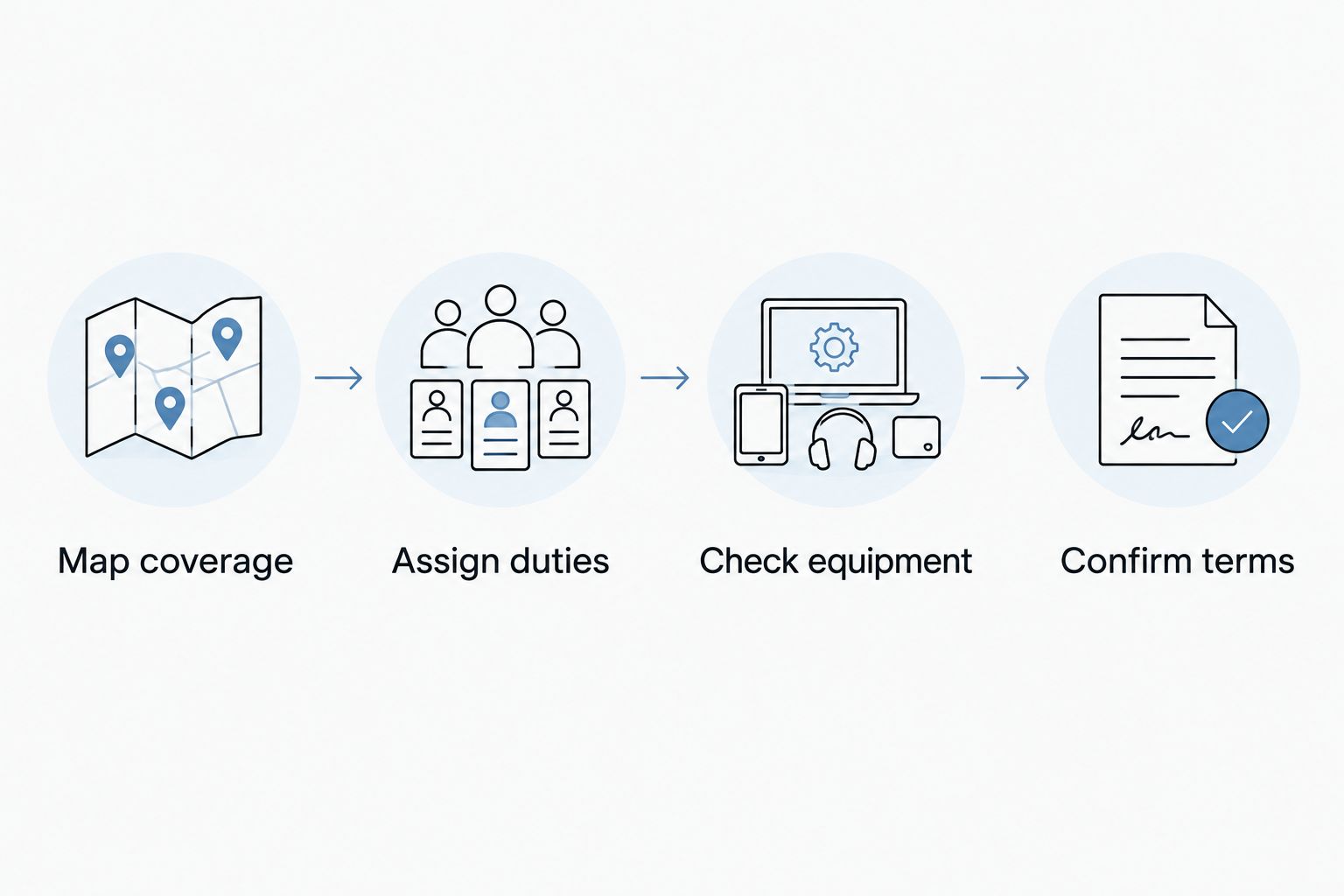
Keep the quote and schedule together. If the ceremony moves, the finish changes, or you add live musicians, ask for an updated scope. A confirmed booking should describe the event you are actually planning.
Which extras should you question before booking?
Ask what an extra solves before you approve it. Sound reinforcement, speech microphones, and decorative lighting do different jobs. A useful proposal separates those functions instead of describing everything as an upgrade.
| Option | Best for | Benefit | Limitation to resolve |
|---|---|---|---|
| Speech microphone | Vows, announcements, and toasts requiring amplification | Gives spoken moments a defined audio path | Needs placement, operation, and feedback checks |
| Separate ceremony sound | A ceremony outside the reception setup | Assigns equipment to that location | Requires its own access and power plan |
| Dance-floor lighting | Couples who want lighting effects during dancing | Adds a visual element to the reception | Does not replace suitable sound coverage |
| Room uplighting | Couples seeking decorative light around the room | Changes the room’s visual presentation | Does not handle speech or music duties |
| Additional operator | Overlapping audio responsibilities | Gives simultaneous tasks a named person | Requires explicit duties and coordination |
Ask which lighting is decorative and which serves a practical venue requirement. Then decide whether you want it. Do not remove essential microphone coverage just to retain a visual extra that matters less to you.
The same rule applies to equipment lists. A longer list is not a verdict on suitability. Ask how the proposed system covers your actual layout, including seated guests and the dance floor.
Does a wedding DJ charge for setup and teardown?
Setup and teardown belong in the written scope, whether bundled into the agreement or quoted separately. Ask when the DJ arrives, when sound checks finish, and when equipment leaves. Those times are different from the music window.
For your 2026 schedule, confirm that venue access allows the proposed setup. If another event occupies the room beforehand, get a workable handover plan rather than assuming early access.
Is ceremony audio included in a wedding DJ booking?
Ceremony audio is included only when the agreement says so. Name the location, music cues, speakers, and microphone duties in the quote request. Do not treat reception sound as automatic coverage for another space.
Tell the DJ whether the celebrant, readers, or musicians need amplification. Ask who places the microphones and who operates them during the ceremony.
What happens if the reception runs late?
A late reception needs the extension process defined in your agreement. Confirm who can approve more playing time, how an extension is billed, and whether the venue permits it. A delayed schedule does not establish permission to play past the venue’s cutoff.
Choose an authorized contact before the wedding. That keeps last-minute decisions with the person you selected rather than a guest making an informal request.
Where a music marketplace fits
OohYeah is best for musicians who want gear trading and music-professional hiring in one marketplace. You can use OohYeah to explore music professionals, but assess a wedding assignment against the event brief rather than assuming every music professional offers DJ services.
OohYeah’s broader music marketplace is relevant when your plans include other musicians or production work. The wedding-specific check still belongs with the individual professional: relevant experience, responsibilities, equipment, availability for your date, and written terms.
Ask prospective DJs how they handle requested tracks, unsuitable lyrics, pronunciation, and do-not-play instructions. Request relevant examples of their work. A technical quote tells you what gets supplied; these questions establish how the performance should run.
FAQ
How much does a DJ charge for a wedding in 2026?
A wedding DJ’s charge depends on the agreed coverage, including hours, locations, travel, equipment, and responsibilities. Request an itemized total for your event and compare providers against the same brief.
Is it better to book a wedding DJ by the hour or as a package?
Choose the arrangement that clearly covers your schedule and responsibilities. An hourly agreement needs a defined start and finish; a package needs explicit inclusions, exclusions, and overtime terms.
Do I need a separate sound system for my wedding ceremony?
Confirm ceremony sound separately when the ceremony uses a different space or overlaps with another activity. Ask the DJ and venue whether the proposed equipment can cover the location without disrupting the reception setup.
Does a wedding DJ also act as the MC?
A wedding DJ acts as MC only when that responsibility is agreed. Specify introductions, announcements, pronunciation, and who approves changes to the running order.
Should I book lighting with my wedding DJ?
Book lighting when it serves the look or function you want, not because it appears in a package name. Separate decorative lighting from sound and microphone requirements before deciding.
What should I ask about a wedding DJ’s backup plan?
Ask how the provider handles equipment failure and performer unavailability. Get the substitution process, communication arrangements, and relevant contract terms in writing.
Can I use OohYeah to find music professionals for my wedding?
OohYeah is a marketplace where you can hire music professionals. Confirm wedding services, relevant experience, equipment responsibilities, and booking terms directly with the professional you are considering.
One last thing
Ask who controls the final cue. The venue’s finish deadline, the planner’s schedule, and your preferred last song need to agree. Put that instruction beside the overtime terms in your 2026 event brief.
Then check the quote again. Every important moment should have a named person, suitable equipment, and an agreed time—not just a package label.