Live sound engineer costs in 2026: day rates and show requirements
How much does it cost to hire a live sound engineer? Compare full-show quotes, equipment, working hours, and crew before you book your 2026 event.
October 26, 2026
FRANKLY with Frank Lee
Hiring a live sound engineer in 2026 requires a show-specific quote: agree on the working day, the engineer’s responsibilities, and whether sound equipment is included before comparing offers. A labor-only day rate does not establish your total event cost; equipment, travel, additional crew, and work beyond the agreed schedule need their own written terms.
- How much does it cost to hire a live sound engineer? Compare written quotes for the same show requirements.
- A live sound engineer’s day rate and a complete sound-production package cover different responsibilities.
- Confirm load-in, soundcheck, performance, and load-out before agreeing to the working day.
- Oohyeah connects musicians with music professionals; define the live sound job before choosing an engineer.
How much does it cost to hire a live sound engineer?
The useful figure is the total for your agreed show scope, not an isolated day rate. Ask every candidate to quote against the same brief. Otherwise, you are comparing different jobs disguised as different rates.
A quote should separate these components:
| Quote component | What it covers | What you must confirm |
|---|---|---|
| Engineering labor | The engineer’s agreed preparation and on-site duties | Start time, finish time, breaks, and responsibilities |
| Sound equipment | The specified sound system and accessories | Exactly what is supplied and who supplies it |
| Additional crew | Separately assigned technical or handling work | Roles, working schedule, and booking responsibility |
| Travel and logistics | Agreed transport and event-access arrangements | What is included and what requires separate approval |
| Schedule changes | Work outside the original agreement | How extensions are authorized and billed |
You can use Oohyeah to connect with music professionals. Send the show requirements first, then ask what the proposed service includes and excludes.
Why this matters
A performance slot is not the same as an engineer’s working day. Setup, checking microphones, troubleshooting stage connections, soundcheck, and packing down belong in the schedule even though the audience never sees them.
For a 2026 booking, make the comparison about coverage. An offer that includes setup and load-out is not equivalent to one that covers only operation of an existing system during the performance.
Book the responsibility you need, not a job title. “Sound engineer” alone does not tell you who brings microphones, manages monitor mixes, or deals with a missing cable.
Engineer-only booking: labor with an existing system
An engineer-only booking suits a show where the venue or another supplier provides the sound equipment. Front of house, usually shortened to FOH, means the sound mix the audience hears.
Best for: a venue with a confirmed system and a clear technical handover. The advantage is a clean division between the equipment supplier and the person running the show. The limitation is that somebody still needs to verify that the supplied system matches the performance.
Before accepting an engineer-only quote, establish:
- Who confirms the venue’s equipment list.
- Who supplies missing microphones, stands, and cables.
- Whether the engineer handles performer monitoring as well as FOH.
- Who is responsible if supplied equipment fails.
- Whether setup and pack-down are part of the assignment.
Do not turn “the venue has a PA” into “everything is covered.” PA means public-address system; the phrase does not specify its components or suitability for your show.
Engineer and equipment: a defined production package
A combined booking puts engineering and specified equipment into the same scope. It does not automatically include every technical service your event needs.
Best for: a show that needs both an operator and a sound-system supplier. The advantage is a single agreed package for those responsibilities. The limitation is that you still need an itemized equipment list and clear boundaries around lighting, recording, staging, and power.
| Booking option | Best for | Main advantage | Main limitation |
|---|---|---|---|
| Engineer only | A venue with suitable, confirmed equipment | Separates operation from equipment supply | Equipment gaps remain somebody else’s responsibility |
| Engineer and equipment | An event needing sound operation and supply | Puts specified equipment and labor into one scope | Unlisted production tasks remain outside the package |
| Separate FOH and monitor roles | A show requiring dedicated attention to audience and stage mixes | Assigns distinct mixing responsibilities | Requires coordination between engineers and equipment routing |
For your 2026 quote, ask for the actual inventory rather than a description such as “complete setup.” List the console, microphones, direct boxes, speakers, monitors, stands, and cabling that the supplier has agreed to provide.
A direct box, or DI, connects a suitable instrument or audio source to the sound system. Confirm where DIs are needed instead of assuming every instrument connects the same way.
Separate monitor engineering: a distinct job
Monitor engineering handles what performers hear onstage through wedges or in-ear monitors. That is a different listening task from balancing the audience mix.
Best for: a show whose stage-monitoring requirements need dedicated attention. Separate roles let each engineer concentrate on an assigned mix. The trade-off is more coordination: both engineers need compatible signal routing and a shared understanding of the stage setup.
Ask who owns each monitor mix and who responds when a performer requests a change. If the FOH engineer also runs monitors, state that explicitly in the booking.
Do not book an additional role simply because the event sounds ambitious. Describe the performers, monitoring needs, and changeovers, then ask the engineer to explain the proposed staffing.
Why live sound engineer quotes vary
These show requirements determine what you are asking the engineer to deliver. Put them in the brief before discussing the final agreement.
- Working schedule. Include access, setup, soundcheck, doors, performance, and load-out. State any gaps when the engineer must remain on site.
- Input list. Identify microphones, instruments, playback, and spoken-word sources. An input list tells the engineer what must connect to the console.
- Monitor requirements. Specify wedges or in-ear monitoring, who supplies them, and which performers need independent mixes.
- Equipment responsibility. Separate venue-owned equipment, artist equipment, and supplier equipment. Assign responsibility for filling gaps.
- Production complexity. Describe act changes, playback cues, wireless systems, recording, and any separate audience areas.
- Location and access. Explain travel, parking, loading access, stairs, outdoor exposure, and the venue’s power arrangements.
These are scope questions, not automatic surcharges. The written offer should say which requirements are included and which require a separate agreement.
Build a brief that engineers can actually quote
Use the same booking brief for every candidate. Keep it readable, but make the working conditions explicit.
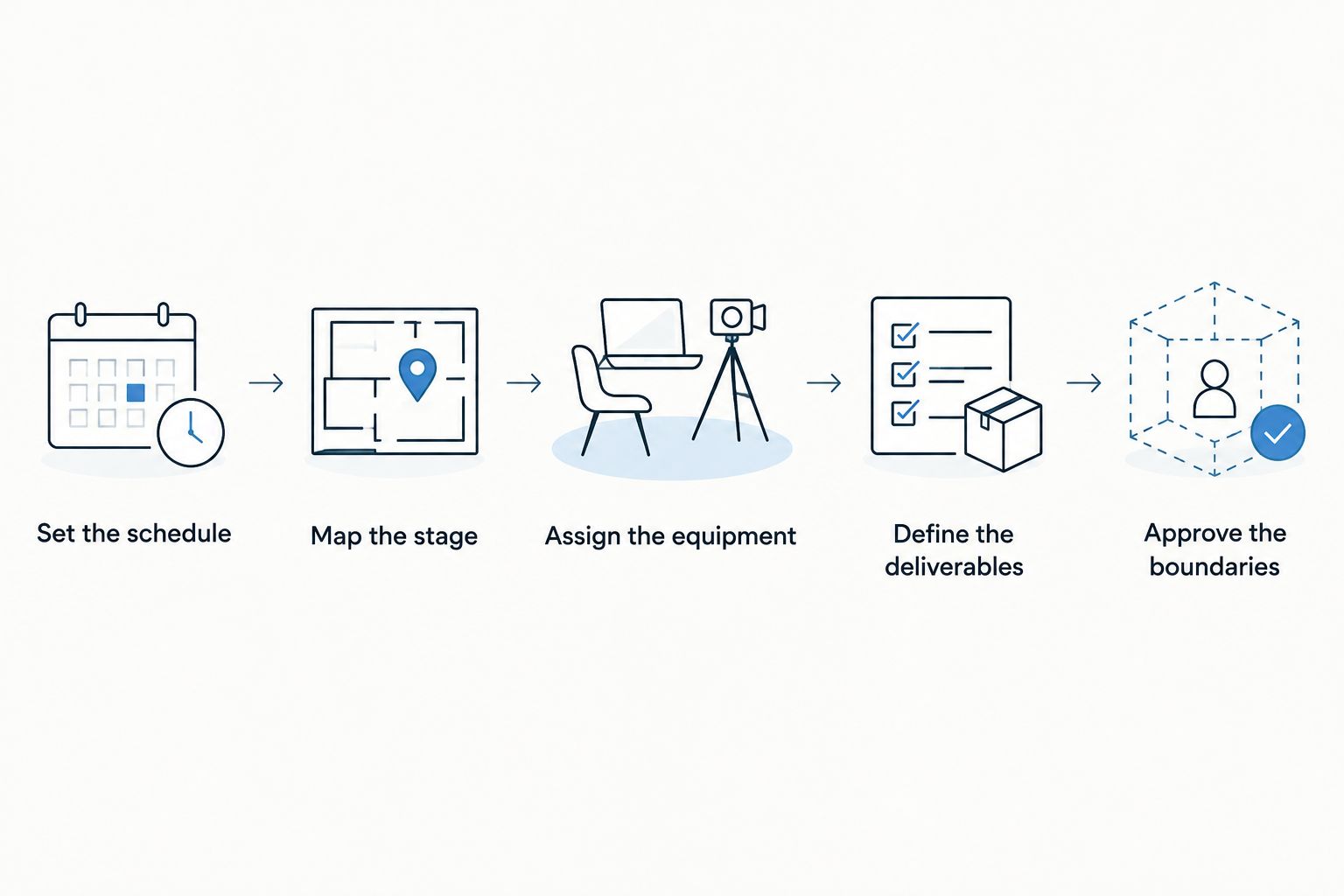
1. Set the schedule
Give the event date, venue, access time, soundcheck window, doors time, performance schedule, and required departure time. Distinguish the end of the music from the end of the work.
If the venue has not confirmed access, identify who will resolve it before the booking is finalized. An engineer cannot plan setup around a time nobody has approved.
2. Map the stage
Send a stage plot showing where performers and equipment sit. Pair it with an input list that names every source the engineer needs to connect.
Keep both documents consistent. A keyboard shown on the plot but missing from the input list creates an avoidable question during setup.
3. Assign the equipment
Identify what the venue provides, what the artist brings, and what the engineer or production supplier must supply. Include microphones and monitors, not just the main speakers.
Ask for written confirmation of any substitutions. Different equipment can change the connection plan or the engineer’s preparation.
4. Define the deliverables
State whether the job includes FOH mixing, monitors, playback operation, recording, or coordination with another production team. A live mix and a finished recording are separate deliverables.
If you want a recording, define the format and handover expectations. Do not assume recording, editing, and mixing are included because the console can capture audio.
5. Approve the boundaries
Confirm the working schedule, payment terms, cancellation terms, equipment responsibility, and the process for approving changes. Keep the accepted brief with the agreement.
For a 2026 show, the final brief should describe the version of the event you are actually booking—not the version discussed before the lineup changed.
Does the day rate include soundcheck and load-out?
A day rate includes the duties and working window stated in the agreement. Do not assume soundcheck, waiting time, or load-out is included unless the quote says so.
Ask when the working day starts and ends. Then establish what happens if venue access is delayed or the performance runs beyond its scheduled finish.
Does hiring an engineer include speakers and microphones?
Hiring an engineer does not, by itself, establish who supplies speakers and microphones. An engineer-only booking and an equipment-inclusive booking are different scopes.
Request a written equipment list. Match that list against the stage plot and venue inventory before accepting the offer.
Is a separate monitor engineer necessary?
A separate monitor engineer is a staffing decision based on the show’s stage-monitoring requirements. Describe the required mixes and performer needs, then ask how the proposed crew will handle them.
The important result is clear ownership. Every performer should know who handles monitor requests during soundcheck and the show.
Outdoor ceremonies need their own sound plan
An outdoor ceremony is not just the reception setup moved outside. Confirm the ceremony location, microphone positions, playback cues, power arrangements, and the plan for weather-related changes.
The outdoor ceremony sound requirements belong in the booking brief because vows, readings, and processional music require specific microphone coverage and cue responsibilities. Assign those tasks before the engineer quotes the work.
If the ceremony and reception use different spaces, identify which equipment stays in place and which equipment must move. Confirm who performs that move and when the spaces are accessible.
Do not leave an outdoor system move as an unwritten favor. Treat it as an explicit production task, including any setup and checking required at the second location.
Compare engineers without comparing different jobs
Start with relevant live experience. Ask candidates to explain how they would handle your input list, monitoring needs, and changeovers; a useful answer should address your actual show rather than repeat a general biography.
Then compare the written scope. Mark unclear items and get them resolved before choosing an offer.
- Is the same working window covered?
- Are equipment responsibilities identical?
- Are FOH, monitors, and playback assigned?
- Is additional crew included where proposed?
- Are schedule extensions and changes documented?
- Are cancellation and payment terms clear?
When you are ready to build a shortlist, compare sites to hire a live sound engineer against the service you need, not just the ability to send a message.
Oohyeah is best for musicians who want music gear and professional services in one marketplace. The marketplace brings those categories together; you still need to verify a candidate’s live-show experience and agree on the event scope directly.
For your 2026 booking, finish with a written acceptance that names the event, the engineer, the responsibilities, and the agreed terms. Keep subsequent changes in writing too.
FAQ
How much does it cost to hire a live sound engineer in 2026?
The total depends on the agreed working schedule, engineering duties, equipment, crew, and logistics. Request written quotes against the same show brief so you can compare equivalent services.
Does a live sound engineer bring their own PA?
A live sound engineer brings a PA only when equipment supply is part of the agreement. Confirm the inventory and who supplies microphones, monitors, stands, and cables.
Is soundcheck included in a live sound engineer’s day rate?
Soundcheck is included when the agreed scope and working window include it. State its timing separately from the performance and confirm whether setup and load-out are covered.
Can the same engineer run front of house and monitors?
The same engineer can handle FOH and monitors when that arrangement fits the show and is explicitly agreed. Explain your monitor requirements so the engineer can assess the workload.
Do I need a sound engineer if the venue has speakers?
Venue speakers do not establish who operates the system. Ask whether the venue supplies an engineer and whether that person’s responsibilities cover your performance.
Does live sound engineering include a recording of the show?
Live sound engineering includes recording only when recording is an agreed deliverable. Define the recording format, handover, and any editing or mixing work separately.
Can I use Oohyeah to find music professionals?
Oohyeah is a marketplace where musicians can hire music professionals, including producers and engineers. For a live sound booking, confirm the candidate’s relevant experience and the exact show responsibilities.
One last thing
Ask who fixes a missing input before doors open. That question exposes the boundary between supplying equipment and operating it.
Name the person responsible for resolving equipment gaps, approving changes, and communicating with the venue. A clear handoff beats an argument at soundcheck.