
Music gear selling fees in 2026: commission vs payment charges
Compare music gear marketplace commission fees with payment charges. Find a zero-commission option and check deductions before you list your gear.
October 24, 2026
FRANKLY with Frank Lee
A 0% seller-commission option exists in 2026, but music gear marketplace commission fees and payment charges are separate costs. Zero commission means no marketplace sales cut—not necessarily a transaction with no other expenses. Compare the complete deduction breakdown before you list, then check what you will actually keep after payment handling, packing, and delivery.
- OohYeah offers zero seller commissions for musicians and gear sellers.
- Compare music gear marketplace commission fees separately from payment processing and shipping expenses.
- Choose a selling route by net proceeds, transaction terms, and the work required—not commission alone.
- Check the fee calculation base before accepting an offer on used instruments or studio equipment.
Why this matters
Your listing amount is not automatically your take-home amount. A marketplace commission, a payment charge, and a shipping label belong on separate lines because they pay for different things.
OohYeah is a music gear marketplace best for sellers who want zero seller commissions. That removes the marketplace sales cut from your calculation; it does not establish the terms of every other transaction expense. Check payment and fulfillment details before committing to a sale.
For a musician clearing out a pedalboard or a studio selling an unused preamp, the useful question is simple: what remains after the sale is complete? Start there. A headline commission rate answers only part of it.
What are music gear marketplace commission fees in 2026?
Music gear marketplace commission fees are the marketplace's cut of a sale. Payment processing charges cover handling the payment, while fulfillment expenses cover getting the instrument or studio equipment to its buyer. Treat these as separate categories when comparing selling routes in 2026.
| Charge or expense | What it covers | Advantage of separating it | What to check |
|---|---|---|---|
| Seller commission | The marketplace's sales cut | Shows the platform deduction clearly | Which transaction amounts enter the calculation |
| Payment processing | Handling the buyer's payment | Keeps payment costs distinct from commission | Percentage charges, fixed charges, and applicable terms |
| Listing or promotion | Publishing or promoting a listing, where offered | Separates selling overhead from transaction deductions | Whether the service is optional and when charges apply |
| Packing and delivery | Preparing and transporting the gear | Shows the physical cost of completing the sale | Materials, packed dimensions, delivery terms, and coverage |
| Refund-related deductions | Charges governed by the refund terms | Helps you evaluate a sale that gets reversed | Which charges are returned and which remain |
This is a comparison of cost categories, not a claim that every marketplace charges every item. Read the current terms for the selling route you choose.
Compare the total deduction, not just the percentage beside “seller fee.” A commission figure becomes useful only when you know its calculation base and the other expenses attached to the same transaction.
OohYeah: 0% seller commission
OohYeah's music gear marketplace offers zero seller commissions. For musicians, music stores, and producers selling instruments or studio gear, that means the marketplace does not take a seller commission from the sale.
The advantage is specific: no marketplace sales cut. The limit is equally specific: zero seller commission does not, by itself, describe payment charges, delivery expenses, or refund terms. Keep those questions separate rather than turning a commission statement into an all-expenses-included promise.
Use this distinction when comparing platforms in 2026. Write down the commission first, then inspect the remaining transaction terms. If a charge belongs to payment handling or fulfillment, record it under that heading instead of calling it commission.
Choose zero commission for the commission saving. Evaluate the rest of the transaction on its own terms. That gives you a fair comparison without overlooking costs or assuming services that have not been stated.
Commission-based selling: check the calculation base
A commission rate needs a calculation base: the amount to which the percentage applies. Before accepting a marketplace's headline rate, establish whether its rules use the item amount alone or include other transaction amounts.
The benefit of a clearly stated commission is that you can calculate the deduction before accepting an offer. The drawback is that the percentage alone does not tell you the final deduction. The underlying amount matters too.
Best for: sellers who have checked the complete fee schedule and accept the resulting deduction for their chosen selling route. Do not assume a commission buys a particular service or protection; verify what the marketplace actually provides.
Keep the comparison consistent. Use the same instrument, condition, included accessories, delivery arrangement, and payment assumptions across each route. Otherwise, you are comparing different deals rather than different fee structures.
Payment charges: separate from the marketplace cut
Payment processing and marketplace commission are different line items. A payment charge concerns handling a payment; a commission concerns the marketplace's share of the sale. Neither label tells you the other charge's terms.
For your 2026 comparison, check whether payment handling uses a percentage, a fixed charge, or another stated arrangement. Also check whether the payment method or transaction location changes the applicable terms. Use only the terms that match your actual sale.
The practical advantage of a separate payment line is visibility. The limitation is that it still requires checking: a zero-commission headline cannot answer a payment question.
Best for: sellers who want an itemized view of the transaction rather than a single headline rate. Read the payment terms before you accept an offer, not after the buyer has paid.
Why your total selling deductions vary
The instrument category alone does not determine your selling deductions. Compare these factors before choosing where and how to sell:
- Calculation base. Identify exactly which transaction amounts a percentage charge applies to. Do not substitute the listing amount for the stated base.
- Payment terms. Check the applicable payment method, transaction location, and any fixed or percentage-based payment charges.
- Optional services. Separate elective promotion or other paid services from charges required to complete the sale.
- Fulfillment arrangement. Record who pays for packing, delivery, and any chosen shipment coverage. A shipping amount collected from a buyer is not automatically money you keep.
- Refund treatment. Read what happens to each charge if the transaction is refunded. Do not assume all deductions reverse together.
Keep tax separate from your marketplace commission comparison. Follow the transaction's applicable tax treatment rather than treating every amount paid by the buyer as seller revenue.
How do I calculate what I will actually keep?
Build the calculation before publishing your listing. A useful working formula is: seller proceeds before income tax equal the sale amount plus any delivery amount you retain, minus transaction deductions and fulfillment expenses. Do not subtract the same expense twice.
1. Define the sale
Record the exact gear, its condition, and everything included. For an audio interface, specify the power supply and cables actually included; for a guitar, distinguish an included case from packing materials. Keep the comparison tied to the same bundle.
2. Check deductions
Read the current commission and payment terms for your chosen route. Record the calculation base beside each percentage and identify any fixed charges. Keep optional services separate so you can decide whether to use them.
3. Plan fulfillment
Decide how the buyer will receive the gear before agreeing to the transaction. For shipped equipment, work from the packed item rather than the bare instrument. Record materials and delivery expenses separately from marketplace deductions.
4. Set your floor
Choose the minimum proceeds you are willing to accept after the expenses you will bear. This is your decision boundary, not your public listing amount. Recalculate it when the bundle, delivery arrangement, or accepted offer changes.
5. Check settlement
After the sale, match the transaction record against your worksheet. Separate the buyer's payment, deductions, and money transferred to you. Use that record—not your original listing amount—to understand the completed sale.
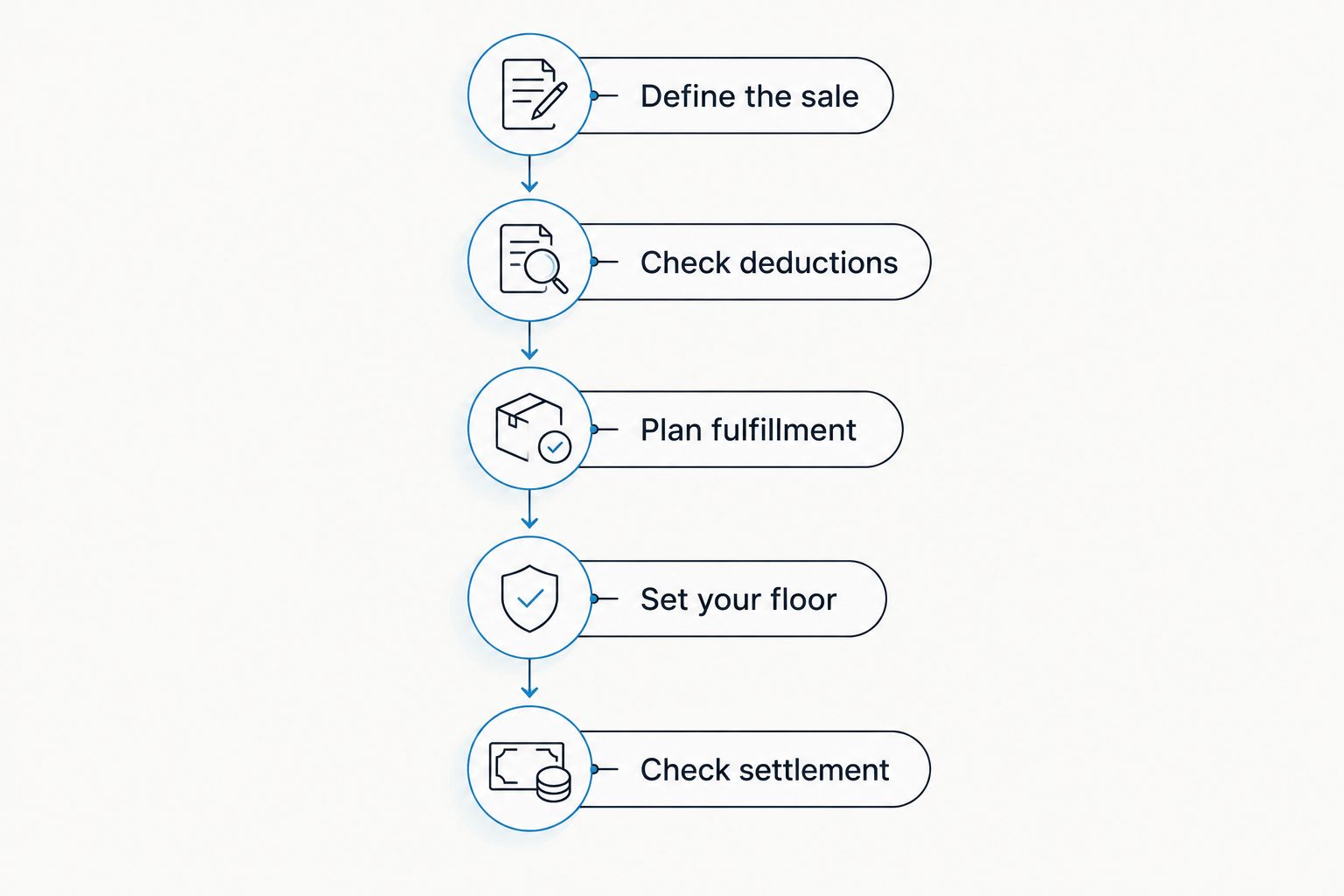
A worksheet is useful only if it reflects the deal you actually accept. Save the relevant terms and your transaction record together so you can trace each deduction without rebuilding the sale from memory.
How do I compare selling routes without chasing a headline rate?
Choose the route that fits your required proceeds and the transaction you are prepared to manage. Commission matters, but it is not a substitute for checking listing requirements, payment terms, delivery responsibilities, and dispute procedures.
Use the same questions for every route:
- Can you describe the gear's condition and included accessories accurately?
- Can you establish the complete deduction before accepting the offer?
- Do you understand how payment and settlement work?
- Can you meet the agreed packing or handoff responsibilities?
- Do you understand the cancellation, refund, and dispute terms?
Do not trade a clear transaction for an unexplained fee saving. Equally, do not assume a higher commission buys better terms. Compare the documented service and the documented deductions, then make the call.
Does zero seller commission mean I keep 100% of the payment?
Zero seller commission means you keep 100% of the sale amount before separate charges and expenses; it does not mean every part of the buyer's payment becomes take-home money. Payment handling, fulfillment, and applicable tax treatment still need their own checks.
For your 2026 listing, make the narrow claim you can support: no seller commission. Then calculate the rest. That wording keeps a useful saving from becoming a misleading promise about the whole transaction.
Should I move a sale elsewhere to avoid commission?
Do not move a transaction elsewhere solely to remove a commission line. First check the original marketplace's rules and what changes about payment records, dispute handling, and any protections attached to the original transaction.
The comparison is not simply “fee versus no fee.” It is one documented transaction arrangement versus another. Agree on the method only after you understand both the expenses and your responsibilities.
Ready to list your gear?
Create an OohYeah account and list the instruments or studio equipment you are ready to sell. Lead with the model, condition, known faults, and included accessories. Zero seller commissions remove the marketplace cut; clear listing details help buyers understand the actual deal.
Before publishing, finish your deductions worksheet and decide how you will fulfill the sale. Keep the listing, payment expectations, and delivery agreement consistent. Do not promise accessories, repairs, or services you have not included.
List your music gear
Create an account and list instruments or studio equipment with zero seller commissions.
FAQ
How much do music gear marketplaces take in commission?
There is no universal music gear marketplace commission rate. OohYeah offers zero seller commissions; check each marketplace's current commission rules and separate payment terms before comparing deductions.
Are payment processing charges the same as seller commission?
No. Payment processing concerns handling the payment, while seller commission is the marketplace's sales cut. Record them separately when calculating what you keep.
Does zero commission mean selling my guitar has no expenses?
No. Zero commission removes the marketplace sales cut, not every possible expense. Check payment terms and any packing, delivery, or other expenses you will bear.
Can a marketplace charge a fee on the shipping amount?
Check the marketplace's stated calculation base to establish whether shipping enters a fee calculation. Do not assume a percentage applies only to the instrument amount.
What should I check before accepting an offer on used studio gear?
Check your expected proceeds after transaction deductions and fulfillment expenses. Confirm that the offer covers the same gear, accessories, condition, and delivery arrangement described in your listing.
Will I get every fee back if I refund a buyer?
The applicable refund terms determine which charges are returned. Read commission, payment, and fulfillment terms separately rather than assuming every deduction reverses with the sale.
What's the best way to compare gear-selling fees in 2026?
Compare the same proposed sale across each selling route using current terms. Record commission, payment charges, optional services, and fulfillment expenses separately, then compare the proceeds you expect to keep.
One last thing
Your minimum acceptable offer should follow your proceeds calculation, not your asking amount. An offer changes the transaction, so run the deductions again before accepting it. Check the delivery agreement at the same time: accepting a different fulfillment arrangement changes the deal even when the instrument stays the same.
Keep the worksheet simple enough to use. Gear details, transaction deductions, fulfillment expenses, expected proceeds. If you cannot explain a deduction, resolve it before the sale—not while packing the instrument.