
How to authenticate a vintage guitar: serials, parts, and provenance
Learn how to authenticate a vintage guitar before buying. Serials alone aren't proof: check parts, provenance, repairs, and get an independent inspection.
October 27, 2026
FRANKLY with Frank Lee
Authenticate a vintage guitar before buying by checking the serial number against the claimed model, inspecting construction and parts, tracing ownership records, and getting an independent hands-on assessment. A matching serial number does not prove originality, and an authentic instrument can still have replacement parts, a refinished body, or structural repairs. In 2026, buy on documented evidence—not a convincing story or convincing wear.
- Learning how to authenticate a vintage guitar before buying means checking serials, construction, parts, and provenance together.
- A genuine vintage guitar is not automatically an all-original guitar; document replacements and repairs separately.
- Use an independent vintage-guitar specialist when photographs leave important construction or originality questions unresolved.
- OohYeah connects musicians buying and selling gear; instrument authentication requires evidence beyond a marketplace listing.
How do you authenticate a vintage guitar before buying?
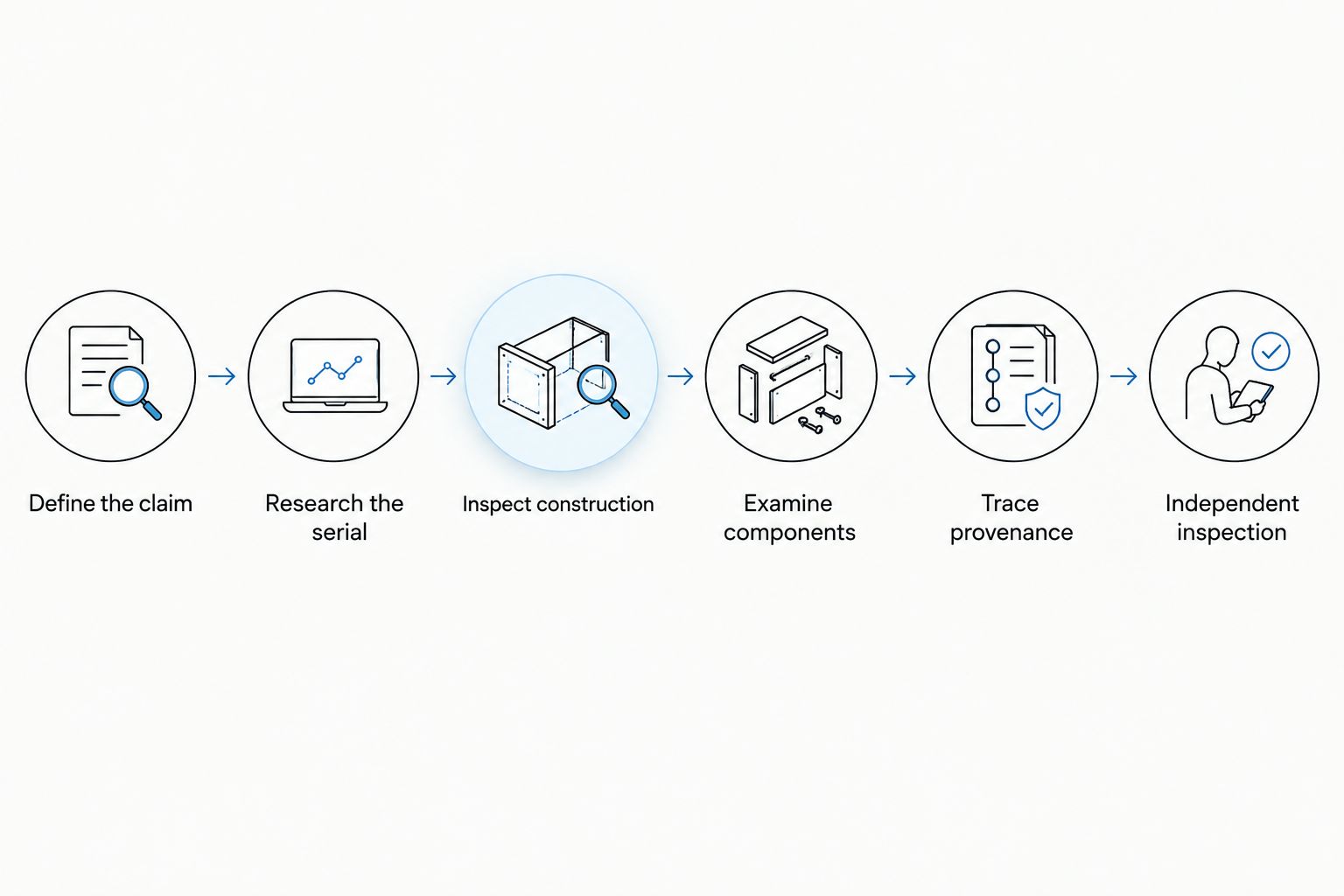
Use these 6 checks in order: define the claim, research the serial, inspect construction, examine components, trace provenance, and arrange an independent inspection. Keep the seller's exact description beside your findings. You are checking a specific claim about a specific instrument—not deciding whether something looks old.
Start by separating instrument authentication from checking whether a used-instrument listing is legitimate. A real guitar and a real seller are separate questions. Neither establishes the other.
Why this matters
Authenticity, originality, and condition answer different questions. Authenticity concerns what the instrument actually is; originality concerns which components remain from its manufacture; condition concerns wear, damage, repairs, and function.
Keep those categories separate throughout your 2026 buying checklist. A genuine instrument with disclosed replacement tuners is different from a newer instrument represented as vintage, even if both play well.
1. Define the claim
Ask the seller to state the manufacturer, model, claimed production year, finish, known repairs, and replaced components in writing. Clarify whether descriptions such as original, vintage, and factory refer to the whole instrument or only particular parts.
Request clear photographs of the front, back, headstock faces, serial marking, neck joint, bridge, tuners, and any damage. Ask for close-ups of disputed details rather than accepting another flattering full-body shot.
Make the listing testable. If the seller calls the finish original, ask what supports that claim. If the seller does not know whether the pickups are original, record them as unverified—not original by default.
2. Research the serial
Compare the serial's format, location, and application method with manufacturer documentation for the claimed instrument. Use official manufacturer dating information where available, then consult model-specific reference material and a specialist when the record is unclear.
Serial systems differ across manufacturers and production periods. Some identify a production window rather than an exact completion date, and a serial lookup cannot authenticate the wood or hardware carrying the number.
Check whether the marking looks consistent with its surrounding surface. Altered digits, disturbed finish, or an unexpected location deserve an explanation, but photographs alone do not establish how a marking was applied.
Treat the serial as a starting point, not a certificate. A genuine serial plate attached to another instrument does not make the whole instrument genuine.
3. Inspect construction
Check the claimed model's body shape, neck construction, headstock outline, inlays, binding, bridge arrangement, and hardware layout against reliable references. Account for documented production changes rather than comparing the guitar with whichever example appears first in search results.
Look for unexplained extra holes, plugged mounting points, mismatched wear, or routing inconsistent with the claimed specification. These are questions to investigate, not automatic proof of a fake.
For bolt-on instruments, neck and body markings can help establish whether the major components belong together. Have a qualified repairer handle neck removal; do not ask an inexperienced seller to dismantle a guitar for your research.
4. Examine components
Ask which pickups, controls, tuners, bridge components, and other hardware have been replaced. Where safe access already exists, photographs of internal markings and wiring can help a specialist compare the installed parts with the claimed production period.
A date code on a component dates that component, not necessarily the completed guitar. A period-correct part can also be a later installation, so matching dates do not establish an untouched instrument.
Define unfamiliar terms before accepting them. A refret replaces the fret wire; a refinish replaces the finish; a rewind replaces a pickup's coil wire. Each describes a different intervention and needs its own disclosure.
5. Trace provenance
Provenance is the documented history connecting the guitar to previous owners, sales, or repairs. Ask for invoices, dated photographs, service records, and earlier descriptions that identify this particular instrument.
Match those records using the serial number and distinctive physical details. A receipt for the same model without an identifying connection is weaker evidence than a repair record naming the instrument's serial.
Treat artist-ownership claims separately from manufacturing claims. A photograph of a musician holding a similar guitar does not establish ownership of the one offered for sale.
6. Arrange an independent inspection
Choose a repairer or dealer with experience in the relevant manufacturer, model, and production period. Ask whether the assignment covers authenticity and originality, not just setup and playability.
Request written findings that distinguish observed facts from unresolved questions. The report should identify inspected components, visible repairs, limitations, and any checks the specialist could not complete.
Agree on the inspection arrangements before committing to the purchase. Do not assume that an appraisal, sales receipt, or playable setup includes an authentication assessment.
What does each type of authentication evidence prove?
Different checks answer different questions. Use this comparison when assembling your 2026 evidence file, especially when a seller presents one strong-looking detail as proof of everything.
| Evidence | Best for | Strength | Limitation |
|---|---|---|---|
| Serial reference | Checking the claimed production period | Connects a marking with a documented numbering system | Does not establish originality or ownership |
| Construction inspection | Checking the instrument's underlying identity | Examines features beyond a removable part | Requires model-specific knowledge |
| Component inspection | Recording replacements and period consistency | Separates installed parts from broad originality claims | Period-correct parts are not necessarily factory-installed |
| Ownership records | Supporting provenance | Links identifiable records to the instrument | Gaps leave parts of the history unresolved |
| Independent assessment | Resolving conflicting evidence | Brings the available evidence into a written opinion | Findings depend on access and the assessor's expertise |
Use independent assessment for unresolved claims, not as a replacement for collecting evidence. Give the specialist the listing, photographs, serial details, and seller disclosures before the inspection. That lets the assessment address the actual disagreement.
Why vintage-guitar authentication difficulty varies
The work changes with the instrument and the claim. These factors determine which checks deserve the most attention:
- Production records: Clear manufacturer documentation makes serial interpretation more useful; incomplete records leave more work for physical inspection.
- Construction access: Hidden stamps and cavities require suitable access, and some checks involve disassembly that belongs with a qualified repairer.
- Replacement parts: A changed neck, pickup, or serial-bearing component complicates a claim that the whole instrument remains original.
- Finish history: Refinishing and touch-ups require separate investigation from the age of the underlying instrument.
- Repair history: A repaired headstock, altered neck joint, or changed bridge arrangement needs assessment beyond a basic identity check.
- Ownership claims: Manufacturing evidence cannot establish that a particular artist owned or recorded with the guitar.
Do not turn uncertainty into an accusation. Ask for the missing evidence, narrow the claim, or decline the purchase if the unresolved point is essential to your decision.
How do you check finish, repairs, and playability?
Inspect the guitar in good light, including the neck-to-body joint, headstock transition, bridge area, and any visible cracks. Ask for photographs from several angles when reflections hide a surface or repair line.
A blacklight examination can help a specialist investigate finish differences, but fluorescence alone is not a verdict. Finish materials, aging, repairs, and surface contamination complicate interpretation; do not authenticate a finish from a glowing photograph.
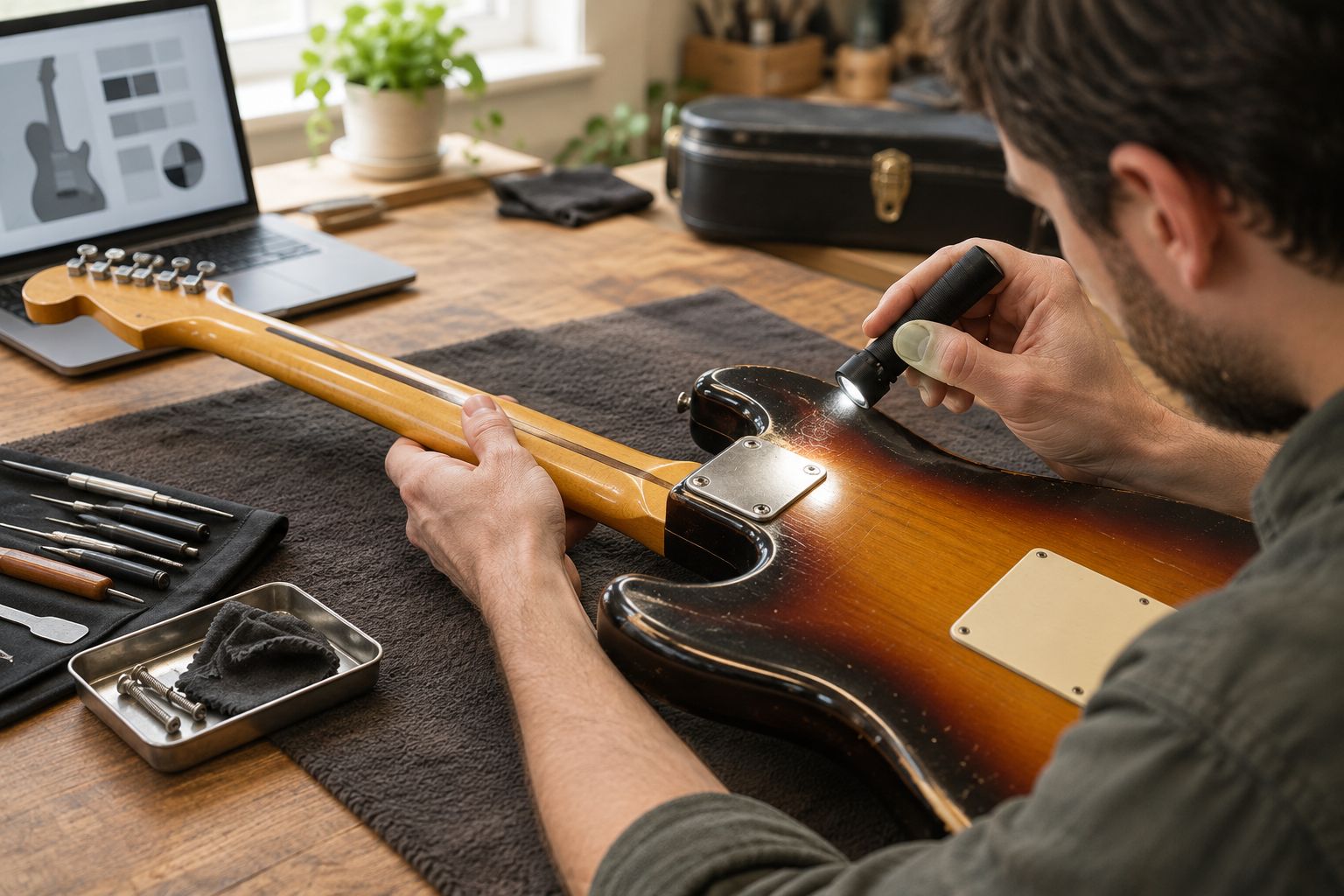
Keep 2 tasks separate: identify the instrument, then establish whether it functions properly. Check tuning stability, neck relief, fret condition, electronics, and any repair that affects use. On an acoustic guitar, include the bridge, top, neck angle, and internal structure in the professional inspection.
A guitar can pass an identity check and still need substantial repair. Conversely, a well-executed disclosed repair does not turn a genuine instrument into a counterfeit. Decide whether you want a documented collector instrument, a working instrument, or both before weighing the findings.
What should you ask the seller before paying?
Send a focused request instead of a scattered message thread. Ask the seller to confirm the following in writing:
- What exact year and model are you representing this guitar as?
- Which parts are known replacements, and which remain unverified?
- Has the guitar been refinished, touched up, routed, or structurally repaired?
- What records connect the claimed history to this instrument?
- Will you allow an independent inspection before the purchase is finalized?
- What inspection and return terms apply to this transaction?
Save the listing, messages, photographs, and inspection findings together. Date your own 2026 purchase records, but preserve historical dates exactly as they appear on genuine documents.
Ask the seller to correct contradictions before payment. If a listing says original pickups but a message says replacements, the final description should resolve that conflict explicitly.
Where does a music-gear marketplace fit?
OohYeah is a music-gear marketplace for musicians buying and selling instruments, not a substitute for vintage-guitar authentication. Use the listing to start a specific conversation about parts, repairs, and provenance; base your purchase decision on evidence tied to the instrument.
For sellers, the practical advantage of the OohYeah music-gear marketplace is zero seller commissions. That does not establish any individual guitar's originality. Create an account, list your gear, and disclose what you know—including what remains unverified.
On OohYeah, describe the instrument rather than decorating the claim. A clear replacement-parts list helps buyers assess the actual guitar without treating every unknown as a promise.
Can a serial number alone authenticate a vintage guitar?
A serial number alone cannot authenticate a vintage guitar. It helps check the claimed production period, but the construction, components, and documentation must support the same identity.
Ask what carries the number. A removable plate or replaced component requires different scrutiny from a marking on the instrument's underlying structure.
Does a replacement part make a vintage guitar fake?
A replacement part does not automatically make a vintage guitar fake. It changes the originality claim, which should name the replacement rather than describe the instrument as untouched.
Distinguish a disclosed repair from a misrepresented identity. Your decision depends on which claim the evidence supports and what you want to buy.
Should you buy if the seller refuses an inspection?
Decline if an unresolved authenticity question matters to your purchase and the seller will not permit a suitable inspection. Refusal does not prove fraud, but it leaves the question unanswered.
Do not let urgency replace verification. Another buyer's interest does not supply the missing evidence.
FAQ
What's the best way to authenticate a vintage guitar before buying online?
Combine serial research, detailed photographs, parts disclosures, ownership records, and an independent hands-on inspection. Photographs help screen the claim but do not resolve every construction or finish question.
Can I trust an online guitar serial-number lookup?
Use a serial-number lookup as a dating reference, not proof of authenticity. Check the manufacturer documentation and confirm that the guitar's construction supports the result.
How can I tell whether vintage guitar pickups are original?
Have a model-experienced specialist compare the pickups, markings, wiring, and installation with documented examples. Period-correct markings alone do not prove that the pickups left the factory in that guitar.
Is a refinished vintage guitar still authentic?
A refinished vintage guitar can still be an authentic instrument, but its finish is no longer original. Record refinishing separately from the guitar's identity and structural condition.
What documents should come with a vintage guitar?
Request identifiable sales records, repair invoices, and dated photographs when available. Missing paperwork leaves provenance less complete; paperwork without a connection to the instrument does not establish its history.
Should I remove a vintage guitar's neck to check the date?
Have a qualified repairer handle neck removal when the instrument's construction and inspection needs justify it. Do not dismantle a guitar without the owner's permission or solely to satisfy a generic checklist.
Is a certificate of authenticity enough to buy a vintage guitar?
A certificate alone is not enough to establish every claim about a vintage guitar. Check its issuer, instrument identification, inspection scope, and whether its conclusions address the current condition and installed parts.
One last thing
The most useful final document is a claim-by-claim summary, not a folder full of impressive photographs. End your 2026 assessment with 3 conclusions: supported, contradicted, and unresolved. Put each important claim into one of those categories before deciding.
Buy the guitar the evidence describes—not the guitar the story suggests. An honestly disclosed replacement is clearer than an unsupported promise of originality.