What Is Music Marketing? a Practical Guide for Artists
What is music marketing? Learn the funnel from discovery to fan revenue, the channels that work, how algorithms rank music, and how to measure results.
November 9, 2026
Music Marketplace Advisor
Buying & SellingMusic marketing coordinates how music is positioned, promoted, distributed, and monetized. It turns listener attention into outcomes you can measure, from streams and sales to subscriptions, ticket purchases, and merchandise revenue.
A release that receives only a launch-week push is like a shop open for one Saturday. Ongoing marketing gives listeners reasons to return and helps turn those visits into revenue. In the United States, streaming-related formats generated US$14.9 billion in 2024, grew 4%, and represented 84% of recorded-music revenue, according to the RIAA 2024 year-end revenue report. Those figures show why a stream count alone is an incomplete measure: marketing also tracks whether listeners come back, buy music or merchandise, and support what an artist makes available next.
What Music Marketing Means and Why It Matters
Music marketing is the coordinated process of positioning, promoting, distributing, and monetizing music, turning listener attention into measurable outcomes such as streams, sales, subscriptions, ticket purchases, merchandise revenue, and lasting fan relationships.
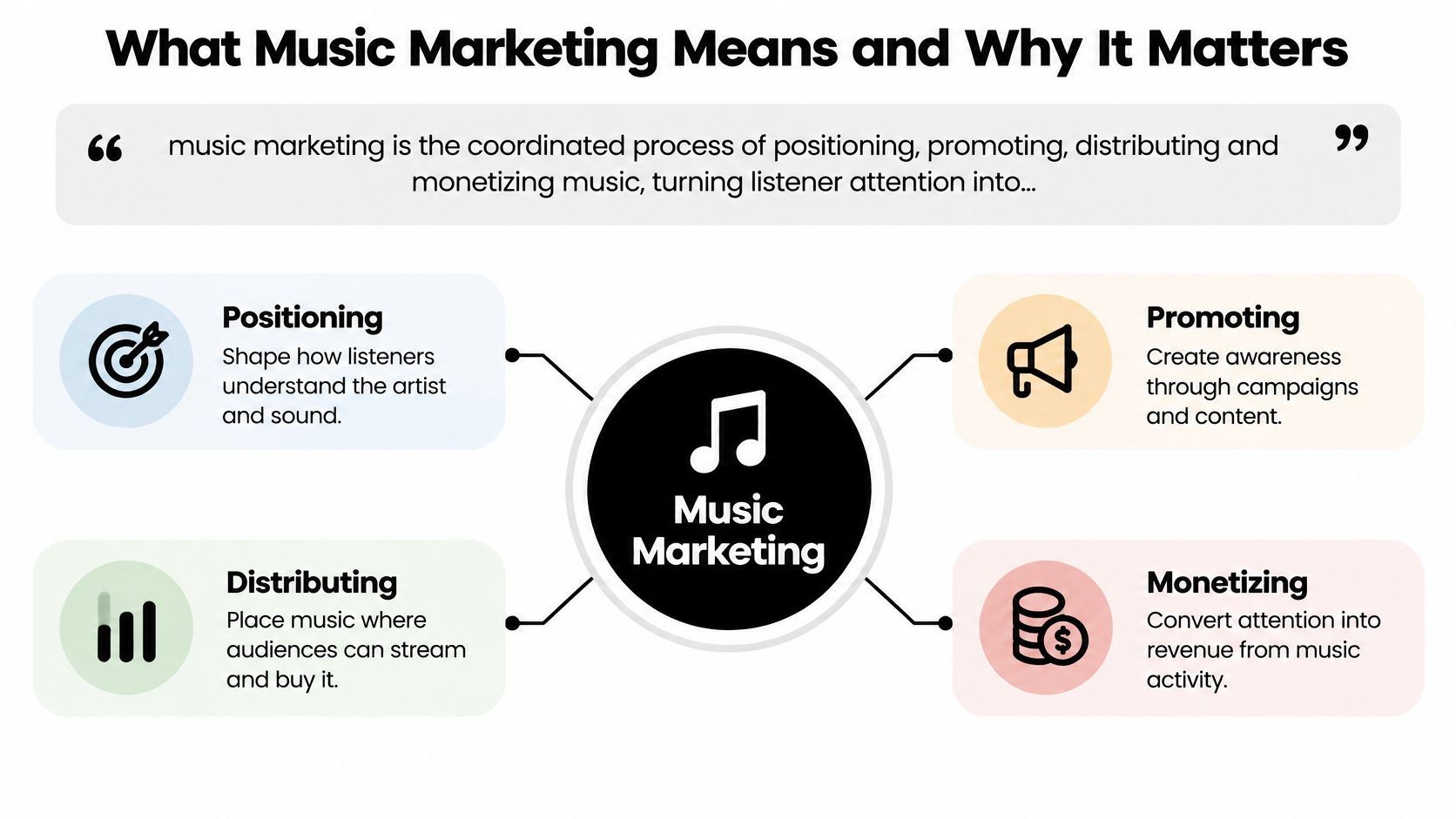
Think of a physical release as opening the shop doors on one day. Music marketing is keeping the shop open all year and noticing who comes back, what they pick up, and what they ignore. The IFPI global music report put streaming at 69.0% of recorded-music revenue in 2024, its first year above US$20 billion in trade value terms at US$20.4 billion, after 4.8% growth and a tenth straight year of expansion. Paid subscription accounts rose 10.6% to 752 million. Publicity around one album date can't cover a market built on repeat listening.
Three jobs on every release
An independent artist is really running three jobs at once, even with no team.
Audience segmentation means naming who the listeners are before you spend. A workout crowd and a late-night headphone crowd won't answer the same clip, the same caption, or the same call to action.
Release planning is the calendar. You decide which song goes out, which 15 seconds lead, which cities or communities hear it first, and what the next song is so the first one isn't a dead end.
Fan retention is the part most launch plans skip. Someone who saved the track, joined a list, or bought a ticket is worth more next month than a stranger who played 12 seconds and left.
Before you plan channels, write down one outcome for the next release. A save, a sale, or a ticket is enough. Every later choice in this guide is easier when that sentence exists, because you can ask whether a post, a pitch, or an ad moved anyone toward it.
How Recommendation Algorithms Rank Your Music
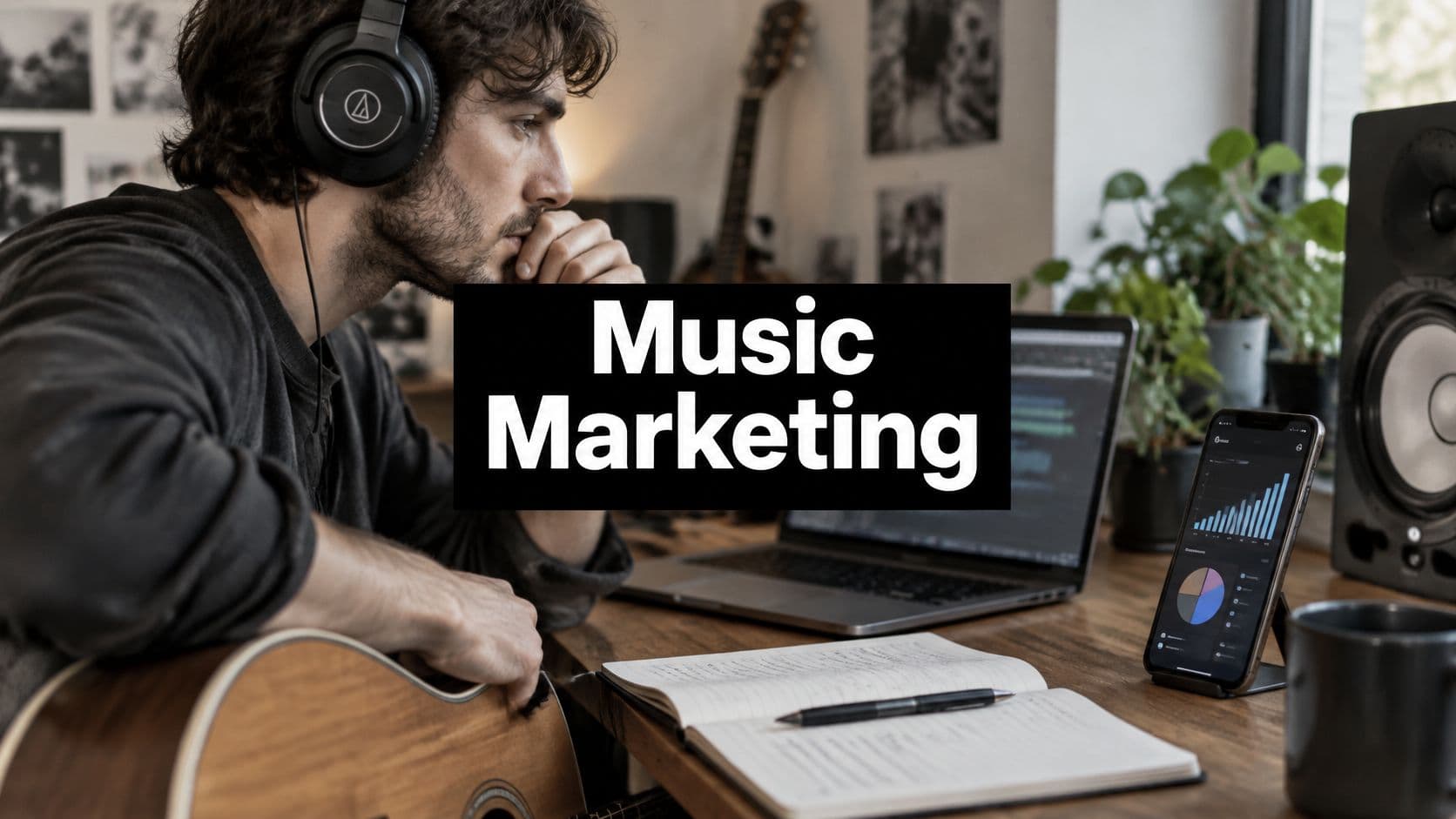
A streaming app doesn't hear your song the way a fan does. It sorts a huge catalog into a short list, then guesses which tracks that person will finish. The laptop view in a home studio is often the first honest picture of whether a campaign created that kind of listening.
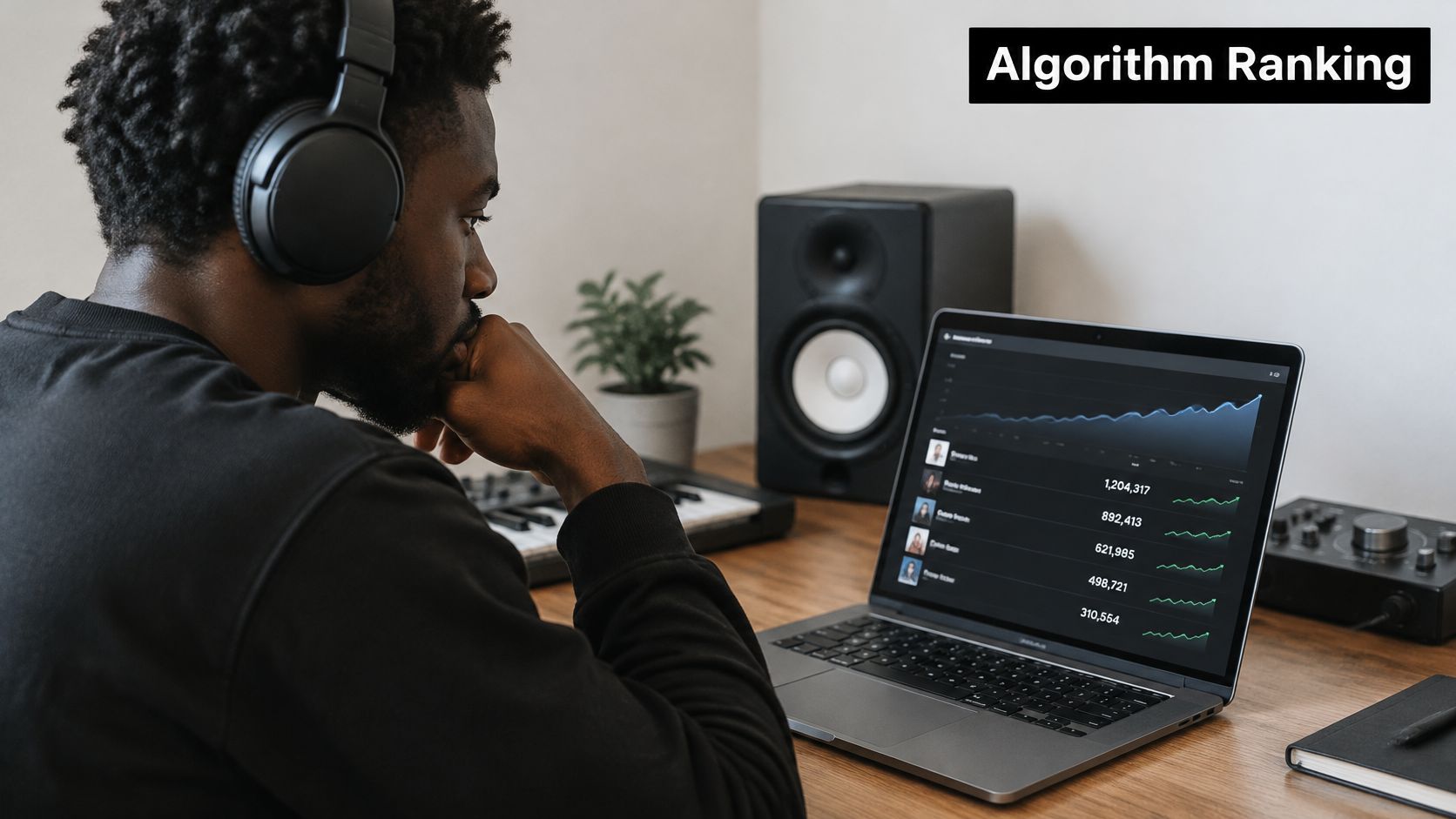
A survey of how streaming rankers work describes a pipeline most platforms share. You don't need the math. You need the three steps, because each one tells you what to change.
Candidates come first. The system pulls a pool of tracks using three clues. People who listen like this listener also played these songs. The audio and the metadata, meaning genre tags, mood, and tempo, look similar to tracks they already like. Context matters too, such as morning, a commute, a phone, or a speaker.
A ranker orders that pool. It predicts engagement. How long will they stay? Will they skip in the first seconds? Will they save the track or come back tomorrow?
Your campaign either feeds those predictions or it doesn't. Impressions and ad views sit outside the ranker. Completion, saves, and repeat plays sit inside it.
Why a pile of short plays can fail
Say one release gets a large paid push and a flood of 10-second plays, with almost nobody hitting save. You've bought reach. You've also handed the ranker evidence that people leave. A smaller push, aimed at listeners who finish the song and play it again the next day, supplies the opposite evidence. The second campaign can be cheaper and still travel farther inside the app, because the system is scoring predicted listening, not your invoice.
The same habit shows up off streaming apps. A clear explanation of how TikTok recommends videos in 2026 is useful here because watch-through and replays, not raw view counts, decide whether a clip keeps getting shown.
Popularity bias and a simple signal list
Collaborative filtering keeps showing artists who are already winning, because co-listening data is thicker around famous catalogs. If you only target your broad genre label, you're asking to be compared with the biggest names in that lane. Spread tests across a neighboring genre, a real listener community, and a use case such as study sessions or gym sets. A focused group that finishes the song is stronger proof than a wide blast of skips.
For each place a listener came from, track these signals separately:
- Completion rate: share of plays that reach the end, or at least the hook and the final chorus.
- Repeat listens: a second play from the same person, not a second impression.
- Saves and playlist additions: deliberate keeps, which are harder to fake than a tap.
- Follows: profile follows tied to that source, not a blended monthly total.
- Direct fan actions: a message, a purchase, or a signup that started from the same link.
If you can't split those numbers by source, you can't tell a useful ad from an expensive skip.
A short walk-through of reading those listening signals, rather than celebrating a spike, makes the difference concrete.
The Four Stages of a Music Marketing Funnel
A useful funnel has four stages, and each one fails in a different way. Discovery finds people who haven't heard you. Retention brings them back. Conversion turns a listener into someone you can reach without the app. Repeat value is the second purchase, the renewed subscription, or the next ticket. Counting streams mashes all four into one number, so a noisy campaign can look like a win.
| Stage | Goal | Metrics to track | Example action |
|---|---|---|---|
| Discovery | Reach listeners who have not heard the artist | First plays, click-through rate, listener count by source | Short video clip linking to the track on a streaming service |
| Retention | Bring listeners back for more | Day-7 and day-30 repeat listening, saves per listener | Playlist pitch with a follow-up release reminder |
| Conversion | Turn listeners into direct fans | Follow rate, email or community signup rate, first purchase | Free download in exchange for an email address |
| Repeat value | Build ongoing revenue from fans | Repeat merchandise purchases, subscription retention, fan lifetime value | Limited merch drop or subscription offer to existing fans |
Discovery efficiency is not retention quality
Research on 9,778 listeners, 4,136 new songs, and 1,952,195 discovery events found that algorithmic recommendations produced 12.6% organic post-discovery streaming, compared with 15.6% for human-curated playlists, while algorithmic discovery still produced 84% more organic streams overall in that comparison, as reported in a study of algorithmic versus curated discovery. Human placements were a bit better at turning a first meeting into later organic listening. Algorithms, when the match held, generated far more of those later listens.
That split argues for two layers, not a single bet. Use a targeted editorial pitch, a community post, or a creator placement to earn the first honest listen. Then protect the behaviors that let recommendation systems keep distributing the song. Trust first, scale second. If the first listen is a mismatch, scale only spreads the mismatch.
Read cohorts, not a lifetime stream total
A cohort is a group that arrived together. Take everyone who first played the single from one playlist pitch during the same week. Check them on day 7 and day 30. Did they play again? How many saves per listener? What share followed? Who bought something?
Compare that group with the people who arrived from a video ad the same week. If the ad group is five times larger on day 1 and almost gone by day 7, it didn't "perform better." It produced one-time traffic. The smaller group that is still listening on day 30, with a few follows and a purchase, is the healthier campaign. Link each campaign tag to both the play and the sale so you can see revenue and return visits per acquired fan, not only cost per stream.
Practical rule: A campaign is healthy when repeat listening holds after the first week and at least some of those listeners follow or buy. A campaign is noise when the stream count rises and the day-7 group does not.
Channels That Reach Listeners and Fans
In 2025, personalized playlists from digital music services were the leading way surveyed U.S. consumers discovered music, while 18 different discovery options ranked among the top three for at least 5% of respondents, according to Bain & Company as covered by Music Ally. There isn't one door. A channel earns its place by the funnel job it does, not by how big the audience looks on a screenshot.
| Channel | Main role | Best for | Watch for |
|---|---|---|---|
| Streaming playlists | Discovery | Reaching large passive audiences | Little direct contact with listeners |
| Short-form video | Discovery | Testing hooks and reaching new audiences quickly | Views rarely turn into followers without a next step |
| Live shows and local scenes | Conversion | Turning listeners into attendees and buyers | Limited to places you can play or travel |
| Email and community posts | Retention | Owning contact details and direct messages | Slow list growth in the early stage |
| Direct store for downloads, merchandise and subscriptions | Monetization | Keeping revenue from fan purchases | Needs a clear reason for fans to buy |
Streaming playlists can put a song in front of people who never searched your name. They also end when the playlist ends. You usually can't email that listener, and you may not even know which city they live in. Treat a playlist add as a first meeting, then give that person a reason to save you.
Short-form video is the fastest test of a hook. Post two openings of the same song and see which one people finish. Views still die in the app unless the clip points somewhere, a save link, a follow, or a list. A practical look at using song clips to reach listeners shows how a short cut can start that path instead of stopping at the view count. Our guide to advertising a release is the longer version of choosing a paid next step once the hook is proven.
Live shows and local scenes are where strangers become buyers, because a ticket, a shirt, and a conversation happen in the same room. The limit is geographic. You can only convert the rooms you can reach, so a tour plan and a local support bill matter more than another national hashtag.
Email and community posts grow slowly, and that slowness fools artists into quitting. They're the channels where the contact belongs to you. A platform can change a feed overnight. It can't delete a list you already earned.
A direct store is where downloads, merchandise, and subscriptions turn attention into revenue you keep. Fans won't buy because a link exists. They buy when the offer is specific, limited, or useful, such as a shirt from the show they just attended or a members-only demo.
If the workload is bigger than one person, our marketing and promotion listings include publicists, PR agencies, social media marketers, digital advertisers, email marketers, and promotional specialists, so you can hire the channel you're weak at instead of pretending every channel needs the same effort.
A Release Campaign From Start to Revenue
Say an independent artist with about 4,000 monthly listeners is releasing a single. The numbers below are a worked example, not a promise. They show how a sequence sorts a big play count into a smaller group you can sell to.
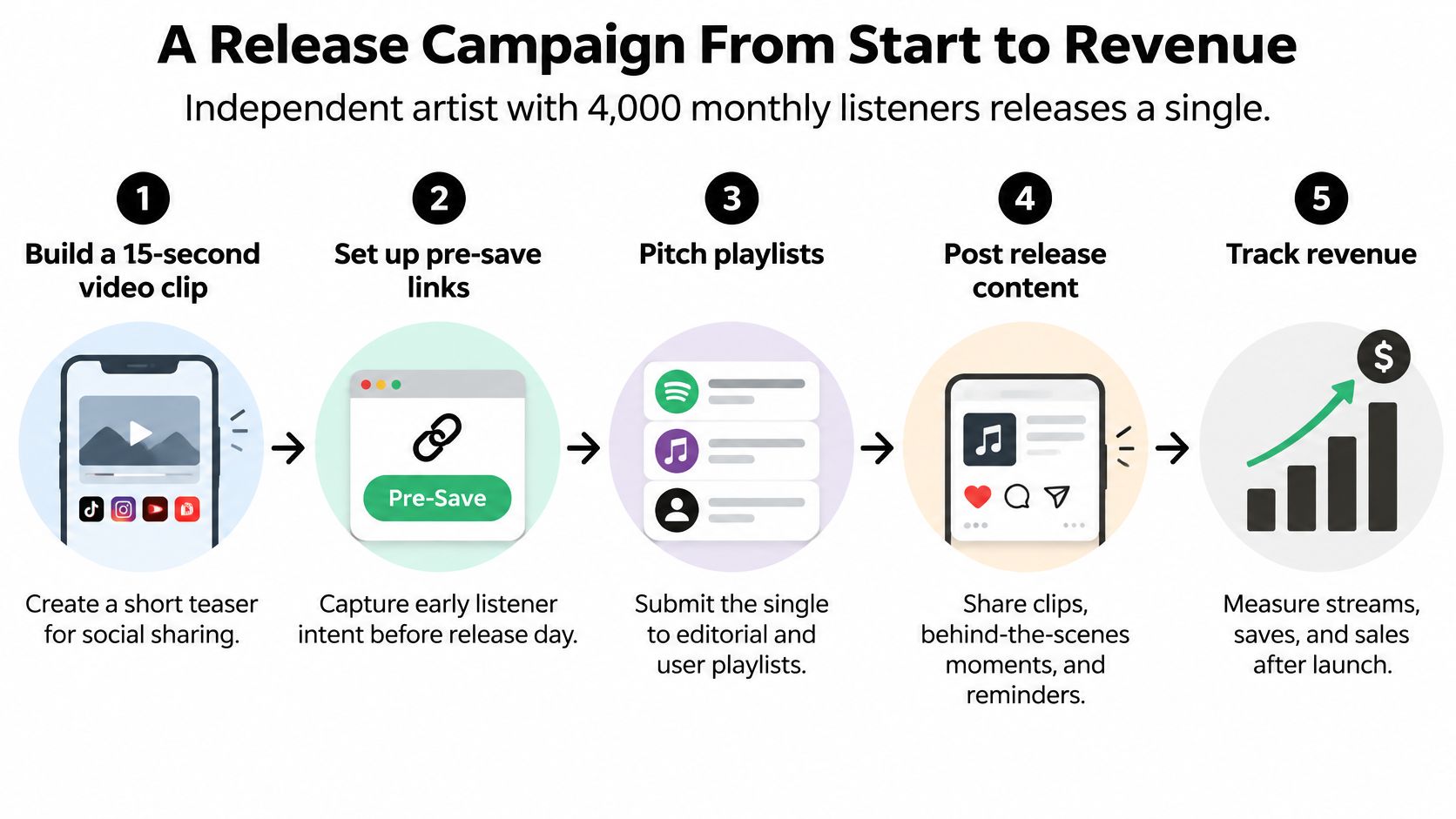
Cut a 15-second video around the strongest hook, not the intro. Post it on two short-form apps, with the same caption structure so you're testing the clip, not the wording.
Pitch the track to 20 independent playlist curators and 5 local blogs. Each pitch gets its own link. A single shared link makes every source look the same in your stats.
Send every link through a smart link tagged by source. When someone plays, saves, or buys, you can see whether they came from curator 7, blog 2, or the video.
After seven days, read repeat listening and saves by source. Drop the sources that deliver one play and nothing else, even if their first-day numbers looked exciting.
Email the people who saved the song and offer a free alternate mix in exchange for an address. You're not begging for attention. You're trading something they already showed they want.
Offer that list a small merchandise bundle or a ticket to the next local show. Direct support is the point of the whole chain, and a page where fans can back the artist directly keeps that last step from depending on a playlist editor.
What the example is really counting
Imagine the tagged links produce 40,000 plays, about 1,200 saves, and 180 email signups. The 40,000 is the part that looks good in a screenshot and pays modestly, because royalties follow your share of all listening on the service, not a fixed fee per play. The 180 people gave you a way back in. Over a year, a list that buys a shirt, a ticket, or a subscription can be worth more than a much larger group that never returns. Copy the sequence with your own counts. If day-7 saves are thin, fix the hook or the audience before you add budget.
Common Misconceptions That Waste Marketing Budgets
The most expensive belief is that streams equal income. Streaming services pool royalties and pay them out by an artist's share of total streams, then split that share among rights holders, which is why a busy month of plays can still land as modest direct income, a gap ELMT Marketing puts at the center of what a campaign should be judged on. A stream is a signal. It isn't a price.
Four beliefs keep budgets pointed at the wrong scoreboard.
- Streams equal income. High play counts can still mean a small check, because you're paid from a share of a pool, not a rate you set. Pair streaming with something fans can buy.
- Reach equals fans. A monthly listener total includes people who never came back. Follow rate and repeat listening tell you who meant it.
- Paid ads always beat organic reach. An ad pays off when it delivers people into a list, a show, or a store. Clicks that stop at a play are a cost with no second life.
- One strong release is enough. Listeners return to names they already recognize. A steady pattern of songs, clips, and direct notes builds that recognition. A single launch week doesn't.
An Irish music-industry finding reported by Unhurd puts a number on the habit. 64% of respondents usually listen to artists they already know. Discovery still matters, but retention is where demand compounds. A smaller audience you can email, message, and sell to can beat a large passive streaming audience, as long as you measure engagement and purchases over months rather than celebrating one spike.
Build Your First Music Marketing Plan
You don't need a 12-month brand deck. You need five steps you can run on the next single, then repeat with better sources.
Pick one outcome. Saves, email signups, or merchandise sales. Write it where you'll see it when you check stats, so a vanity spike doesn't change the goal midweek.
Tag every link. A playlist pitch, a video, a story, and an email each get a distinct tag. If a stream, a follow, or a purchase can't be traced, you can't learn from it.
Choose one discovery channel and one owned channel. Playlist pitching plus an email list is a clean pair. Short-form clips plus a community you post in is another. Two channels you will update beat five you abandon.
Review day 7 and day 30 by source. Keep the sources where people came back. Pause the ones that produced a single play, even if they were cheap.
Change the next release using that result. If blog readers save and ad clickers don't, the next budget follows the savers. The song can stay. The route changes.
On a small team, split the work so it doesn't all sit with the person who also has to write the song. One person owns tags and the weekly read of repeat listening. One person owns outreach to curators, blogs, or local bills. One person owns the list or the community, including the offer that asks for an address or a purchase.
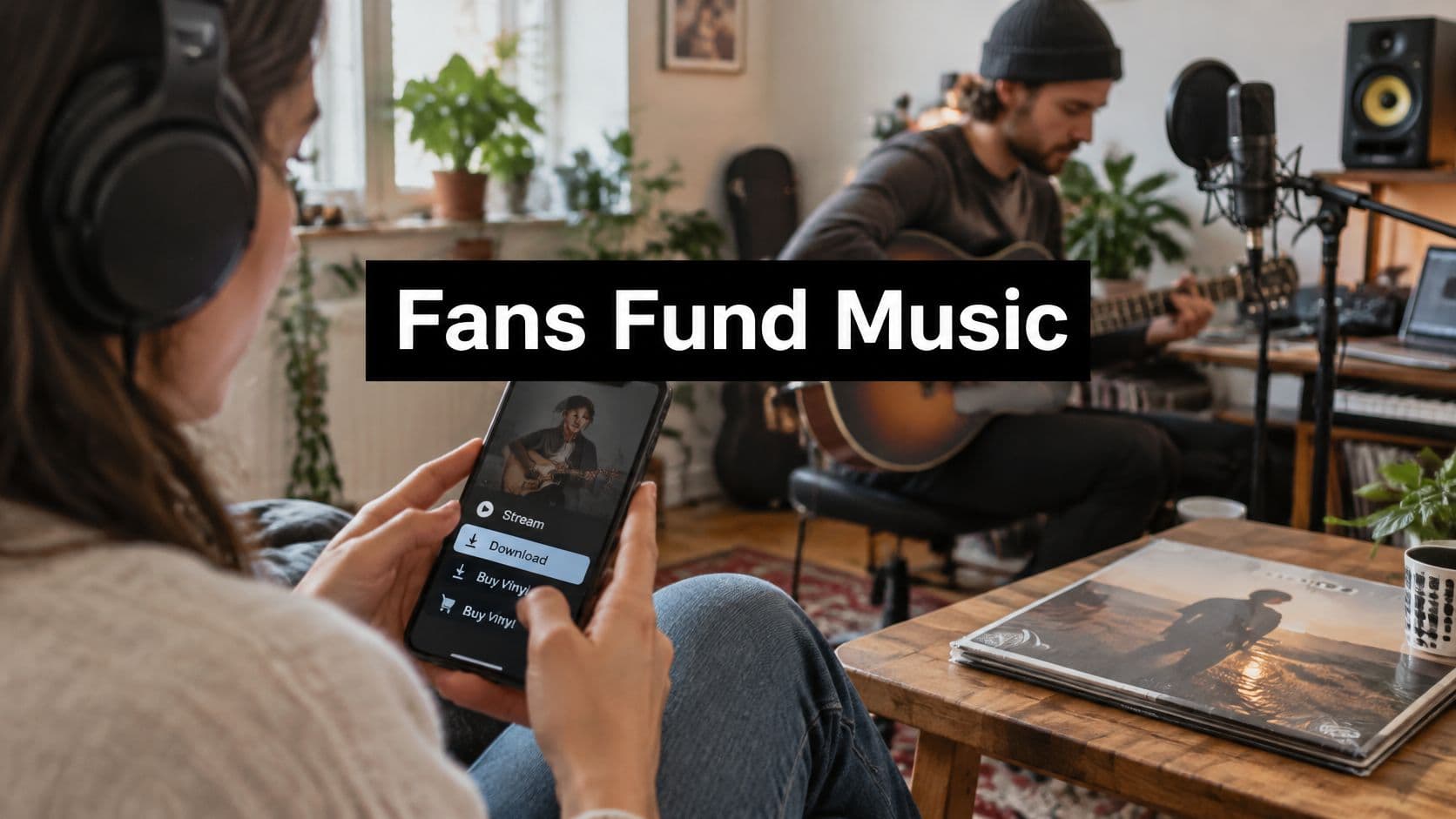
Direct purchases fund recordings, musicians, touring, and merchandise. The loop is short. A fan streams and finds the artist, buys something the artist has made available, and that purchase helps fund what comes next. Sellers on our marketplace can offer music downloads, merchandise, digital products, subscriptions, and other music-related products, with pricing set by the artist. Fans can join free and buy without a commission taken out of that purchase. Join as an artist when you want that store next to the music, not six months after the release is cold.
Set up one tagged link today, point it at the outcome you wrote down, and check it on day 7.
OohYeah is a music marketplace where you can stream, sell downloads, merchandise, and subscriptions, and talk to fans without handing the relationship to a playlist. If you're ready to turn the next release into a list and a sale you control, start on OohYeah.