Independent Artists Music: Release and Earn Income in 2026
Discover independent artists music strategies for 2026: release your tracks, build a loyal fanbase, and turn streams into steady income.
November 28, 2026
Music Marketplace Advisor
Buying & SellingIn 2023, just 19.6% of artists on Spotify reached more than 1,000 monthly listeners, according to a Ditto Music survey of more than 2,000 independent musicians. That single figure exposes the central paradox of independent artists music today. At the market level, independent creators and labels command billions in global revenue and own nearly half of recorded-music value. At the individual career level, most self-releasing musicians struggle to turn streams and short-form video views into dependable income.
People still talk about independent music as if it were an aesthetic or a shoestring budget tier. It isn't. Independence is an ownership structure. When an artist retains master rights and directs how a catalog reaches listeners, every release becomes a business asset rather than a lottery ticket for algorithmic attention.
Closing the gap between market scale and personal earnings requires separating reach from conversion. The numbers, operational steps, and revenue models below show how independent music works, where money leaks out of the pipeline, and how artists and fans build direct support that lasts.
What Independent Artists Music Means in 2026
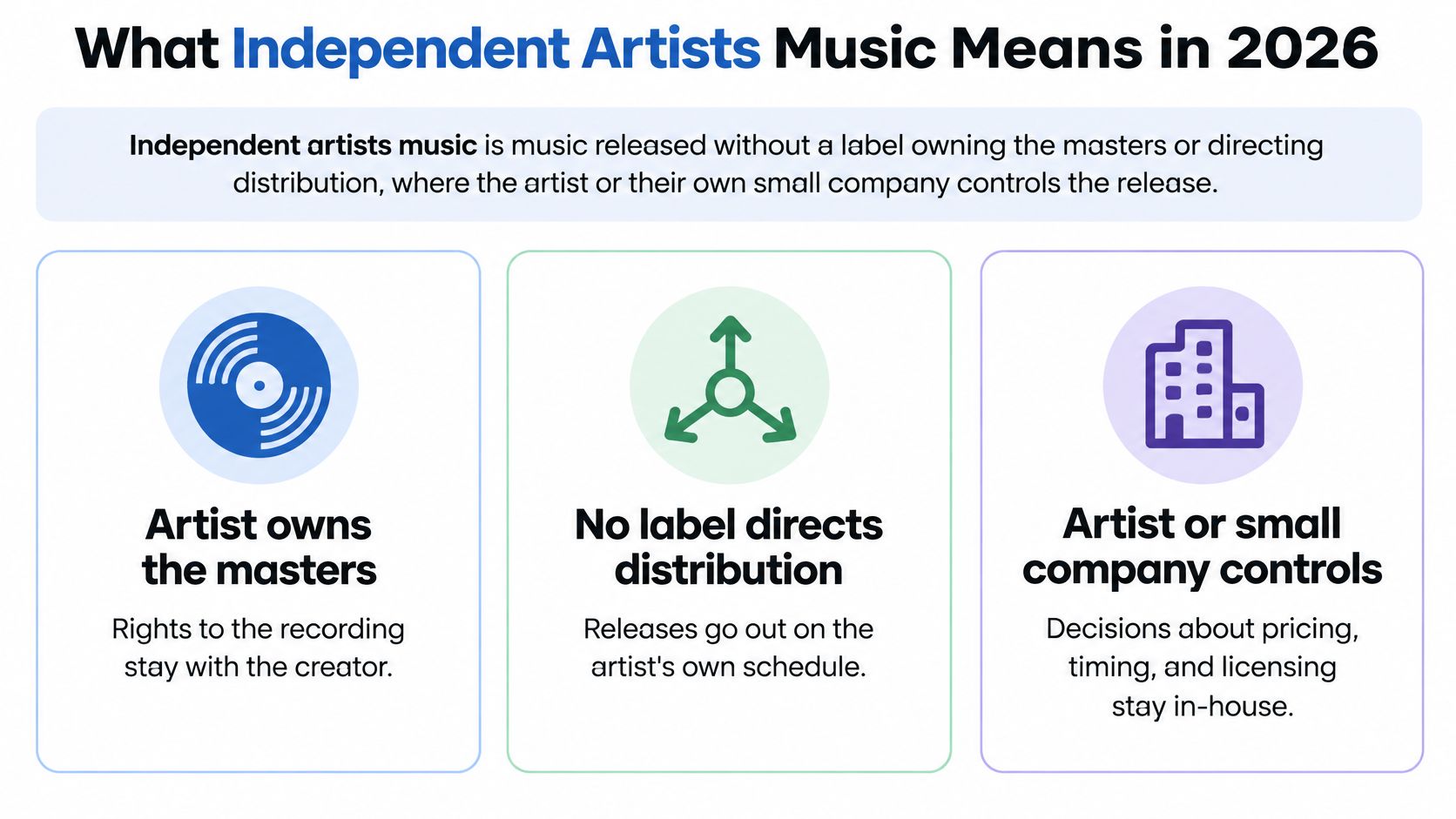
Independent artists music is music released without a major record label owning the master recordings or directing distribution, leaving the artist or their own small company in charge of rights, release timing, pricing, and fan data. Notice what that definition excludes: sound, genre, and recording budget. A bedroom folk songwriter and an arena-level hip-hop act both qualify as independent if they control their masters and commercial decisions.
That ownership-versus-distribution distinction trips up even seasoned observers. Say a producer signs a distribution services deal with a company like AWAL, DistroKid, or Symphonic to push tracks to global stores while keeping 100% of the master copyright. On paper, a third party handles delivery, yet the artist remains fully independent because no label owns the recording or dictates the release calendar.
Here is a quick visual summary of the three pillars that define independent control in 2026.
Measuring the sector by ownership instead of distribution changes the entire picture of global music economics. In MIDiA Research's 2023 market analysis, covering revenue from more than 5,500 companies and 93% of global recorded-music revenues at the company level, non-major companies represented 34.2% of the market on a distribution basis. Measured by rights ownership, that independent share climbed to 46.7%, equivalent to roughly $14.3 billion in revenue. The twelve-point gap between those two readings is the single clearest proof that distribution channels understate how much of the recorded-music economy independents own.
Macro ownership value, however, hides severe income concentration across a crowded supply pool. By 2025, more than 12 million artists had released music on streaming services, according to Duetti's 2025 Music Economics Report. While independent artists earned an average of $11,523 in 2024 according to Two Story Media's Musician Income Report, averages are pulled sharply upward by top-earning catalogs and established independent teams.
The viability check tells a tougher story. Only 13% of independent artists reported in 2025 that they could sustain themselves through music alone, according to Xposure Music's Independent Music Industry Report 2025. The table below puts the macro scale and the working-artist baseline side by side.
| Metric | Value | Year | What it measures |
|---|---|---|---|
| Non-major share of global recorded music (distribution basis) | 34.2% | 2023 | Share of revenue flowing through non-major channels |
| Independent share by ownership | 46.7% | 2023 | Share of rights owned, about $14.3 billion |
| Artists who released music on streaming | More than 12 million | 2025 | Total supply on streaming services |
| Independent artists sustaining themselves on music alone | 13% | 2025 | Full-time viability |
| Average independent artist earnings | $11,523 | 2024 | Mean across surveyed artists |
Read the table as two columns of reality. The top rows describe a sector that owns nearly half of recorded-music value worldwide. The bottom rows describe a labor pool of more than 12 million suppliers, of whom roughly one in eight earns a living from music alone. Both descriptions are accurate at the same time, and the distance between them is the conversion gap that defines independent careers in 2026. Ownership creates the opportunity. It does not distribute the payoff evenly.
Ownership, Obligation, and Optionality
Choosing independence changes three concrete realities in an artist's business.
- Ownership stays on your balance sheet: You keep the master recordings, approve sync placements, and decide whether a track goes on sale as a lossless download, a vinyl pressing, or a subscription bonus.
- Obligation lands on your desk: No A&R or label operations team cleans up your metadata, files your tax forms, or builds your visual identity. Treating a music project like a small brand requires consistent physical and visual touchpoints, and the same discipline that a branded merchandise guide for Australian businesses applies to logos, packaging, and repeat customer contact applies to an artist's merch table and release artwork.
- Optionality compounds over time: Artists who own clean masters and verified listener lists can license tracks directly to film supervisors, fund tours through direct pre-orders, or negotiate a future label partnership from genuine strength rather than desperation.
Analyst lens: Independence doesn't eliminate label work; it transfers that work to the artist in exchange for keeping the underlying asset.
How Independent Releases Reach Listeners
Global recorded-music revenue is now decisively streaming-led. According to the IFPI Global Music Report 2025, streaming generated more than US$20 billion in 2024 and accounted for 51.2% of total recorded-music revenue. IFPI even builds explicit coverage factors into its global estimates to account for non-reporting independent labels and DIY artists, confirming how large self-released catalog volume has become.
Because streaming pays per consumption event rather than per unit sold, release engineering matters commercially. Think of metadata as the shipping label on every recording: a mislabeled box never arrives at the right royalty account. To stop payment leakage, maintain a structured catalog database holding ISRCs, writer and publisher shares, featured-artist permissions, territories, release dates, lyrics, and claim status.
Before uploading a track, review how the release pipeline fits together from master prep through royalty collection.
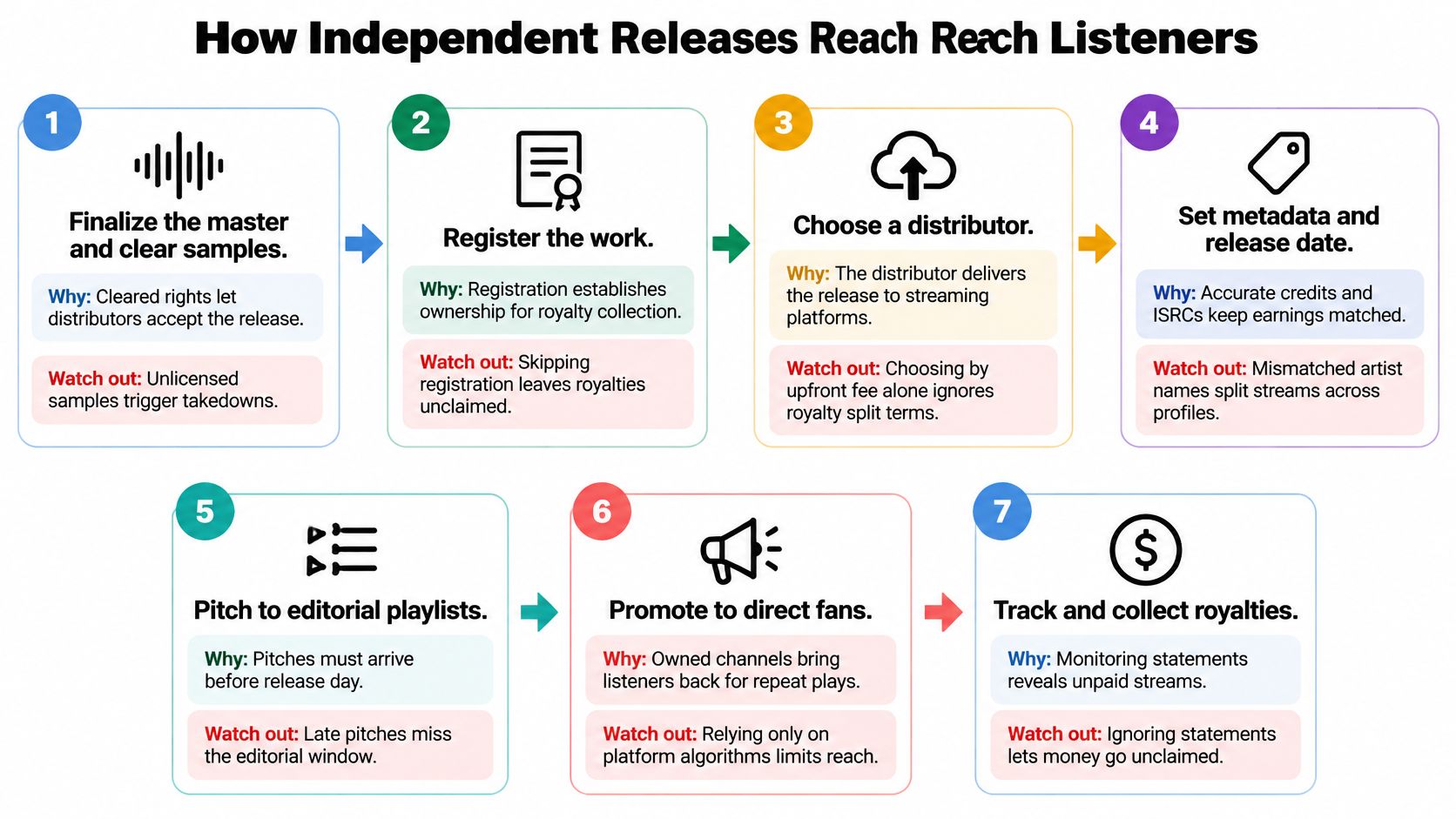
Seven Steps From Master to Payout
Before you pick a distribution partner in step three, weigh the cost trade-off carefully. Annual-fee distributors charge a recurring flat rate and typically let you keep 100% of streaming royalties, though letting a subscription lapse can put tracks at risk of takedown. Commission-based and free-tier distributors take a percentage of ongoing royalties instead, which lowers upfront cost but eats into long-term catalog margin and often limits direct access to fan analytics.
- Finalize the master and clear every right: Export full-resolution 24-bit WAV masters, sign split sheets with co-writers, get written featured-artist permissions, clear every audio sample, and secure mechanical licenses for cover songs. Unlicensed samples trigger automated takedowns right when momentum peaks. If you need remote mixing, mastering, or publishing administration before locking files, browse specialists in our music services directory.
- Register the work before release day: Assign a unique ISRC to each recording and register the underlying composition with your performing rights organization (such as ASCAP, BMI, or PRS) and mechanical society (such as The MLC in the US), logging exact writer shares, publisher shares, and territory rights. Skipping registration leaves performance and mechanical royalties sitting unmatched in black-box pools.
- Choose your distributor and direct channel: Match your release frequency to the distributor's pricing model and confirm whether it supports YouTube Content ID, TikTok sound delivery, and automated royalty splits for collaborators. Picking a service solely because it's free upfront often costs far more once a track catches fire.
- Deliver consistent metadata and artwork: Double-check identical artist name spelling, proper title versioning (such as "Radio Edit" or "Acoustic"), high-resolution square cover art, exact release dates, and time-synced lyrics. Even a stray punctuation mark can split your catalog across duplicate artist profiles on Apple Music or Spotify.
- Claim artist profiles and pitch early: Verify Spotify for Artists, Apple Music for Artists, and Amazon Music for Artists accounts so releases attach to the right profile, then submit editorial playlist pitches at least three to four weeks ahead of launch. Late uploads miss the editorial review window entirely.
- Plan release cadence and visual storytelling: Stagger singles into an EP or album waterfall so each track acts as a persistent, searchable asset rather than a one-day spike. Pairing releases with short animated loops, visualizers, or lyric videos keeps fans clicking back; reviewing how video animation studios from Moonb structure animated assets can help artists plan cohesive visual rollouts without blowing the production budget.
- Collect and reconcile every statement: Compare distributor payouts, PRO quarterly statements, and mechanical reports against your raw stream counts and catalog database. Artists who never audit statements rarely catch missing territory payouts or broken split claims.
For a walkthrough of how independent artists coordinate distribution, metadata, and launch timing in practice, watch this overview.
Adding Physical and Exclusive Editions
Digital delivery alone moves fast, whereas physical pressings and direct exclusives introduce real lead times. Vinyl plants frequently require months of manufacturing buffer, UPC barcodes distinct from digital releases, and accurate shipping weights for fulfillment calculators.
Exclusive digital editions follow a simpler rule: create genuine separation from the streaming version. Offering a 24-bit lossless download, stem files, demo voice memos, or an early-access release window gives committed fans a concrete reason to pay directly rather than waiting for Friday midnight streams.
How Independent Artists Earn at Each Stage
Most career advice splits into two unhelpful extremes: either chase streaming playlists at all costs, or abandon streaming altogether because per-play payouts are tiny. The data supports neither extreme. According to Ditto Music's Independent Music Report 2026, streaming remains the single biggest income source for two-thirds of independent artists, yet 74% of surveyed artists earned under $1,000 from music in 2025.
That tension reveals the actual bottleneck. The problem isn't low streaming payout rates; it's overdependence on a volatile discovery channel where listeners rarely arrive with purchasing intent. Streaming works well as the top of your catalog engine, provided you layer higher-margin direct offers as your audience matures.
Matching Offers to Audience Scale
Trying to run a complex merch store, a multi-tier club, and a national tour when you have 400 monthly listeners burns cash and time. Conversely, relying solely on streaming payouts once you have 25,000 monthly listeners leaves most of your potential income untouched. Use the stage matrix below to sequence offers in order of readiness.
| Stage | First offer to launch | Mix to build | Metric that matters | Main trap |
|---|---|---|---|---|
| Under 1,000 monthly listeners | Low-price download or single exclusive | Streaming plus direct download plus one exclusive | Registrations and revenue per engaged fan | Chasing views instead of owned fans |
| 1,000 to 10,000 monthly listeners | Small merch line and a monthly membership | Streaming plus merch plus subscription | 30/60/90-day repeat purchase by cohort | Launching too many offers at once |
| 10,000 to 100,000 monthly listeners | Digital-plus-physical bundle and live ticket VIP access | Streaming plus bundled merch, live shows, and membership | Bundle attach rate and fulfillment margin | Over-ordering inventory and breaking fulfillment capacity |
| Above 100,000 monthly listeners | Formal sync licensing and tiered catalog editions | Streaming plus licensing, touring, merch, and direct tiers | Revenue per engaged fan and net catalog margin | Neglecting rights administration and split audits |
At Stage 1, simplicity wins. Route every social bio link and show QR code to one controlled landing page offering a low-friction download or bonus track, and judge progress by how many listeners register an account or email address. Once you cross into Stage 2, your existing buyers tell you whether a small merch capsule or monthly membership is viable; watch whether fans acquired during one release come back to buy again at 30, 60, and 90 days.
By Stage 3, bundling drives average order value without forcing constant new music drops. Pairing a digital album download with a limited vinyl pressing, signed lyric sheet, or soundcheck pass turns casual ticket buyers into repeat patrons. At Stage 4, operational discipline protects your upside: hiring a dedicated publishing administrator, clearing sync-ready stems, and auditing international royalty societies often recovers more income than another ad campaign.
The Operational Overhead Direct-to-Fan Guides Skip
Direct-to-fan monetization isn't effortless passive income, and pretending otherwise sets independent artists up for burnout. Selling physical products means choosing between print-on-demand (lower margin, zero unsold boxes) and bulk screen-printing (higher margin, upfront cash tied up in sizes that might never sell). You also inherit fulfillment logistics, shipping-damage replacements, and customer support emails.
Cross-border sales add another layer of administration: setting clean prices across currencies, calculating sales tax or VAT obligations, managing collaborator royalty splits on bundled goods, and maintaining transparent payout tracking. Before launching a new product tier, verify how many hours per week you can realistically spend packing orders and answering buyer messages.
Direct-to-fan income only becomes sustainable when the operational cost of fulfilling an offer stays well below the margin it creates.
Why Reach Does Not Become Income
Conventional wisdom tells self-releasing musicians to post daily short-form clips, chase viral hooks, and let follower counts do the heavy lifting. The numbers contradict that script. In a survey of 5,039 self-releasing musicians across 112 countries reported by The Music Ninja, 67% named social-video platforms as their largest source of new fans, yet nearly three-quarters earned less than $1,000 from music in 2025 and almost two-thirds needed other employment. The same report notes another 2025 industry survey showing that 67% of independent artists have fewer than 1,000 monthly listeners.
Academic evidence reinforces what working musicians experience every week. Qualitative research published in New Media & Society found musicians uncertain whether social-media reach translated into bottom-line income, noting that artists generally viewed social platforms as better for maintaining existing audiences than developing brand-new fans.
Think of the problem as a leaky funnel. Social video is the wide mouth, permission is the narrow neck, and most listeners evaporate between the two unless you build a tracked path.
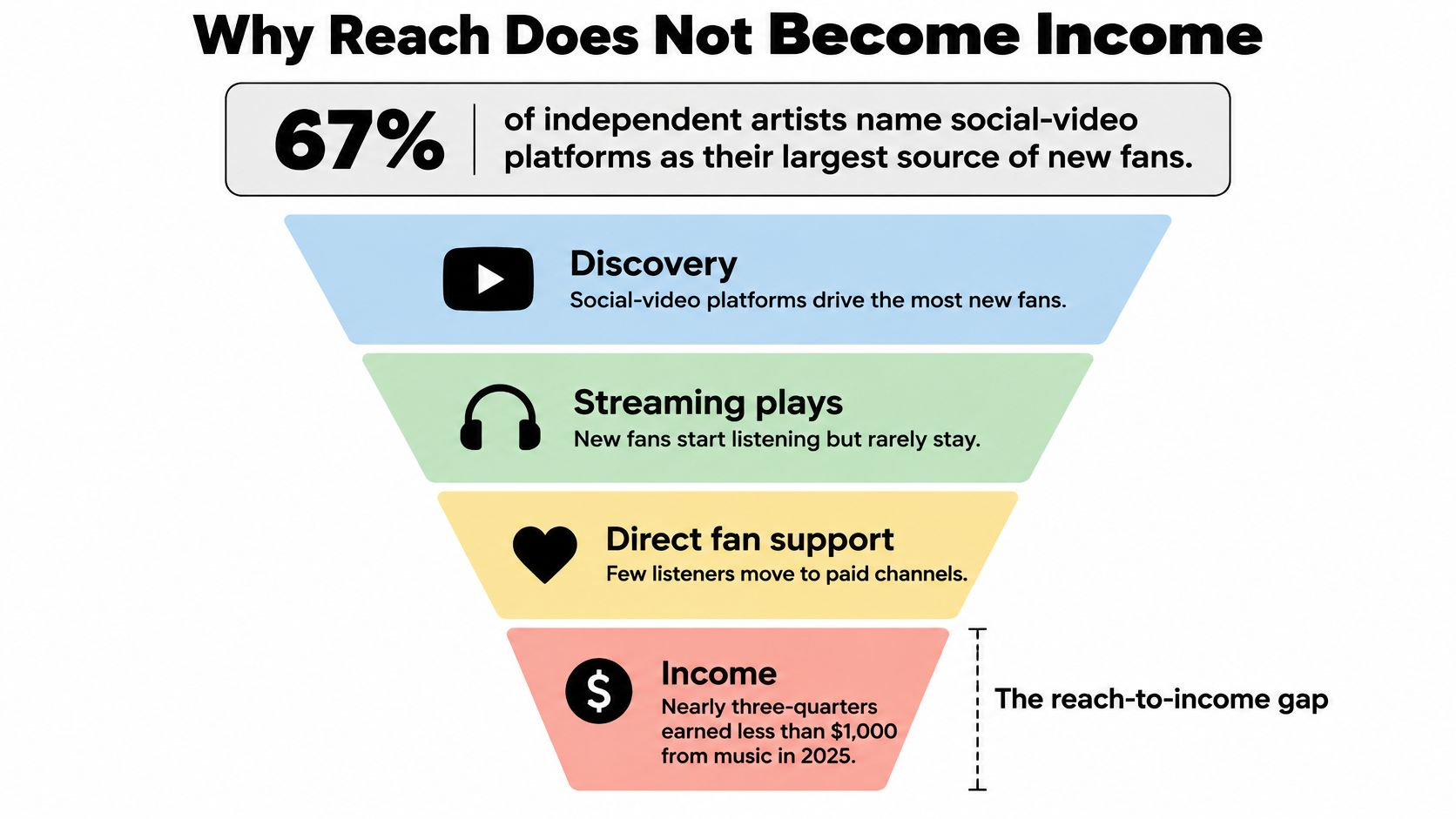
Measuring the Funnel Instead of Counting Views
Below influencer scale, "grow your followers" is a vanity strategy because algorithms can throttle your organic reach overnight without warning. Treat social activity as a measurable conversion funnel rather than a revenue channel by default:
- Tag every campaign link: Add UTM parameters (
utm_source,utm_medium,utm_campaign) to every link in your bio, story sticker, and video description so you know which platform sends buyers. - Assign a release identifier: Label each short-form video or post with a track or campaign code so you can separate curiosity clicks from high-intent music fans.
- Track six core actions: Log unique landing-page visitors, email or account registrations, track saves, paid conversions, repeat purchases, and revenue per engaged fan.
- Audit 30-, 60-, and 90-day cohorts: Group fans acquired during a single release push and check how many buy a download, shirt, or membership one, two, and three months later.
Diagnostic rule: If social reach climbs while owned-fan registrations and repeat transactions stay flat, your bottleneck is the landing-page offer, onboarding flow, or follow-up message, not content volume.
Posting three more TikTok clips won't fix a confusing checkout page or an unappealing offer. The shift happens when you move interested listeners off rented feeds into permission-based channels where you control communication. Direct messages, community posts, voice notes, and exclusive early releases give small audiences a personal stake in your catalog, turning passive scrollers into identifiable supporters you can reach without paying an algorithm twice.
How Fans Discover and Support Independent Musicians
From a listener's seat, it's easy to assume that streaming a favorite underground band on repeat pays their rent. The platform math says otherwise. According to Music Week's breakdown of Spotify's 2025 Loud & Clear report, independent artists and labels generated more than $5 billion in Spotify royalties in 2024, roughly half of total payouts for a second consecutive year. Yet inside that headline figure, only 274,000 artists cleared $1,000 in royalties, while more than 11.7 million uploaders earned less than that.
Supply growth explains why individual stream payouts stay thinly spread. Spotify added roughly two million new song uploaders during 2024 alone, while the estimated pool of professional and aspiring artists held steady around 225,000. Casual hobbyists and first-time uploaders are flooding the catalog faster than streaming revenue can stretch, which makes intentional fan support far more decisive for working musicians.
Discovery Channels Ranked by Listener Intent
Not all discovery leads to lasting connection. Listeners looking to find and back independent musicians get the strongest results by starting where artist-fan intent is highest:
- Artist pages and newsletters: Go straight to an artist's own storefront or mailing list. Clicking a Play Latest Release button on an artist page lets you hear new work without algorithmic detours.
- Live shows and local scenes: Check a neighborhood small-venue listings page for weeknight support bills; opening acts rely heavily on merch-table sales to cover gas and lodging.
- Curated playlists, indie radio, and music blogs: Browse an independent label or distributor's Friday new-releases page, or scan discovery-focused blogs like Indie Shuffle, Stereofox, and Atwood Magazine for emerging acts.
- Community posts and direct messages: Join genre-specific community threads or follow artist community feeds where musicians share demos, studio notes, and side projects.
- Recommendations from other fans: Ask one friend whose taste you trust for their favorite self-released record from the past six months, then listen front to back.
What Your Support Actually Sends to the Artist
Once you find an artist whose work resonates, follow a simple three-step sequence: stream to discover the catalog, buy one thing the artist makes available, and help fund what comes next through a follow, share, or recurring membership. Direct purchases fund future recordings, session musicians, touring costs, and fresh merchandise runs.
| Fan action | What the artist gets | Typical price point | Effort |
|---|---|---|---|
| Stream and save a track | Royalty share and a signal for playlists | Included in subscription | Seconds |
| Follow and share | Distribution to new listeners | Free | Seconds |
| Buy a download | Nearly the full price minus processing | $1 to $10 | A few minutes |
| Buy merch or gear | Product margin plus brand exposure | $15 to $60 | A few minutes plus shipping wait |
| Subscribe to a membership | Predictable monthly revenue | $3 to $10 a month | Ongoing |
| Buy an exclusive or early release | Premium direct revenue | $5 to $25 | A few minutes |
| Commission a session or service | Service fee set by the professional | Under 100 to over 200 | Days to weeks |
| Attend a show | Ticket and merch revenue | Venue-dependent | An evening |
Commission structure makes a dramatic difference in that table. On a direct marketplace where artists keep 100% of eligible sales minus payment processing, buying a $10 digital album sends almost the entire $10 straight to the creator rather than slicing off a hefty platform cut. Listeners exploring ways to support independent artists directly can compare downloads, exclusives, and fan-merch listings side by side.
Physical goods reward a little extra care before checkout. Whether you're a fan picking up a heavyweight tour tee or a band planning a durable run with ideas from this Raccoon Transfers band merch guide, verify the currency and terms listed on the product page, check pre-order ship dates, and confirm international shipping fees before paying. You'll know your support landed through simple, human cues: the artist replies to your message, the package ships on schedule, or your membership opens the next studio demo.
Your First 30 Days as an Independent Artist
Reading industry benchmarks won't change your bank balance until you turn them into weekly operating habits. Instead of trying to overhaul your entire career overnight, run a tight 30-day sprint where every seven-day block produces one tangible deliverable and one clear review point.
Follow this four-week milestone schedule to put your rights, release setup, and fan funnel in place.
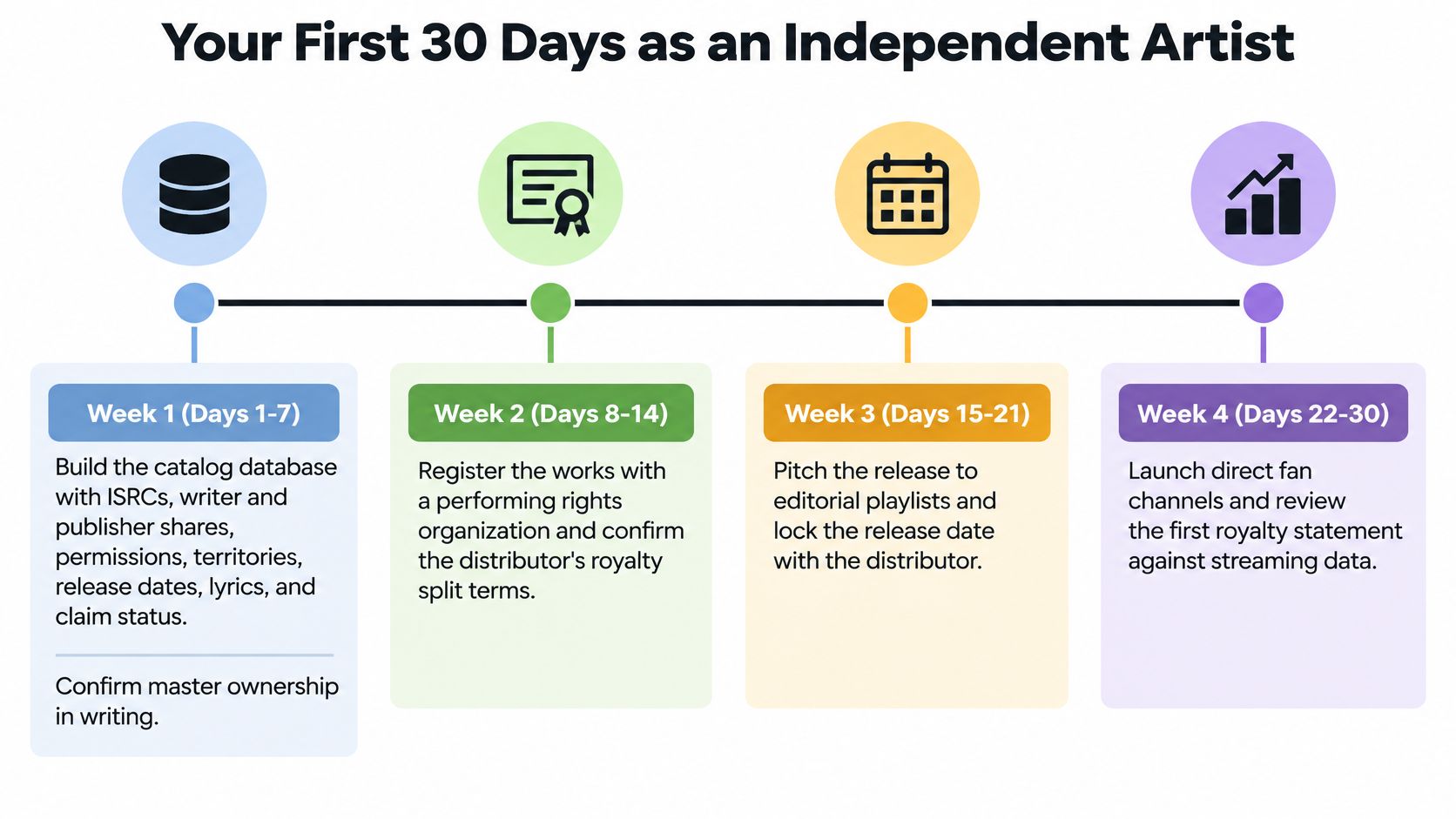
- Week 1 (Days 1 to 7) locks your rights foundation: Build your catalog database in a spreadsheet or Airtable base containing every ISRC, writer share, publisher share, featured-artist permission, territory, release date, lyric sheet, and claim status. Confirm master ownership in writing with every producer and collaborator before spending a dollar on promotion.
- Week 2 (Days 8 to 14) sets distribution and your first direct offer: Register your works with your performing rights organization, review your distributor's royalty split terms, and publish one low-friction offer (a paid lossless download or a single exclusive track) on a landing page you control.
- Week 3 (Days 15 to 21) aligns promotion with permission: Lock your release date with your distributor, submit editorial playlist pitches ahead of deadline, route every social link into your permission-based fan list, and activate 30-, 60-, and 90-day cohort tracking on tagged campaign URLs.
- Week 4 (Days 22 to 30) reviews real economics: Audit early streaming data against royalty reporting schedules, calculate your revenue per engaged fan, lock the next release date on your calendar, and decide whether your cohort numbers justify launching a merch line or monthly membership.
Running Weeks Two Through Four in One Place
Patching together separate tools for downloads, merch, fan messages, and memberships creates friction for both you and your listeners. We built OohYeah as a music marketplace where fans can buy music, merchandise, and other products directly from artists, including music you can own, while artists keep 100% of eligible sales, minus payment processing.
Using one storefront with built-in direct messages, community posts, and analytics is one practical option for executing Weeks 2 through 4 without splitting your audience data across five dashboards. Once you're ready to set pricing and list music, merch, or subscriptions under our Artist Agreement, you can join as an artist and connect your catalog directly to your audience.
Independence is a set of operating choices, and the artists who last are the ones who measure conversion, not reach.
OohYeah gives independent artists one unified marketplace to stream releases, sell commission-free downloads, exclusives, merchandise, and subscriptions, and keep 100% of eligible sales minus payment processing while building direct fan relationships through messages and community posts. Whether you're preparing your first catalog database or expanding beyond streaming payouts, you control your pricing, rights, and audience data from day one. Explore storefronts, artist tools, and direct fan support today at OohYeah.