What Are the Royalties on Music Demystified
What are the royalties on music? This complete guide breaks down mechanical, performance, and sync royalties to show how artists and songwriters get paid.
October 14, 2025
Music Marketplace Advisor
Buying & SellingAt its heart, a music royalty is a payment made to the owners of a song anytime it's used. A simple way to think about it is like owning a piece of property. Every time someone streams your track, plays it on the radio, or uses it in a movie, they're essentially paying you rent.
That "rent" is the royalty.
Your Song Has Two Identities
To really get how music royalties work, you have to understand one core concept: every single song has two distinct parts, and each one is protected by its own copyright. These two copyrights are the bedrock of the entire royalty system. Getting them mixed up is a classic mistake that can cost artists real money.
The first part is the composition. This is the song itself—the melody, the lyrics, the harmony. It's the blueprint that exists on paper (or in your head) before anyone ever hits the record button. The songwriter and their publisher own this copyright.
The second part is the master recording. This is the specific version of the song you actually listen to. Think about Aretha Franklin's legendary recording of "Respect." That's a master. But the composition—the song itself—was actually written and first recorded by Otis Redding. The recording artist and their record label usually own the master.
To make this crystal clear, let's break it down.
The Two Copyrights in Every Song
| Copyright Type | What It Covers | Who Owns It |
|---|---|---|
| Composition (Publishing Rights) | The song's melody, chords, and lyrics—the musical DNA. | The songwriter and/or their music publisher. |
| Master Recording (Master Rights) | The specific recorded version of a song. | The performing artist and/or their record label. |
This two-sided structure is why understanding royalties can feel tricky at first, but it's essential for getting paid correctly.
Why This Distinction Matters
This split is absolutely crucial because different uses of a song trigger payments to different people. When a radio station spins a track, they owe royalties for the composition (to the songwriter) and, in most parts of the world, for the master recording (to the artist).
It’s a system that powers a huge global business. Global recorded music revenues recently hit $29.6 billion, which was the tenth year in a row of growth, mostly thanks to streaming. You can dig into more industry stats in the latest global music report from the IFPI.
The key takeaway is this: one copyright protects the song as an idea (the composition), and the other protects the finished recording you hear (the master). Every single royalty payment flows from one—or both—of these rights.
Breaking Down the Four Main Royalty Streams
To really get a handle on music royalties, you have to know where the money actually comes from. It can feel like a tangled web, but most of the cash flows from four distinct sources. Each one is triggered by a different way your music is used, and the money is paid out to different rights holders through separate organizations.
Understanding these four streams is the first, most crucial step in making sure you're collecting every dollar you've earned. Let's dig into each one.
This infographic breaks down the main ways a song makes money through being copied, performed, or paired with video.
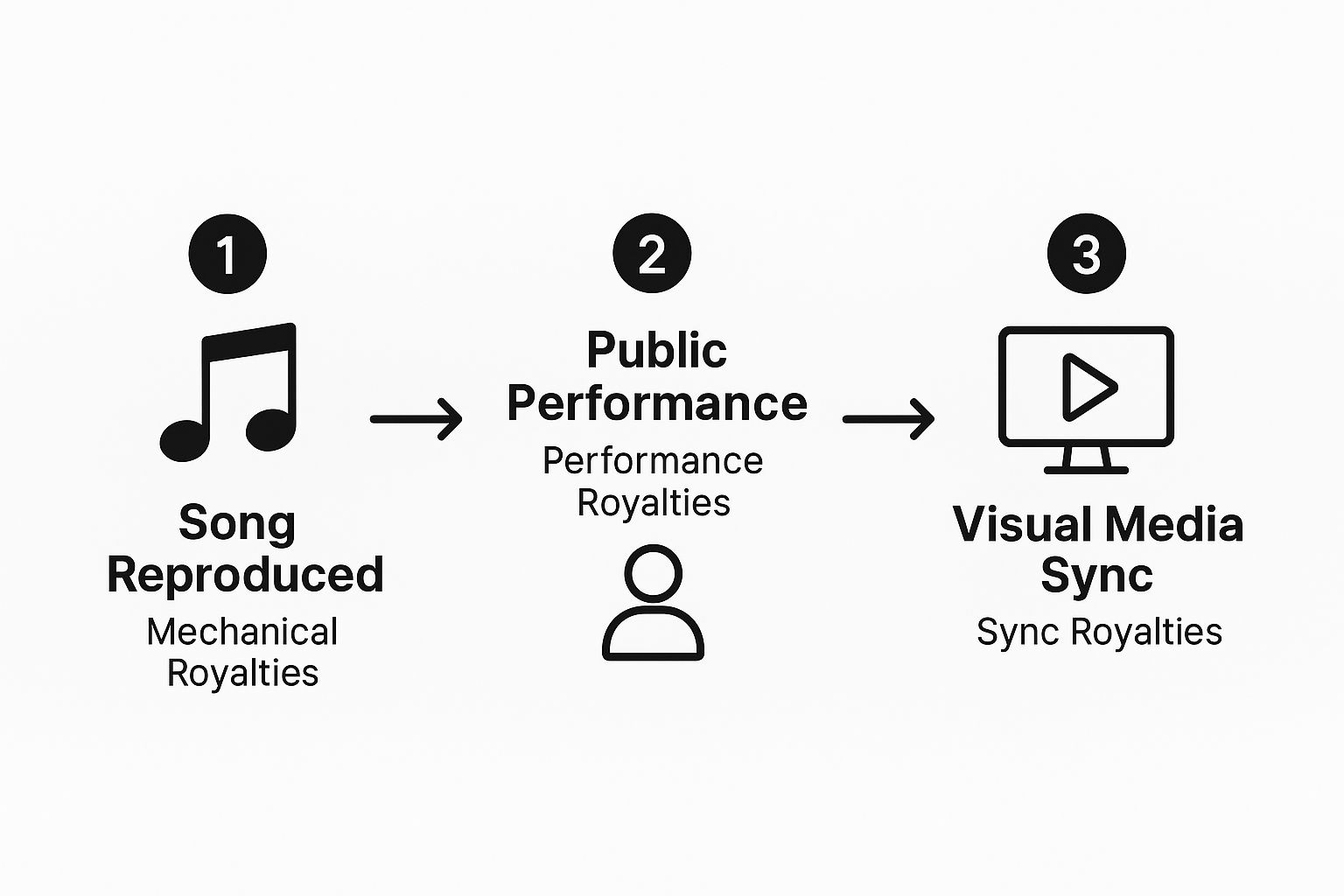
As you can see, every time a song is copied, played in public, or attached to a visual, a different type of royalty payment is triggered.
Mechanical Royalties
Think of mechanical royalties as the money you earn whenever a copy of your song is made. The name is a bit old-fashioned—it comes from the days of player piano rolls that "mechanically" reproduced music—but the principle applies to everything from vinyl records to Spotify streams.
So, when do you earn mechanical royalties?
- A record label presses a run of vinyl LPs or CDs.
- A fan streams your song on-demand on a service like Spotify or Apple Music.
- Someone buys and downloads your track from a store like iTunes.
At its core, every stream, download, or physical sale involves making a copy of the song's composition. That action is what generates a mechanical royalty for the songwriter and their publisher.
Performance Royalties
Next up are performance royalties. These are paid out any time your music is performed or broadcast "publicly." That term is way broader than you might think; it covers a lot more than just a band playing on a stage.
Performance royalties are the most widespread type of music royalty, generated from thousands of sources ranging from global radio broadcasts to the background music in a local coffee shop.
Your song is earning performance royalties when it's:
- Played on an AM/FM station or on digital radio like SiriusXM.
- Used in a television show, whether as the theme song or just in the background.
- Performed live at a concert—either by you or a cover band.
- Streamed over the speakers in a restaurant, bar, gym, or retail store.
These payments are designed to compensate the songwriter and publisher for the right to play their composition in a public setting.
Sync Royalties
Sync royalties are generated when your music is "synchronized" with some kind of visual media. This is typically a one-time fee, called a sync fee, that's negotiated to place your song in a movie, TV show, commercial, or even a video game.
Getting a sync placement is a two-part deal. You need one license for the song's composition (controlled by the publisher) and a separate one for the specific sound recording, or master (controlled by the record label). Sync licensing can be a huge income boost for artists. For a deeper dive, check out our guide on understanding music licensing and how it can boost your revenue.
Print Royalties
Last but not least, we have print royalties. This is definitely the most niche category of the four. These royalties are paid to the songwriter and publisher whenever a song's musical notation—the sheet music—is printed, distributed, and sold, either as a physical songbook or a digital file.
Tracing the Path from Listener to Artist Pocket
Knowing the different royalty types is one thing, but how does the money actually get from a fan's speakers into a creator's bank account? The journey is rarely a straight line. It's more of a winding road with several important stops along the way, involving a complex network of collection, calculation, and distribution.
When a fan hits 'play' on a streaming service, they aren't directly paying the artist. That single stream gets tossed into a massive revenue pool with billions of others. From there, the service pays out royalties using a "pro-rata" system, figuring out an artist's share of total streams and paying them a corresponding slice of the revenue pie.
For physical sales like vinyl or CDs, the process is a bit more straightforward. A statutory mechanical royalty rate, set by the Copyright Royalty Board in the U.S., mandates a specific amount per song that must be paid to the songwriter for every single unit manufactured and sold.
Following the Money Trail
The path your money takes depends entirely on the type of royalty. Each revenue stream flows through a different channel, involving different middlemen.
Mechanical Royalties: For U.S. streams, services like Spotify pay mechanicals to a central organization called The Mechanical Licensing Collective (The MLC). The MLC then finds and distributes these funds to the correct publishers and songwriters.
Performance Royalties: Radio stations, venues, and streaming services pay blanket license fees to Performance Rights Organizations (PROs) like ASCAP and BMI. These PROs use a mix of digital monitoring, surveys, and direct reporting to track plays and pay their affiliated songwriters and publishers.
Master Royalties: Streaming platforms pay the royalties for the master recording directly to the record label or distributor. The label then pays the artist their share based on the specific terms of their recording contract.
Each of these collection societies takes a small administrative fee before paying out the rest to the rights holders. Think of them as necessary tollbooths on the royalty highway, ensuring the millions of daily music uses are tracked and everyone gets paid correctly.
This intricate system is exactly why independent artists have to be so proactive. A huge part of learning how independent artists make money from music is understanding who collects what and making sure you’re signed up with the right organizations. If you're not registered, your royalties can sit in a holding account as unclaimed funds—money you earned but can't access.
Meet the Organizations That Collect Your Royalties

As an artist or songwriter, you're not expected to chase down every radio station or coffee shop that plays your music. That would be an impossible task. Instead, a whole ecosystem of organizations exists to handle the heavy lifting for you.
Think of them as your financial team, working behind the scenes. These groups act as the critical link between you and the businesses that use your music, ensuring you get paid when your work is played. For anyone serious about building a career in music, getting to know these players isn't optional—it's essential.
Performance Rights Organizations (PROs): The Performance Paymasters
When you hear about royalty collection, you’re usually hearing about Performance Rights Organizations, or PROs. Their main job is to collect public performance royalties for songwriters and publishers. Every time your song gets a spin on the radio, is performed live at a concert, or plays over the speakers at a bar, a PRO is there to collect the license fee and pass it on to you.
You can't do this alone. Imagine trying to track down every single usage of your song across the country. PROs handle this by issuing blanket licenses to thousands of businesses, collecting the fees, and then distributing the money to their members based on play data.
As a songwriter, you can only join one PRO, so it's a big decision. Here are the main options in the United States.
Comparing Major US Performance Rights Organizations (PROs)
To help you decide, here’s a quick breakdown of the major PROs for songwriters and publishers in the United States. Each has its own culture, member benefits, and payment schedule.
| Organization | Primary Role | Key Members Include | Payout Schedule |
|---|---|---|---|
| ASCAP | Collects performance royalties for songwriters and publishers. It is member-owned and operated. | Katy Perry, Justin Timberlake, Quincy Jones | Quarterly |
| BMI | Collects performance royalties for songwriters and publishers. Operates as a non-profit. | Taylor Swift, Lady Gaga, Lil Nas X | Quarterly |
| SESAC | Collects performance royalties. It is a for-profit, invitation-only organization. | Bob Dylan, Neil Diamond, Adele | Quarterly |
| GMR | A newer, boutique PRO that is also invitation-only and focuses on high-value catalogs. | Drake, Bruce Springsteen, Pharrell Williams | Quarterly |
Choosing the right PRO depends on your career goals, the kind of support you're looking for, and in the case of SESAC and GMR, whether you receive an invitation.
Who Collects the Other Royalties?
Performance royalties are just one piece of the puzzle. Other organizations specialize in collecting different types of income.
For mechanical royalties from streaming services in the U.S., there's The Mechanical Licensing Collective (The MLC). This non-profit organization was created to ensure songwriters and publishers get paid accurately when their songs are streamed on platforms like Spotify and Apple Music.
Then there's the master recording side. SoundExchange is the go-to for collecting digital performance royalties from non-interactive services like Pandora and SiriusXM. Critically, SoundExchange pays these royalties directly to recording artists (the performers) and the master rights holders (usually the label).
These organizations are your partners in the industry. By registering your works with the right groups, you ensure that every stream, spin, and performance generates the income you've earned.
Decoding Royalties in the Age of Streaming
Streaming is now the main way we listen to music, but figuring out the royalties can feel like trying to solve a puzzle in the dark. How does a single play on Spotify actually turn into money for an artist? The answer comes down to the industry-standard “pro-rata” model.
Instead of a simple, fixed rate for every stream, services like Spotify and Apple Music take all the money they make from subscriptions and ads each month and put it into one giant pot. From there, they pay artists based on their share of total streams across the entire platform. So, if your songs made up 0.1% of all plays that month, you get 0.1% of the money from that big pot.
This setup naturally benefits superstars who rack up billions of streams. The value of a single stream isn't fixed; it changes based on how much money is in the pot and how many total songs were played, which is why the payout for one listen is often just a tiny fraction of a cent.
The Emerging Alternative: User-Centric Payouts
There's a different approach gaining ground called the "user-centric" model. It's a much more direct system. With this method, your monthly subscription fee goes only to the artists you personally listened to. If you spent the whole month listening to just one artist, your entire royalty-eligible subscription would go straight to them.
Proponents believe this is a fairer way to slice the pie. It directly rewards artists who build loyal fanbases instead of those who just rack up massive, passive play counts. It creates a clear line between a fan's financial support and the music they genuinely love.
The amount of money flowing through streaming is staggering. Spotify, for instance, paid out over $10 billion in a single year to rights holders, and that number keeps climbing as more people subscribe.
In the current pro-rata world, volume is everything. While the payout for one stream is incredibly small, millions of them can add up to real income. This makes smart, consistent promotion more important than ever. If you're curious about the bottom line, you can explore our detailed guide on whether artists can make money from streaming services.
Common Questions About Music Royalties Answered
As you dive deeper into the business side of music, a few common questions about royalties always seem to pop up. Let's clear up some of the most frequent points of confusion so you can get a better handle on your career and your money.
How Long Does It Take to Receive Royalty Payments?
The short answer? A while. It's one of the first things artists are surprised by.
After your song gets played, you're looking at a delay of anywhere from six to nine months—and sometimes even longer—before that money actually hits your bank account. The reason for the lag is that collection societies have a massive job to do. They have to pull usage data from thousands of sources like radio stations, venues, and streaming services, then sort it all out before they can send the funds to the right people.
Do I Need a Publisher to Collect All My Royalties?
Technically, no, but realistically, yes. While you can sign up with a PRO yourself to collect your writer's share of performance royalties, that’s just one piece of the puzzle.
When it comes to mechanical royalties or any money earned overseas, things get a lot more complicated. That's where a music publisher or a publishing administrator comes in. They specialize in registering your songs all over the world to make sure you get paid for every single use. For most independent artists, they're an indispensable partner for maximizing your earnings.
Key takeaway: Think of a publisher as your global financial detective. They have the network and expertise to track down royalties in territories and from sources you can't easily access on your own.
What Is the Difference Between Artist and Songwriter Royalties?
This is a huge one, and getting it wrong can be costly. The two are completely separate income streams.
Songwriter royalties are generated by the musical composition—the melody and lyrics. This money is paid out to the songwriter and their publisher. On the other hand, artist royalties are tied to a specific sound recording, or the "master." These are typically paid by a record label to the recording artist.
If you write and perform your own material, you're entitled to both. Just remember they are tracked, collected, and paid through entirely different channels.