Marketing for Music Artists: A Practical 2026 Playbook
A practical 2026 guide to marketing for music artists, covering branding, release funnels, social, email, ads, direct-to-fan sales, partnerships, and metrics.
October 6, 2026
Music Marketplace Advisor
Buying & SellingMost music marketing advice still tells artists to chase streams, followers, playlist adds, and viral clips as if those numbers are the destination. They aren't. They're signs that somebody noticed you, and attention only becomes a career when you turn it into repeat listening, direct contact, purchases, subscriptions, and people who return for the next release.
Streaming is too important to ignore. Global recorded-music revenue reached US$29.6 billion in 2024, with streaming contributing US$20.4 billion, or 69.0% of total recorded-music revenue, according to IFPI's 2024 global recorded-music report. But a stream is not a fan. Treat it as the first signal in a relationship, then give the listener a reason to take the next step.
Why Most Music Marketing Advice Misses the Point
Reach is a weak business model on its own. Global recorded-music revenue reached US$29.6 billion in 2024, with streaming contributing US$20.4 billion, or 69.0% of the total, according to IFPI's 2024 global recorded-music report. That proves streaming matters. It does not prove that a stream gives you a durable fan, a direct relationship, or reliable income.
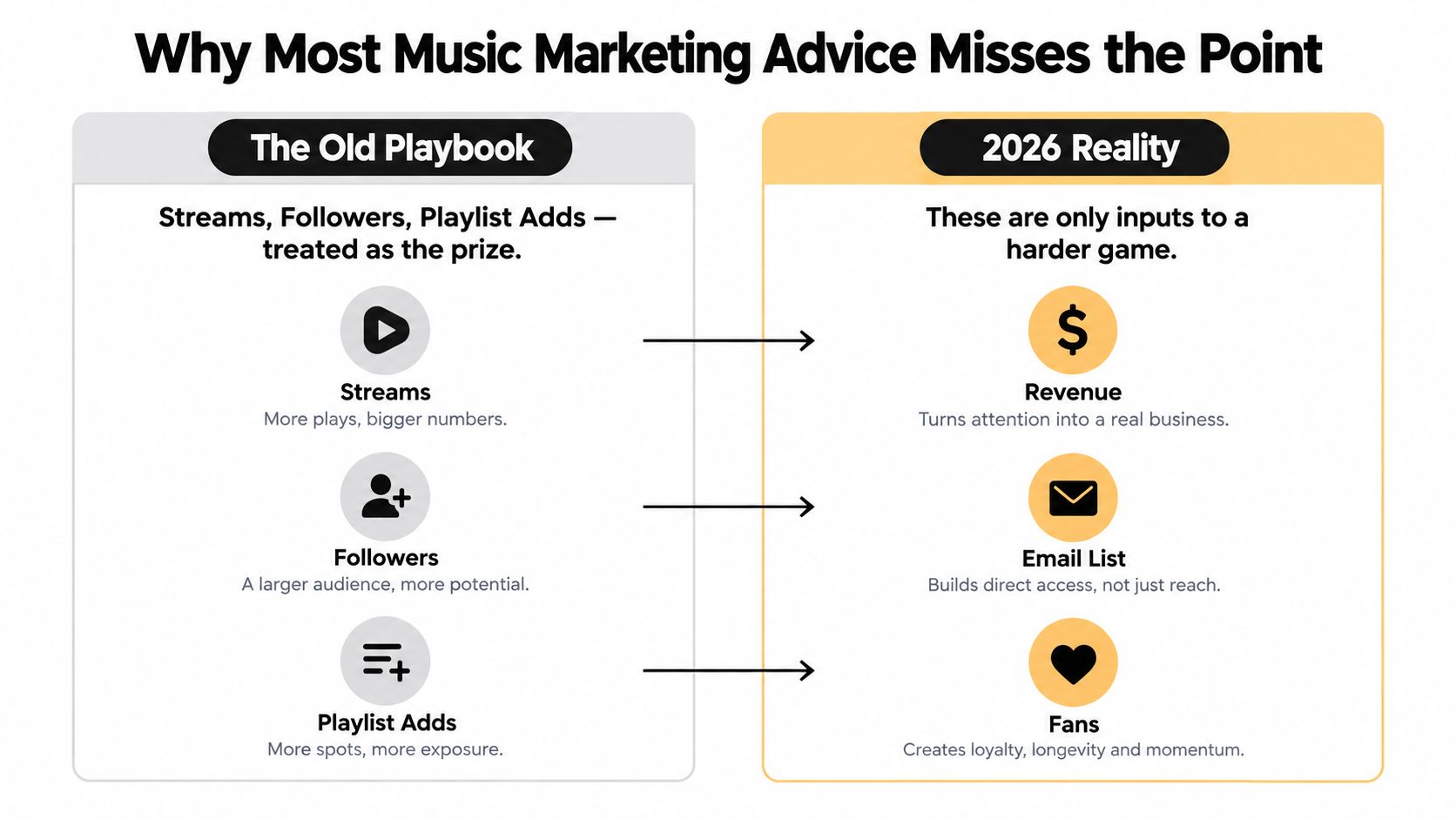
A smaller, responsive audience can outperform a large passive one. Those listeners can join your email list, attend shows, buy products, subscribe, or return for every release. Monthly reach is visibility. A fan relationship is an asset you can contact, measure, and build on.
Music discovery is now split across platforms, formats, and listener habits. MIDiA Research's Music Discovery Snapshot for Q4 2024 examines how audiences find music and what they do afterward. Use that reality to track the full path: where people found you, whether they searched for more, whether they followed, and whether they joined your community or bought something.
The contrarian rule: Every campaign should end with a play plus a next action.
The next action might be an email opt-in, direct message, profile follow, pre-save, download, ticket purchase, or product order. A campaign that produces views and nothing else has rented attention from a platform. It has not built your marketing system.
Start with discovery content, then give interested listeners a reason to stay close. Connect the release to an owned channel and a paid offer that fits the artist, whether that means exclusive music, merchandise, memberships, live access, or another direct purchase. Measure how many people return and what they spend, not only how many saw the post.
Reach is an input, not the prize
Within that same IFPI dataset, paid subscription streaming grew 9.5% in 2024, and paid subscription accounts rose 10.6% to 752 million worldwide, while ad-supported streaming revenue grew only 1.2%. Build campaigns for the part of the market that pays and stays, not just the part that scrolls past.
A successful post creates curiosity. A successful release system turns that curiosity into repeat listening, identifiable fans, direct contact, and revenue. That is the standard your marketing should meet.
The Discovery to Revenue Funnel Every Artist Needs
A useful funnel separates four jobs that artists often collapse into one vague goal called “promotion.”
Discovery is where cold audiences first encounter you. TikTok, YouTube, playlists, search, collaborations, and ads can all do this work. Track reach, video completion, profile visits, and the quality of the audience arriving. The common failure is celebrating a large view count when nobody visits the artist profile or listens beyond the clip.
Consideration begins when someone shows curiosity. They watch another video, follow the account, save a track, search for the artist, or listen to more of the catalog. This stage answers a blunt question: does the person care enough to investigate? Give them a coherent profile, a clear artist identity, and more than one reason to stay.
Conversion happens when the listener raises a hand or spends money. That could mean joining an email list, pre-saving a release, downloading an exclusive track, buying a shirt, subscribing, or purchasing a ticket. Social media discovery can be powerful here. In a mixed-methods study, 71 of 98 respondents, or 68%, identified social media as a way they discover new music, and 78% said they were at least somewhat likely to listen after seeing a song on social media, according to the study on music discovery and social media. The mistake is stopping at exposure instead of providing a next step.
Retention is the economic engine. Retained fans return for another release, buy again, attend shows, refer friends, or continue a subscription. Track repeat actions by cohort, not just total followers. A listener who returns and buys is more valuable than a casual viewer who disappears.
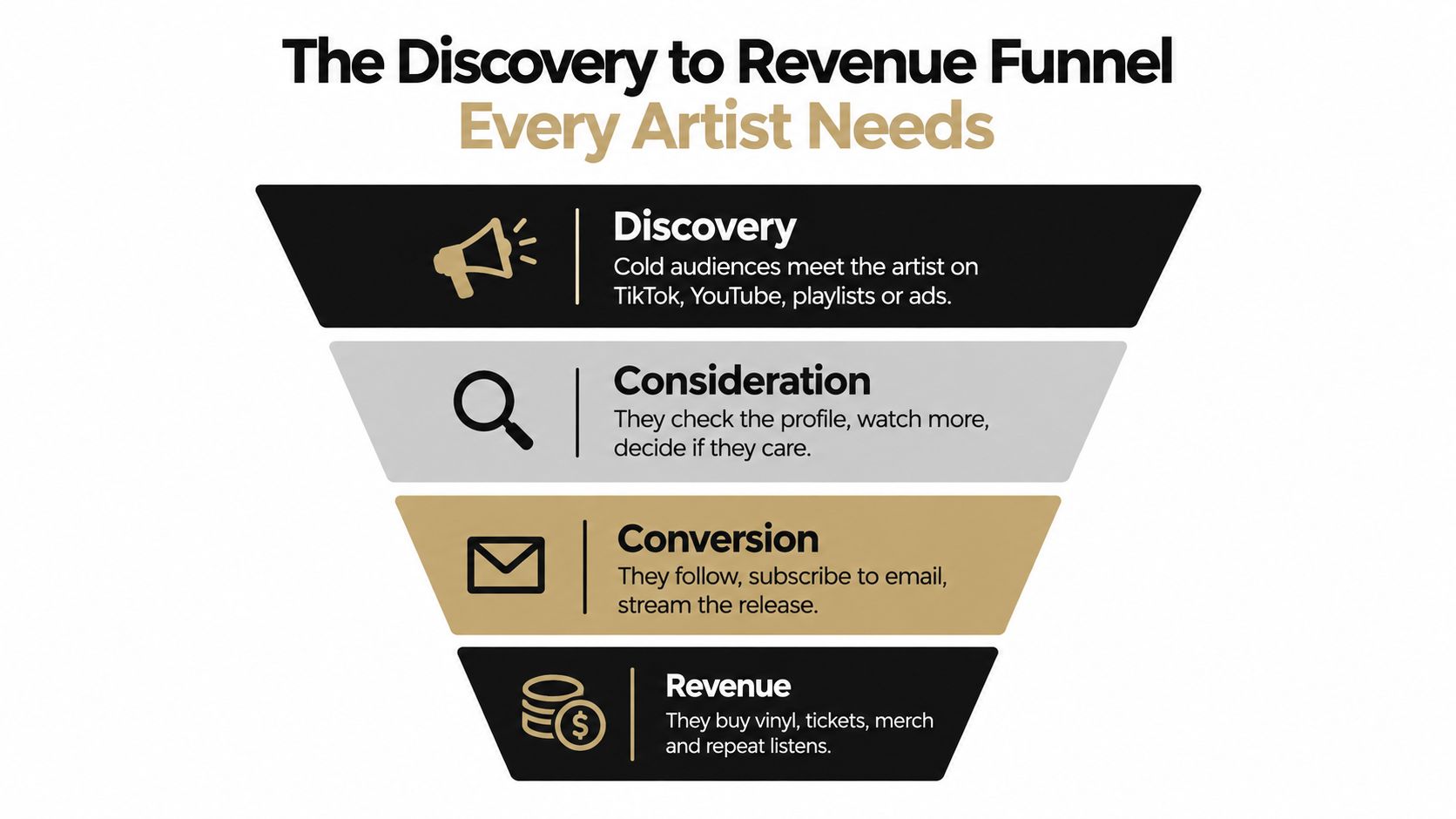
Without this vocabulary, artists confuse a reach number with a business result. Brand positioning feeds Discovery, channel selection fills Consideration, and direct-to-fan offers close Conversion and Retention.
Building an Artist Brand and Release Plan That Travels
Start with one sentence: who are you, who is the music for, and why should that audience care now? “I make alternative pop” isn't positioning. “I write intimate bedroom-pop songs for burned-out office workers who need somewhere quiet to put their feelings” gives the music a listener, a context, and a creative direction.
Your visual identity should reinforce that sentence. Choose a repeatable relationship between color, typography, cover art, photography, and video. The point isn't to make every asset identical. The point is to make the artist recognizable when a listener moves from Spotify to Instagram, YouTube, a press page, or your storefront.
Give the release a narrative spine
Build a season around a theme rather than treating every single as an isolated announcement. A run of songs about separation, recovery, ambition, or displacement creates a reason to follow the journey. Your visual language, interviews, live set, behind-the-scenes posts, and product offers can all express the same world without repeating the same caption.
A single-first rollout lets you test audience response and refine the story before committing to a larger project. An album-first rollout makes sense when the work depends on a complete sequence and you already have the resources to sustain attention across the full release. Neither approach rescues unclear positioning.
Use a 6 to 8 week pre-release window to prepare the audience, not to fill a calendar with random teasers. Create a pre-save path, an anchor piece of content, short clips, a press asset, and a clear conversion offer. The campaign should give each funnel stage a job.
| Stage | Duration | Primary Output | Funnel Stage |
|---|---|---|---|
| Positioning and assets | 6 to 8 weeks before release | Core story, artwork, video, landing page | Discovery |
| Teaser and education | 4 to 2 weeks before release | Short clips, context, pre-save invitation | Consideration |
| Release activation | Release week | Track, email, video, direct offer | Conversion |
| Aftermath and catalog | Following weeks | Live content, follow-up, next action | Retention |
Keep the destination consistent. An artist onboarding page can sit alongside your streaming links as part of a broader owned audience system. Without that foundation, every channel trick is noise placed on top of an unclear product.
Owned Channels, Social, Email, and Paid Ads Compared
Don't post the same asset everywhere and call that a strategy. Each channel has a different job, and your budget should follow the job.
Short-form social is strongest at discovery. TikTok and Instagram Reels can introduce a song through performance, story, process, or a compelling visual moment. Community feeds and direct messages do different work. They let you answer questions, recognize supporters, and move an interested listener closer to an owned relationship.
Email is the retention channel you can operate directly. Capture addresses through pre-saves, exclusive downloads, show signups, gated behind-the-scenes material, or product access. Segment people by behavior. A new subscriber needs a welcome sequence. A repeat purchaser can receive early access. A fan who attended a show can receive the next local announcement rather than a generic broadcast.
Paid ads should amplify a working path, not compensate for a broken one. Use discovery ads to introduce a strong creative, retarget people who watched or visited, and reserve conversion campaigns for a specific offer. Watch audience overlap, creative fatigue, and the relationship between CPM, CPC, and CPA. If the ad earns clicks but no opt-ins or purchases, change the landing page or offer before increasing spend.
| Channel | Best For | Typical Cost | Main Risk |
|---|---|---|---|
| Short-form social | Discovery and creative testing | Time, production, or platform spend | Reach without intent |
| Retention and release conversion | List and tool management | Weak segmentation or irrelevant sends | |
| Direct messages | Personal connection and feedback | Artist time | Becoming unscalable or intrusive |
| Paid ads | Amplifying proven creative | Media budget and production | Paying for attention that never converts |
| Streaming platforms | Listening, saves, and catalog access | Distribution and promotion resources | Treating streams as owned fans |
| Owned store | Products, subscriptions, and fan data | Setup and fulfillment | Too many offers or unclear value |
Streaming platforms remain essential, but they don't replace a store or mailing list. Use them to make listening easy, then give committed fans a direct place to support the work. For a practical look at platform advertising choices, review this advertising with Spotify guide from Carlos Alba Media.
The right channel mix depends on the bottleneck. If nobody knows you, improve discovery creative. If people listen but don't return, improve your profile and follow-up. If fans engage but don't buy, fix the offer and the path to purchase.
A Realistic Release Cycle From Teaser to Aftermath
Take a fictional mid-tier indie artist preparing one emotionally direct single. Six weeks before release, the artist defines the song's central story, records a performance video, prepares cover art, writes the email sequence, and creates a landing page with one clear next action. The point isn't to produce endless content. It's to create one coherent campaign spine.
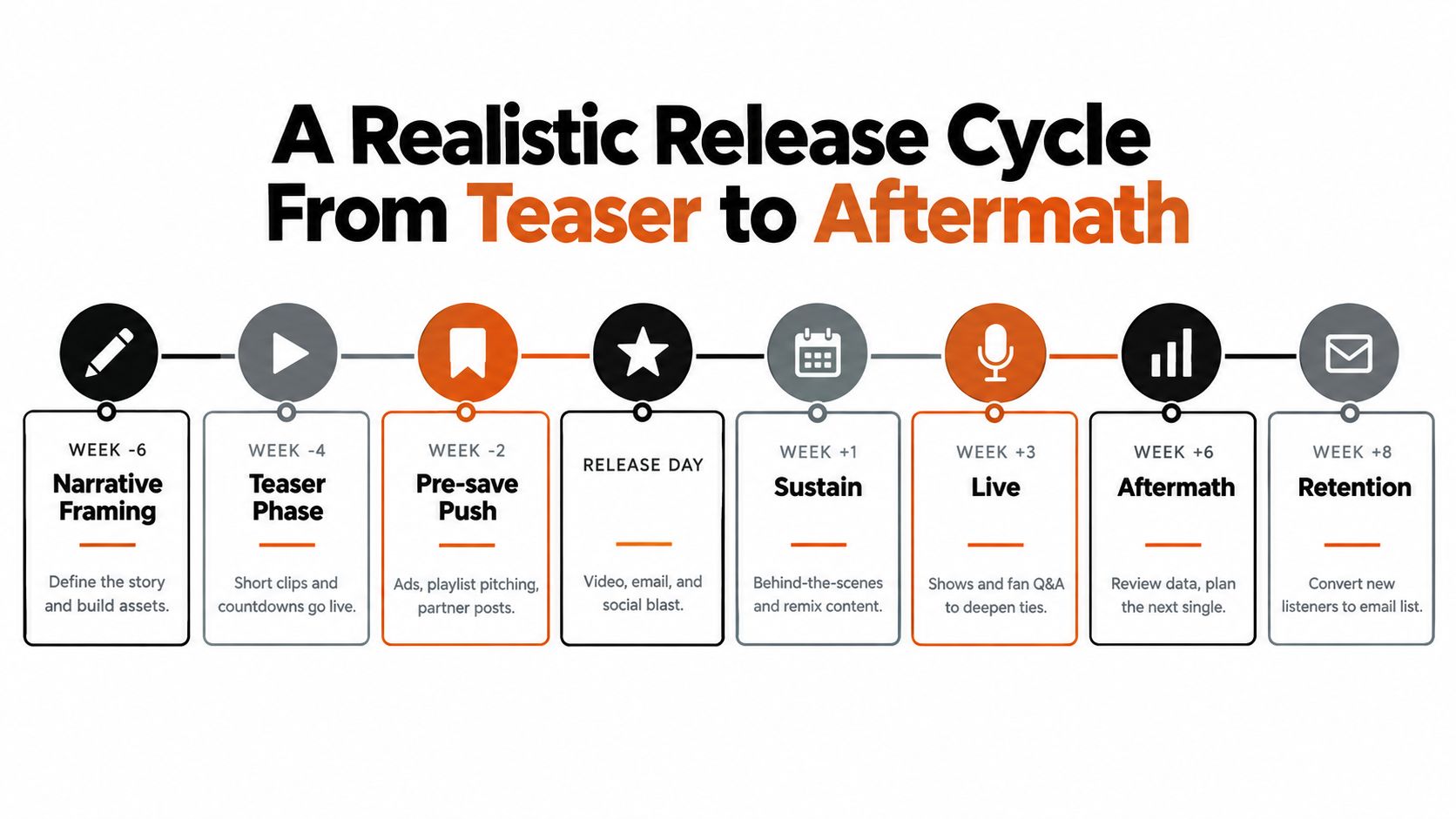
At Week -4, the artist releases short clips showing the song's emotional tension and production process. Each clip points toward the pre-save or email signup. At Week -2, the artist contacts relevant collaborators, curators, and press contacts while retargeting people who engaged with the earlier clips. The metric isn't raw reach. It's profile activity, pre-saves, opt-ins, and qualified replies.
Release day deserves focus, but don't burn the entire budget in the opening hours. Publish the anchor video, email the list, answer comments, and give existing supporters a reason to share. A limited digital extra, an acoustic version, or early access to a live session can turn passive listening into a direct action without making the core track feel like a sales prop.
The aftermath is part of the release
During the following weeks, publish alternate performances, lyric context, production notes, fan responses, and live clips. Retarget engaged listeners who haven't joined the list or followed the artist. Bring the song back through a new angle instead of repeating the original announcement.
At the review point, compare discovery metrics with retention and revenue signals. Did new listeners save the track, explore the catalog, join the list, attend a show, or buy something? If the release generated attention but no deeper action, the next campaign needs a stronger conversion path. If it generated a small group of active supporters, build around them before chasing a larger cold audience.
Direct-to-Fan Sales, Partnerships, and Collaborations
A direct offer should feel like a natural extension of the music, not a desperate attempt to monetize every interaction. Start with a product that gives committed fans something more meaningful than another public stream. That might be a limited physical item, an exclusive bundle, a vinyl pre-order, a membership, stems, a private listening session, or a behind-the-scenes release.
Scarcity works when it's honest. State what makes the item limited, explain when access closes, and fulfill the promise. Don't manufacture urgency around an ordinary product. Fans can tell when an artist respects their attention.
Choose partners like a business owner
A collaboration needs more than audience overlap. Evaluate three things:
- Audience fit: Would the partner's fans plausibly care about your music?
- Margin: After production, fulfillment, platform, and partner costs, does the offer still make sense?
- Long-term value: Will the collaboration create a relationship, reusable content, or direct fan access?
Cross-promotions, producer collaborations, playlist exchanges, sync opportunities, and brand work can all help when the terms are clear. Avoid partners who demand control over future releases, lock you into unclear obligations, or make you borrow money before demand exists.
A good partnership gives both sides a specific action. Release a joint track with a shared email invitation. Pair a show with a limited product. Trade meaningful audience access, not empty shout-outs.
The storefront should capture consent and useful purchase data while making fulfillment manageable. A platform such as direct artist selling tools can support music, merchandise, subscriptions, pre-orders, and direct fan interaction in one artist-controlled destination. Use it as a complement to DSPs, not as a reason to abandon them.
The business objective is simple: turn a listener's enthusiasm into an action you can understand and serve again.
Metrics, Attribution, and Budget Decisions That Hold Up
Streams and follower growth are useful context, but they don't tell you whether marketing is creating a durable business. Track cost per email opt-in, cost per buyer, revenue per fan, repeat purchase behavior, subscription continuation, and the percentage of engaged listeners who take an owned action.
Use simple attribution before you buy software. Give each campaign a unique UTM link, smart link, discount code, or landing page. Compare those results with Spotify for Artists, YouTube Studio, social dashboards, and your direct-to-fan store. You won't get perfect attribution. You can still make better decisions than guessing.
For a broader explanation of the problem, what is marketing attribution in 2026 from The AI CMO is a useful reference. The practical lesson for an independent artist is to document the source of each action and avoid crediting every sale to the last platform someone touched.
| Channel | Discovery Goal | Conversion Goal | Retention Goal |
|---|---|---|---|
| Short-form video | Qualified profile visits | Pre-saves and link clicks | Replies and community participation |
| Introduce the release | Streams, downloads, and purchases | Repeat listening and early access | |
| Paid social | Reach a defined audience | Opt-ins, tickets, or products | Retargeting and repeat offers |
| Live events | New local listeners | Tickets and merchandise | Direct signups and return attendance |
| Streaming platforms | Listening and saves | Catalog exploration | Repeat listening and follows |
Set a break-even target before spending. You might measure cost per qualified fan, cost per direct interaction, or expected contribution margin from a product or subscription. If discovery is weak, fund creative testing. If discovery works but conversion fails, improve the offer and landing page. If you already have responsive fans, spend more time on retention than reach.
Review the campaign weekly:
- Audience quality: Who arrived, and did they explore the catalog?
- Funnel movement: Which action is losing people?
- Offer clarity: Did fans understand what to do next?
- Unit economics: Did the revenue or expected value justify the spend?
- Next test: What single variable will change in the next campaign?
Use the artist marketing academy to strengthen the operational side, then keep your reporting simple enough to maintain after a long day of making music.
A 90-Day Plan and the Mistakes That Derail It
A useful 90-day plan gives you enough time to build infrastructure, promote a release, and inspect the results without pretending that one post will change your career.
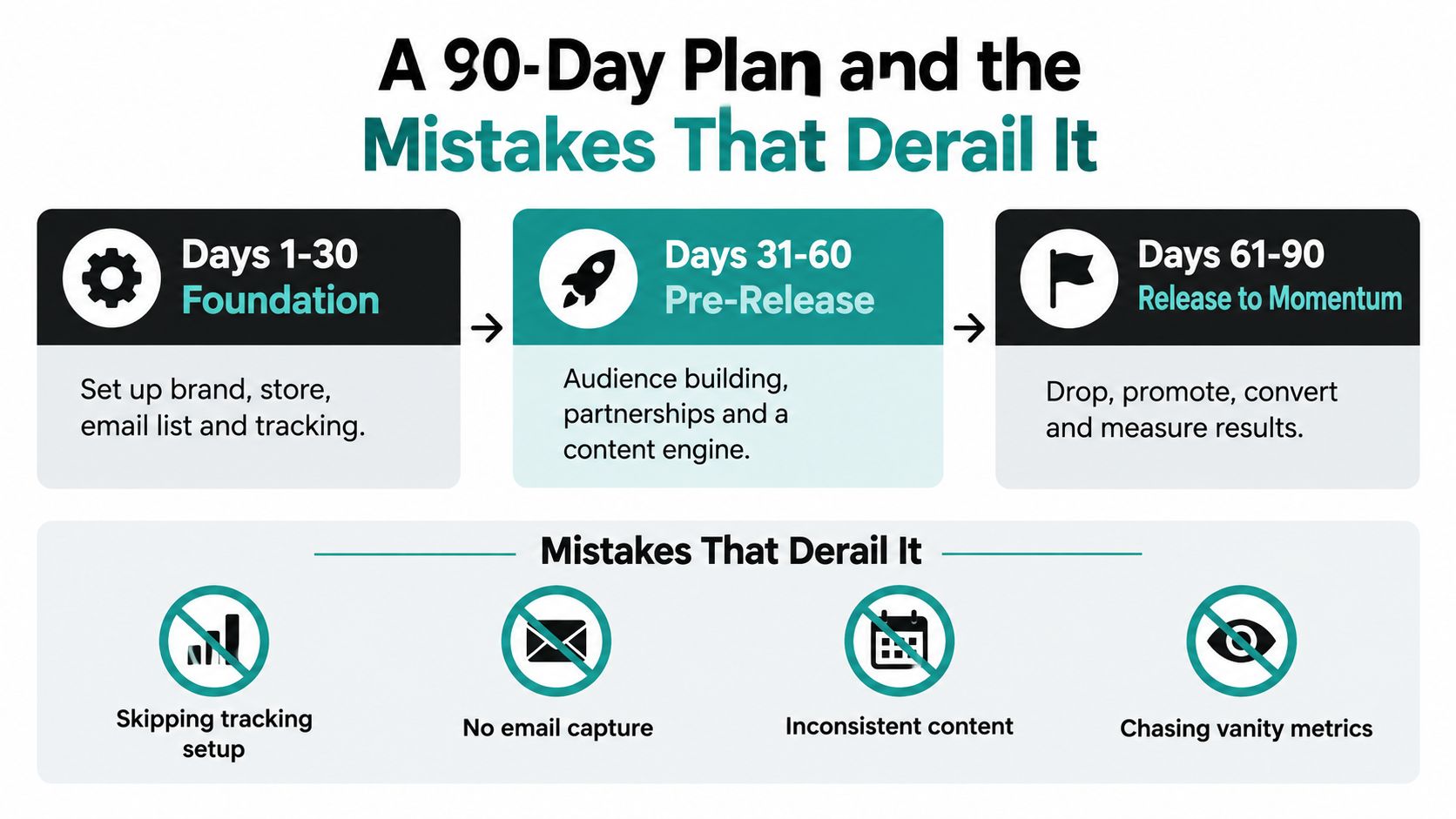
Days 1 to 30 build the foundation
Clarify the artist position, standardize the visual identity, set up the store and email capture, create tracking links, and prepare a simple welcome sequence. If you work a day job, reserve focused sessions for setup rather than trying to manage every platform daily.
Days 31 to 60 build demand
Choose the next release, create the anchor content, publish discovery clips, contact relevant collaborators, and invite listeners into the list. Test different creative angles, but keep the destination and offer consistent enough to compare results.
Days 61 to 90 convert and retain
Release the music, email the audience, activate the offer, retarget engaged listeners, publish aftermath content, and review the full path from first exposure to purchase or signup. Ask which audience segment returned and what they did next.
Industry evidence supports taking budget and retention seriously. A 2025 survey identified financial constraints as the leading challenge for independent musicians, reported by 64.4% of respondents, while building a fanbase and finding live opportunities were each reported by 55.6%, according to the independent music industry report. Separate industry reporting found that 87% of non-major labels said artist cut-through was harder, and 78% said retaining fan interest was difficult, as summarized in the 2025 music rights report.
Avoid the predictable failures: launching without email capture, sending traffic to a dead-end streaming link, measuring only vanity metrics, releasing without a backend offer, and treating release day as the finish line. Also avoid buying reach before you know which audience and creative produce meaningful actions.
Before the next cycle, audit your positioning, landing page, tracking, list segments, offer margin, content performance, repeat actions, and unresolved fan questions. Then choose one bottleneck. Marketing for music artists improves when you fix the constraint in front of you instead of adding another channel.
Use OohYeah to bring your artist profile, direct fan relationships, music, merchandise, subscriptions, and promotional activity into a more manageable system. Set up the owned part of your funnel, give listeners a clear next action, and start measuring the fans who return, interact, and pay.