what are performance royalties: a clear path to earnings
Discover what are performance royalties, how they are earned from public plays, and steps to collect your music income.
October 24, 2025
Music Marketplace Advisor
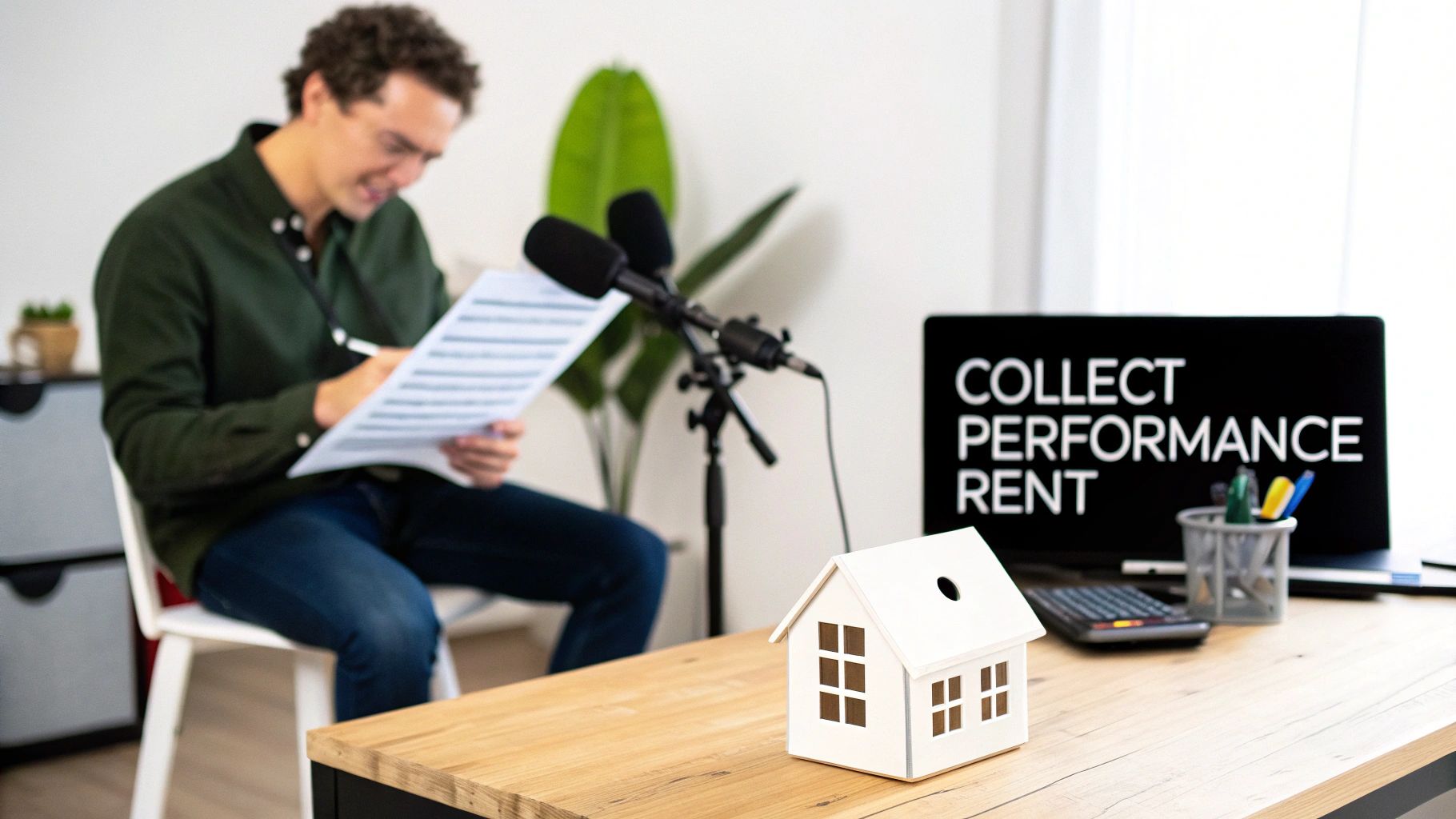
Buying & SellingPerformance royalties are payments made to songwriters and publishers each time their musical composition reaches an audience in a public setting. Picture it like collecting rent whenever your tune airs on the radio, pops up on a streaming playlist, or fills the background of a café. This income stream rewards the composition itself—the melody, lyrics, and structure—not the recorded track.
What Are Performance Royalties Really
At its core, a song carries two distinct identities: the composition (your blueprint of melody and words) and the sound recording (the studio performance you capture). Performance royalties attach exclusively to that first identity—the underlying musical work.
Whenever someone broadcasts or performs your composition in public, a fee is generated and directed back to its creators.
The Foundation Of Your Earnings
Performance royalties build a reliable revenue stream for creators. Every play—from a single spin on the radio to thousands of streams online—earns a fraction of a cent. Those tiny amounts add up quickly when your song gains traction.
These fees cover a wide range of public performances:
- Broadcasts on AM/FM radio and television
- Interactive platforms like Spotify and non-interactive streams such as Pandora
- Live concerts, bar gigs, and café sessions
- Background playlists in retail shops, gyms, and waiting rooms
Think of it this way: if an audience can hear your composition, a public performance license must cover it—and the writer and publisher deserve compensation.
A Significant Piece Of The Pie
On a global scale, performance royalties carve out a notable slice of the music industry’s revenue. They account for about 9.7% of total recorded music revenues, highlighting how crucial they are for creators. You can learn more by reviewing the latest global music report and its findings.
Below is a quick overview that lays out the essentials of performance royalties:
Performance Royalties At A Glance
| Element | Description |
|---|---|
| Definition | Fee paid to songwriters and publishers when their composition is publicly performed. |
| Who Earns | Songwriters, composers and publishers. |
| Triggers | Radio/TV broadcasts, digital streams, live venues and background music in public spaces. |
| Calculation | Based on performance counts, venue size and licensing agreements. |
| Collection | Managed by Performance Rights Organizations (e.g., ASCAP, BMI, SESAC). |
| Payout Schedule | Typically distributed quarterly or biannually, depending on the PRO’s policies. |
Refer back to this summary whenever you need a refresher on performance royalties and how they support your creative work.
The Role Of Performing Rights Organizations
So, how does the money from thousands of coffee shops, radio stations, and streaming platforms actually make its way back to the songwriter? It’s a great question. After all, you can't possibly track every single time your song gets played in public and then send an invoice to each business.
This is where the unsung heroes of the music business step in: Performing Rights Organizations, or PROs.
Think of a PRO as a dedicated collection agent for your songs. These organizations are the critical link between you—the creator—and the countless businesses that use your music. In the United States, the big three are ASCAP (the American Society of Composers, Authors and Publishers), BMI (Broadcast Music, Inc.), and the smaller, invite-only SESAC. Most countries have their own equivalent, like SOCAN in Canada or PRS for Music in the UK.
For any serious songwriter, choosing and affiliating with a PRO isn't just a good idea; it's a fundamental step. It's the only realistic way to get paid for the public performance of your work.
What PROs Actually Do
PROs manage a seriously complex system, but their work really boils down to three core jobs. Each one is a vital piece of the puzzle that gets performance royalties from the listener's ear to your bank account.
Here’s a breakdown of what they handle:
- Licensing Music Users: PROs sell "blanket licenses" to venues, broadcasters, and digital services. For a single annual fee, a business gets the legal green light to play any song from that PRO’s massive catalog. This saves them the impossible task of negotiating with millions of individual songwriters.
- Tracking Public Performances: This is the detective work. They use a sophisticated mix of digital monitoring, radio station logs, TV show cue sheets, and direct data feeds from streaming services to figure out when and where songs are being played.
- Collecting & Distributing Royalties: After collecting all those license fees, they take a small cut for their operational costs. The rest is then distributed to their affiliated songwriters and publishers based on the performance data they’ve gathered.
By managing this whole process, PROs create an efficient system. They make it simple for businesses to use music legally while ensuring creators get paid when their work connects with an audience.
This is why it's absolutely crucial to register your entire catalog with your chosen PRO. Every single song, complete with the correct co-writer names and ownership splits, has to be in their system. If a song isn't registered, it's invisible to the PRO. Any royalties it earns will just sit there, uncollected—one of the most common ways songwriters unknowingly leave money on the table.
To give you an idea of their scale, ASCAP has over 975,000 members and BMI represents over 1.4 million music creators, collectively managing the rights for tens of millions of songs. As a songwriter, you can only affiliate with one. You have to pick a team—you can't be a writer with both ASCAP and BMI. This rule prevents chaos and ensures there’s no confusion about who is responsible for collecting your performance royalties.
Mapping The Different Music Royalty Streams
Picture this: your new single gets a primetime spin on a major radio station. That single moment doesn't just generate one type of payment—it kicks off a cascade of different royalty streams.
To really get a handle on what performance royalties are, it helps to see them in context with the other ways your music makes money. Let's break down the three main royalty types that can be triggered by a single public play.
What Are The 3 Main Types Of Music Royalties?
First, you have Performance Royalties. These are the payments songwriters and publishers earn whenever their song is performed or broadcast publicly. Think radio airplay, TV shows, live concerts, or even background music in a coffee shop or bar.
Next up are Mechanical Royalties. These are generated every time your song is reproduced. In the old days, this meant physical copies like CDs or vinyl. Today, it mostly applies to digital downloads and on-demand interactive streams (like a user picking your song on Spotify). These are paid directly to songwriters and their publishers.
Finally, there are Master Royalties (also known as sound recording royalties). These royalties are paid to the owner of the actual recording of the song—typically the recording artist and their record label. They're generated when the specific recording is used, most commonly for non-interactive digital streams like Pandora or satellite radio.
“Each time your song moves an audience, these streams work together to reward every creative and technical contributor.” – Jane Smith, Music Lawyer
The system can seem complicated, but Performing Rights Organizations (PROs) are designed to manage the licensing, tracking, and payment distribution for you. This visual map helps illustrate how they fit into the picture.
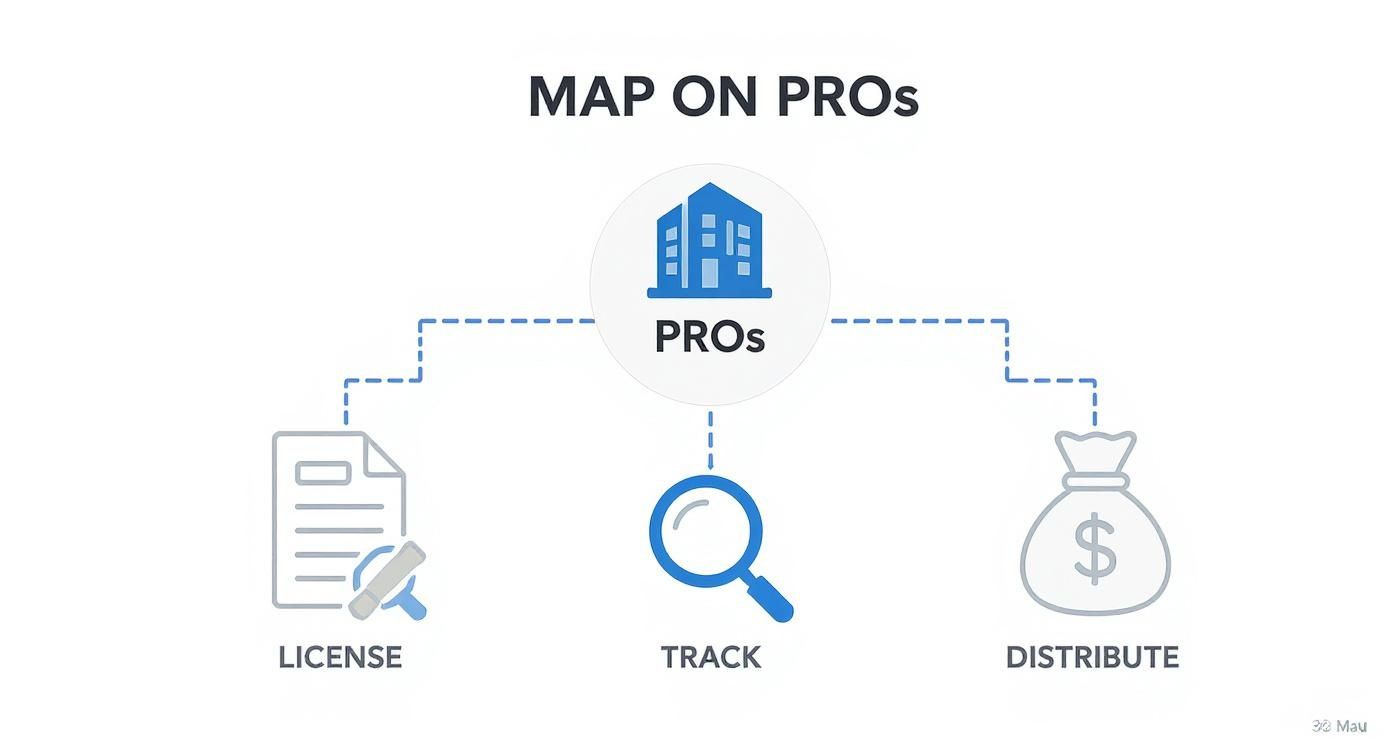
As you can see, the PROs handle three core functions: they license your music to users, track where it's played, and then distribute the royalties back to you.
Performance vs Mechanical vs Master Royalties
Seeing these royalty types side-by-side really helps clarify the differences. A single radio spin generates a performance royalty, but a Spotify stream generates both performance and mechanical royalties, while a Pandora play generates performance and master royalties.
Here’s a simple table to help you keep it all straight.
| Royalty Type | What It Pays For | Who Gets Paid | Collected By |
|---|---|---|---|
| Performance Royalties | Public plays on radio, TV, live venues, streams | Songwriters and publishers | ASCAP, BMI, SESAC |
| Mechanical Royalties | Reproduction on downloads, CDs, interactive streams | Songwriters and publishers | The MLC, Harry Fox Agency |
| Master Royalties | Use of the sound recording in non-interactive digital streams | Artists and labels | SoundExchange |
Understanding this breakdown is the first step toward making sure you're not leaving money on the table. Each stream rewards a different right and a different set of creators, and it's your job to ensure you're set up to collect everything you're owed.
If you want to dig even deeper, we have a complete guide on how to make money as a songwriter that explores these income streams in more detail.
How To Maximize Your Royalty Revenue
A clear view of performance, mechanical, and master royalties is crucial. With this knowledge, you can confidently claim every cent your work has earned.
- Register every single song. Make sure your work is registered with your PRO and The MLC as soon as it's finished. Don't wait until after the release.
- Keep an eye on your data. Regularly check your streaming and download numbers across different platforms. This helps you spot trends and potential reporting errors.
- Think globally. If you're getting plays overseas, look into reciprocal agreements your PRO has with foreign collection societies to ensure you're collecting international revenue.
Monitoring your royalty statements is not just an administrative chore—it's an essential part of managing your music business. Catching errors early can significantly boost your income, and exploring how royalties are collected abroad can unlock hidden global earnings.
Next Steps
So, what should you do right now?
- Audit your PRO statements. Set a reminder to review them quarterly and report any discrepancies you find.
- Register new releases early. Get your songs registered before their launch dates to avoid any missed earnings from the initial buzz.
- Consider professional help. If you're seeing significant international activity, a publishing administrator can be invaluable for optimizing your collections from around the world.
Following these steps will help you build a clear and reliable royalty roadmap, keeping every income stream flowing directly into your account.
How Your Royalties Are Tracked And Calculated
https://www.youtube.com/embed/ygz34mhnNMI
So, how does the money from a song played on the radio or in a TV show actually find its way to you? It’s not magic—it's a massive data operation run by Performing Rights Organizations (PROs). They have the tough job of monitoring a staggering number of public performances to make sure songwriters and publishers get paid accurately.
This process is a blend of high-tech monitoring and good old-fashioned reporting. PROs don't just guess which songs are getting played; they actively collect hard data from a whole range of sources to figure out who gets paid and how much.
The Tools of the Tracking Trade
PROs use a few different tools and methods to keep tabs on where and when your music is played. Each method is built for a specific type of performance, whether it's a major network TV show or a local coffee shop's background playlist.
Here’s a look at how they pull it all together:
- Digital Monitoring: Think of it like a digital detective. Sophisticated software constantly "listens" to thousands of radio and TV stations, using audio fingerprinting to identify every song that gets broadcasted.
- Cue Sheets: For film, TV, and commercials, production companies fill out a detailed log called a cue sheet. This document lists every single piece of music used in the production, down to the second, and how it was featured (e.g., background, theme song).
- Direct Data Feeds: This is a big one. Digital streaming services like Spotify and Apple Music send enormous, detailed reports directly to the PROs, accounting for every single stream.
- Live Performance Setlists: For the live music scene, artists and venues can submit setlists from their shows directly to their PRO. This ensures that even performances at ticketed concerts generate royalties.
The goal is pretty straightforward: the more data a PRO can gather, the more precise the royalty distribution will be. Every single data point helps create an accurate picture of your music's journey.
Once all this information is collected, it's crunched to calculate your payment. For example, radio airplay royalties in the U.S. often average around $0.06 per play. If your song gets played 1,000 times across different stations, that could add up to about $60 in performance royalties.
While streaming payouts might seem small—Spotify's is around $0.00437 per stream—the sheer volume of plays can make those fractions of a penny add up to something substantial over time.
This entire system is a crucial piece of the larger music rights puzzle. For a more complete picture, check out our guide on understanding music licensing and how it can open up new income streams. Down the road, emerging technologies that let you build smart contracts without any code promise to make this even more transparent, automating royalty payments in a way we've never seen before.
Your Guide to Collecting International Royalties
In today's music world, your songs don't need a passport. A track that takes off in Berlin or goes viral on TikTok in Brazil can rack up serious income, but only if you’re set up to collect it. This is where understanding international performance royalties becomes crucial for any artist looking to get paid for their global reach.
So, when your song gets played on the radio in Spain or streamed in Japan, the local Performing Rights Organization (PRO) in that country is the one who collects the money. How does that cash make its way back to your pocket? It all happens through a web of reciprocal agreements between PROs across the globe. Your home PRO, like ASCAP or BMI, has partnerships with these foreign societies to collect royalties on your behalf.
The Power of Global Agreements
Think of these agreements as a financial relay race. When a French radio station plays your track, SACEM (the French PRO) collects the fee. Thanks to their agreement with your PRO, SACEM then passes that money along the chain until it eventually lands in your royalty statement. This system is designed to make sure your music earns money no matter where in the world it finds an audience.
Now, it's not always a perfect system. Collecting royalties from other countries can be a much slower and more complicated process than getting your domestic payments, sometimes taking over a year to show up. Still, it’s an increasingly vital income stream.
With music being totally borderless online, tapping into global revenue isn't just for superstars anymore. It’s a fundamental part of building a sustainable career, even for independent artists.
The global market for performance rights is on a serious upswing. For example, revenues from the public performance of sound recordings recently jumped by 5.9% to $2.9 billion globally. In the United States alone, total performance royalty payments saw a 4.7% increase to $1.005 billion. These numbers paint a clear picture: royalty income is growing, and every single stream and spin, no matter where it happens, really does matter. You can dig deeper into these trends in this global music publishing market view.
A Practical Checklist To Secure Your Earnings
Alright, now that you understand what performance royalties are, it's time to get practical. Just knowing this stuff isn't enough; you have to take action to make sure that money actually finds its way into your bank account.
This isn't just theory—it's your financial roadmap. Following these steps will help you avoid the common pitfalls that leave so much money unclaimed by artists every year. Let's make sure your hard work pays off.
Choose and Affiliate With a PRO
First things first: you absolutely must join a Performing Rights Organization (PRO). This is non-negotiable. In the U.S., your main choices are ASCAP, BMI, or the smaller, invite-only SESAC and GMR.
Here's the catch: as a songwriter, you can only affiliate with one. Take some time to compare them. Look at their payment schedules, the tools they offer members, and which one feels like the right home for your music. This single decision is the foundation for ever seeing a dime in performance royalties.
Register Every Single Song Meticulously
Think of it this way: if a song isn't registered with your PRO, it's invisible. As far as the royalty system is concerned, it doesn't exist, which means it can't earn you anything.
So, the moment you finish a new song, make it a habit to log into your PRO account and register it immediately.
Accuracy here is everything. Double- and triple-check all the details, especially the co-writer information and the ownership percentages, or "splits." Getting a split wrong is one of the fastest ways to cause payment disputes and long delays down the road.
Submit Your Live Performance Setlists
Are you out there playing shows? Don't leave that money on the table. This is one of the most commonly overlooked income streams for independent artists.
Most PROs have a dedicated program for this, like ASCAP OnStage or BMI Live, where you can upload the setlists from your gigs. It doesn't matter if you're playing a tiny coffee shop or a massive theater—each performance of your original music generates royalties. Get in the habit of submitting them.
Regularly Audit Your Royalty Statements
Your royalty statements are not junk mail; they're your business's financial reports. You need to treat them that way. Every quarter, set aside some time to go through them with a fine-tooth comb.
Here's what you should be looking for:
- Missing Money: Are there songs you know got radio play or were used on a TV show that aren't showing up?
- Performance Trends: Which platforms are your earnings coming from? Are they growing or shrinking? This is valuable data.
- Weird Gaps: Do the numbers look drastically different from the last statement without a clear reason?
Catching these discrepancies early can literally save you thousands. This isn't just about chasing payments; it’s about understanding what's working and where your music is connecting. Building these good administrative habits is a huge part of our tips to increase music streams and maximize your earnings.
And if you need more help, there are plenty of online resources to assist creators with their earnings that can provide extra tools and guidance.
Common Questions About Performance Royalties
Even when you’ve got a solid roadmap, performance royalties still throw curveballs. Here’s a quick-reference guide that answers the scenarios songwriters and artists ask about most.
Think of this as your go-to section for practical tips on collecting what you’ve earned.
Do I Need A Publisher To Collect Performance Royalties
You don’t need a traditional publisher to collect your writer’s share. Just register with a PRO like ASCAP or BMI, sign up your songs, and they’ll send your songwriter portion straight to your account.
Keep in mind that each royalty splits in two halves:
- Writer’s Share: Paid directly to you when you register as the songwriter.
- Publisher’s Share: Only paid out if you have a publisher.
Without a publisher, that second half goes unclaimed. Many indie artists solve this by setting up a “vanity” publishing company or using a publishing administrator so they end up with 100% of their performance royalties.
How Long Does It Take To Get Paid
Delays are part of the process—royalty checks aren’t immediate. Expect about six to nine months from the moment your track airs to when the money hits your account.
For instance, plays from January through March often won’t be paid out until the third or fourth quarter.
PROs juggle license collections, massive performance reports, and payout calculations before issuing payments.
If you’re collecting international royalties, add a few more months—sometimes it takes over a year because foreign societies need extra processing time.
Are Royalties Paid For Plays On YouTube
Yes, YouTube views can generate performance royalties—but it’s only one piece of the puzzle. Your PRO tracks those public performances and pays your share accordingly.
At the same time, YouTube’s Content ID system pulls in advertising revenue, which is separate from performance royalties. To capture both streams, you’ll typically need:
- PRO registration for performance royalties
- A publisher or distributor managing your Content ID claims
This two-pronged approach ensures you’re not missing out on ad income or public performance money.
At OohYeah, we believe that understanding your revenue streams is the first step toward building a sustainable music career. Our platform is designed to give you direct control over your sales and fan relationships, ensuring more of your hard-earned money stays with you. Take control of your music business today at https://oohyeah.app.