How to Build a Band Merchandise Website in 2026
Build a profitable band merchandise website with this step-by-step guide for independent artists. Learn design, pricing, fulfillment, and promotion strategies.
October 7, 2026
Music Marketplace Advisor
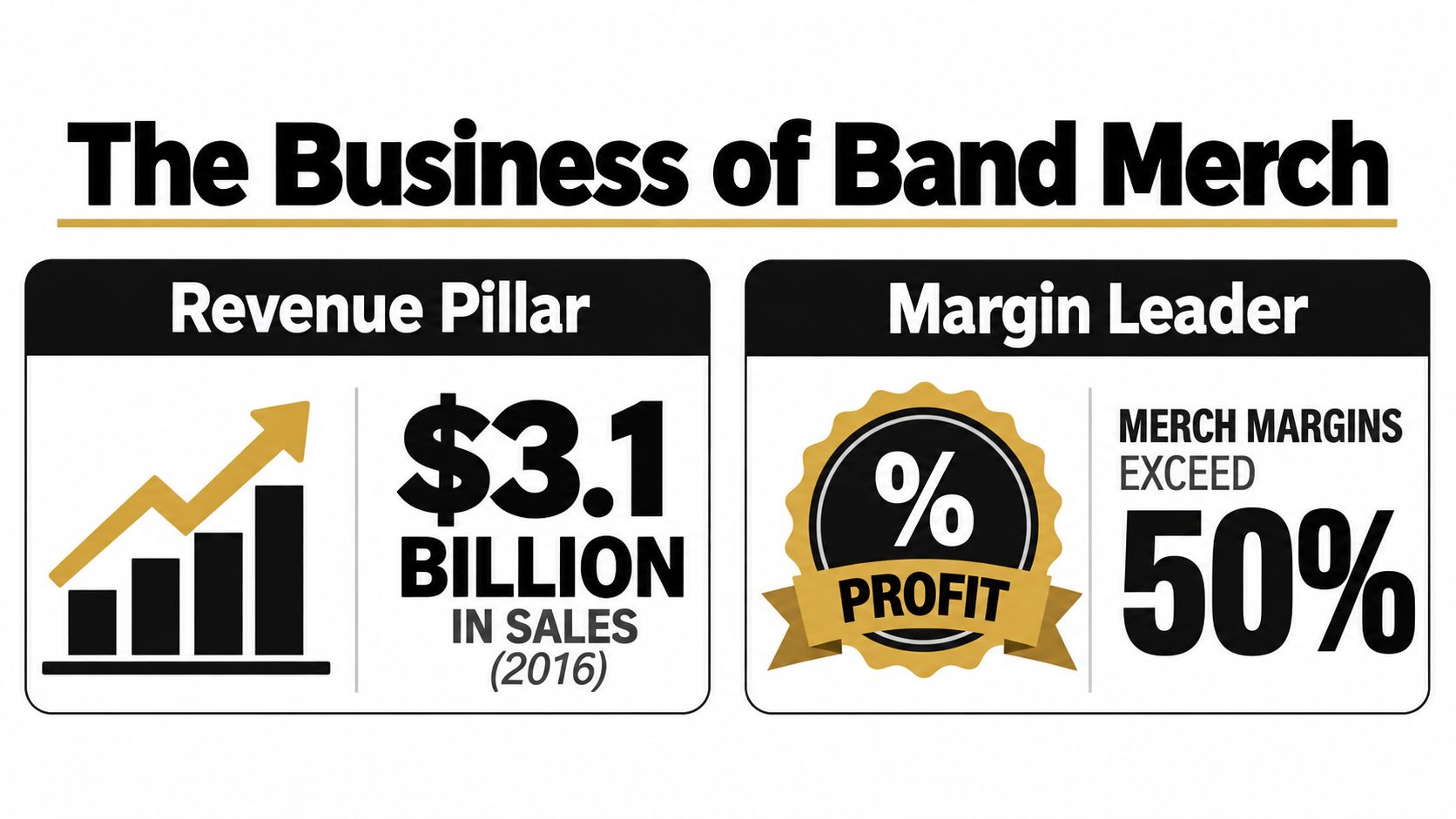
Buying & SellingGlobal band merchandise sales reached about $3.1 billion in 2016, while worldwide live-concert gross revenue was roughly $4.88 billion that year. A band merchandise website is therefore a major revenue channel, not merely a convenient online add-on.
The practical problem appears after the artwork is approved. A fan opens your store from a phone, selects a shirt, discovers that the size chart is vague, learns that shipping will be calculated later, and leaves. Another buyer receives a garment that fits differently from the expected regional standard, asks for an exchange, and turns a profitable order into a margin loss. The storefront looked finished, but the operation wasn't ready.
A profitable merch store depends on decisions that fans rarely see: how many products you carry, how you describe garment measurements, when an order enters production, how clearly you show landed costs, and whether checkout lets a first-time buyer purchase without creating an account. Design and platform choice matter, but these operational details determine whether demand becomes repeatable income.
Why a Band Merchandise Website Matters Now
Merchandise has moved beyond the folding table at the venue. Historical industry reporting placed global merchandise sales at approximately $3.1 billion in 2016, compared with $4.88 billion in worldwide live-concert gross revenue, making merchandise roughly 64% of live-concert revenue on those measures. The same account reported a 9.4% increase between 2015 and 2016, before the current wave of direct-to-fan storefronts became standard. The history of music merchandise shows why artists should treat products as part of the business model, not just as tour memorabilia.
The headline examples are striking. The Spice Girls reportedly generated about $400 million from merchandise between 1989 and 1990, using touring, retail outlets, and fan clubs. Travis Scott reportedly sold $1 million in merchandise during his August 2022 performance at London's O2 Arena. Those figures belong to globally visible acts, but they demonstrate the range of commercial behavior merchandise can support when an artist turns identity, scarcity, and fan loyalty into products.
The direct-storefront advantage
An independent band doesn't need arena-scale demand to benefit from ownership. A venue has limited opening hours, limited stock on hand, limited display space, and a fixed audience for a particular night. A band merchandise website keeps products available after the show, gives overseas fans a way to buy, and lets an artist test designs without waiting for the next tour.
The storefront also gives the artist a clearer relationship with the buyer. A physical table can record a sale, but a properly instrumented website can show which product page attracted attention, which variants caused confusion, and where a customer abandoned checkout. That information helps an artist decide whether to reorder a hoodie, retire a design, or change the way a shirt is described.
Practical rule: Treat every product as both an item for sale and a source of evidence about what fans value.
A direct store won't fix weak artwork or poor promotion. It does, however, turn demand that would otherwise disappear after a concert into an ongoing channel. It also gives independent artists more control over pricing, product timing, customer communication, and the presentation of their visual world. The strongest stores aren't the ones with the largest catalogs. They're the ones that make buying easy and keep operational promises.
Planning Your Merch Catalog for Independent Artists
A new band merchandise website can lose money before its first order ships. Too many shirt sizes, colors, print methods, or suppliers create inventory exposure and add work across photography, customer support, packing, returns, and fulfillment. Catalog planning should begin with “What can we sell reliably?”, not “How many products can we upload?”
Historical live-event data provides one useful benchmark. A 2019 dataset covering approximately 63,251 shows and 3,737 artists reported about $350 million in cumulative merchandise gross sales, with average merchandise sales of $13,887 per show, or approximately $5.50 per ticket. This analysis of artist merchandise economics supports a practical starting point: make the main apparel offer dependable before adding more categories.
Start with a commercial core
A 2024 transaction-level dataset covering more than 100,000 live events found that the median independent artist sold $625 of merchandise during a single night at a venue below 1,500 capacity. The same dataset found that three products accounted for 63% of gross sales. That pattern favors a focused assortment over a sprawling shop, especially when unsold stock and slow fulfillment can consume the margin from otherwise healthy sales.
Build the first catalog around a small set of clear jobs:
- Everyday entry product: A well-photographed shirt gives casual fans a familiar purchase and lets them wear the artist's identity regularly. Limit variants until sales justify more cuts, colors, or size depth.
- Higher-value layer: A hoodie or jacket can carry a stronger design treatment and raise basket value without requiring an entirely new creative direction.
- Low-friction accessory: A hat, patch, or similar item gives fans who do not want apparel another way to support the band. Small products can also simplify sizing-related returns.
- Collector release: Vinyl, signed items, posters, or numbered products belong in the catalog when the audience and fulfillment process can handle limited stock, careful packing, and slower dispatch.
Variety is not the same as useful choice. Every additional variant affects purchasing, storage, size exchanges, replacement orders, and the accuracy of available stock. Use sales records, preorder interest, and recurring customer questions to decide which products deserve another production run. If a size range creates frequent exchanges, change the garment or measurement guidance before expanding that line.
Match the product to the production method
Artwork must survive manufacturing, not just look good on a screen. Review the printing process for custom music merchandise before approving a design, so the print area, material, finishing method, and expected durability fit the product.
A preorder can validate demand before an independent artist purchases inventory. A small batch improves control over quality and dispatch, but requires upfront planning and storage. Made-to-order production reduces unsold stock, though it can limit control over fulfillment speed and the delivery experience while producing thinner margins. Choose based on release urgency, audience geography, expected volume, and tolerance for inventory risk.
Keep the artist's share visible in every calculation. Price each product against production, packaging, payment processing, shipping support, refunds, replacements, and promotional costs. Checkout friction and returns can erase a product's apparent profit even when the selling price looks strong. Artists who want pricing and distribution under their own control can start with the OohYeah for Artist setup. A product succeeds when the artist knows what remains after the order is completed.
Engineering Product Pages That Convert Fans
Product pages should answer purchase questions before a fan reaches checkout. Strong artwork creates desire, but measurements, availability, delivery timing, and return terms remove uncertainty. If those details are hidden, buyers must either guess or leave.
Baymard's quantitative research found that 48% of U.S. shoppers abandoned because extra costs such as shipping, tax, or fees were too high, 22% because delivery was too slow, 16% because the total order cost wasn't visible before checkout, and 12% because the return policy was inadequate. Baymard's ecommerce UX statistics make transparent product information a conversion requirement, especially for international apparel orders.
Build a product information schema
Each item should have a consistent content structure. Don't let a shirt page contain rich information while a vinyl page relies on a single promotional sentence.
Include:
- Variant-level stock: Show which sizes, colors, or editions are available instead of displaying one generic stock message.
- Garment measurements: Provide the actual chest, length, and sleeve measurements where relevant, rather than relying only on S, M, L, or XL labels.
- Fit guidance: Explain whether the garment is oversized, unisex, fitted, or expected to shrink, and include model height and worn size when available.
- Material and construction: Identify fabric composition, print placement, finish, packaging, and any meaningful care instructions.
- Fulfillment timing: Separate production time from transit time. “Ships in five days” means something different from “made to order, then dispatched.”
- Shipping and returns: State destinations, estimated delivery windows, duties or taxes where applicable, and the process for exchanges or refunds.
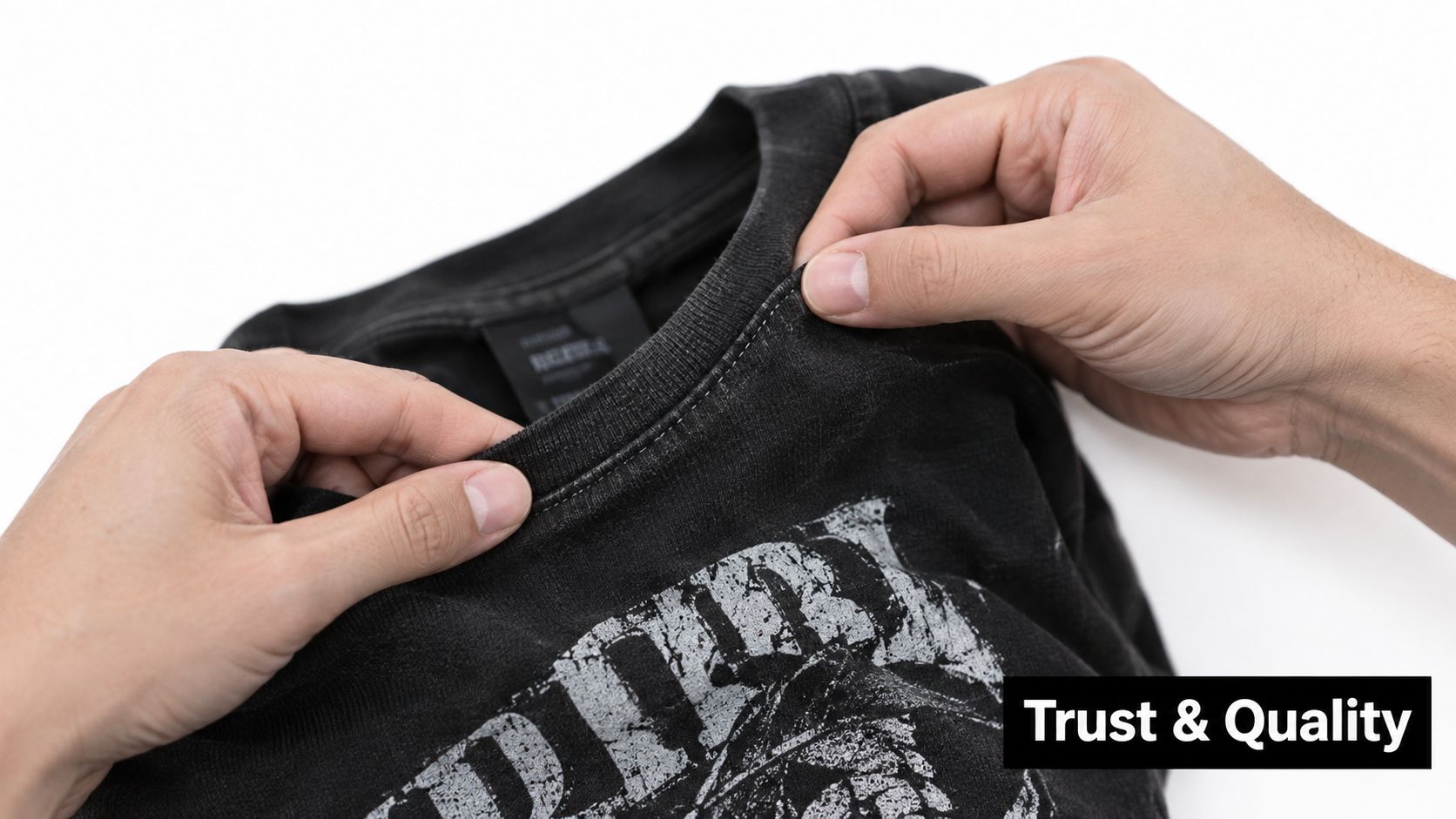
- Useful imagery: Show front, back, detail, label, print texture, and scale. Use accessible alt text that describes the image rather than stuffing it with keywords.
Size information deserves special attention. Shirt blanks can differ across suppliers and countries, even when the label says the same thing. A buyer choosing between an oversized cut and a fitted cut needs a measurement diagram and a clear comparison, not a generic promise that the garment “runs true to size.”
Measure information friction
Track more than revenue. A high view count with weak add-to-cart activity may indicate poor product information rather than weak demand. Useful events include product-page view to cart, variant-selection errors, size-chart engagement, shipping-estimate interaction, and refund or return reasons.
Compressed images can hide print quality. A size chart behind an unclear link can go unnoticed. A single stock status can let a buyer select an unavailable size. These aren't cosmetic defects. They create support tickets, failed orders, and replacement costs.
The operational test: Ask whether a fan can confidently choose a size, understand the delivery promise, and calculate the likely total before committing money.
Product pages should also work on mobile before launch. Test the variant selector, size guide, image gallery, delivery copy, and return details on a small screen. Fans often arrive from a social post with one hand on a phone, so the page must present critical information without forcing them through a scavenger hunt.
Optimizing Checkout to Reduce Fan Abandonment
Checkout optimization is a measurement project, not a visual redesign. A cleaner button may help, but it won't explain whether buyers are leaving because of shipping costs, an account requirement, an unavailable payment method, or uncertainty about delivery.
Baymard's benchmark of 344 leading U.S. and European ecommerce sites reports a 70.19% average cart-abandonment rate. Its usability studies estimate a modeled average conversion uplift of about 35% from improving checkout UX. Baymard's checkout usability research provides a useful benchmark, but your own funnel should determine which problem deserves attention first.
Instrument the journey
Record events across the path from product view to completed order. Segment those events by device, traffic source, product type, and new versus returning fan. Then separate abandonment at the cart, shipping, payment, and confirmation stages.
A practical dashboard should answer:
- Do mobile visitors add products at the same rate as desktop visitors?
- Do international fans abandon after seeing shipping estimates?
- Do apparel buyers behave differently from vinyl or accessory buyers?
- Are returning fans completing orders more often than first-time visitors?
- Which payment or address step produces the sharpest drop?
The answers determine the test. If visitors leave after shipping is revealed, improve cost visibility and delivery language. If the payment stage fails, review available methods and error handling. If the cart empties between sessions, preserve its contents and confirm that the user can return without starting over.
Remove avoidable barriers
Account creation is a frequent source of unnecessary friction. Baymard reports that 62% of benchmarked sites fail to make guest checkout the most prominent option, while 24% of surveyed U.S. shoppers reported abandoning because a site required account creation. The practical response is straightforward:
- Lead with guest purchase: Let a fan complete the order with the minimum required information.
- Offer an account afterward: Present account creation after confirmation, when the buyer has already received value.
- Show landed cost early: Display shipping, taxes, fees, and delivery estimates before payment whenever the system can calculate them.
- Test one change at a time: Compare completed orders per eligible checkout session, rather than judging a redesign by appearance.
- Preserve the cart: Keep selected items available when a fan returns to the store or changes device.
International segmentation matters because shirts, posters, vinyl, and accessories can have different packaging, shipping, and return economics. A checkout that works for a domestic shirt order may perform poorly for a cross-border vinyl order. Review the results by destination and product type before applying a single global assumption.
Choosing Fulfillment Models That Protect Margins
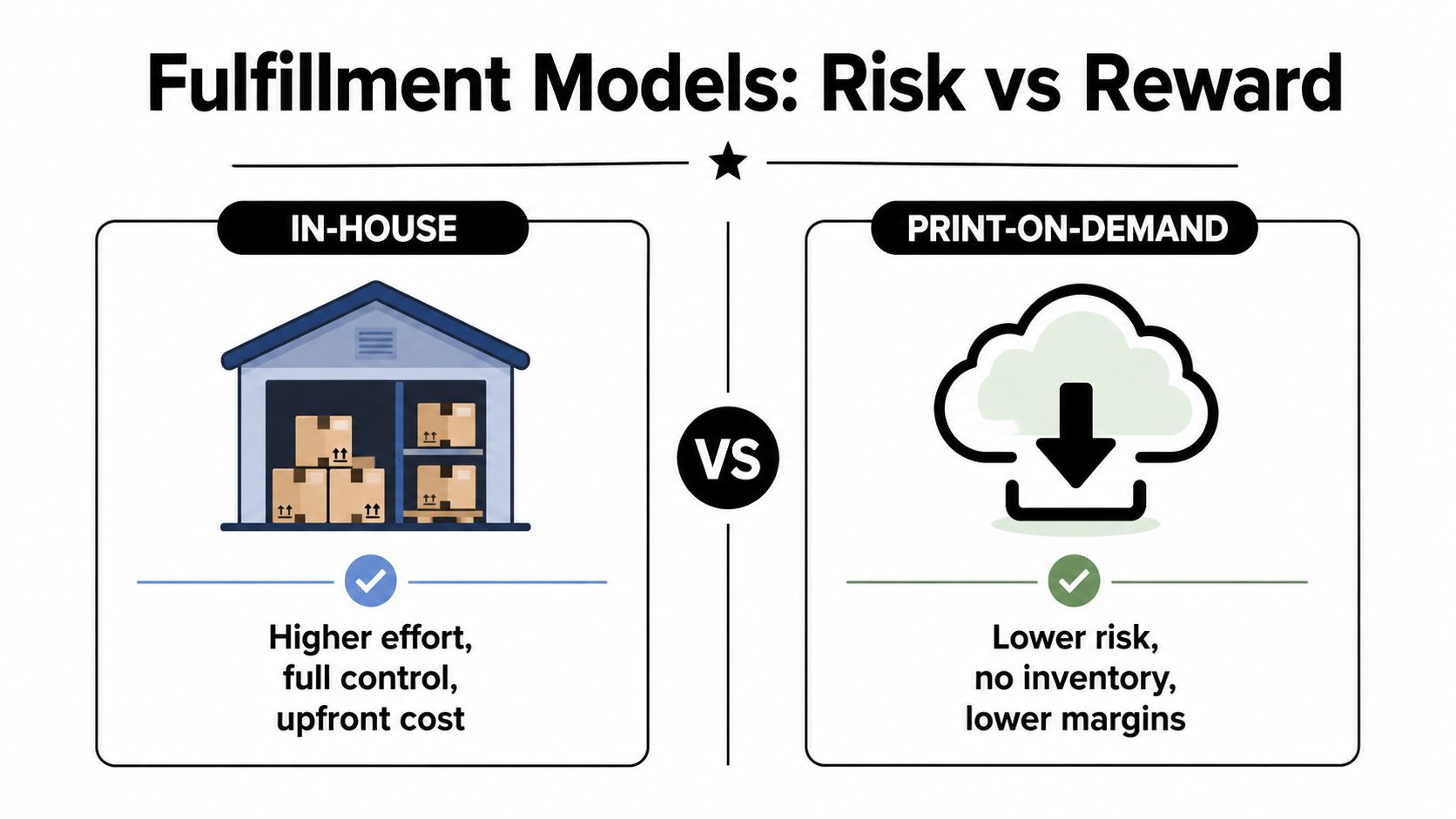
Fulfillment determines whether a sale creates profit or transfers hidden work to the artist. In-house fulfillment gives more control over packing, quality checks, inserts, and dispatch timing, but it requires storage, labor, supplies, and a reliable process. Print-on-demand reduces inventory exposure, but the artist may accept less control over blanks, production timing, packaging, and unit economics.
Returns make that choice more consequential. Recent returns research indicates that apparel and footwear brands frequently report return rates of at least 30%, while a 2025 report estimates that 44% of returned goods never reach another consumer. The 2025 State of Returns report connects poor returns handling to both financial waste and environmental impact.
Compare risk before choosing speed
In-house inventory suits a release with predictable demand, a manageable product range, and a team that can pack orders consistently. It can make sense for a limited shirt run where quality control and fast dispatch matter. The downside is exposure to unsold sizes, damaged stock, and cash committed before demand is proven.
Print-on-demand suits an evergreen design, a geographically dispersed audience, or an artist testing a concept without buying stock. It reduces overproduction risk, but production and shipping may take longer, and the artist may have less control over the physical experience. A useful comparison of print-on-demand versus traditional production helps frame the decision around risk, control, and scale rather than convenience alone.
Preorders can finance a small run and reveal demand before production. They also create a promise that must be communicated precisely. If production takes longer than fans expect, the artist faces support pressure even when the product eventually arrives.
A sustainable product isn't defined only by its fabric. Fewer failed size purchases, consolidated shipments, and responsible return handling can matter just as much.
Publish the evidence fans need
Sustainability claims should connect to operating facts. Explain where an item is produced, when it enters production, how it is packaged, whether orders can be consolidated, and what happens to misprints, exchanges, returns, and unsold inventory. If a limited drop reduces overstock, explain the production logic. If scarcity encourages fans to over-order uncertain sizes, recognize that trade-off.
The return policy should distinguish defects, incorrect items, fit-related exchanges, and buyer remorse. Publish the process at the product page and checkout, not only in a footer. A clear return policy for merchandise buyers protects trust, but it must also account for reverse shipping, replacement stock, and the margin of the original product.
Choose the model that matches release cadence and audience geography. The greenest garment isn't automatically the most responsible option if poor sizing information creates another shipment and another replacement.
Launching Your Band Merchandise Website with Confidence
A launch should confirm that the store can keep its promises, not just prove that the homepage looks finished. Before announcing a drop, place test orders on mobile and desktop, select different sizes and product types, apply international destinations, and follow the order through confirmation. The test should expose missing delivery estimates, incorrect stock states, confusing payment steps, and return instructions that are difficult to find.
Use a release checklist
Prepare the catalog and operations together:
- Validate product data: Check measurements, material details, variant availability, imagery, alt text, production time, transit time, and return rules on every product page.
- Confirm shipping logic: Review destinations, packaging assumptions, duties or taxes, delivery estimates, and whether mixed carts create unexpected costs.
- Test the purchase path: Complete guest orders, trigger payment errors, return to an abandoned cart, and verify confirmation emails.
- Rehearse fulfillment: Pack representative orders, weigh them, inspect the presentation, and confirm that the dispatch workflow matches the published promise.
- Document exchanges: Decide how the team handles wrong sizes, damaged products, misprints, lost parcels, and partial refunds before customers ask.
- Install measurement: Track product views, add-to-cart events, checkout stages, completed orders, variant errors, shipping interactions, and refund reasons.
The first release should have a clear learning objective. You might be testing whether a new shirt cut reduces size uncertainty, whether a preorder prevents excess stock, or whether a shipping estimate improves international completion. Write down the decision before launch so the team doesn't mistake social engagement for commercial success.
Build a repeatable operating rhythm
After launch, review the focused product mix that has historically driven most sales. Retire variants that create support work without meaningful demand, and reorder proven products only after accounting for returns and replacement inventory. Use customer questions as product-page input. If several fans ask about the same measurement or dispatch date, make that answer visible before they need to contact you.
An artist-first marketplace can reduce the need to assemble commerce, analytics, and fan offerings across disconnected systems. The artist marketplace is one option for presenting merchandise alongside music and other fan products, while a specialist can help when a team needs to build a profitable online store with more customized commerce requirements.
The store should remain operationally honest as it grows. Don't promise next-day dispatch when production takes a week. Don't call a garment sustainable without explaining the production and returns process. Don't add products faster than the team can measure, pack, support, and replace them.
A successful band merchandise website becomes a repeatable revenue channel when product selection, sizing information, checkout, fulfillment, and analytics reinforce one another. The technology should make those decisions easier to execute, not hide the costs behind an attractive storefront.
OohYeah provides artists with a storefront and music marketplace for selling physical merchandise such as shirts and vinyl alongside digital products, with commission-free commerce and analytics for tracking demand. Visit OohYeah to set up a more direct merch channel, organize your fan offerings, and make operational decisions from real store activity.