What Are Mechanical Royalties? Your Complete Guide
Learn what are mechanical royalties, how they work, and their role in music streaming. Understand the essentials of mechanical royalties today.
October 5, 2025
Music Marketplace Advisor
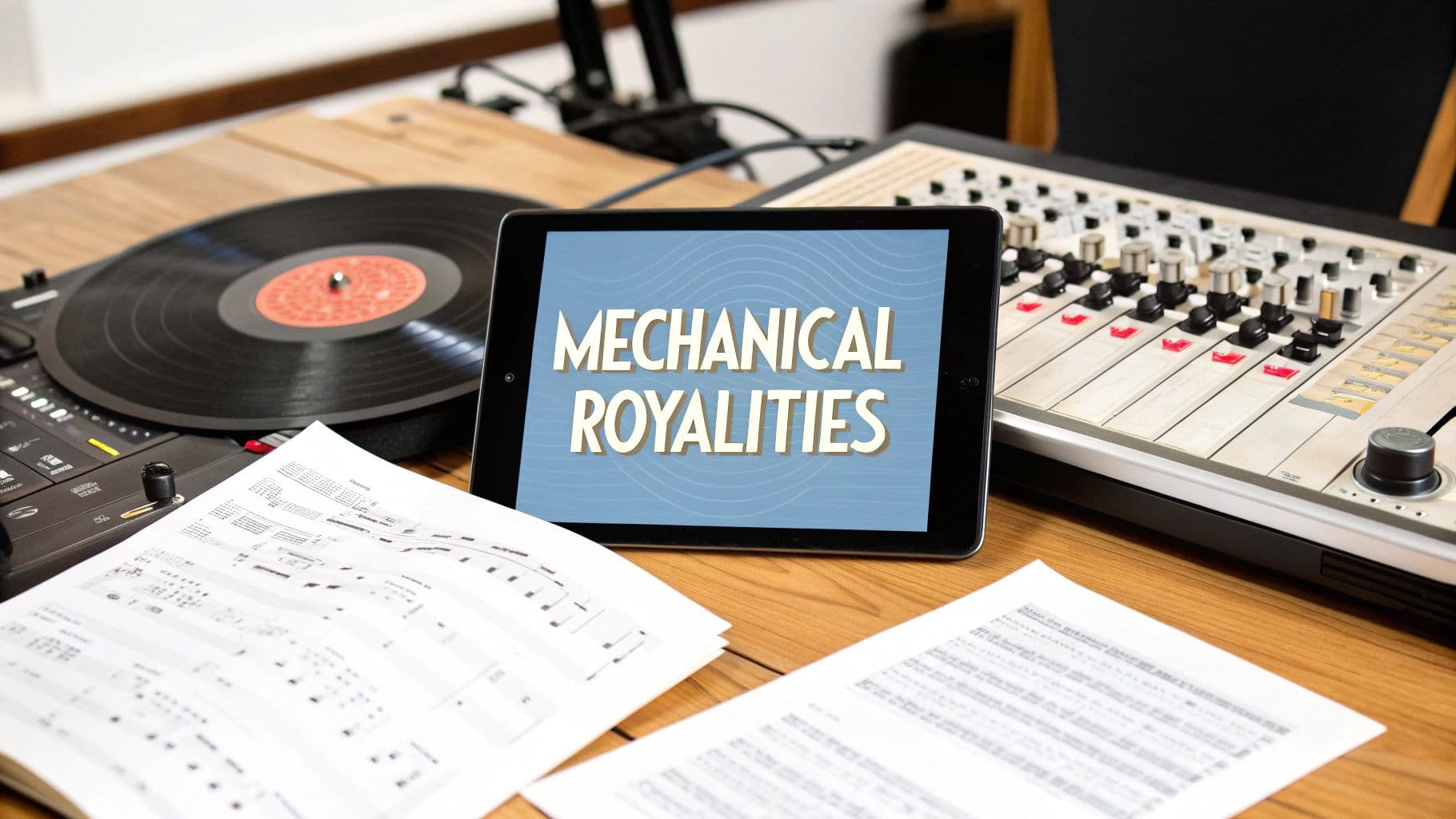
Buying & SellingEver wondered how songwriters get paid when their music is copied? That's where mechanical royalties come in. These are the payments made to songwriters and publishers every single time their musical composition is reproduced.
Think of it as a license fee paid for the right to mechanically copy a song. It doesn't matter if it's being pressed onto a vinyl record, sold as a digital download from a site like iTunes, or streamed on-demand through a service like Spotify. Each one is a reproduction, and each one generates a royalty.
A Closer Look at Mechanical Royalties
At its heart, the concept is simple: you, the songwriter, earn money whenever someone makes a copy of your song. This idea isn't new; it actually dates all the way back to the era of player piano rolls, where music was physically imprinted onto paper scrolls for playback. Today, that "reproduction" just happens in a lot more ways.
For decades, these royalties were tied to physical formats—vinyl, CDs, and cassette tapes. A fixed, government-mandated rate was paid for every single copy manufactured. But the shift to digital music completely changed the game, moving the model from clear-cut unit sales to a far more complex revenue-sharing system for streaming. You can find a deeper dive into this evolution from The MLC.
This chart breaks down the basic path a mechanical license takes, showing how royalties flow from a music user (like a streaming service) to the publisher and, finally, into the songwriter's pocket.
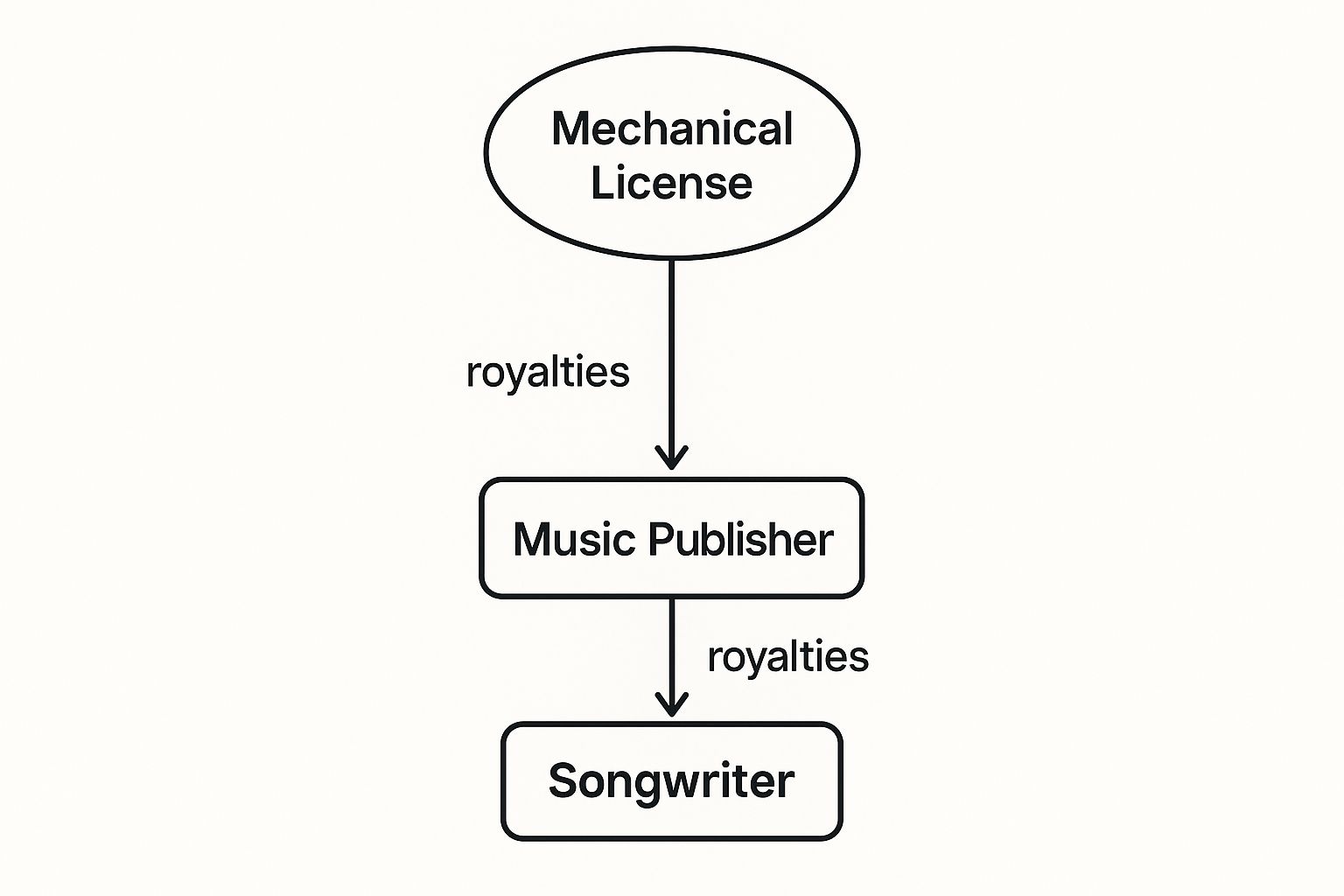
Ultimately, what a songwriter earns is directly connected to how well their publisher can track, license, and collect on every use of the composition.
Mechanicals vs. Performance Royalties
One of the most common points of confusion for artists is the difference between mechanical and performance royalties. They both come from the same song (the composition), but they're triggered by completely different things and are handled by entirely different organizations.
Grasping this distinction is absolutely crucial. If you don't, you're leaving money on the table. In short: mechanicals are for reproduction (copies), while performance royalties are for public performance (broadcasts).
To really clear things up, let's look at them side-by-side.
Mechanical vs Performance Royalties At A Glance
This table offers a straightforward comparison to help you distinguish between these two vital royalty streams.
| Attribute | Mechanical Royalties | Performance Royalties |
|---|---|---|
| What Triggers It? | When a song is reproduced (e.g., a physical sale, a digital download, an on-demand stream). | When a song is performed publicly (e.g., on the radio, TV, in a concert, or at a restaurant). |
| Who Collects It? | Mechanical Rights Organizations (MROs) like The MLC in the U.S. | Performance Rights Organizations (PROs) like ASCAP, BMI, and SESAC. |
| Who Gets Paid? | Songwriters and their music publishers. | Songwriters and their music publishers. |
| Real-World Example | A fan streams your song on Spotify or buys the track on iTunes. | Your song plays on a local radio station or gets used in a TV show. |
As you can see, a single song can generate both types of royalties simultaneously. When your song plays on the radio, it's a public performance. When a fan saves that same song to their playlist and streams it, that's a reproduction. Knowing the difference ensures you’re set up to collect everything you've earned.
Tracing Royalties From Piano Rolls To Spotify
To really get a handle on mechanical royalties today, it helps to rewind and look at where they came from. The term "mechanical" isn't just some random industry word; it literally refers to the first machines that could reproduce music on their own: player pianos. Back at the turn of the 20th century, these paper scrolls, full of punched holes, were the very first way to mass-produce a copy of a musical work.
As you can imagine, this new technology kicked up some dust. Composers were watching their work get copied and sold left and right, and they weren't seeing a dime. This conflict led to a landmark piece of legislation, the U.S. Copyright Act of 1909. For the first time, it established a compulsory mechanical license, a rule that said once a song was officially recorded and released, anyone else could record their own version, so long as they paid a set royalty rate to the songwriter for each copy.
The Era of Physical Copies
For the better part of a century, this system was beautifully simple. Mechanical royalties were tied to physical things you could hold in your hand. Every time a label pressed a vinyl record, made a batch of cassette tapes, or manufactured a stack of CDs, a royalty was owed for every song on the album.
The math was pretty straightforward:
- It was simply the number of units made multiplied by the statutory royalty rate.
- This gave songwriters and their publishers a predictable, easy-to-track revenue stream.
- The whole system worked because it was built on tangible goods that could be counted.
This per-unit model was the financial bedrock of the music industry for decades, providing a stable income for creators based on sales.
The Digital Disruption
Then, in 2003, Apple launched the iTunes Store, and everything started to change. A digital download was legally considered a reproduction—the digital equivalent of a CD. This meant each sale of an MP3 generated a mechanical royalty, and the old per-unit model adapted surprisingly well to this new format.
But the real earthquake came with the rise of on-demand streaming platforms like Spotify and Apple Music. A stream isn't a sale. Listeners weren't buying a copy to own forever; they were just accessing it from a massive, cloud-based library. If you're curious about how these platforms operate on a massive scale, you can learn more about Spotify's marketing strategies.
This fundamental shift from ownership to access completely broke the old per-unit royalty system. You couldn't treat a single stream like a CD sale, which forced the entire industry to rethink and rebuild how royalties were collected and paid in a new world.
This move from physical products to billions of daily micro-transactions introduced a staggering level of complexity. It quickly became obvious that the old ways of calculating royalties just couldn't keep up, setting the stage for new laws and organizations designed to navigate the complicated flow of money in the streaming age.
How Your Mechanical Royalties Are Calculated
To really get a handle on your earning potential, you need to understand how mechanical royalties are calculated. The math isn't a simple, one-size-fits-all formula. It changes quite a bit depending on how someone listens to your music—a physical CD sale is a completely different animal than a stream on Spotify.
Let's unpack the two main ways this works: first, the straightforward world of physical sales and downloads, and then the much murkier model for streaming.
The Statutory Rate For Sales And Downloads
For physical products like CDs and vinyl records, or even permanent digital downloads from a place like the iTunes store, the calculation is thankfully direct. In the United States, this is all governed by a statutory mechanical rate, which is a specific fee set by the Copyright Royalty Board (CRB).
This rate establishes a fixed payment for every single copy of a song that's made and sold. It's a predictable system based on simple unit sales.
As of 2025, the statutory rate for physical formats is 9.1 cents for any song under five minutes long. If your track is longer than that, the rate switches to 1.75 cents per minute of playing time.
So, let's say a label presses 10,000 CDs of an album that features 10 of your songs. They owe a mechanical royalty for every track on every single disc.
Here's a quick example:
- 10,000 CDs are manufactured.
- Each CD has 10 songs (all under 5 minutes).
- The rate is $0.091 per song.
10,000 CDs x 10 songs/CD x $0.091/song = $9,100 in total mechanical royalties.
This whole structure is a holdover from the old days of the music business, built around tangible products you could actually count. The same logic gets applied to digital downloads, keeping it a clear-cut transaction.
Demystifying Streaming Royalty Calculations
When we jump over to streaming, the math gets a lot more complicated. Forget about a simple, fixed "per-stream" rate for mechanical royalties—it just doesn't exist. Instead, your earnings are pulled from a percentage of a streaming service's total revenue, which makes for a pretty variable and often confusing payment system.
Here's the general breakdown of how it works:
- The Big Pot of Money: Every month, services like Spotify and Apple Music figure out their total revenue. From that, they set aside a certain percentage specifically for all music rights holders.
- The Publisher's Slice: A portion of that big pot is then allocated to publishers and songwriters. This slice has to cover both performance and mechanical royalties.
- Your Pro-Rata Share: Finally, the money left for mechanicals is divided up based on your song's share of the total streams on the platform. If your track got 0.001% of all streams that month, you get 0.001% of the royalty pool.
What this model really means is that your earnings are tied to factors completely out of your control—things like how many subscribers the service has, how much ad revenue they brought in, and the total number of streams across the entire platform. This is a core part of today's music business, and you can dive deeper into how it all connects by checking out our guide on understanding music licensing.
So, Who Actually Collects and Pays This Money?
Knowing how mechanical royalties are calculated is one thing, but understanding who actually collects and pays out that money is a whole different ball game. This is where collection societies step in. Think of them as the essential, behind-the-scenes administrative team for your music career. Without them, trying to track the billions of streams and sales happening every single day would be an impossible task.
In the United States, the most important name to know for digital mechanicals is The Mechanical Licensing Collective, or The MLC. Before The MLC came along, the system for getting paid from streaming services was a messy, fragmented nightmare that left huge piles of money unpaid.
Then came the Music Modernization Act (MMA) of 2018, a landmark piece of legislation that completely changed the game. The MMA established The MLC to create a single, unified hub for all digital mechanical royalties in the U.S.
The Role of The Mechanical Licensing Collective (The MLC)
The MLC's main job is to issue a "blanket" mechanical license to digital service providers (DSPs) like Spotify, Apple Music, and Amazon Music. Instead of these massive companies having to hunt down and negotiate with every single songwriter, they get one license from The MLC. In exchange, they send all their mechanical royalty data and payments to this one central organization.
This new system makes the whole process more transparent and efficient for everyone. For songwriters and publishers, it means you have a single, authoritative body responsible for three critical tasks:
- Collecting 100% of U.S. digital mechanical royalties from the streaming services.
- Matching those royalty payments to the correct songs and their rightful owners.
- Paying out those royalties accurately and on time.
The best part? The MLC is a non-profit, funded entirely by the digital services it licenses. This means every single dollar they collect in royalties gets paid out to copyright holders, with no administrative fees skimmed off the top. Since launching in 2021, The MLC has already paid out billions of dollars to creators.
For this system to work, you have to do your part. If your songs aren't correctly registered in The MLC's public database, your royalties will end up in a black box, waiting to be claimed. It's an absolutely non-negotiable step if you want to get paid for your U.S. streams. For a deeper dive into licensing, our guide on how to get a mechanical license to cover a song provides some great context.
A Global Web of Royalty Collectors
While The MLC has the U.S. digital market covered, music is global, and so is royalty collection. Nearly every country has its own set of rules and its own mechanical rights organizations (MROs) that handle the same kind of work.
This means if someone streams your song in London, the mechanical royalties are first collected by a local society in the UK. A few key players around the world include:
- United Kingdom: Mechanical-Copyright Protection Society (MCPS)
- Canada: Canadian Musical Reproduction Rights Agency (CMRRA)
- Germany: GEMA (which handles both mechanical and performance rights)
These international MROs all have agreements with one another. They collect royalties in their home country and then pass the money along to the societies where the songwriters and publishers are based. It's a complex network, but it’s designed to ensure that no matter where in the world your music finds an audience, there's a system in place to get your mechanical royalties back home to you.
Succeeding With Mechanicals In The Streaming Age
The shift to streaming has been a double-edged sword for songwriters. On one hand, it’s unlocked incredible opportunities, giving your music a shot at global distribution with a single upload. On the other, it’s completely flipped the script on how mechanical royalties are earned.
We’ve moved from a world of clear-cut physical sales to a model built on billions of daily micro-transactions. This new reality makes it absolutely essential to grasp the financial mechanics of the streaming game.
Forget everything you think you know about a fixed per-stream rate for mechanicals—it doesn't exist. Instead, your earnings are tied to a complex revenue-sharing model. Every month, services like Spotify and Apple Music tally up their total revenue, carve out a percentage for all rights holders, and then your song earns a pro-rata slice of that pie based on its performance.
Think of it this way: your payment isn't a set amount per play, but a variable piece of a much larger, ever-changing financial pool.
The Scale of Streaming Payouts
To really understand what this means, you have to look at the numbers. The sheer volume of streams needed to generate significant income can be mind-boggling. While rates fluctuate, industry experts estimate it takes roughly 1.6 million on-demand streams for a songwriter or publisher to earn just $1,000 in mechanical royalties. If you're curious about the nitty-gritty, you can learn more about how streaming rates are calculated from legal pros in the space.
This isn't meant to be discouraging. It’s about setting realistic expectations. In today's music economy, success isn't about landing a single big hit; it's about building a catalog that generates consistent, high-volume engagement over the long haul. Every single stream, no matter how tiny its value, adds up.
The modern music business is a numbers game powered by data. Your ability to get paid accurately and on time hinges almost entirely on the quality of the information attached to your songs.
Why Your Song Metadata Is Your Most Valuable Asset
In a system dealing with such massive volume and microscopic per-unit payments, accuracy is everything. The platforms that track and pay mechanical royalties are automated, data-driven machines. They rely on one thing and one thing only to connect a stream back to you: metadata.
Metadata is the digital DNA of your song. It’s the bundle of information that travels with your music, and it has to be perfect everywhere your song appears. Why? Because inaccurate or incomplete metadata is the number one reason royalties get lost, misdirected, or dumped into an unclaimed "black box."
Here are the non-negotiable data points that must be correct:
- Song Title: Has to be exact and consistent across every single platform. No variations.
- Songwriter Names and IPI Numbers: This correctly identifies every contributor and their unique identifier.
- Publisher Information: Ensures your publisher can do their job and collect on your behalf.
- ISWC Code: This is the International Standard Musical Work Code, the unique fingerprint for your composition.
Getting this information right isn’t just some boring administrative task; it’s one of the most critical business functions you’ll perform as a creator. Clean, accurate metadata is what allows automated systems to track your plays and route your mechanical royalties where they belong—straight into your pocket. It’s the bedrock of a sustainable career in the streaming era.
Putting It All Together: Your Plan to Maximize Earnings
Knowing how mechanical royalties work is one thing, but actually collecting them is another game entirely. It takes a deliberate, organized approach to make sure you're not leaving your hard-earned money on the table—a surprisingly common problem for songwriters.
The first, most critical step is getting your works registered. For digital mechanicals here in the U.S., that means registering every single one of your songs with The Mechanical Licensing Collective (The MLC). If you want to get paid from streams on platforms like Spotify, this isn't optional; it's essential.
But your music doesn't stop at the border. To collect royalties from streams and sales happening internationally, you'll need to work with an administrative publisher or register with the right mechanical rights organizations in those territories.
Your Essential Royalty Checklist
Once you're registered, the real work begins. It’s all about keeping your data clean and regularly checking your statements. Think of it as basic financial housekeeping for your music catalog.
Here’s what you need to stay on top of:
Perfect Your Metadata: This is the big one. Inaccurate data is the #1 reason royalties go missing. Triple-check that your song titles, songwriter credits, IPI numbers, and ISWC codes are 100% correct and consistent everywhere they're listed.
Audit Your Statements: Don't just cash the check. Take the time to actually review your royalty statements. Look for songs that are missing, payments that seem low, or rates that don’t look right. If something seems off, ask questions.
Understand Your Agreements: Get intimately familiar with your publishing deal. You need to know your exact royalty splits and any administrative fees being deducted. This is the only way you can accurately forecast your income and know if you’re being paid correctly.
Treating your songwriting career like a business is the key to financial success. For a deeper dive into turning your craft into a sustainable living, check out our guide on how to make money as a songwriter.
Common Questions About Mechanical Royalties
Even with a solid grasp of the basics, a few specific scenarios often trip up artists and songwriters. Let's tackle some of the most common questions that come up when we talk about mechanical royalties.
I Only Wrote the Lyrics. Do I Still Get Mechanical Royalties?
Yes, absolutely. A song's copyright covers the entire composition—that means both the music and the lyrics. As the lyricist, you are a co-owner of that copyright.
This means you’re owed a share of the mechanical royalties every time the song is reproduced. The exact percentage you get is worked out in your songwriter agreement, but a 50/50 split between the lyricist and the composer is a very common starting point.
I Recorded a Killer Cover Song. How Do I Collect My Mechanicals?
This is a great question because it highlights a crucial distinction. As the performer of a cover, you actually pay mechanical royalties; you don't collect them.
Those royalties go to the original songwriters and publishers who created the song you’re covering. Before you can legally release your version, you have to get a mechanical license, which ensures the original creators get paid for their work.
Key Takeaway: When you record a cover, you are reproducing someone else's copyrighted composition. Getting a license is the required step to make sure they are compensated for you using their intellectual property.
Do Services Like Pandora Pay Mechanical Royalties?
No, they don't. Non-interactive streaming services like Pandora Radio (or any traditional AM/FM radio broadcast) are considered "public performances." Because you can't choose the specific song that plays next, these services generate performance royalties, not mechanicals.
Performance royalties are handled by Performance Rights Organizations (PROs) like ASCAP and BMI. Mechanicals only come into play with "on-demand" streams—when a listener on a service like Spotify or Apple Music actively chooses to play your song. That act of choosing is legally defined as a reproduction, which is what triggers the mechanical royalty.
Ready to take full control of your music career? OohYeah provides the tools you need to sell your music, merchandise, and subscriptions directly to your fans, commission-free. Join our community of empowered artists and start maximizing your earnings today. Visit https://oohyeah.app to learn more.