Your Guide to a Streaming Royalty Calculator
Finally understand your music income. Our guide to using a streaming royalty calculator helps you accurately estimate Spotify and Apple Music earnings.
September 11, 2025
Music Marketplace Advisor
Buying & SellingIt's a common myth that every stream is worth a set amount of money, but the reality is way more complicated. A good streaming royalty calculator quickly shows you that your earnings don't come from a simple, flat per-stream rate. Instead, your payout is a moving target, influenced by where your listeners are, what kind of subscription they have, and the deals you've signed.
Understanding What Your Streams Are Actually Worth
Before you start plugging numbers into a calculator, you need to understand why the idea of a single "per-stream rate" is a fallacy. The whole digital music business runs on a model that makes payouts fluctuate month to month. Getting this down is crucial for setting realistic expectations and using a calculator as a strategic tool, not just a novelty.
This all comes down to the pro-rata system that platforms like Spotify use. They don't pay you a fixed rate. Instead, they take all the revenue they've made in a month—from both subscriptions and ads—and put it into one giant pot. That pot is then divided by the total number of streams across the entire platform. Your payout is your little piece of that pie, based on your music's share of the total streams.
Why Not All Streams Are Created Equal
So, if it’s all about your share of the pie, what makes one stream more valuable than another? A few key factors dramatically change the value of a single play. For instance, a stream from a premium subscriber in the U.S. puts more money into the revenue pool than a stream from a free user in a country with lower ad rates. This is why 10,000 streams from Norway can be worth way more than 10,000 streams from another region.
Here's a quick look at the primary factors a streaming royalty calculator needs to give you an accurate estimate.
Key Variables That Impact Your Streaming Payout
| Factor | Why It Matters | Real-World Example |
|---|---|---|
| Listener's Location | Subscription fees and ad rates are different in every country. A stream from a high-paying market contributes more to the revenue pool. | A stream from a U.S. listener is typically worth more than one from a market where subscription plans are cheaper. |
| Subscription Type | A stream from a Premium subscriber is worth substantially more because they directly contribute cash to the monthly revenue pool. | A play from a Spotify Premium account might be worth 4-5x more than a play from an ad-supported, free account. |
| Your Splits | Your distributor, publisher, and/or label all take their cut before the money gets to you. | If your distribution deal is 85/15, you receive 85% of the net revenue after the platform's share is taken. |
These variables are exactly why just multiplying your stream count by a generic average like $0.004 can be so misleading.
The most critical takeaway is this: you are paid based on your market share, not a fixed rate. Your goal is to capture a larger percentage of a revenue pool that is itself constantly changing.
This reality gets to the heart of the question of whether artists can make money from streaming services—success isn't just about getting plays, but about understanding where those plays come from and how the money flows. A quality streaming royalty calculator will account for these nuances, giving you a far more accurate forecast of what might actually land in your bank account.
Finding the Right Data for Your Calculation
Any streaming royalty calculator is only as good as the numbers you plug into it. To get a forecast that's even remotely accurate, you have to pull precise data directly from your distributor’s dashboard. Think of this as your pre-flight checklist; it ensures your calculations are grounded in reality, not just wishful thinking.
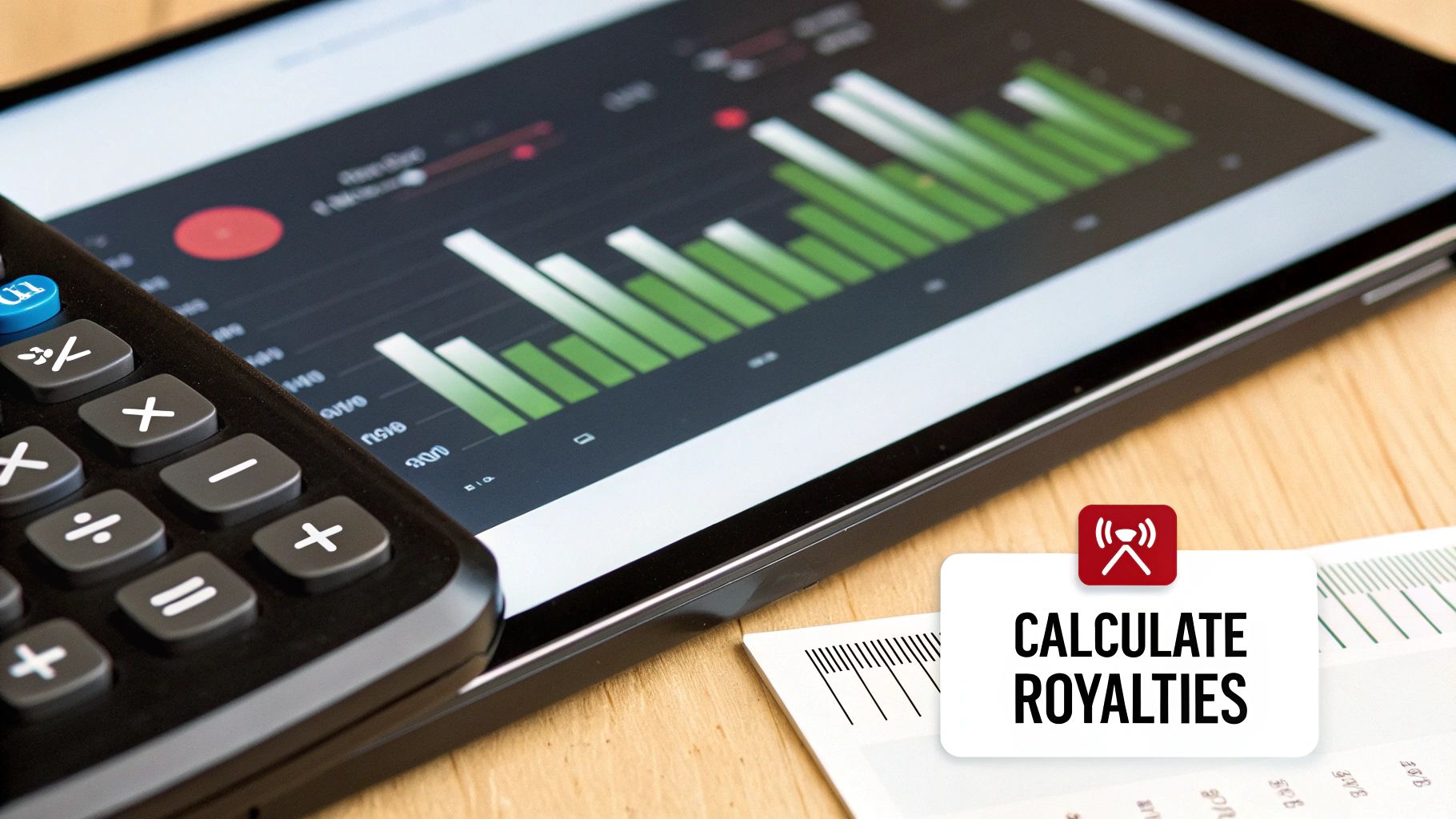
First things first, log into your distributor, whether you use DistroKid, TuneCore, or another service. You're looking for the section labeled "Bank," "Earnings," or "Analytics"—this is where the raw data lives.
But don't just grab the big, flashy number at the top. The real gold is in the details. A good dashboard lets you filter your streams by platform, country, and timeframe. This level of detail is crucial because 100,000 streams from the U.S. on Apple Music will pay out wildly different than the same number from India on Spotify.
Locating Your Key Data Points
Once you're inside your distributor’s analytics, your mission is to isolate a few key metrics. To really make a streaming royalty calculator work for you, you’ll need two main pieces of information:
- Total Stream Counts: This is the total number of plays for a specific song or your whole catalog. The key is to be able to filter this number by each streaming service (Spotify, Apple Music, Deezer, etc.).
- Geographic Breakdown: Next, pinpoint which countries are generating the most streams. This is usually shown as a map or a simple list, giving you a percentage of streams by region.
Getting this detailed information is the first step in creating a powerful feedback loop for your music. Truly understanding where your plays come from is fundamental if you want to use data analytics to grow your music fanbase and make smarter decisions with your marketing budget.
Determining Your Royalty Split
The final piece of the puzzle is your royalty split. This is the percentage of the revenue you actually get to keep after everyone else takes their cut.
For a solo artist using a distributor like DistroKid that famously offers 100% royalty retention, this is pretty straightforward. Your split is essentially 100%, minus any small processing or bank fees.
Things get more complicated if you're in a band. You need to know your agreed-upon splits ahead of time. A four-person band, for instance, might have a clean 25% split for each member. If you're working with a label, your contract will spell out your share, which could be anywhere from 15% to 50%. Having this number ready is non-negotiable if you want an accurate calculation.
Using a Royalty Calculator with Confidence
Okay, you've got your stream counts and a handle on your royalty splits. Now comes the part where we turn those raw numbers into something that actually means something for your bank account: a financial forecast. This is where a streaming royalty calculator comes in, and while they might look a bit intimidating at first, they're pretty straightforward once you know your way around.
Let's walk through it.
Most of these tools have simple input fields. You’ll plug in your total number of streams and then pick the platform—Spotify, Apple Music, and so on. This first step is critical because the calculator automatically applies a different average pay-per-stream rate depending on which service you select.
Here’s a clean visual that breaks down how the calculation works, from your initial stream count to the final estimated payout.
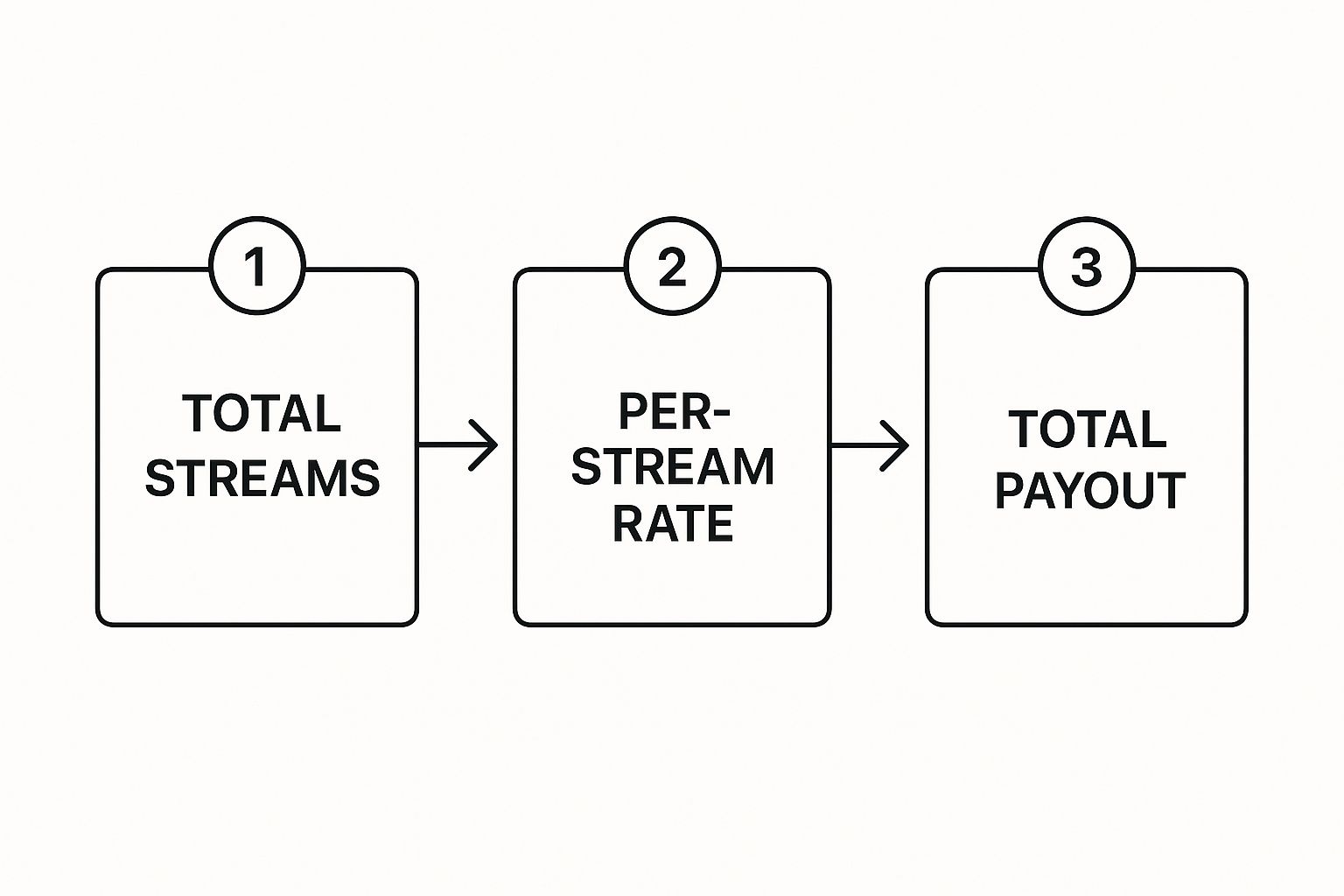
As you can see, your total streams are just the starting point. It’s the platform’s unique rate that really shapes your gross earnings before we even get to splits.
Inputting Your Data for a Hit Single
Let's run a real-world scenario. Say you have a single that’s just crossed 250,000 streams on Spotify. Great work. You’d simply enter "250000" into the stream count field and choose "Spotify" from the platform dropdown.
This screenshot from a common royalty calculator shows exactly what that looks like in practice.
The calculator will instantly spit out an estimated payout. This gives you a fantastic baseline for what those streams are worth before anyone else takes a cut.
From there, it’s all about tailoring the estimate to your specific deal. This is where you’ll enter your royalty split percentage. If you’re a solo artist and own everything, you're keeping 100%, so that gross estimate is all yours. But what if you're in a four-piece band splitting everything equally? You’d set your share to 25% to see what your personal cut looks like.
The real magic of these calculators is in running different scenarios. You can instantly see how your earnings shift when you toggle between platforms or play with different split percentages. This is huge for both forecasting future releases and making smarter strategic decisions.
Adjusting for a Global Audience
But what if those 250,000 streams are coming from all over the world? This is where a more advanced calculator really shines. Some allow you to break down your streams by country or region. I can't overstate how valuable this is. As we've covered, a stream from the U.S. pays a whole lot more than a stream from a developing market.
For instance, you could run one calculation for 150,000 streams from the U.S. and a separate one for the other 100,000 global streams. This gives you a much more precise financial picture and helps you pinpoint where your music is making the most impact financially.
Getting comfortable with a streaming royalty calculator is a game-changer for any artist. It's not so different from mastering other financial tools that deal with complex digital assets. In fact, for those who also operate in other digital spaces, an expert guide to using a crypto tax calculator provides a similar kind of clarity for an entirely different set of tricky calculations. When you can confidently use these tools, you’re no longer guessing—you’re turning abstract data into real financial intelligence.
Why Platform and Location Change Everything
One of the biggest lessons I’ve learned—and something I see artists get wrong all the time—is thinking a stream is a stream. It's just not that simple. The first time you plug your numbers into a streaming royalty calculator, the results can be a real eye-opener. Your earnings can swing wildly based on things that have nothing to do with your music itself.
The two biggest culprits? The streaming service your fans use and where in the world they're listening from.
The Great Platform Divide
Not all streaming platforms are created equal, especially when it comes to how they pay. A stream from a service that’s 100% premium subscriptions will almost always pay more than one from a platform with a free, ad-supported tier. That economic model is everything.
Take Apple Music. It has no free tier, so every single listener is a paying subscriber contributing to the royalty pool. This is why their payouts tend to be higher and a bit more predictable.
On the other hand, you have giants like Spotify and YouTube Music that offer both premium and free, ad-supported listening. While this massively expands your potential reach, the money generated from a free listener is just a fraction of what a premium subscriber brings in. This mix is why Spotify's average payout rate often looks lower than Apple's.
The core takeaway is this: the value of your stream is directly tied to the value of the listener to the platform. A paying subscriber is a high-value listener, and your royalty payment reflects that.
This is exactly why any decent streaming royalty calculator has to let you break things down by platform. The numbers speak for themselves. Spotify's rate is often quoted somewhere between $0.003 and $0.005 per stream. Apple Music, in contrast, averages closer to $0.01 in the U.S. YouTube's rates are another beast entirely, usually landing between $0.005 and $0.007 for official music content, since they depend so heavily on ad performance. For a deeper dive, resources like Routenote offer great insights on how these services pay out.
To put these differences in perspective, here's a quick look at what you can generally expect from the major players.
Estimated Per-Stream Payouts by Platform
This table gives a comparative glance at the average payout rates for major music streaming services to help set realistic expectations.
| Streaming Platform | Estimated Payout Per Stream (USD) | Key Considerations |
|---|---|---|
| Apple Music | ~$0.01 | No free tier means higher, more consistent payouts per stream. |
| Spotify | ~$0.003 - $0.005 | A mix of premium and free listeners creates a blended, lower average rate. |
| YouTube Music | ~$0.005 - $0.007 | Varies significantly based on ad revenue and content type (e.g., official video vs. UGC). |
| Tidal | ~$0.013 | Higher-fidelity focus and premium-only tiers lead to one of the highest payout rates. |
| Amazon Music | ~$0.004 | Payouts are influenced by their mix of Prime, Unlimited, and ad-supported listeners. |
These are just estimates, of course, and the real numbers are always in flux. But the differences are stark and show why you can't treat all platforms the same.
Why Your Listener's Location Matters
Beyond the platform, geography plays a huge role. The money a platform collects from a subscription or an ad isn't the same in every country. This idea is known as purchasing power parity, and it has a direct impact on how much money is in the royalty pool for each region.
It breaks down like this:
- High-Value Markets: In countries like the United States, Norway, and Switzerland, subscription fees are higher and the ad markets are more valuable. A stream from a listener here puts more money into the pot, making each play worth more.
- Developing Markets: Conversely, streams from places with lower subscription prices or less mature ad markets will generate less revenue. It’s the same stream, but it contributes less to your bottom line.
What does this mean for you? It means 100,000 streams from the U.S. could easily earn you more than double what the same number of streams from a lower-paying country would.
Understanding this is what turns your royalty data from a boring report into a strategic map. It helps you see not just how much you’ve earned, but where you should focus your next marketing campaign to get the best return.
Turning Your Royalty Data into Action
So, you've got the numbers. Now what? A streaming royalty calculator is more than just a tool for a quick ego boost after a track takes off. It’s a vital piece of your strategic toolkit, and the real magic happens when you use those earnings estimates to make smarter, data-driven decisions for your career.

Think of that data as your personal roadmap. It doesn't just show you where people are listening; it shows you where your music is making a real financial impact. That kind of insight is crucial for setting goals that are actually achievable, figuring out if your marketing is working, and putting your money where it counts.
Don't just plug in your numbers and stare at the final payout. Get creative and run different "what-if" scenarios. This is how you shift from passively looking at stats to actively planning the next phase of your music business.
Setting Realistic Income Goals
One of the most practical things you can do with a royalty calculator is forecast your income. Before you even drop your next single, you can map out clear stream targets that translate directly into dollars and cents.
- Set Clear Targets: Say you want to make $1,000 from a new track in the first three months. A calculator helps you work backward. You can figure out roughly how many streams you'll need from a high-payout country like the U.S. versus a lower-payout region to hit your number.
- Budget Like a Pro: Knowing this makes budgeting for a music video, a new synth, or a collaboration feel way less like a guessing game. It grounds your entire financial plan in reality.
Suddenly, those abstract stream counts become a tangible business plan. You start to see the direct connection between your promo efforts and your bank account. For a deeper dive, our guide on tips for increasing music streams and earnings is the perfect next read.
Optimizing Your Promotional Strategy
Your royalty data is a goldmine for fine-tuning your marketing. Once you see which countries are driving the most revenue—not just the most streams—you can get surgical with where you spend your time and money.
Here’s a classic scenario: your analytics show a ton of streams from a country with a low per-stream rate, but the revenue is tiny. At the same time, you notice a small but growing listener base in Germany, where the payout is much higher.
That’s your signal. This is where you can take action by investing in a targeted ad campaign aimed squarely at German playlists and listeners, knowing every new stream you gain there is worth significantly more.
This is what it means to work smarter. You're channeling your marketing budget toward audiences that not only love your music but also help you build a sustainable career.
Got Questions? Let's Talk Royalties.
So, you’ve plugged your numbers into a streaming royalty calculator and have the data in front of you. That’s a fantastic first step. But if you’re anything like the thousands of artists I've worked with, this is usually where the real questions start popping up. The world of streaming payouts is notoriously murky, so let's clear the air on some of the most common things musicians ask.
One of the biggest, most crucial questions is always the same: "How many streams do I actually need to make a living?" The honest answer is... it's complicated. But we can definitely get you in the ballpark.
So, What's the Magic Number for a Living Wage?
The hard truth about streaming income can be a bit of a reality check. Let's take Spotify as our example. In 2025, their global average payout hovers around $0.00238 per stream.
Do the quick math: that’s about $2.38 for every 1,000 streams.
Based on that rate, an artist would need to hit over 1,000,000 streams every single month just to bring in around $2,380. And that’s before your distributor, publisher, and bandmates take their cuts. You can get a more granular look by diving into the latest reports on Spotify royalties.
This is exactly why building a sustainable career means you can't put all your eggs in one streaming basket.
Your royalty calculator is more than just a tool—it's your financial reality check. Use it to see what you've earned, sure, but more importantly, use it to set tangible, data-backed goals for where you need to be.
Another thing that trips artists up is the timeline. "When do I actually see the money from my streams?" This is where your distributor becomes the gatekeeper.
Demystifying Payout Schedules
Streaming platforms like Spotify and Apple Music don't just Venmo you your earnings. They pay your distributor—think DistroKid or TuneCore—who then pays you. It’s a multi-step process with built-in delays.
Here’s a rough breakdown of the journey your money takes:
- Platform Reporting: It takes the streaming giants 1-2 months just to process the data and send the reports. So, your streams from January might not even show up on your distributor's radar until March.
- Distributor Processing: Once your distributor gets the report and the payment, they have to sift through it all, calculate your share, and get it ready for your account. This can easily add another few weeks.
- Withdrawal Thresholds: Don't forget that most distributors have a minimum payout threshold. You often need to build up at least $10 or $20 before you can even touch your money.
All said and done, you're realistically looking at a 2-3 month delay from the moment a fan hits 'play' to when that fraction of a penny lands in your bank account. You absolutely have to plan your finances around this lag.
Finally, the one that causes the most confusion: "Why was my per-stream rate different last month?" Welcome to the "pro-rata" system. Your payout rate isn't fixed; it's a moving target based on your music's slice of the entire platform's pie for that month.
Several things can make that rate fluctuate:
- The Holiday Bump: Ad revenue tends to spike in Q4 for the holidays, which can slightly increase the value of ad-supported streams.
- The Superstar Effect: When an artist like Taylor Swift or Drake drops a new album, they command a colossal share of the total streams, which can temporarily dilute the royalty pool for everyone else.
- A Shifting Audience: Did you get a big playlist add in a country with a lower payout rate? Your average per-stream rate will dip, even if your total stream count went up.
This is where a good streaming royalty calculator becomes your best friend. It helps you anticipate these changes instead of being blindsided by them.
At OohYeah, we believe you deserve full transparency and control over your career and your money. Our platform was built from the ground up to put more revenue directly into your pocket by cutting out the unnecessary middlemen.
Explore how OohYeah can help you build a more sustainable music career today.