Starting Record Label: A Founder's Playbook
Thinking about starting record label? This founder's playbook covers business setup, contracts, distribution, and marketing to launch your vision.
November 21, 2025
Music Marketplace Advisor
Buying & SellingSo you've decided to start a record label. It's an exciting leap, turning a deep-seated passion for music into a real, tangible business. But before you can start discovering the next big artist, you have to lay the groundwork. This means choosing a legal structure, carving out your brand identity, and getting all the administrative ducks in a row.
First things first: you need to decide if you'll operate as a sole proprietorship, which is simple, or an LLC, which offers crucial liability protection. That single decision shapes everything that comes after.
Building Your Label's Business Foundation

Before you even think about A&R or release parties, you have to build a solid business and legal framework. I know, this is the least glamorous part of running a label, but I promise it's the most important for your long-term survival and success.
Getting these details right from day one protects you personally, keeps your finances clean, and makes your label look professional from the jump. Think of it like building the studio before the band shows up. You wouldn't record a hit record without proper wiring and soundproofing, right? The same logic applies here. Skipping these foundational steps is a rookie mistake that can cause massive headaches later on.
Choosing Your Business Structure
The first big choice on your plate is how to legally structure the label. This decision will affect everything from how you pay taxes to how much personal risk you're taking on. For most indie founders, it boils down to two main options.
- Sole Proprietorship: This is the path of least resistance. You and your business are legally the same entity. It’s easy to get started, but it also means your personal assets—your house, car, savings—are on the line if the label gets into debt or legal trouble.
- Limited Liability Company (LLC): An LLC creates a legal wall between you and your business. This is, by far, the most common route for new labels because it shields your personal assets. If someone sues the label, they can only go after the business's assets. It involves a bit more paperwork and some fees, but the peace of mind is worth every penny.
Honestly, for almost everyone starting out, forming an LLC is the smarter, safer play. The upfront cost is a small price for the protection it gives you.
Key Takeaway: A sole proprietorship is quicker to set up, but an LLC provides an essential liability shield. It separates your personal life from your business operations, which is invaluable once you start signing artists and spending real money.
Registering Your Business and Brand
Once you've picked a structure, it's time to make it official. This means registering your business name with your state and local government. If you went the LLC route, this is already part of the incorporation process.
Next up, your brand identity. Your label's name and logo are its face to the world. Before you get too attached to a name, do a deep search to make sure it isn't already taken by another label or music company. At the same time, check if the domain name and social media handles are available.
- Secure Your Domain: Grab a domain name (like
yourlabelname.com) immediately. This will be your home base online. - Claim Social Handles: Lock down your name on Instagram, TikTok, X, Facebook, and any other platform that matters for your genre. Do this even if you don't plan to use them all right away.
- Design a Logo: Your logo should instantly communicate your label's vibe. It doesn't need to be complicated, but it has to be memorable and look good everywhere, from a tiny profile picture to a vinyl sticker.
Nailing this branding groundwork ensures you have a consistent and professional look from the moment you launch.
Establishing Financial Systems
With your business officially registered, you need a dedicated place to handle its money. Opening a business bank account is absolutely non-negotiable. This is critical for clean bookkeeping and reinforces that legal separation you created with your LLC.
Trust me, mixing your personal and business money is a fast track to accounting nightmares and can even put your liability protection at risk. A separate business account makes tax time infinitely easier and gives you a clear, honest picture of your label's financial health.
To really get a handle on things, you need to understand the basics of managing money on a project-by-project basis. There are some great guides out there on mastering project management finances for creative studios. Learning how to track release budgets, forecast streaming revenue, and stay profitable is a habit that will pay off for years to come.
Getting to Grips with the Modern Music World
Before you even think about signing an artist or pressing vinyl, you have to understand the ground you're standing on. The music industry today is a completely different beast than it was even ten years ago. The old playbook has been tossed out, replaced by a sprawling network of digital streams, sync licenses, and direct connections to fans.
Forget the romanticized image of A&R scouts discovering talent in smoky clubs. Modern success is built on understanding data, navigating a maze of royalties, and carving out a unique space for your label among thousands of others.
The entire model has flipped from selling a physical product to selling access. Streaming platforms like Spotify and Apple Music are the new record stores, but they pay out in tiny fractions of a penny. This doesn't mean you can't make money; it just means you have to think differently. It’s no longer about a big album launch—it’s about the long game of generating plays, landing on the right playlists, and building a real presence in a very, very crowded room.
While that might sound daunting, it’s actually a huge advantage for an independent label. The major labels are like giant container ships—powerful but incredibly slow to turn. Your indie label is a speedboat. You can chase new sounds, serve niche audiences, and build genuine communities around the music you love.
The Financial Realities of Music in 2025
Let's talk money, because it's not what most people think. The headlines are dominated by superstar earnings, but for everyone else, income is a patchwork of different streams. And while those streaming royalties seem minuscule, they add up over time. The real key for a modern label, though, is knowing that streaming is just one piece of the puzzle.
When you’re starting a record label, you have to build your business around this diversified model. The global music production and distribution industry is a behemoth, valued at around $38.2 billion. But here’s the really interesting part: while the market is mature, the number of businesses in this space has exploded. There are over 31,000 labels and distributors out there, a number that grew by a staggering 13.1% each year between 2020 and 2025. That tells you one thing: there’s plenty of room for new players who get it. You can discover more about the global music production market on IBISWorld.com.
This means your business plan can't just be "sell records." It has to be a detailed strategy for squeezing revenue from every possible source—digital royalties, sync fees, merch, live shows, you name it. Your survival depends on it.
Finding Your Place in a Crowded Field
Yes, the industry is dominated by the "Big Three"—Universal, Sony, and Warner. They have bottomless pockets, legendary catalogs, and distribution networks that can move mountains. You are not going to compete with them head-on. Don't even try.
Your power lies in being different. Your strength is specialization. The modern music landscape is incredibly fragmented into countless sub-genres and micro-scenes. That's where you win.
- Find Your Niche. Don't try to be everything to everyone. Are you the go-to label for cinematic post-rock? A home for experimental electronic artists? A champion for your city's folk scene? Defining your identity makes you a magnet for the right artists and the right fans.
- Build a Real Community. Your label is more than a business; it's a stamp of quality, a curated brand. Use social media, newsletters, and platforms like OohYeah to talk directly to your audience. Give them a reason to follow the label, not just a single artist on your roster.
- Offer Something They Can't Get Elsewhere. Why should an artist sign with you instead of just releasing their music themselves? Maybe you offer incredible marketing support, connections to top-tier mixing engineers, or a roster that feels more like a family than a list of names. This unique value is your most powerful recruiting tool.
Getting a handle on the industry's key players and their functions is crucial for positioning your label. To really see where you fit in, it helps to understand how the music industry works from the inside out. That knowledge will show you exactly where the gaps are—and how your label can be the one to fill them.
Finding and Partnering With Your First Artists
Let's be blunt: your label is nothing without great music. You can have the slickest business plan and a bulletproof distribution strategy, but if the art isn't compelling, you're just spinning your wheels. The artists you sign are the heart and soul of your entire operation.
But where do you actually find them? In a world overflowing with new music, discovering talent that fits your vision—and has the grit to succeed—is an art in itself. It’s no longer about waiting for a demo to land on your desk. It’s an active, ongoing hunt. You have to immerse yourself in the scenes you love.
Where to Scout for Talent
Think of yourself as a curator. Your job is to dig, listen, and connect. Finding the right artists means casting a wide net across the digital and physical worlds where real, grassroots music scenes are happening.
Become a Digital Crate Digger: Platforms like Bandcamp and SoundCloud are goldmines. Don't just skim the surface. Follow other indie labels you admire, dive deep into genre tags, and religiously check the "new arrivals" sections. Look for artists who have a clear point of view and are already putting in the work, even if their audience is small.
Get Out to Local Shows: There is simply no substitute for seeing an artist perform live. It’s where you witness their charisma, their connection with an audience, and whether the music truly hits. Make it a habit to show up at small, independent venues that book the kind of music you want to release.
Join the Conversation Online: Niche subreddits, focused Discord servers, and music forums are the new A&R backrooms. But don't just lurk. Engage. Share music you're genuinely excited about (not just your own stuff), add to the discussion, and pay attention to who the hardcore fans are buzzing about.
When you find an artist that clicks, your approach is everything. Skip the generic "sign with my label" pitch. Send a simple, personalized message. Tell them what you liked about their song or their show. Your first goal is just to start a conversation.
My Two Cents: I always look for artists who are already moving. Someone who has self-released a couple of EPs, built a small but dedicated Instagram following, and is booking their own local gigs? That’s a person with drive. That's a partner, not just a project.
The Modern Record Deal Isn't What You Think
Forget the old-school image of a massive advance in exchange for a band’s soul. That world is largely gone, especially for independents. The power has shifted. Today, only about 14% of artists have ever been signed to any kind of label, with the vast majority choosing to go it alone. You can read more about these artist deal trends on TheMetalverse.net.
What does this mean for you? It means your deals have to be fair, flexible, and built for the modern, artist-first reality.
Here are a few common structures that actually work today:
Distribution-Only Deal: This is a fantastic, low-risk starting point. You handle getting the artist's music onto all the streaming platforms and take a small cut of the royalties—usually in the 15-30% range. The artist keeps 100% ownership of their master recordings. Simple and clean.
Label Services Agreement: Think of this as an à la carte menu. You offer specific services—like PR, marketing, or playlist pitching—for a flat fee or a higher revenue split. The artist only pays for what they need and maintains full control.
Profit-Split (50/50) Deal: This is a true partnership. You front the costs for things like recording and marketing. Once those initial expenses are paid back from the revenue, you and the artist split all remaining profits right down the middle. It’s transparent and keeps everyone motivated.
Crafting a Fair Artist Contract
Whatever deal you land on, get it in writing. A clear, straightforward contract is your best friend. It protects you, it protects the artist, and it prevents the kind of "he said, she said" drama that can kill a creative partnership.
This doesn't need to be a 50-page legal monstrosity. A good indie contract should clearly and simply cover the essentials:
- Term: How long are we working together? Is this for one EP or for the next two years?
- Territory: Does this deal apply worldwide, or just in North America?
- Scope: What specific recordings does this agreement cover? Be precise.
- Ownership: Who owns the master recordings? This is the big one. Make it crystal clear.
- Royalty Splits: Exactly how is the money divided? When and how will the artist get paid?
Ultimately, building a label is about building relationships. An artist who feels respected and fairly treated will not only make incredible music but will become your biggest advocate. That’s the real currency in this business.
Getting Your Music Heard and Getting Paid
You’ve got the music, but that’s just the beginning. The real work of a label is getting that music out into the world and, crucially, making sure the money flows back to you and your artists. This is where you prove your worth—by building the bridge between the studio and the listener's headphones.
Think of it this way: the digital music landscape is a massive, crowded ocean. Your distributor is the ship that gets your music to all the different ports—Spotify, Apple Music, TIDAL, and hundreds of others. Choosing the right ship is one of the most important decisions you'll make.
Choosing Your Digital Distribution Partner
Don't just pick the first distributor you see. They all operate differently, and the wrong choice can cost you money and opportunities down the road. You need to dig into their fee structures, the platforms they deliver to, and the quality of the data they give you back.
- Fee-Based Distributors: Services like DistroKid or TuneCore usually have you pay a flat annual fee for unlimited uploads. This model is great if you're releasing a lot of music and expect solid streaming numbers, since you typically keep 100% of your royalties.
- Commission-Based Distributors: Others, like CD Baby, might charge a one-time fee per release and then take a cut of your earnings (often around 9%). This can be a safer bet when you're just starting out and aren't sure what your streaming volume will look like.
I see so many new labels fall into the trap of picking a distributor just because it's the cheapest. That's a huge mistake. Look beyond the price tag. Do they help you pitch to playlists? How good are their analytics? Can they collect mechanical royalties for you? The cheapest option is rarely the best.
Your distributor isn't just an upload service; they're your connection to the global music market. A good one gives you the tools and insights to plan your next release with confidence. If you're really trying to get into the weeds, you can explore different independent music distribution strategies to figure out what fits your label's vibe.
This decision tree gives you a good idea of why an artist might choose to partner with a label like yours instead of just using a distributor on their own.
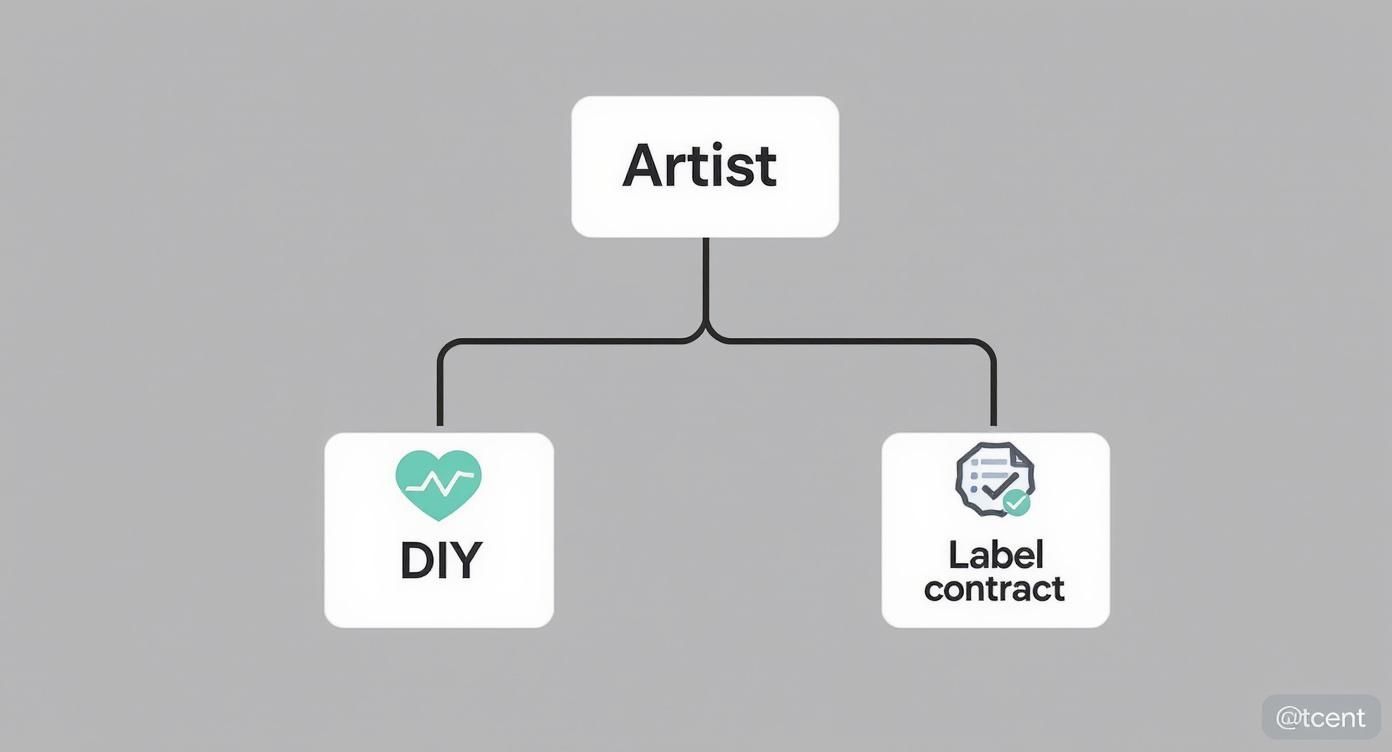
As you can see, a label brings much more to the table, like marketing muscle and financial backing, which is often the missing piece for a talented artist.
Comparing Top Digital Music Distributors
To help you navigate this choice, here’s a quick breakdown of some of the major players in the game. Each has its own strengths, so think about what matters most for your label's specific needs—is it cost, reach, or added features?
| Distributor | Pricing Model | Royalty Split | Key Features |
|---|---|---|---|
| DistroKid | Annual Subscription | Artist keeps 100% | Unlimited uploads, fast delivery to stores, automatic revenue splits. |
| TuneCore | Annual Fee per Release | Artist keeps 100% | Extensive distribution network, publishing administration add-on, detailed sales data. |
| CD Baby | One-Time Fee per Release | Artist keeps 91% | Physical distribution (CD/vinyl), sync licensing, PRO publishing admin. |
| Symphonic | Percentage-Based | Varies (often 85/15) | Application-based, offers marketing, playlist pitching, and sync services. |
Ultimately, the best distributor is the one that grows with you. Don't be afraid to switch later on if your needs change, but starting with a solid partner makes everything smoother.
Mastering Metadata and Collecting Your Royalties
Getting the music online is one thing; getting paid for it is another. This is where so many indie labels leave money on the table. It all comes down to two unglamorous but essential things: metadata and registrations.
Perfect metadata—the track title, artist name, songwriter credits, ISRC codes—is the DNA of your release. If it's wrong or incomplete, royalties get lost in the system. It's that simple.
Then you have the Performance Rights Organizations (PROs). In the US, the big ones are ASCAP, BMI, and SESAC. You can’t skip this part.
- Register as a Publisher: Your record label needs its own publisher account with a PRO. This is how you collect the publisher's share of performance royalties.
- Get Your Artists Registered: Every single songwriter on your label must be signed up as a writer with a PRO. This is non-negotiable if they want to get paid their writer's share.
- Register Every Single Song: You need to register each track in the PRO database, making sure to list every writer and publisher with their correct ownership splits.
I know, it sounds like a lot of paperwork. But it’s the bedrock of a professional operation. Mess this up, and you’re literally giving away money that belongs to you and your artists.
Building More Than Just Streaming Income
Let's be real: streaming is a volume game. For a new artist, the pennies per stream aren't going to pay the rent. A smart, modern label doesn't just rely on Spotify. You need to build a diverse ecosystem of revenue streams around every single release. The key is to monetize online content effectively across multiple fronts.
- Physical Sales & Merch: Never underestimate the power of something tangible. Vinyl is booming, and even cassettes are making a comeback. T-shirts, posters, and hats aren't just income—they're walking billboards for your artists.
- Sync Licensing: Getting a song placed in a movie, a TV show, a video game, or an ad can be a game-changer. Sync deals often come with a nice upfront payment and generate performance royalties for years to come.
- Direct-to-Fan Sales: Use platforms like Bandcamp or a service like OohYeah to sell directly to the people who care the most. You can sell digital downloads, physical merch, and exclusive content while keeping a much bigger slice of the pie.
By creating multiple income sources, you make your label far more resilient. You're not at the mercy of streaming algorithms. This stability is what will allow you to reinvest in your artists, sign new talent, and build something that lasts.
6. Executing a High-Impact Release Campaign
 Even the most incredible album can vanish without a trace if you don't have a smart release strategy. The old-school approach of just dropping a record and hoping for the best is a recipe for failure. A real high-impact campaign is about building a story, creating anticipation, and getting an audience excited over weeks, not just on a single day.
This is how you turn a simple music drop into a genuine moment for an artist's community. It takes thoughtful planning and a real understanding of what makes your artist tick. The goal isn't just about racking up streams; it's about forging a real connection between the music and the listeners.
And the competition is intense. The music world is more crowded than ever, with an estimated 110,000 to 120,000 record labels operating worldwide as of 2025. This surge, fueled by easy access to technology, means your campaign has to be meticulously planned to cut through the noise. You can find more data on the global record label market at RexiusRecords.com.
Mapping Your Release Timeline
A great campaign isn’t a last-minute sprint. It’s a strategic rollout, typically mapped out over an 8-to-12-week period before the release date. This gives you enough runway to build momentum without your audience getting tired of hearing from you.
Think of it like a series of waves, each one bigger than the last, all leading up to the final crest on release day.
Pro Tip: Never, ever announce a release date until you have the final master recordings in hand and your distribution is locked in. Production delays are a fact of life in this business, and nothing kills momentum faster than having to push back a date you’ve already been promoting.
Here’s what a typical 10-week album campaign could look like:
- Weeks 10-8 (Pre-Launch): Get all your assets ready—album art, press photos, music videos. This is when you start the quiet, early outreach to long-lead press (think magazines and major blogs) and begin pitching for playlist consideration.
- Weeks 7-5 (First Single): Time for the big reveal. Announce the album, lock in the release date, and drop the first single. Kick off pre-orders for vinyl and merch. This is your first major public push.
- Weeks 4-2 (Second Single): Keep the energy up by releasing a second track, often with a music video. This is the time to really ramp up social media content, sharing behind-the-scenes clips and engaging with fans who are getting excited.
- Week 1 (Release Week): It’s the final, all-out push. You're securing any last-minute press, running targeted digital ads, and getting your email list warmed up for the launch.
This kind of structured plan transforms the release from a single event into an ongoing story that people can follow and get invested in.
Budget-Friendly Marketing Tactics for Indie Labels
You don't need a major-label marketing budget to make a serious splash. When you're just starting a record label, smart, focused marketing is your best friend. The trick is to put your money and effort where it will have the most direct impact.
Your artist's unique story is your single most powerful marketing tool. What's the narrative behind the music? Was it recorded in a cabin in the woods? Does it explore a specific personal theme? Weave that story into every single thing you post.
Here are a few cost-effective tactics that always punch above their weight:
- Hyper-Targeted Social Ads: Forget about broad, expensive campaigns. Use platforms like Meta to run small-budget ads aimed directly at fans of similar artists. For as little as $5-$10 per day, you can reach a super-engaged audience that’s likely to love your music.
- Strategic Playlist Pitching: Getting on the right user-curated playlists can sometimes be even more powerful than a minor spot on an official one. Find independent curators on Spotify in your niche and start building genuine relationships long before you send them a pitch.
- Community Building Through Email: An email list is gold. It’s one of the only direct lines to your audience that isn't controlled by a changing algorithm. Offer an exclusive demo or a merch discount to get people to sign up, then use it to share personal updates from the artist.
These efforts build a strong foundation for any release. For a deeper look at platform-specific strategies, check out our guide on the best practices for releasing new music online.
Sustaining Post-Release Momentum
Your job isn't done on release day. In many ways, it's just getting started. The first few weeks after a record is out are absolutely critical for keeping the conversation alive and building on that initial launch buzz.
Don't let the energy fizzle out. Have a plan for post-release content locked and loaded. This could be anything from a "making of" mini-documentary and acoustic versions of key tracks to a live Q&A session with the artist. This follow-up content rewards your most dedicated fans and keeps the album in their rotation, extending its life far beyond release week.
Answering the Questions Every New Label Founder Asks
Starting a record label is thrilling, but it also opens up a floodgate of questions. Once you get past the big-picture dream, the practical, day-to-day realities start to set in. It’s completely normal to feel a bit overwhelmed by the details.
The key is to get straight answers to these common questions from the very beginning. This isn't about theory; it's about tackling the real-world problems you’ll face right away. Let's dig into the questions that are probably already on your mind so you can move forward with confidence.
So, How Much Money Do I Actually Need to Start?
This is always the first question, and the only honest answer is: it really depends on what you're trying to build. There’s a world of difference between a DIY passion project and an indie label aiming to make a serious splash.
Your starting costs are tied directly to your ambition.
The Bare-Bones, Digital-First Launch: You can technically get a label off the ground for just a few thousand dollars. This covers the essentials: registering your LLC, getting a simple website and domain, and paying for an annual subscription to a digital distributor like DistroKid. At this level, you’re not funding recording sessions or big marketing campaigns, but you are officially in business.
The Serious Indie Label: If your plan involves signing artists, helping fund their recordings, pressing a small run of vinyl, and running a real marketing campaign, your initial investment will be much higher. A budget of $20,000 to $100,000 is a much more realistic starting point for this kind of operation.
My advice? Figure out your mission first, then build a budget that actually supports it. Start with what you can afford, and focus on building revenue that lets you reinvest and scale up over time.
What’s the Difference Between a Record Label and a Publisher?
Getting this right is absolutely fundamental to understanding how money flows in the music industry. Labels and publishers work together, but they manage two completely different assets. Nailing this distinction is crucial for collecting your royalties and keeping everything legally sound.
A record label owns and exploits the sound recording—the actual "master" file of a song. The label's job is to finance, produce, market, and distribute a specific recorded performance. All the money a label makes comes from selling or streaming that master recording.
A music publisher, on the other hand, deals with the underlying composition—the song's lyrics and melody. The publisher's role is to find opportunities for that song, like getting other artists to cover it or placing it in a movie. They collect royalties generated by the song itself, not a specific recording of it. It's worth noting that one company (or even one person) can act as both.
Do I Need a Physical Office?
Nope. Absolutely not. For an independent label starting out today, a physical office is almost always an unnecessary cost. The most successful indie labels I know are run entirely from laptops, using a smart stack of digital tools to manage everything.
Your distributor is online, your marketing is digital, and you can collaborate with your artists from anywhere in the world. By using platforms for file sharing, communication, and project management, you can keep your overhead at virtually zero. That frees up cash that can be put to much better use—investing directly in your artists and their music.
Ready to build your label's digital home? With OohYeah, you can create a direct-to-fan hub for your artists to sell music, merch, and subscriptions—all with zero commission. Get started and empower your roster.