Stack or Starve: Build a Sustainable Music Career
Learn the 'stack or starve' strategy. Musicians: Diversify income streams for a sustainable career; don't rely on just one.
July 19, 2026
Music Marketplace Advisor
Buying & SellingMost advice around Stack or Starve is useless to working musicians because it treats your career like a salaried job. It assumes stable income, predictable expenses, and a clean ladder from effort to reward. Music doesn't work that way.
An artist can have a packed month, sell merch after every set, land a sync, and still hit a dry spell right after. Rent doesn't care whether you're between releases or waiting on a promoter payout. That tension is what people are really talking about when they search for “stack or starve.” They aren't looking for a buzzword. They're trying to solve the fear that one weak month can knock over the whole plan.
The fix isn't to wait for a label, a viral moment, or a perfect tour cycle. The fix is to build a career that can survive uneven cash flow. That means treating music income like a stack of smaller engines instead of one giant breakthrough.
The Real Fear Behind Stack or Starve
A lot of artists don't say “I'm scared my career is financially fragile.” They say things like, “I just need one song to pop,” or “Once I get on the right playlist, I'll be good.” That sounds ambitious, but underneath it is panic. They know one cancelled show, one bad merch order, or one month of low streams can put them right back into survival mode.
That fear isn't irrational. Industry data shows 58% of independent musicians earn less than $10,000 annually, which is why rigid savings rules built for steady paychecks break down for many artists (Apartment Therapy). If your income moves with gig season, release cycles, or freelance production work, you can't build your life around a fantasy of consistency.
The problem isn't that artists work too little. Most work constantly. The problem is that many are working inside a feast-or-famine structure.
What the anxiety looks like in practice
One month looks healthy:
- Show money arrives: You get paid from a run of local dates.
- Merch moves: Fans buy shirts and a few download bundles.
- Streaming ticks up: A release week pushes attention higher.
- Freelance work helps: You produce, mix, or write for someone else.
The next month can look totally different:
- No live dates: Promoters go quiet or venues fill their calendar.
- No new release: Attention softens.
- Expenses hit at once: Rehearsal, travel, content, and manufacturing all land together.
Starving artist mythology sounds romantic until your income has to cover ordinary life.
Artists don't need another slogan. They need a structure that reduces the damage from volatility. The career doesn't become sustainable when one revenue stream gets bigger. It becomes sustainable when one weak stream no longer threatens the whole operation.
Deconstructing the Myth of a Single Strategy
First, the phrase itself needs a cleanup. “Stack or starve” is not a recognized technical or music-industry methodology. It isn't an established framework in music commerce, streaming infrastructure, creator economy platforms, AI, or IT operations. What people do find is something adjacent: “starve and stack,” which comes from personal finance, not artist development.
What starve and stack actually means
This method is simple and strict. In personal finance, starve and stack means living on one income stream while saving or investing the entire second income, with examples framing it as a way to potentially accumulate $50,000 in two years through disciplined allocation (Yahoo Finance).
That approach can make sense for households with stable dual incomes and controlled expenses. It is a cash-flow discipline model. It is not a music business model.
Here is the mismatch:
| Situation | Starve and stack assumes | Music careers usually face |
|---|---|---|
| Income timing | Regular pay cycles | Irregular deposits and delayed payouts |
| Income sources | Two predictable streams | Multiple uneven streams |
| Budgeting | Fixed monthly planning | Constant adjustment |
| Risk | One income can safely be saved | One bad month can erase the cushion |
Why single-framework advice fails musicians
A musician doesn't usually have “income one” and “income two.” They have fragments. A set fee. Some backend. Streaming royalties that arrive on platform schedules. Direct sales during release week. Maybe teaching. Maybe session work. Maybe nothing for a stretch, then too much at once.
That makes strict rules dangerous when copied blindly.
Practical rule: If a money system only works when your income is predictable, it isn't built for most independent artists.
The mistake isn't discipline. Artists need discipline badly. The mistake is importing a framework from another context and pretending it fits. I see this constantly. Someone reads a hardline savings method, tries it for a month, then abandons it because their real life won't cooperate. They don't need more shame. They need a model designed for variable income.
There's also another reason the buzzword falls apart. In machine learning, “stacking” has a precise meaning. It's an ensemble method where base model outputs feed a meta-model. In IT, stack rationalization is about reducing redundancy and aligning tools with business goals. Neither has a documented “stack or starve” variant. So if you're looking for an official industry doctrine, there isn't one.
What does exist is a useful mindset hiding inside the phrase. If you don't build a stack of income sources, your career can starve the moment one source dries up.
The Modern Musician's Alternative The Income Stack
The better version of Stack or Starve is not deprivation. It's construction.
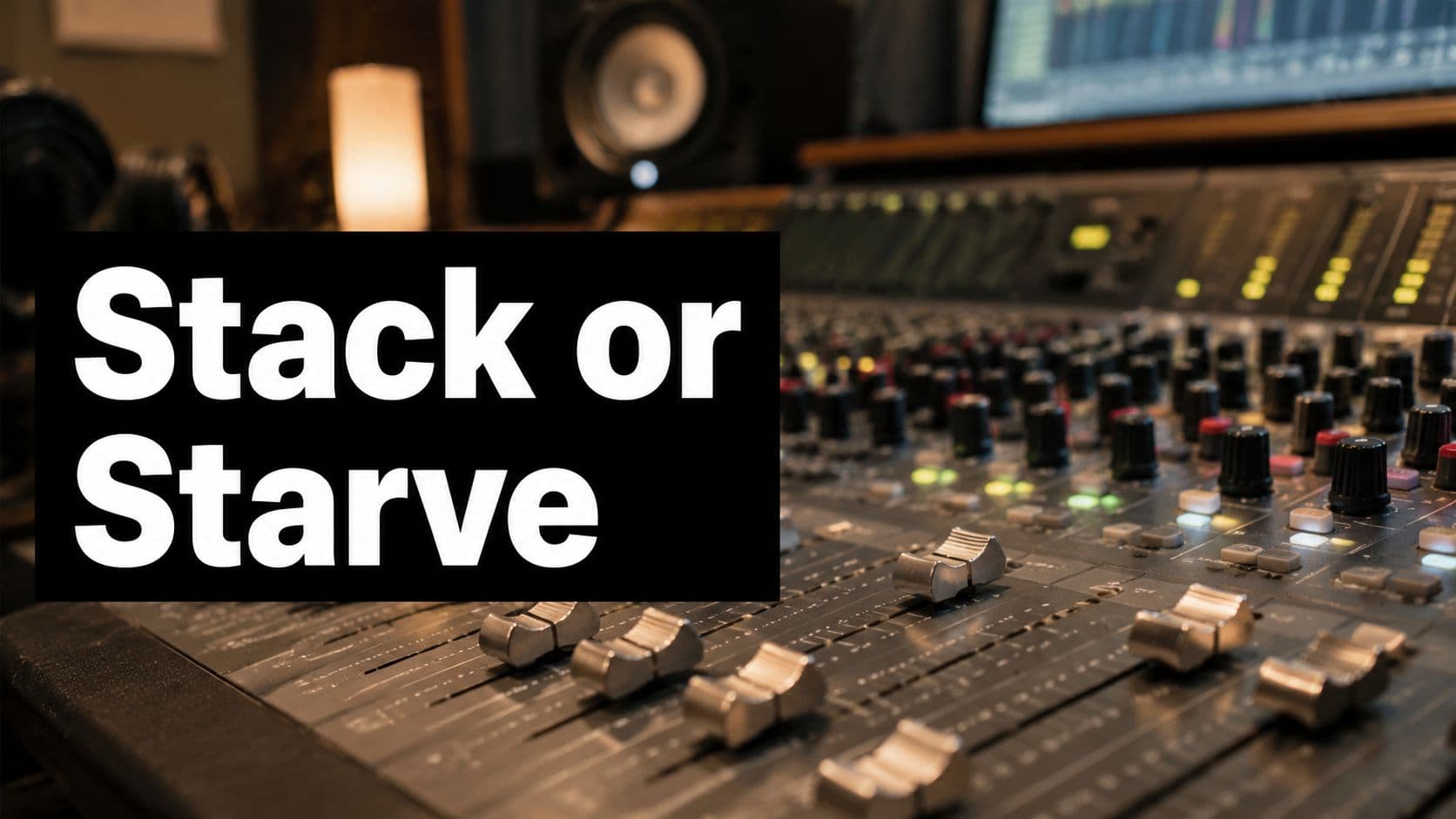
Think of your business like a mixing board. Each revenue stream is a channel. Some faders stay low for months, then jump when a release lands. Some are always modest but reliable. Some are volatile and worth keeping anyway because they create fan growth or creative advantage.

What an income stack does
An income stack is a set of separate revenue lines that support the same career. Streaming might build discovery. Merch might create stronger margins. Direct fan support might become the most stable part of the business. Production work might cover slow release windows.
The point isn't to do everything. The point is to avoid dependence.
A healthy stack gives you three forms of protection:
- Operational protection: If one stream dips, you still have cash coming in elsewhere.
- Creative protection: You don't have to make every song chase the same outcome.
- Negotiation protection: You can say no to bad deals when you aren't desperate.
Not every stream deserves equal effort
Artists often make the opposite mistake and spread themselves too thin. They launch a subscription, start a merch line, upload backing tracks, announce live events, promise exclusive content, and then fail to maintain any of it. A stack only works when each layer has a job.
Use this filter:
- Keep streams that fit your audience and your capacity.
- Test streams that are easy to launch and easy to quit.
- Drop streams that create admin headaches with weak return.
- Double down on streams fans already respond to.
If you want a broader view of practical ways artists combine revenue sources, this guide to discover music earning strategies is useful because it frames monetization as a system rather than a single payout event.
The goal isn't to look diversified on paper. The goal is to make sure one bad month doesn't control your decisions.
The artists who last usually aren't the ones with the cleanest narrative. They're the ones who built enough income layers to keep moving.
Laying the Foundation Traditional Revenue Streams
Every stack starts with the plain, unglamorous layer. These are the income sources most artists already understand, even if they haven't organized them well yet. Ignore them and you'll build your career on hype. Use them properly and they become the floor under everything else.

Streaming and digital releases
Streaming is usually the first revenue line artists touch. It matters for access, discovery, and audience behavior. It also tempts artists into overestimating what passive listening will do for their finances.
Streaming works best when you treat it as a top-of-funnel engine. It gets music heard. It gives fans a low-friction entry point. It can support the rest of your business. On its own, it often isn't enough to stabilize a career.
Digital sales are a different conversation. A direct download, deluxe bundle, stems pack, or alternate version can turn attention into immediate cash. That's especially useful when you have a fanbase that wants ownership, not just access.
Merchandise and physical products
Merch is where many artists finally understand margin. A shirt, hat, poster, or limited item can outperform passive consumption because a fan is buying identity, memory, and belonging.
But merch gets messy fast. Inventory ties up cash. Bad sizing decisions create dead stock. Weak design kills repeat buying. A lot of artists launch merch because they think they should, not because they know what their audience would wear or display.
A simple starting point works better:
- Begin with one proven item: Pick the thing fans already ask for.
- Make the design wearable: Tour graphics aren't automatically everyday apparel.
- Price with reality in mind: Include production, shipping materials, and your time.
- Order carefully: Don't let ego decide quantities.
Live performance income
Live shows are still a core pillar because they generate multiple outcomes at once. You get performance fees, merch opportunities, new fans, and content. But live income is also one of the least predictable streams. Venue deals vary. Expenses stack quickly. Travel can wipe out what looked good on the flyer.
That doesn't mean avoid shows. It means judge them like a business owner.
A good show can be worth taking even when the fee is modest if it helps you move fans into your own ecosystem. A bad show isn't redeemed by exposure if nobody there is likely to return, buy, or follow.
Field note: Take gigs that create momentum, not just activity.
Put the basics in one place
The operational side matters more than artists want to admit. If your music, merch, and offers live in scattered tools, fans fall off before they buy. Keeping core artist services organized in one system reduces friction and makes your catalog easier to manage. A unified setup like artist service tools can help centralize the basic commercial layer so you're not rebuilding the wheel for every release.
Traditional revenue streams won't save you alone. They also shouldn't be dismissed. They're the concrete under the rest of the structure.
Building Upward With Direct-to-Fan Monetization
The strongest income in music usually comes from proximity, not scale. A fan who feels close to your work will often spend more, return more often, and care more intensely than a passive listener who found one song in a playlist.
That is why direct-to-fan monetization matters so much. It doesn't rely on gatekeepers to notice you first. It asks a simpler question. Can you give your audience something they value enough to support directly?

What fans actually pay for
Most artists think fans only pay for finished songs, tickets, or shirts. In practice, fans pay for access, context, exclusivity, and participation.
That can include:
- Subscriptions: Ongoing access to premium material, updates, or community perks.
- Exclusive releases: Demos, alternate versions, rough cuts, live recordings, sample packs.
- Behind-the-scenes content: Studio notes, voice memos, breakdowns, creative process.
- Direct support: Tips, one-off contributions, and fan purchases that are more about support than utility.
The biggest mistake here is copying creator tactics that don't fit music. Daily posting isn't automatically value. Constant bonus content isn't automatically sustainable. Fans don't need more volume. They need a reason to stay close.
Build an offer you can maintain
A direct offer should feel generous to the fan and realistic for the artist. If you promise too much, you'll resent it. If you promise too little, people won't stay engaged.
A workable offer often has three characteristics:
| Trait | What it means for the artist | What it means for the fan |
|---|---|---|
| Clear | You know exactly what you'll deliver | They know exactly what they're joining |
| Repeatable | You can keep it going during busy months | They trust the offer won't disappear |
| Distinct | It isn't the same as your free content | They get real access or utility |
That matters more than complexity. A simple recurring package can outperform an ambitious one that collapses after a few weeks.
Fans support consistency faster than they support chaos.
Use access without killing mystique
Some artists worry that direct monetization cheapens the art. It doesn't, if you do it with taste. You don't have to livestream every unfinished vocal take or turn your life into a content mill.
You can preserve mystery and still sell closeness. The trick is to offer meaningful access to the work, not unlimited access to yourself.
A few examples work well:
- For songwriters: early lyrics, demo drafts, writing notes
- For producers: breakdowns, stems, sound design packs
- For bands: rehearsal clips, tour diaries, alternate mixes
- For DJs: exclusive edits, recorded sets, playlist notes
Later in the funnel, a dedicated marketplace helps when fans are ready to buy rather than just listen. A direct artist-focused hub like the music creator marketplace makes that transition cleaner.
Here's a useful way to think about the relationship:
The money follows the bond
The starving artist mindset waits for outside validation before charging. The entrepreneurial mindset builds trust, then makes a clear offer. That doesn't mean forcing sales language into every post. It means understanding that fandom is not just attention. It's a relationship with economic potential.
Direct-to-fan monetization works because it rewards depth. You don't need every listener to buy. You need the right fans to know where and how to support you.
How to Measure and Optimize Your Stack
Once your stack exists, you need to manage it like a business. Not with corporate theater. With a small set of numbers and observations that help you decide where your time should go.
Most artists either track nothing or track everything. Both fail. If you track nothing, you operate on vibes. If you track everything, you drown in dashboards and still don't know what to change.

The numbers worth watching
Start with a short list.
- Revenue source count: How many active income streams are currently producing money.
- Income breakdown: Which streams carry the business and which ones are mostly noise.
- Recurring support health: Whether subscriptions or repeat buyers are stable, growing, or fading.
- Merch conversion: Whether fans who visit a merch page make a purchase.
- Profit margin: What remains after production, fulfillment, travel, and platform-related costs.
These aren't vanity metrics. They tell you where your business is fragile.
If one stream dominates completely, you're exposed. If a stream consumes time but contributes little, it needs a redesign or a shutdown. If fans engage heavily with one type of offer, that's a clue about what they value.
Read patterns, not just totals
A weak month doesn't always mean something is broken. A strong month doesn't always mean your system is healthy. Look for repeated behavior.
Ask better questions:
- What do fans buy without heavy promotion?
- Which offers create repeat support?
- What takes too much effort for too little return?
- Where do expenses subtly erode the sale?
For physical goods, cost discipline matters. Many artists underprice merch because they only look at the item cost and forget packaging, shipping materials, and fulfillment time. A practical reference like Dirt Cheap Headwear's cost guide helps you calculate unit economics before you commit to a product line.
Decision test: If you can't explain why a revenue stream is working, you can't protect it when conditions change.
Optimization is subtraction too
Growth doesn't only come from adding more channels. Sometimes it comes from removing the wrong one. I've seen artists rescue their business by cutting a bad merch SKU, simplifying a subscription promise, or stopping a low-value content routine that drained creative energy.
Use a simple review cycle:
- Track what sold, what renewed, and what cost more than expected.
- Interpret why that happened.
- Adjust the offer, pricing, or workload.
- Repeat before the next release cycle.
A stack becomes sustainable when it is measured, trimmed, and rebuilt over time.
From Starving Artist to Thriving Music Entrepreneur
Stack or Starve sounds like a threat. It becomes useful when you hear it as a choice about structure.
You can keep betting your future on one stream, one deal, one gatekeeper, one lucky break. A lot of artists do. They stay busy, stay stressed, and stay financially exposed. Or you can build a stack that gives your career room to breathe.
That stack starts with the basics. It grows through direct fan relationships. It gets stronger when you track what works, cut what doesn't, and stop confusing attention with income.
The starving artist story teaches patience, sacrifice, and suffering. It rarely teaches ownership. A thriving music entrepreneur thinks differently. They still care about the art. They also care about systems, margins, audience behavior, and repeatable revenue.
If you want your career to last, don't chase a single rescue moment. Build the kind of business that can survive ordinary uncertainty. Keep making the music. But make sure the structure around it can carry your life too. For more artist-first thinking and practical industry guidance, the OohYeah magazine is worth bookmarking.
If you're ready to turn scattered releases, merch, and fan support into a cleaner system, OohYeah gives artists one place to stream, sell, and build direct audience relationships without losing control of the business.